
When you see a flock of birds circling overhead, the most likely explanation depends on three quick things you can observe right now: the species, the altitude, and whether the birds are gaining height or holding steady. Broad-winged soaring birds like vultures, hawks, or storks are almost certainly riding a thermal updraft to gain free altitude. Tight, swirling flocks of small birds like starlings near dusk are almost certainly running an anti-predator defense called a murmuration before dropping into a roost. And birds circling low, erratically, or in a way that looks genuinely disorganized may be signaling something is wrong in their environment. If a bird appears to be flying straight towards you, it can also be a normal behavior, but the context and body language matter bird flying towards you meaning. There is rarely one single answer, but within a few minutes of watching you can usually narrow it down.
Why Do Bird Flocks Fly in Circles? Causes and Clues

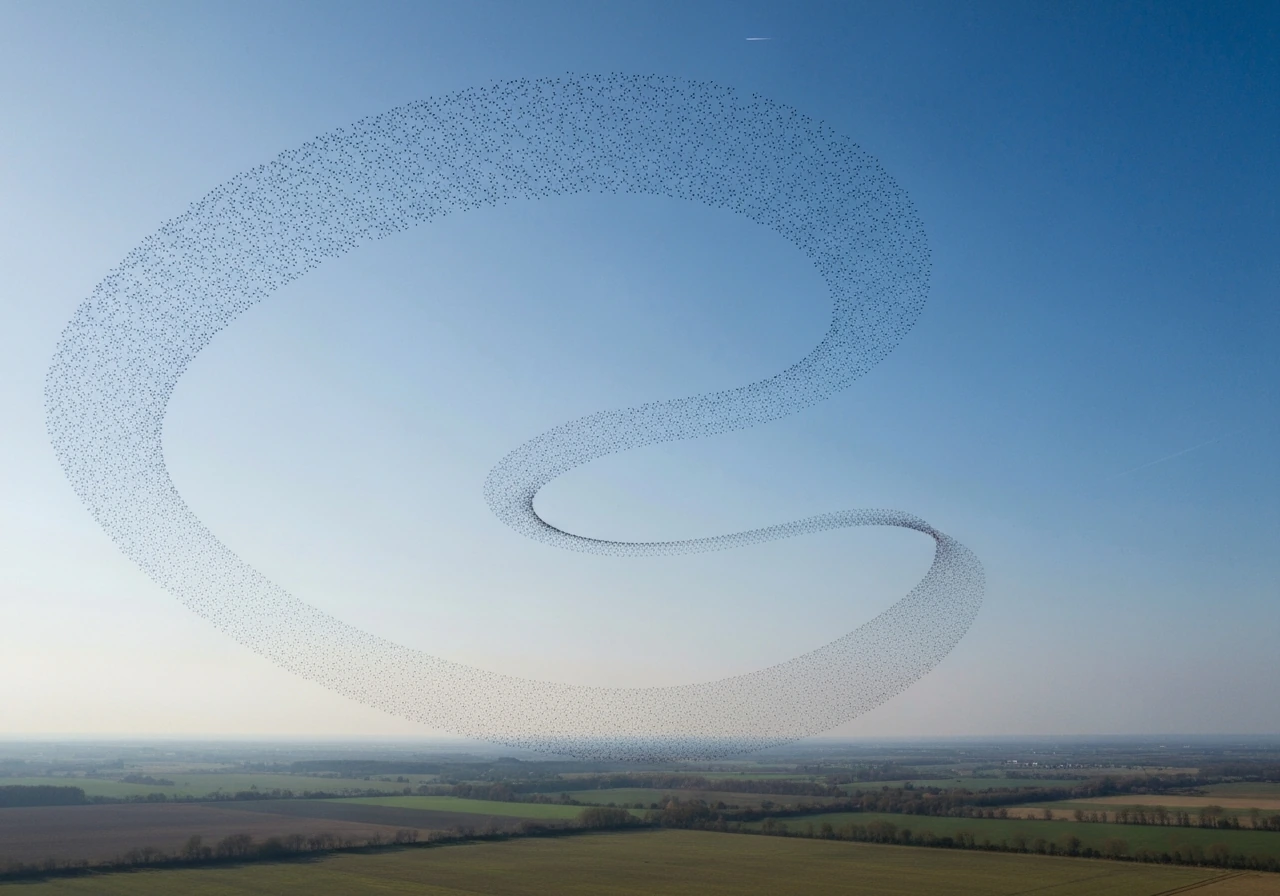
What circling actually looks like in real flocks
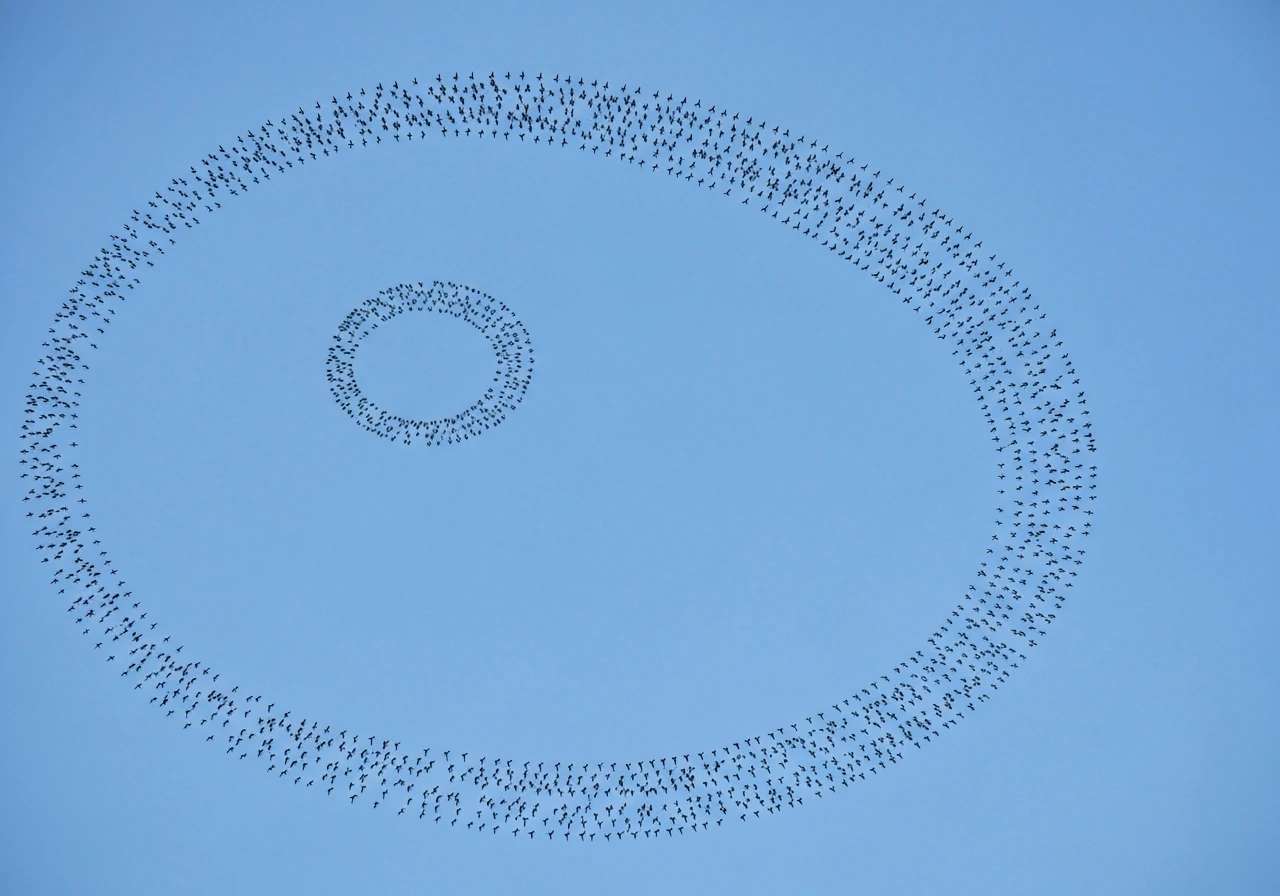
"Flying in circles" covers several distinct behaviors that look superficially similar from the ground. The first is a sustained, slow, ascending spiral: birds banking in wide arcs and gaining altitude with each loop, often with minimal wingbeats. The second is a rapid, tight, constantly shifting cloud of birds that rolls and pulsates as a unit, changing direction many times per minute without a clear upward or downward trend. The third is a repetitive loop over a specific area, where a flock keeps coming back over the same patch of ground or water. And the fourth, less common but important to recognize, is a lone bird or small group flying in confused, tight circles near the ground.
The key distinction for most people watching from below: are the birds going up, holding level, or descending? Spiraling upward almost always means thermals. Holding at altitude in a swirling mass near dusk almost always means predator defense before roosting. Repeated loops over one spot usually means foraging or a social gathering point. And low, erratic circles with no clear structure deserve closer attention because they can indicate distress.
Navigation cues and how flocks stay coordinated in a turn
One of the genuinely fascinating things about watching a flock turn is that not every bird decides to change direction at the same moment. Research on starling flocks shows that turns propagate through the group in a measurable wave: birds on the flock's edge or individuals that initiate the change bank first, and the heading shift ripples outward with a calculable delay between neighbors. The flock's path before and after a turn is roughly straight, with the actual heading change concentrated in the turning interval itself. It's not telepathy and it's not a single leader calling the shots. It's fast, local copying with what researchers call "behavioral inertia," where each bird matches its immediate neighbors with a slight lag.
While all this turning is happening, individual birds are still tracking navigation cues. Birds use a geomagnetic compass and polarized light from the sky to maintain directional orientation, and these cues continue to work even during complex maneuvers. So a flock can execute dozens of tight turns during a murmuration and still collectively know which direction is north, which helps them return to a roost site or resume a migratory heading. Wind drift adds another layer: birds actively compensate for sideways wind push during flight, which can produce what looks like looping or curved paths when what's actually happening is the flock correcting its heading to stay on course.
Thermals: why circling is the best way to gain free altitude
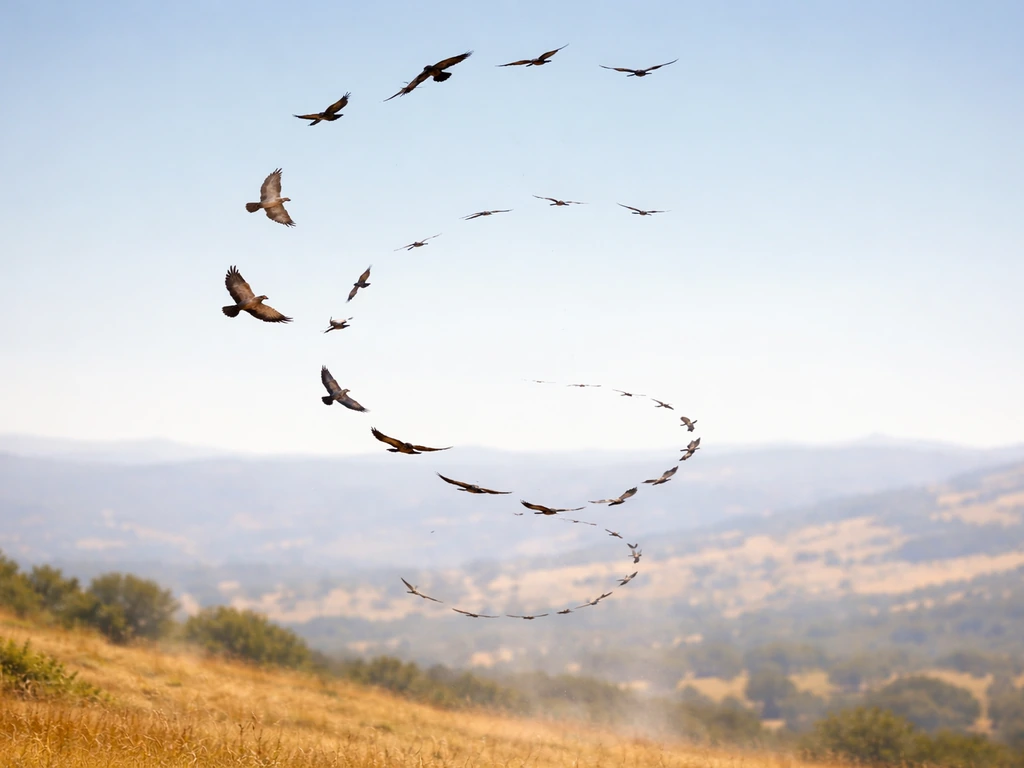
Thermal soaring is probably the most common reason large birds circle, and it's a beautifully practical aerodynamic strategy. A thermal is a column of warm air rising from sun-heated ground, often over dark surfaces, cleared fields, or roads. The column is not huge, typically only a few hundred meters across at low altitude, so a bird that wants to stay inside it has to circle. The circle keeps the bird within the rising air. Straight flight would carry the bird out of the thermal in seconds.
Studies of vultures show that the bank angle, which is how steeply the bird tilts into the turn, changes with altitude and corresponds directly to changes in circling radius. Near the ground, where thermals are narrow and turbulent, birds fly tighter circles with steeper banks. Higher up, where thermals spread out and smooth out, they widen the circle and reduce the bank angle. The bird is essentially solving a continuous optimization problem: stay inside the lift, maximize altitude gain, minimize energy spent. Researchers describe thermal soaring as having a "circling phase" where the bird climbs, followed by a "gliding phase" where it uses that altitude to travel distance, then seeks the next thermal. Frigatebirds take this even further, occasionally circling inside cumulus clouds to harvest the updrafts generated by cloud formation itself. In studies of frigatebirds flying inside clouds, researchers found that circling in updrafts is aerodynamically functional for controlling ascent and maintaining stability in strong updraft environments.
For observers, the practical cue is simple: soaring birds in thermals gain altitude visibly and steadily over several minutes, wingbeats are rare or absent, and multiple species (hawks, vultures, storks, pelicans, eagles) often share the same thermal because the lift is available to all of them. If you see a kettle of hawks spiraling upward on a warm afternoon with clear skies, thermals are almost certainly the explanation.
Predator evasion and the physics of safety in numbers
When a predator like a peregrine falcon attacks a flock of starlings, the flock doesn't scatter. It does something almost counterintuitive: it contracts, swirls, and collectively maneuvers in ways that make it harder for the predator to isolate a single target. This is the murmuration, and the circling-like quality of it comes from continuous coordinated turning as the group responds to the predator's position.
The anti-predator mechanics work through three overlapping effects. First, dilution: with hundreds or thousands of birds present, any individual bird has a much lower chance of being the one caught. Second, many eyes: a large group detects approaching threats earlier and more reliably than an individual would. Third, confusion: a peregrine trying to target one bird in a fast-moving, constantly reshaping cloud of thousands has genuine difficulty locking onto a single individual long enough to complete a successful strike. Experiments using robotic falcons confirm that these same collective escape responses appear across multiple bird species, not just starlings.
The specific visible signature of a predator response is what researchers call an "agitation wave": a dark band or pulse that moves through the flock away from the predator's position. As birds bank away from the threat, the change in wing angle makes them momentarily darker to a viewer below, and this wave propagates across the flock at a measurable speed. Jackdaw flocks show the same kind of collective turning during anti-predator mobbing, and researchers have actually separated and compared the turning kinematics between routine transit flights and active predator response in the same species.
An important timing cue: murmurations happen most intensely at dusk, just before a flock drops into its roost for the night. If you're watching a dense, fast-moving, pulsating flock of small birds in the late afternoon or early evening, you're almost certainly watching predator-defense behavior that is about to transition into roosting.
Foraging and the social reasons flocks loop the same area
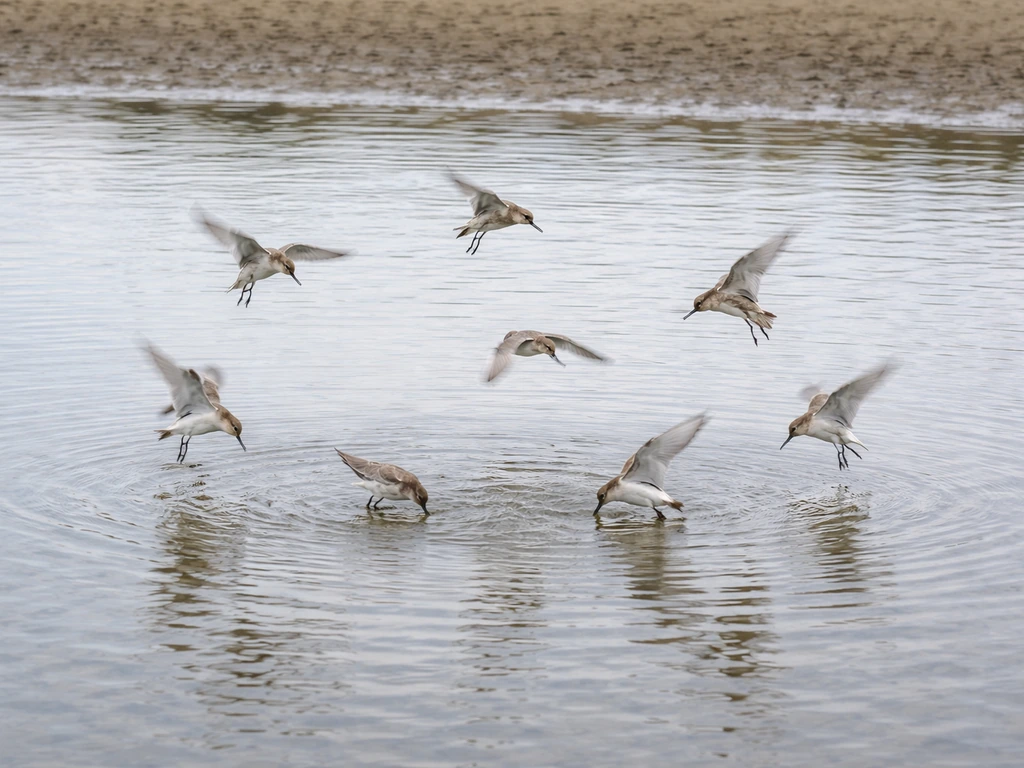
Not all circling is thermal-driven or predator-driven. Sometimes a flock circles a specific area repeatedly because that area contains food, water, or a social gathering point that the birds keep returning to. Gulls circling a fishing boat or a landfill, swallows looping over a pond where insects are hatching, or raptors repeatedly passing over a field where prey was spotted all fall into this category. The circle here is functional in a different sense: it keeps the birds in proximity to a resource without requiring them to land and commit.
There's also a social coordination aspect. Many bird species use repeated circular flight as part of gathering before migration, deciding on a roost site, or regrouping after a disturbance. The circling gives stragglers time to catch up and gives the group a shared reference point. In these cases the flock often converges downward toward a specific location after 10 to 30 minutes, which is the clearest behavioral cue that the circles were about assembly rather than lift or predator response.
When circling means something is wrong
Most circling flocks are doing exactly what they're supposed to do. But there are specific patterns that indicate distress, illness, or environmental disruption, and they look different enough to recognize once you know what to look for.
A single bird flying in tight, repetitive circles at low altitude, especially near the ground, is a warning sign. It can indicate neurological damage from a collision, ingestion of a toxin, or inner-ear injury. Healthy birds don't circle this way independently because there's no aerodynamic or social benefit to it. Similarly, a bird that circles and repeatedly bumps or veers toward structures, power lines, or fences is likely disoriented. Power line collisions and electrocutions are among the documented causes of injury in birds, and a bird that's already been stunned may show erratic flight including circling before crashing.
At the flock level, environmental disruption can cause abnormal circling patterns. Some people also connect unusual bird circling with symbolic ideas, such as the bird flying with snake meaning described in folklore abnormal circling patterns. blank" rel="noopener noreferrer">Smoke from wildfires or other sources causes respiratory stress and can disorient birds that rely on visual and olfactory landmarks. Severe weather can push migrating flocks off course in ways that produce disorganized circling as the group tries to reorient. Near wind turbines, soaring birds sometimes circle repeatedly in uplift-rich zones near the turbines, which creates genuine collision risk and can be a sign that the birds are being attracted to thermal-like conditions in a hazardous location.
The practical distinction: normal circling has structure. Thermals produce smooth, consistent arcs that gain altitude. If you are trying to interpret bird flight patterns meaning, thermals are usually the “smooth, consistent arcs that gain altitude” type of circling. Murmurations have coherent pulsing and clear flock boundaries. Foraging loops return to the same point deliberately. Distress circling is irregular, low, often involves a single bird or very small group, and lacks the spatial consistency of the other types.
How to figure out what you're watching in real time
Here's a practical observation sequence you can run through in about two to three minutes the next time you see a flock circling overhead.
- Identify the species first if you can. Large broad-winged birds (vultures, hawks, storks, pelicans) circling high almost always means thermals. Small to medium birds (starlings, blackbirds, swallows) in a dense, fast-moving flock means murmuration or predator response. Gulls or corvids circling a specific ground location means foraging or social assembly.
- Watch the altitude trend over 60 seconds. Gaining height steadily with few wingbeats: thermal. Holding altitude and pulsing: predator response or pre-roost murmuration. Losing altitude slowly and converging on a point: social assembly or roosting. Staying very low and erratic: possible distress.
- Check the time of day and weather. Warm, sunny afternoon with cumulus clouds forming: prime thermal conditions. Late afternoon approaching dusk: pre-roost murmuration. Morning or midday over a specific location: foraging. After a storm, near smoke, or during strong unusual wind: possible disorientation.
- Look for a predator. Scan above and around the flock for a hawk or falcon. If one is present and the flock keeps contracting and reshaping, you're watching active predator evasion.
- Watch what happens next. Does the flock ascend and then glide off in one direction? Thermal. Does it suddenly drop into trees or reeds at dusk? Pre-roost murmuration. Does it converge on a patch of water or a field and land? Foraging or assembly. Does it keep circling with no resolution for many minutes in a low, irregular pattern? Worth investigating for a hazard.
| Circling type | Key species | Altitude trend | Time of day | Wingbeat pattern | What happens next |
|---|---|---|---|---|---|
| Thermal soaring | Vultures, hawks, storks, eagles | Steadily gaining | Late morning to afternoon | Rare or absent | Glides away in one direction |
| Murmuration / predator defense | Starlings, blackbirds | Holding level, fluid shape | Late afternoon to dusk | Rapid, synchronized turns | Drops into roost site |
| Foraging / social assembly | Gulls, corvids, swallows | Gradual descent toward a spot | Variable | Normal, moderate | Lands at a specific location |
| Distress or disorientation | Any, often solitary | Low, not gaining | Any | Irregular, labored | May crash or disappear into cover |
A few things worth knowing about specific species
Vultures are the canonical thermal soarer: their wide, fingered wings and light wing loading make them almost purpose-built for circling in thermals, and a group of them spiraling upward is called a kettle. Hawks of many species do the same thing, especially during migration, when they conserve energy by thermal-hopping along ridge systems. Storks and pelicans use thermals in the same way and can cover enormous distances with very little active flapping.
Starlings are the classic murmuration species, and their ability to coordinate near-instantaneous turns through a flock of thousands is one of the most studied examples of collective animal behavior in biology. The information that triggers a turn travels through the flock in a wave with a measurable propagation speed, not a simultaneous group decision. Jackdaws show similar collective turning both in transit to roosts and during active predator mobbing, and researchers have measured the difference in turn kinematics between those two contexts.
Swifts and swallows loop over water and open ground while foraging on flying insects, and their circling can look frantic but is simply them tracking moving prey. Their flight speed and agility means their "circles" are often more like complex figure-eights or spirals than the clean arcs of a soaring vulture.
The bigger picture: circling as a signature of bird intelligence
What's easy to miss when you're looking up at a circling flock is just how much information processing is happening. Every bird is simultaneously tracking its immediate neighbors, sensing the air around it, orienting to geomagnetic and light cues, and making continuous micro-decisions about bank angle, speed, and heading. The result looks like a single fluid entity, but it emerges from thousands of individual calculations running in parallel. If you're interested in going deeper on the mechanics behind how birds pull all of this off, the broader science of bird flight explains the aerodynamic foundations, and the study of bird flight patterns covers more of the behavioral signals that flocking movements can carry.
Next time you see a flock circling, give it two full minutes before you decide what's happening. The answer is almost always in the altitude trend, the time of day, and what the flock does at the end. Those three things will get you there most of the time.
FAQ
How can I tell the difference between thermals and birds simply circling around food in the same sky?
Use altitude trend plus repeatability. Thermal circling usually brings the whole group higher over several minutes with wingbeats dropping as they ride lift, while food-related loops tend to hover around one height and repeatedly return over the same patch. If you can mark a point on the ground (field edge, pond, boat), food loops will keep lining up with it; thermals often drift and widen as the birds gain height.
Why do some flocks circle even when it does not look very sunny or “warm”?
Thermals do not require strong visible sunshine. Warm air can still form over dark surfaces after clouds pass, along roads, parking lots, or recently sun-exposed ground, and birds can find weak updrafts that are less obvious to people on the ground. If the flock is mostly soaring with smooth, consistent arcs, that still favors lift rather than distress.
What does it mean if the flock is circling but the birds keep changing direction instead of steadily climbing?
Frequent heading changes without an overall up or down trend often points to predator-defense behavior, especially near dusk, because the flock continuously maneuvers as the threat position shifts. Repeated looping over one spot with steadier alignment usually favors foraging or a gathering point, even if individual birds turn often.
Can wind make normal circling look like something is wrong?
Yes. Strong crosswinds can force birds to make repeated heading corrections, creating curved or looping tracks that resemble chaotic motion from far away. A key check is group structure: wind-driven correction usually keeps a coherent flock shape and does not produce low, tight, isolated circling by a single bird.
Why do I sometimes see only one or a few birds circling when everyone else seems to be doing something else?
A single bird circling tightly near the ground is more suspicious for disorientation, injury, or disorientation from hazards, but small subgroups can also break off from a larger murmuration during transitions (for example, separating to roost). If it stays low and repeats tight loops without joining a larger pattern, that leans toward distress more than normal flock behavior.
How long should I watch before I can trust my interpretation of the circling?
Give it a full two to three minutes. Thermal activity often shows a visible climb trend over that window, murmurations intensify and then typically transition into roosting behavior near dusk, and foraging or social loops usually keep returning to the same target location. Very short looks (10 to 30 seconds) are more likely to mislead because birds can momentarily turn during both normal and predator-driven maneuvers.
Are bird circling patterns different over water compared with land?
Often, yes. Over water, swifts and swallows may loop over moving insect prey and their paths can look frantic even though the birds are successfully tracking food. Over land, thermals are easier to associate with sun-heated ground features, and repeated circles over a specific patch more often reflect birds staying near a resource such as fields, landfill edges, or a water source.
What should I do if I see distress circling near power lines or buildings?
Treat it as a potential hazard. Keep your distance from roads and structures, do not try to handle the bird, and consider notifying a local wildlife rescue or animal control if the bird is low, disoriented, or repeatedly hitting obstacles. Birds stunned by collisions can remain trapped in looping flight patterns until they collapse or are rescued.
Why do murmuration flocks look like a single moving cloud even though there is no single leader making decisions?
Because turns propagate locally, each bird adjusts based on nearby neighbors with a slight delay. The group maintains direction using shared orientation cues like geomagnetic and polarized light information, so the flock can keep an organized shape even while the turning wave moves through the mass.
Do birds “circle” the same way when migrating compared with during roosting?
Not exactly. During migration, raptors often use thermals to conserve energy and may show repeated soaring phases that connect with ridge or waypoint movement. In roosting and pre-roost transitions, small birds are more likely to produce intense, dense murmuration behavior that ramps up at dusk and then ends with a downward settling toward a specific location.
Understand the bird has flown meaning, when it’s used, and how to reply with examples for real-life conversations.
Learn the flight or bird prefix meaning, origin, examples, and a checklist to decode new words and avoid look-alikes.
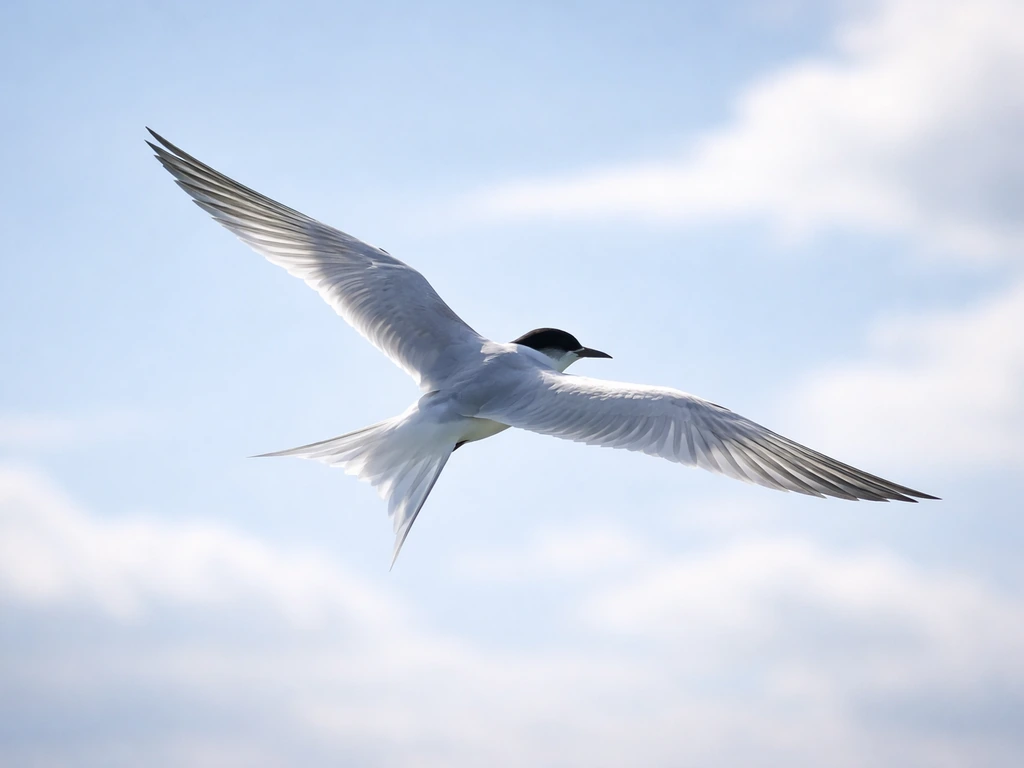
Clarifies flyer meaning for birds and explains which species fly well and why, plus a checklist to verify in context.