
A flying bird carries kinetic energy from its motion, but that's only part of the picture. The bird is simultaneously converting stored chemical energy (from food, via ATP) into mechanical energy through muscle contractions, which powers the wing beats that generate lift and overcome drag. This is sometimes summarized as a bird's will to power, meaning behavior and muscle output are organized around sustaining and increasing its functional performance.
What Type of Energy Is a Flying Bird? Chemical to Kinetic

Marcus Chen
29 Apr 2026

So at any given moment in flight, a bird is running all three: chemical energy being burned, mechanical energy being produced by muscles, and kinetic energy expressed as the bird moves through the air. You can't pin it to just one type because flight is an ongoing energy transformation, not a single static state.
The main energy types in a flying bird
When people ask what type of energy a flying bird has, they're often expecting a single-word answer from a physics worksheet. The honest answer is that several forms are present at once, and they feed into each other continuously.
Here's the short map: food energy (chemical potential energy stored in bonds) gets converted into ATP, ATP fuels muscle contractions (mechanical energy), and those contractions drive wing beats that push the bird forward and upward (kinetic energy plus the energy required to produce lift). Each conversion in that chain has a label, and none of them is wrong.
But kinetic energy is the one most directly associated with the bird's motion through the sky, and chemical energy is the original fuel source.
| Energy Type | Where It Appears in Flight | Physics Label |
|---|---|---|
| Chemical energy | Stored in food and ATP molecules inside muscle cells | Potential energy (chemical bonds) |
| Mechanical energy | Produced when muscles contract and wings beat | Sum of kinetic + potential energy in moving parts |
| Kinetic energy | The bird's body moving through the air at speed v | KE = ½mv² |
| Induced power energy cost | Energy used to generate lift and support the bird's weight | Work done against gravity via air deflection |
From food to flapping: how chemical energy becomes movement
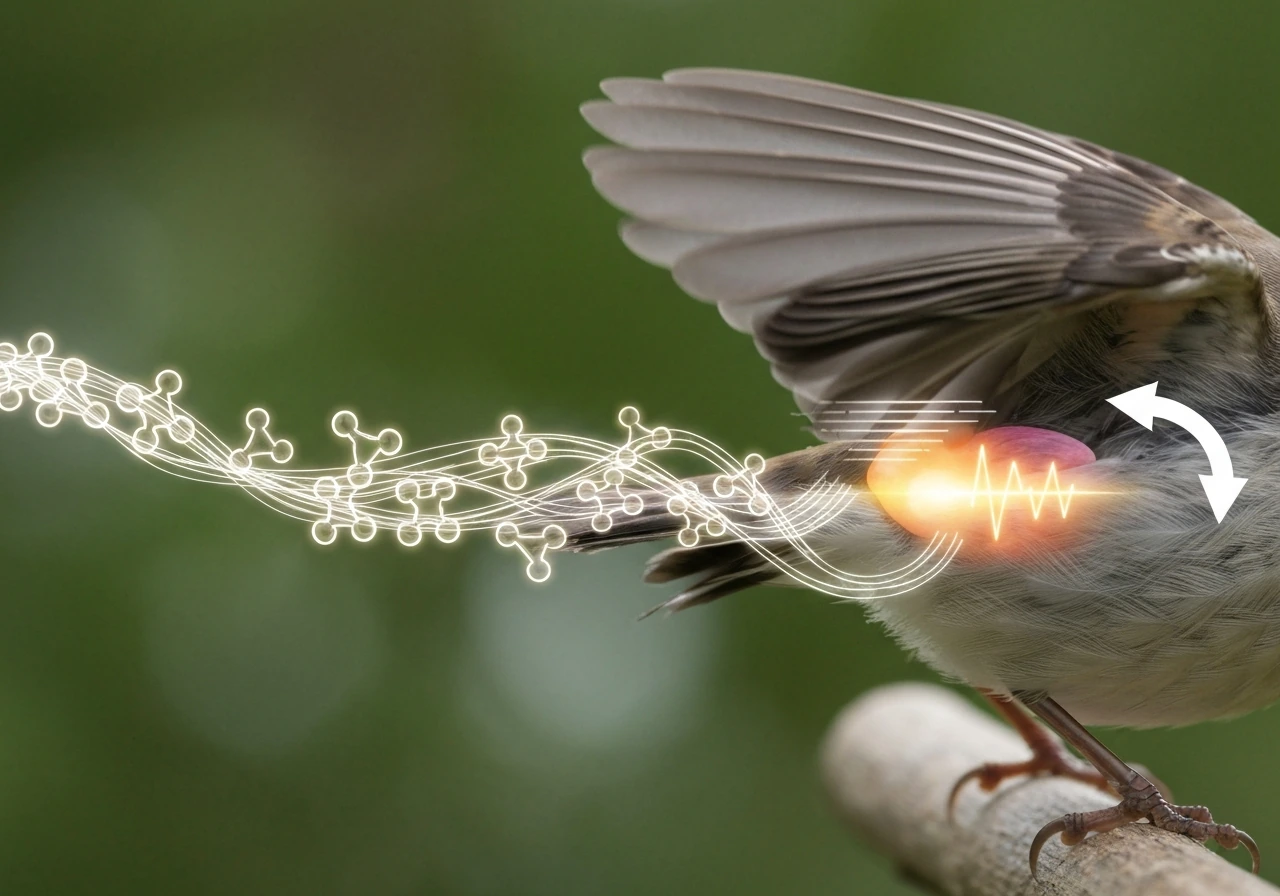
The energy chain starts long before the bird leaves its perch. A bird digests food, and that energy gets packaged into ATP (adenosine triphosphate), the universal energy currency of cells. When the bird's pectoralis muscles (the massive chest muscles that drive the downstroke) contract, ATP is hydrolyzed during what's called the cross-bridge cycle: myosin heads bind to actin filaments, pull, release, and repeat. That molecular-level ratcheting is where chemical energy becomes mechanical energy. The conversion is real and measurable. Studies integrating in vivo measurements of pectoralis force and length change have built mechanical power curves for specific bird species showing exactly how much mechanical output those muscles generate at different flight speeds.
A useful way to think about it: the bird is essentially running an internal combustion engine, except the fuel is glucose and fat, the cylinders are muscle fibers, and the output is wing movement rather than a crankshaft. Some of that output becomes useful mechanical work (moving air, producing lift, overcoming drag) and some is lost as heat, which is why birds can overheat during sustained intense flight. The ratio of mechanical work output to total metabolic energy input is the bird's muscular efficiency, and it varies by species, speed, and flight mode.
Kinetic energy: what the bird's motion actually looks like in physics terms
Kinetic energy is simply the energy an object has because it's moving. The formula is blank" rel="noopener noreferrer">KE = ½mv², where m is the bird's mass and v is its speed.
This means a heavier bird or a faster bird carries more kinetic energy. A 30-gram warbler cruising at 10 m/s carries far less kinetic energy than a 1-kilogram goose at 20 m/s, even though both are 'flying birds. For example, a 30-gram warbler at 10 m/s has KE = ½·0. 03·10² ≈ 1.
5 J of kinetic energy [KE = ½mv²](/energy-in-bird-flight/give-a-numerical-example-for-the-bird-flight-formula). ' That kinetic energy is what the bird has to rebuild every time it slows down, changes direction, or lands. Landing, in fact, is essentially a controlled conversion of kinetic energy back into other forms (heat, sound, a bit of deformation stress on legs and feet).
Direction matters too. A bird climbing at an angle has both translational kinetic energy (from forward speed) and is gaining gravitational potential energy (from altitude). That altitude gained is stored potential energy the bird can cash in later by gliding downward without flapping. This is why soaring birds like eagles and vultures spend so much effort finding thermals: free altitude is free potential energy, and converting it back to speed during a glide costs essentially nothing beyond fighting drag.
Lift, drag, and the energy cost of staying up
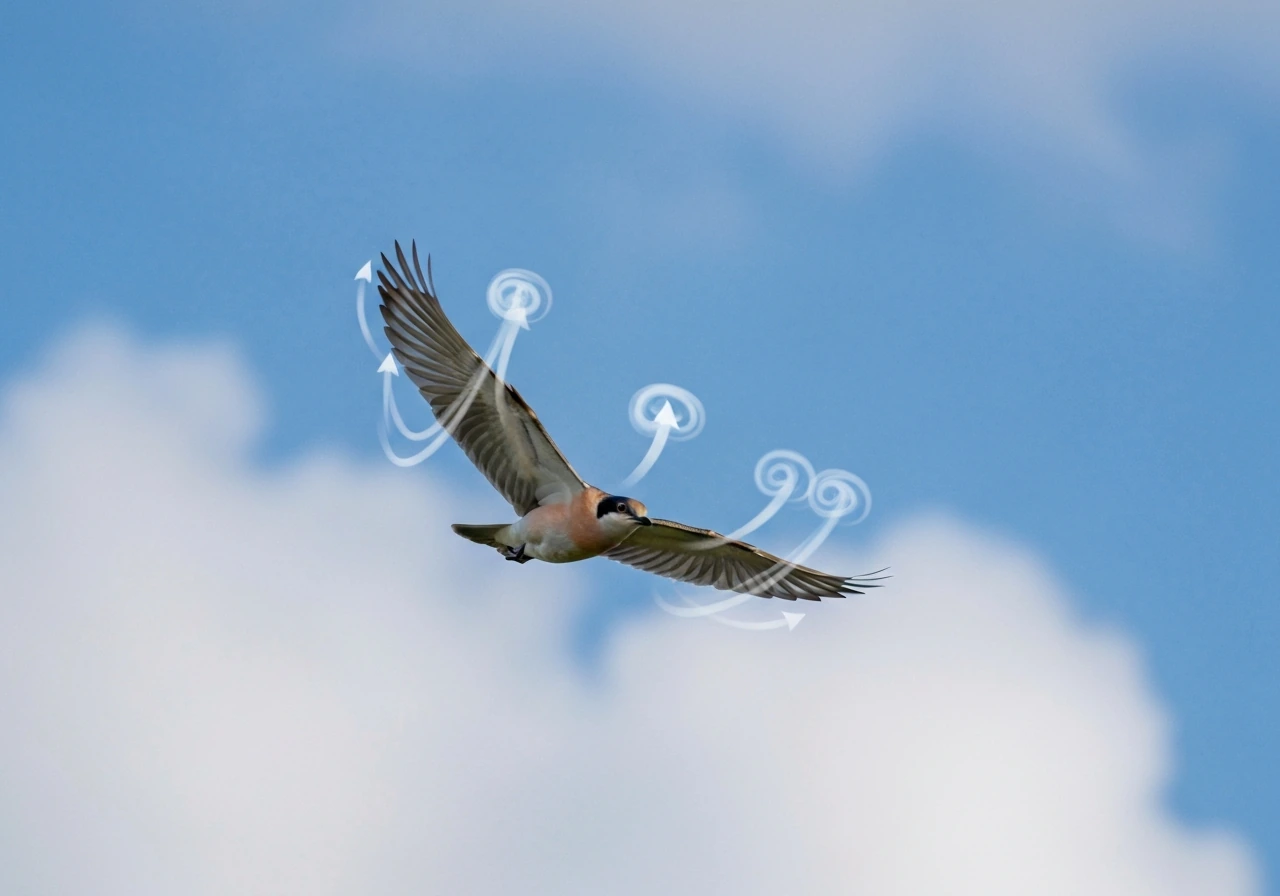
Staying airborne isn't free. Even a bird gliding perfectly still relative to rising air is doing work in an aerodynamic sense. Researchers decompose the total mechanical power a bird needs into three main components: induced power (the energy cost of generating lift to support body weight), parasite power (the cost of pushing the bird's body through the air against body drag), and profile power (the cost of moving the wings themselves through the air against wing drag). All three must be paid from the bird's metabolic budget on every second of flight.
Induced power dominates at low speeds, which is why taking off and hovering are so expensive. Parasite power grows fast with speed (it scales with the cube of velocity), which is why flying extremely fast is also costly. There's a sweet spot in the middle, the minimum-power speed, where total energy expenditure per unit time is lowest. Birds don't always fly at this speed but understanding it explains a lot of migratory behavior: why geese fly at specific altitudes and speeds, why swifts can sustain flight for months while small flapping birds cannot.
How energy use changes across flight modes
Not all flight looks the same energetically, and the type of energy being actively used shifts depending on what the bird is doing.
Flapping flight
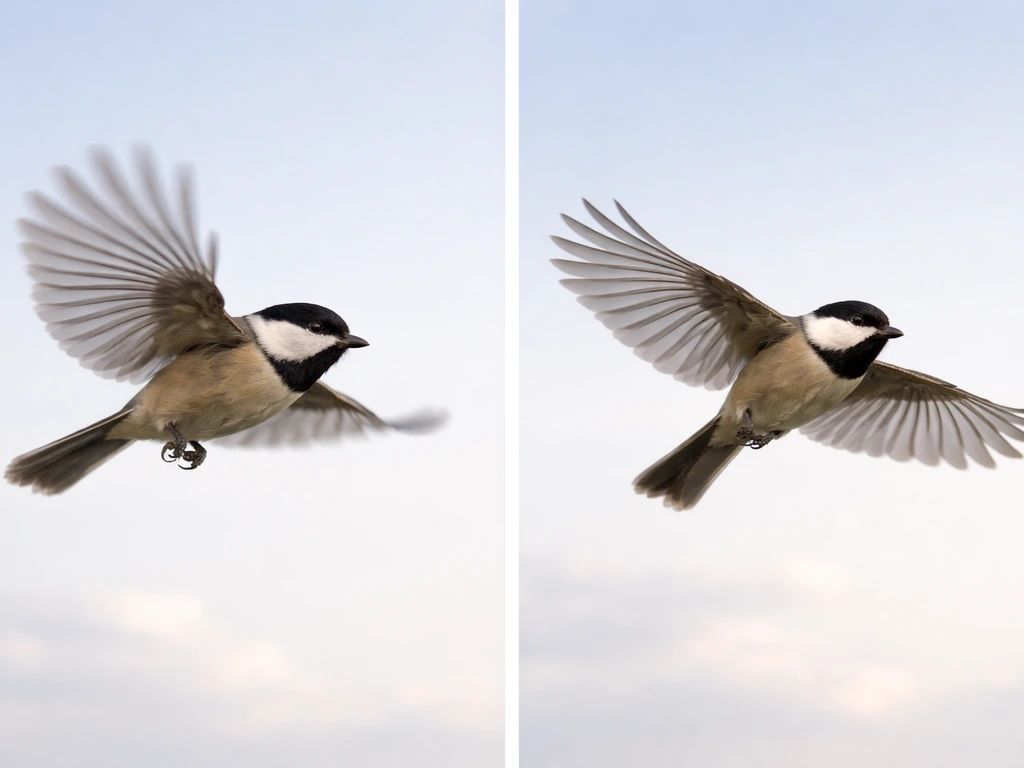
This is the most metabolically expensive mode for most birds. Every wing beat is a burst of muscle activity, chemical energy to mechanical energy to lift and thrust. The pectoralis drives the power downstroke, and the supracoracoideus muscle (running beneath the chest) powers the recovery upstroke. The energy demand is continuous and high. Metabolic rates during flapping flight can be 10 to 15 times higher than at rest for many species.
Gliding and soaring
Here the bird is mostly converting stored potential energy (altitude) into kinetic energy (speed), while muscles work mainly to hold the wings in position rather than actively flapping. The energy expenditure drops dramatically. Albatrosses and condors have exploited this to near perfection: by using dynamic soaring and thermal soaring respectively, they can stay airborne for hours while burning only slightly more energy than when perched. The chemical-to-mechanical conversion is minimal; it's mostly gravitational potential energy doing the heavy lifting.
Hovering
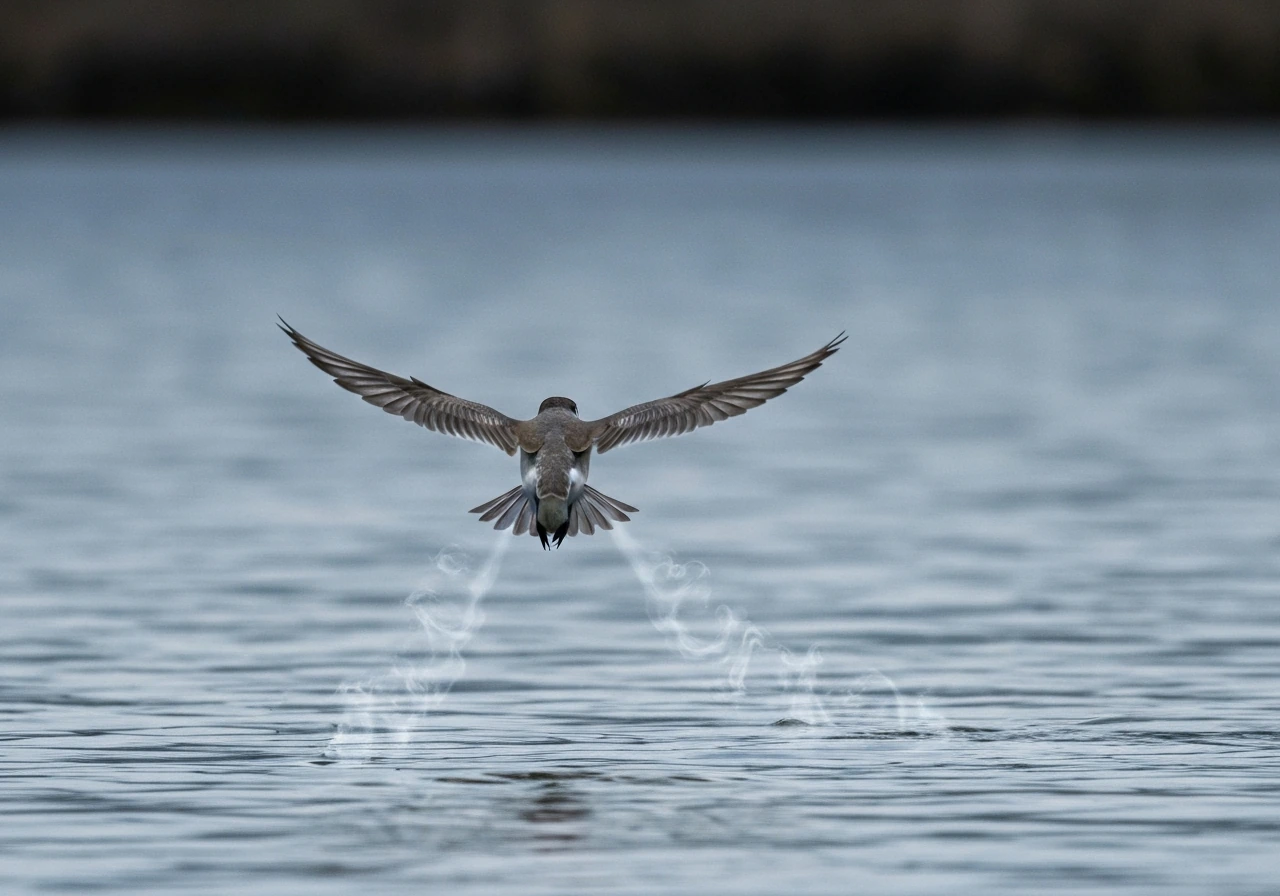
Hovering is the most demanding flight mode per unit time. The bird has zero forward speed, so there's no free lift from airflow over the wings, and no altitude to convert. Everything must come from continuous, rapid muscle-powered wing strokes. Hummingbirds are the extreme example: their whole-body oxygen consumption rate during hovering has been measured at around 700 mL of O2 per kilogram per minute, an astonishing metabolic rate that reflects just how much chemical energy must be burned to stay aloft with no help from momentum or potential energy. Kinetic energy in the hovering bird is very low (it's barely moving translationally), but the power being expended is the highest of any flight mode.
Climbing and takeoff
During a climb, the bird is actively converting metabolic (chemical) energy into both kinetic energy and gravitational potential energy simultaneously. So when a bird climbs, it’s simultaneously building kinetic energy and storing some gravitational potential energy, rather than being purely potential or purely kinetic energy is a bird flying potential or kinetic energy. Takeoff is arguably the most mechanically demanding brief moment in any bird's day: drag and lift roles can even be repurposed depending on the wing angle and speed, as research on bird takeoff and landing mechanics has shown. The burst of muscle power required at liftoff is well above what sustained level flight demands.
The one-sentence version and some misconceptions worth clearing up
If you need one sentence: a flying bird has kinetic energy from its motion, powered by a continuous conversion of chemical energy (from food and ATP) into mechanical energy through blank" rel="noopener noreferrer">muscle contractions, which produce the lift and thrust needed to move and stay airborne. That covers the core chain. Lightning can strike a flying bird, meaning the bird can receive a sudden electric shock while already in motion through the air.
Now for the misconceptions, because they come up often. The biggest one is treating 'potential energy' as the only stored energy relevant to flight, as if a bird is just a rock thrown upward. A bird at altitude does have gravitational potential energy, and it uses it, but the driving engine is chemical energy from metabolism, not gravity. A thrown rock has no metabolism; a bird does, and that's the whole difference.
Another common mix-up is thinking a hovering bird has lots of kinetic energy. It doesn't, not in the translational sense. It has extremely high power expenditure (energy per unit time) but low instantaneous kinetic energy of forward motion. The wings are moving fast through their stroke, so they carry kinetic energy, but the bird's body is nearly stationary.
Finally, people sometimes assume gliding birds use 'no energy. ' They use less, but they're still paying the induced power cost for lift (supported by trading altitude) and still losing energy to drag the whole time.
Understanding the reaction forces involved, where wings push air down and back and the air pushes the bird up and forward via Newton's third law, ties directly into why induced power exists as a cost at all. And if you want to go deeper on the numerical side of these energy relationships, the kinetic energy formula (KE = ½mv²) opens up a whole set of practical calculations you can run for real species with known masses and flight speeds.
FAQ
If a bird is gliding, does it have any kinetic energy at all?
Yes. Even with minimal wing flapping, the bird’s translational motion through the air gives it kinetic energy. What changes during gliding is that the bird relies more on previously gained altitude (gravitational potential energy) and pays a smaller chemical-to-mechanical conversion rate, but it still spends energy combating drag.
Which “type” of energy should I write on a homework answer, kinetic or chemical?
If the question is literally “energy a flying bird has,” kinetic energy is the most direct because it’s tied to its speed. If the question is “energy that powers flight,” chemical energy (stored in food and moved into ATP) is the driver. Many problems intend one answer based on what they’re asking about, so check whether they mean energy present vs energy source.
Does hovering mean the bird has high kinetic energy because the wings are moving so fast?
The bird’s body has low translational kinetic energy because it’s not moving forward much. However, the wings have motion relative to the bird, so the wing tissues carry kinetic energy too. The key distinction is that hovering has very high power demand, but not necessarily high body-level kinetic energy.
When a bird lands, is its kinetic energy converted into heat only?
Not only heat. Landing converts kinetic energy into several forms, including heat from muscle activity, sound, deformation and stress in the wings and legs, and potentially some elastic recoil in tendons and joints. The overall effect is dissipation of motion energy to the surroundings.
Can a bird store energy like “potential energy” while flying, and how is it released?
Yes, when a bird climbs it gains gravitational potential energy. Later, during a glide or descent, that stored energy can be converted back into speed (kinetic energy) while the bird still must spend energy to maintain lift and overcome drag.
Why is “potential energy” not the main explanation for why birds can fly?
Because birds need a continuous metabolic energy supply. Gravity can help a bird gain speed during descent, but it does not provide the sustained power needed to generate lift and thrust. Without chemical energy burning in the muscles, the bird cannot keep its wings and posture producing aerodynamic forces.
How does wind or a thermal change the energy story for the same bird?
Airflow can change how much power the bird must produce for the same ground motion. In rising air (thermals), the bird can gain or maintain altitude with less work, meaning less induced power drawn from metabolism for lift support. The bird may still have kinetic energy from its motion relative to the surrounding air, which is what matters for aerodynamic drag and lift.
If a bird’s speed goes up, does its energy go up linearly or faster?
Faster. Translational kinetic energy scales with the square of speed (KE = 1/2 mv²). Doubling speed quadruples kinetic energy, which is one reason very fast flight can be costly even for the same bird mass.
Is “energy per second” (power) the same thing as kinetic energy?
No. Kinetic energy describes how much motion energy the bird has at an instant. Power describes how quickly energy is being used or converted. A bird can have low translational kinetic energy but very high power demand during hovering because it must continuously produce lift.
Can an electric shock affect a bird in a way that changes its flight energy?
Yes. An electric shock can disrupt muscle control and respiration, which can change how the bird generates thrust and lift. Even though kinetic energy is tied to motion, loss of effective muscle output can quickly reduce speed control and destabilize flight, leading to a change in its energy transformations.
Next Articles

Bird Has Flown Meaning: Definition and How to Respond
Understand the bird has flown meaning, when it’s used, and how to reply with examples for real-life conversations.
Prefix Meaning Flight or Bird: Definition and Examples
Learn the flight or bird prefix meaning, origin, examples, and a checklist to decode new words and avoid look-alikes.
Flyer Meaning Bird: What It Says About Flight Ability
Clarifies flyer meaning for birds and explains which species fly well and why, plus a checklist to verify in context.