
A 'high-flying bird' can mean two very different things depending on who is using the phrase. In biology and ornithology, it refers to a species that routinely sustains flight at thousands of metres above ground level, either during migration or foraging. In everyday language, it describes someone ambitious and successful. If you landed here because you searched for the Netflix film of the same name, that is a different topic entirely, and I will point you toward the right resources below. If you are here for the science, you are in the right place.
High-Flying Bird Explained: Biology, Flight, and Altitude

Marcus Chen
9 Aug 2026
What 'High-Flying Bird' Actually Means
The phrase carries two parallel lives. Dictionaries including Merriam-Webster and the Cambridge Dictionary list both senses: the figurative meaning of someone who is ambitious or achieving great success, and the literal meaning of something that flies at considerable height. In everyday conversation the figurative sense dominates, which is why the phrase works as a film title or a compliment to a colleague.
In ornithology, the term is context-dependent but has a workable biological definition: a species that routinely attains and sustains flight at thousands of metres above ground level during foraging or migration qualifies as a high-flying bird. This is not just a bird you happen to see high overhead on a thermal on a warm afternoon. The distinction matters because nearly any bird can gain altitude briefly, but very few species can sustain powered or gliding flight at extreme altitudes where air is thin, cold, and oxygen-poor.
Criteria: What Makes a Bird 'High-Flying' in Biology
Ornithologists use several criteria to decide whether a species genuinely qualifies. Casual height is not enough. The species must regularly operate at altitudes where atmospheric conditions become physiologically challenging, typically above 3,000 metres, and must have the anatomy, physiology, and behaviour to sustain performance there. The criteria most commonly applied in the literature are:
- Documented GPS or radar-confirmed altitudes above 3,000 m during normal activity (not just exceptional single events)
- Evidence of sustained flight at those altitudes, not just transient climbs
- Measurable physiological or morphological adaptations to reduced air density and lower oxygen partial pressure
- Repeatability across individuals and seasons, not single anecdotal observations
- Independent validation through telemetry, radar, or verified bird-strike records rather than visual estimates alone
Visual estimates of bird height are notoriously unreliable, a point worth keeping in mind throughout this article and one I will return to in the measurement section. The most credible records come from GPS data loggers attached to individual birds, weather radar networks, and the grim but useful category of aircraft bird-strike reports.
Species That Actually Fly High: Notable Records
The number of species with validated extreme-altitude records is smaller than popular lists suggest. Here are the best-documented cases, each backed by either peer-reviewed telemetry studies or verified incident reports.
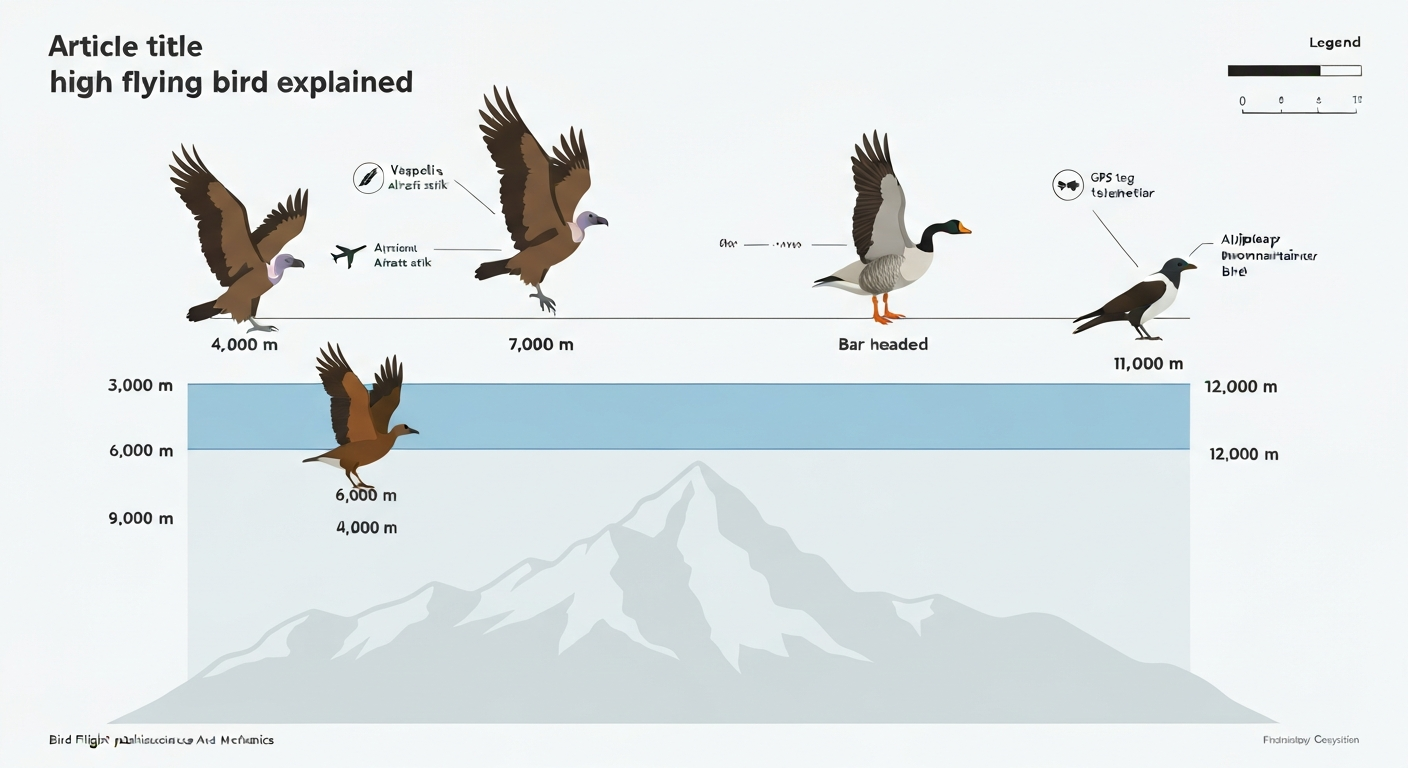
- Rüppell's griffon vulture (Gyps rueppelli): The highest reliably documented altitude for any bird. A specimen was ingested by a commercial aircraft at 37,000 ft (approximately 11,278 m) over West Africa. The identification was confirmed from feather and tissue remains, reported by Laybourne in the Wilson Bulletin (1974). This remains the accepted record.
- Bar-headed goose (Anser indicus): The most thoroughly studied high-altitude migrant. GPS and heart-rate data loggers from Bishop et al. (Science, 2015) show that 95% of GPS fixes occur below approximately 5,784 m, with a confirmed maximum of 7,290 m. The birds cross the Himalayas seasonally, making this a repeatable, validated record.
- Common crane (Grus grus): Radar and tracking data confirm regular migration above 5,000 m over mountain passes, though systematic telemetry data are less detailed than for bar-headed geese.
- Whooper swan (Cygnus cygnus): Aircraft encounter reports place individuals at approximately 8,200 m over the North Atlantic during autumn migration, corroborated by multiple independent pilot reports and later ornithological review.
- Alpine chough (Pyrrhocorax graculus): Reliably observed foraging near the summit of Everest at around 8,200 m, making it one of the highest-altitude resident birds documented by direct observation.
- Bearded vulture (Gypaetus barbatus): Resident in high-mountain zones across the Himalayas and Alps, regularly foraging above 4,000 m with credible observations approaching 7,000 m.
Altitude Records and Key Adaptations at a Glance
| Species | Documented Max Altitude | Validation Method | Key Adaptation |
|---|---|---|---|
| Rüppell's griffon vulture | ~11,278 m (37,000 ft) | Aircraft strike / feather ID (Laybourne 1974) | Extreme soaring efficiency; high-affinity hemoglobin variant |
| Bar-headed goose | 7,290 m (GPS confirmed) | GPS + heart-rate logger telemetry (Bishop et al. 2015) | Modified hemoglobin; unidirectional airflow lungs; metabolic reduction |
| Whooper swan | ~8,200 m (estimated) | Multiple pilot reports; ornithological review | Large wing area; sustained powered flight in cold air |
| Alpine chough | ~8,200 m (observed) | Direct mountaineer and research observation | Foraging flexibility; compact physiology at altitude |
| Common crane | >5,000 m | Radar tracking during migration | Long, broad wings; soaring-gliding migration strategy |
| Bearded vulture | ~7,000 m (credible obs.) | Field observation; resident range data | High aspect-ratio wings; thermal and orographic soaring |
Wings Built for Thin Air: Anatomy and Biomechanics
The physical challenge of flying at altitude is straightforward: air density drops with elevation, so a wing must work harder to generate the same lift. At 6,000 m, air density is roughly half what it is at sea level. To compensate, a bird either increases wing speed (costly in energy), increases wing area, or evolves wing geometry that maximises aerodynamic efficiency. High-flying birds have converged on a specific set of morphological solutions.
Aspect Ratio and Wing Loading
Aspect ratio is the ratio of wingspan to mean wing width. A long, narrow wing (high aspect ratio) generates lift with less drag, which is essential when air is thin and every joule of muscle energy counts. Wing loading is the bird's body mass divided by total wing area. Lower wing loading means the bird can stay airborne at lower air speeds, reducing the power needed at altitude. The modelling framework developed by Colin Pennycuick, described in his book 'Modelling the Flying Bird,' formalises these relationships: induced power (the energy needed just to support body weight in the air) scales with wing loading and inversely with air density, which means that at high altitude, low wing loading is not just beneficial but necessary. Vultures and geese that routinely fly high both show lower wing loading and higher aspect ratios than typical lowland species of similar body mass.
Muscle Architecture and Power Output
Flight muscle performance under hypoxia is a separate constraint from wing geometry. The pectoralis major, which drives the downstroke in most birds, must maintain output when oxygen delivery is compromised. Bar-headed geese have a higher capillary density in their flight muscles than closely related lowland geese, meaning oxygen can diffuse more quickly into muscle fibres even when blood oxygen saturation is reduced. Experimental wind-tunnel studies by Meir et al. (eLife, 2019) showed that bar-headed geese actually reduce their metabolic rate under simulated hypoxia rather than compensating by burning more fuel, a counterintuitive and efficient strategy that lowers the oxygen demand required to sustain flight.
Breathing Thin Air: Physiological Adaptations
Avian respiratory anatomy is fundamentally different from mammalian lungs, and that difference is a key reason birds can fly at altitudes that would incapacitate most mammals. Instead of the dead-end sac structure of mammalian lungs, birds have a system of air sacs that drives air through the lung in one direction only. This unidirectional flow maintains a near-constant supply of fresh air across the gas-exchange surfaces throughout both inhalation and exhalation, giving birds a much more efficient extraction of oxygen from each breath.
Overlaying this structural advantage, high-altitude specialists carry molecular modifications to their hemoglobin. Natarajan et al. (Science, 2015) used protein engineering and ancestral-resurrection techniques to pinpoint specific amino acid substitutions in bar-headed goose hemoglobin that increase its affinity for oxygen. Natarajan et al., ‘Molecular basis of hemoglobin adaptation in the high‑flying bar‑headed goose’ (Science) experimentally identified specific hemoglobin substitutions that increase Hb–O2 affinity, helping bar‑headed geese load oxygen at high altitude. These substitutions allow hemoglobin to load up with oxygen even when the partial pressure of oxygen is low, as it is at altitude. A follow-up study published in the Journal of Experimental Biology (Jendroszek et al., 2018) worked out the allosteric mechanism: the substitutions reduce the sensitivity of hemoglobin to organic phosphate inhibitors, keeping affinity high without compromising the ability to release oxygen to the tissues.
Metabolic adjustments round out the picture. Rather than running hotter to generate more power at altitude, bar-headed geese conserve oxygen by reducing overall metabolic rate when hypoxic conditions demand it. Cold temperatures at altitude actually help here: the air acts as a heat sink, reducing the cost of thermoregulation and allowing metabolic resources to focus on flight muscle performance.
How High-Flying Birds Actually Use the Sky
Altitude is not just about biological capacity; it is also about strategy and environment. The most energy-efficient high-altitude flights exploit external forces rather than fighting against them.
Soaring Types: Thermals, Orographic Lift, and Dynamic Soaring
Thermal soaring involves circling inside columns of warm rising air, gaining altitude for free before gliding forward. This is what most large raptors and vultures use over open terrain. Orographic (or ridge) lift occurs when horizontal wind hits a slope or mountain range and deflects upward, creating a continuous updraft along the ridge face. Bar-headed geese use orographic lift along Himalayan ridges extensively. Bishop et al. (Science, 2015) described their migration as a 'roller-coaster' strategy: the geese descend into valleys at night to dense, oxygen-rich air, then climb rapidly the following day using orographic lift, rather than maintaining a sustained extreme altitude throughout. This is a deeply practical solution to the physics of mountain crossing. Dynamic soaring, the strategy used by albatrosses over open ocean, exploits wind speed gradients between wave level and higher air, but this technique is not commonly used by high-altitude migrants over land.
Weather, Wind, and Migration Timing
High-flying migratory birds are not indifferent to weather. Favourable tailwinds can dramatically reduce the energy cost of migration, which is why many species time their crossings of mountain barriers with specific synoptic weather patterns. Flying into a headwind at altitude, where air is already thin, compounds the power required exponentially. Radar ornithology studies, including those by Dokter et al. using networks of operational weather radars, show that migrants shift their altitude distributions in response to wind layers, actively selecting the height band that offers the best wind support. For species crossing mountain ranges, the tradeoff between altitude (to clear terrain) and wind support (which may be better at lower levels) drives nuanced, flexible behaviour rather than a fixed ceiling.
How Scientists Actually Measure Bird Altitude
This is an area where popular claims and scientific evidence often diverge, and it is worth being precise about what methods exist and what their limitations are.
GPS and Barometric Telemetry
Modern bird tracking relies on two main sensor types aboard data loggers attached to birds. GPS/GNSS tags record position and altitude through satellite triangulation. Vertical accuracy from GPS is inherently lower than horizontal accuracy, but high-frequency sampling (tags recording fixes every 1 to 3 seconds) can reduce mean vertical error to roughly 2 to 7 metres. Barometric altimeters measure air pressure and convert it to altitude; they have lower noise but can carry systematic bias from the pressure reference used. The consensus from tag validation studies by UvA-BiTS and related tracking consortiums is that combining high-frequency GPS with calibrated barometric sensors gives the best vertical accuracy, typically within single-digit metres. Movebank-hosted device metadata and the study ‘Optic‑flow cues help explain altitude control over sea in freely flying gulls’ (validation/Movebank‑based methods, PMC) document that combining high-frequency GNSS with calibrated baro‑altimetry yields the best vertical accuracy. Data from these devices are archived and publicly accessible through Movebank, the central repository for animal tracking data.
Radar Networks and Citizen Science
Radar provides a complementary, population-scale view. Weather radar networks in Europe and North America detect migrating birds as distinct echoes and can estimate the altitude distribution of nocturnal migrants across thousands of kilometres simultaneously. This is the primary method for understanding altitude patterns at the population level rather than the individual level. Citizen-science platforms such as eBird record enormous numbers of bird observations, but height is rarely recorded precisely and almost never with instrumented measurement. Visual estimates of bird altitude are systematically unreliable: the brain uses familiar size cues to judge distance, and birds at genuinely great height lose those reference points entirely. This connects to a question several related topics on this site address: why a flying bird can appear to be at a different height than it actually is, and why the shadow of a high-flying bird is invisible from the ground.
Why You Cannot See a High-Flying Bird's Shadow
At ground level, a bird's shadow is sharp and easy to spot because the bird is close, the sun angle is steep enough to project the shadow near your feet, and the shadow has high contrast against pavement or bare soil. At extreme altitude, three things change simultaneously. First, the bird is so far above the surface that its shadow is projected onto an area of ground far from your position, and the angular size of the shadow becomes vanishingly small. Second, at low sun angles typical of dawn and dusk migration, shadows extend enormously and are stretched to invisibility. Third, vegetation, complex terrain, and atmospheric haze all scatter and diffuse incoming light, reducing contrast until no discrete shadow is cast. For a species like Rüppell's griffon vulture flying above 10,000 m, the geometry alone makes a ground-level shadow observation physically impossible for a human observer.
Why High-Flying Birds Appear Even Higher Than They Are
Atmospheric optics and perspective combine to make altitude estimation from the ground particularly inaccurate. As distance increases, atmospheric haze and scattering reduce contrast, making objects appear farther away than they are (the aerial perspective effect). Birds at altitude also subtend a smaller visual angle than expected by observers accustomed to judging distance from familiar objects at lower heights. The result is that observers routinely overestimate the altitude of birds they see high overhead, a systematic bias that has fed many anecdotal claims about species flying at implausible altitudes. Reliable altitude records depend on instrumented measurement precisely because visual estimates cannot be trusted. For a focused explanation of why a flying bird appears higher, see the section on why a flying bird appears higher.
The Other 'High Flying Bird': The Netflix Film
If you typed 'high flying bird explained' into a search engine looking for Steven Soderbergh's 2019 Netflix film rather than avian biology, you are in the right place to get pointed in the right direction. The film, starring André Holland, is about a sports agent navigating an NBA lockout and has nothing to do with birds in any biological sense. The title uses 'high-flying' in its figurative meaning of ambition and success, which is its most common colloquial use.
For a parent or educator assessing whether the film is appropriate for younger viewers, resources like Common Sense Media provide age ratings and content breakdowns. For viewers who found the film's ending ambiguous or wanted a narrative analysis, dedicated 'ending explained' write-ups are the resource you want. Both of those topics are covered by related content on this site that addresses the film specifically, separate from the biology here.
Putting It Together: What a High-Flying Bird Represents
The biological high-flying bird is not simply a bird that climbs high on a lucky afternoon. It is an organism shaped over evolutionary time by the specific physics of thin, cold, oxygen-depleted air. Its wing geometry reflects the aerodynamic demands of low-density lift. Its hemoglobin carries molecular substitutions that fine-tune oxygen binding at partial pressures most animals cannot exploit. Its respiratory system runs a fundamentally different ventilation strategy that mammalian lungs cannot match. And its behaviour, the roller-coaster routes, the timing with orographic lift, the response to wind layers, reflects a sophisticated interaction with the atmosphere that instruments are only now beginning to capture in full detail.
The figurative 'high-flying' person borrows exactly the right metaphor. Reaching and sustaining performance at altitude, whether atmospheric or professional, requires structural advantage, efficient resource use, and the ability to read and exploit the environment rather than simply overpower it. For another relevant comparison, see high flying bird ending explained.
FAQ
What does “high‑flying bird” mean in biological vs. popular (figurative) contexts?
Biological sense: a species that routinely attains and sustains flight at very high altitudes above ground (typically hundreds to thousands of metres during foraging or migration) or displays anatomical/physiological specializations enabling such flight (examples: bar‑headed goose, Rüppell’s griffon vulture, some albatrosses and swifts). This working definition follows ornithological usage in migration and flight literature (see radar and telemetry reviews). Popular/figurative sense: “high‑flying” means ambitious or successful; dictionary entries (Merriam‑Webster, Cambridge, Oxford learner’s) list both literal and metaphorical senses. Distinguish the biological topic from slang or media references (see Cultural/Media FAQ below).
Which bird species are representative high‑altitude fliers and what altitude records exist?
Representative species and notable records (validated where possible): - Rüppell’s griffon (Gyps rueppelli): collision with an aircraft recorded at ~37,000 ft / ~11,300 m (Laybourne 1974). - Bar‑headed goose (Anser indicus): GPS/physiology studies report routine migration below ~5,800 m with validated fixes up to 7,290 m (Bishop et al. 2015; telemetry reviews). - Alpine/soaring raptors and some vultures: regularly soar at several hundred to a few thousand metres using thermals and orographic lift. - Alpine choughs, lammergeiers and other mountain specialists: frequent high mountain flight though typical heights are lower than the extreme bar‑headed/geese records. Note on claims: many claimed heights in popular press exceed validated telemetry or radar data; use peer‑reviewed telemetry, radar, or properly documented observational records for verification (Movebank, PNAS/Dokter radar work).
What anatomical and biomechanical features enable sustained high‑altitude flight?
Key features (established flight‑mechanics principles such as Pennycuick and Norberg): - Wing geometry: high aspect ratio (long, narrow wings) reduces induced drag for efficient long‑range flight; low wing loading (wing area relative to body mass) lowers stall speed and required lift in thin air. - Muscle architecture: proportionally larger flight muscles and fiber types that provide sustained power output; muscular power must match the increased power required at low air density. - Aerodynamic performance: lift and power equations include air‑density terms; as density drops with altitude, birds compensate via wing kinematics, higher airspeed, and wing morphology to maintain lift. - Behavioural biomechanics: flap–glide patterns, intermittent bounding, or use of soaring reduce average power costs. These relations are formalized in flight‑model frameworks (Pennycuick) and comparative morphology studies (Norberg).
What physiological adaptations allow birds to function in thin air and cold at high altitude?
Established physiological mechanisms: - Avian respiratory system: air sacs and unidirectional flow enable efficient pulmonary ventilation and cross‑current gas exchange, improving O2 extraction. - Hemoglobin and blood: increased Hb–O2 affinity via specific amino‑acid substitutions (documented in bar‑headed goose; Natarajan et al., Science) raises oxygen loading in hypoxia. - Metabolic adjustments: reduced resting or flight metabolic rate under hypoxia (wind‑tunnel/physiology studies, e.g., Meir et al., eLife) and efficient muscle oxidative capacity. - Cardiovascular/ventilatory responses: adjustments in heart rate, stroke volume, and breathing that match oxygen delivery needs. These findings are supported by experimental physiology, protein‑engineering, and telemetry studies.
What flight strategies and environmental factors let birds reach or exploit high altitudes?
Common strategies and constraints (empirical and modelling sources): - Soaring on thermals (thermal convection) and dynamic/static soaring on wind gradients reduces metabolic cost for gaining/holding altitude (important for raptors and vultures). - Orographic lift: using wind deflected by mountains to gain height without continuous climbing (bar‑headed geese exploit Himalayan orography in ‘roller‑coaster’ flights; Bishop et al. 2015). - Wind support and tailwinds: favorable winds lower energy cost for migration and affect preferred flight altitudes. - Density altitude and weather: colder air is denser but high pressure/temperature interactions and weather systems change effective flight cost; extreme cold and hypoxia impose physiological limits. - Migration tactics: birds trade off altitude vs. wind support and oxygen availability—many migrations occur at altitudes where aerodynamic and metabolic costs are minimized. References: flight‑mechanics modelling (Pennycuick), radar migration studies (Dokter et al.).
How is bird altitude measured and what are limits/accuracy of these methods?
Primary measurement methods and accuracy considerations: - GPS/GNSS telemetry: vertical fixes have larger error than horizontal; high‑frequency sampling (1–3 s) improves vertical accuracy—typical mean vertical error can be ~2–7 m for good tags but varies by device and fix geometry. - Barometric altimeters on tags: generally lower short‑term noise but require calibration to local pressure and can have systematic bias. Combining GPS and barometric data yields best estimates (Movebank guidance; UvA‑BiTS analyses). - Radar (weather and dedicated avian radars): provides large‑scale altitude distributions for migrating flocks and populations but not species‑specific identity without corroboration. - Visual estimates and binoculars: highly uncertain for high altitudes—suitable only for rough, qualitative observations. - Camera photogrammetry and lidar: used in research contexts but require calibration and known geometry. Best practice: use validated telemetry (with metadata on device and sampling), cross‑validate with radar where possible, and report error margins and sensor type (Movebank/PNAS recommendations).
Next Articles

Why We Cannot See the Shadow of a Flying Bird: Explained
Why you often can't see a flying bird's shadow, physics explained, when visible, and tips to capture it.
High Flying Bird Common Sense Media: Film & Bird Science
High Flying Bird, Common Sense Media–style review and plot/ending, plus clear science on why birds look higher or cast
High Flying Bird Ending Explained: Literal Flight and Meaning
Disambiguate high flying bird ending: literal flight steps from lift to landing, plus story meaning and how to spot each