
A flying bird almost never casts a visible shadow on the ground, and that is not an illusion or a coincidence. Several physical forces work together against you: the bird is small, it is moving fast, the Sun is not a perfect point of light, scattered skylight fills in shadows from every direction, and the ground itself may be too bright or too textured to show the contrast. Any one of those factors alone could soften a shadow into invisibility. Together, they usually erase it completely.
Why We Cannot See the Shadow of a Flying Bird: Explained
Marcus Chen
19 Jul 2026
How shadows actually form
A shadow exists because an opaque object blocks a light source from reaching a surface. The geometry seems simple, but the Sun complicates it immediately. The Sun is not a point of light. From Earth it subtends an angular diameter of about 0.53 degrees (roughly 0.0093 radians). That tiny but real disk means that light from one edge of the Sun can partially sneak around an object even when light from the center is completely blocked. The result is two distinct zones in every solar shadow: the umbra (the central region where all direct sunlight is blocked) and the penumbra (the surrounding fringe where the Sun is only partially obscured and illumination fades gradually from full shadow back to full sunlight). See HyperPhysics, Umbra and Penumbra (Georgia State University) for the standard explanation that extended sources like the Sun create distinct umbra and penumbra regions and therefore produce a penumbral fringe rather than an ideally sharp shadow edge HyperPhysics — Umbra and Penumbra (Georgia State University).
For objects resting on the ground, the penumbra is narrow and the umbra is relatively dark and visible. But as an object moves upward, the geometry changes dramatically. The penumbra grows with height while the umbra shrinks. At a high enough altitude, the umbra vanishes entirely and only a soft penumbral smear remains. That is the mathematical core of why a bird soaring overhead often leaves no trace on the pavement below. For a deeper dive into how altitude affects shadows and related flight optics, see high flying bird explained. See high flying bird ending explained for another concise, accessible explanation of why high-altitude birds usually cast no visible ground shadow.
Height and angular size: why distance erases the shadow
The relationship between height and penumbra width is direct and measurable. Because the Sun's angular radius is approximately 0.0093 radians, the lateral edge blur of a solar shadow at ground level scales as height multiplied by that figure. A bird flying 10 meters above the ground produces an edge blur of about 9 centimeters on each side of its shadow. At 50 meters, that blur spreads to roughly 46 centimeters. At 100 meters, nearly a meter of gradual fade surrounds what was already a small central shadow.
Now match that to real bird sizes. A house sparrow has a wingspan of around 20 to 25 centimeters. A rock pigeon spans roughly 50 to 67 centimeters. Even a red-tailed hawk, with a wingspan of 110 to 133 centimeters, is not large in absolute terms. At 30 meters of altitude, the hawk's shadow footprint is already being swallowed by its own penumbra. The sparrow's shadow at the same height is geometrically gone: the penumbra edge blur alone is wider than the bird itself. Higher-altitude flight, which is common for migrating and soaring birds, makes this problem far worse. Many migratory flights cruise hundreds to thousands of meters above the ground, at which point no shadow of any practical size is possible.
| Species | Wingspan | Height 10 m: edge blur | Height 50 m: edge blur | Shadow likely visible? |
|---|---|---|---|---|
| House sparrow | ~22 cm | ~9 cm each side | ~46 cm each side | No (blur wider than bird) |
| Rock pigeon | ~60 cm | ~9 cm each side | ~46 cm each side | Possibly at 10 m, no at 50 m |
| Herring gull | ~130 cm | ~9 cm each side | ~46 cm each side | Marginally at 10 m |
| Red-tailed hawk | ~120 cm | ~9 cm each side | ~46 cm each side | Marginally at 10 m, no at 50 m |
Sun angle and time of day: the brief window when shadows are longest
The Sun's elevation angle above the horizon determines how long and at what angle a shadow projects onto the ground. When the Sun is low (early morning or late afternoon), shadows stretch long and are cast nearly horizontally, meaning a bird's shadow travels far across the ground before dispersing. When the Sun is high overhead at midday, shadows compress almost directly beneath the bird and can become so short they disappear into the bird's own footprint. The sweet spot for seeing a bird's shadow is roughly the first two hours after sunrise and the last two hours before sunset, when the Sun sits low enough to cast long shadows but is still direct and intense rather than being filtered through thick atmosphere near the horizon.
Solar position tools (the NREL Solar Position Algorithm is the professional standard, and NOAA provides a freely accessible online calculator) can tell you exactly what solar elevation angle to expect at your location and time of year. This is genuinely useful if you are trying to photograph bird shadows deliberately: plan for early morning in summer when the Sun rises fast, or late afternoon when it lingers low. Seasons matter too. In winter at higher latitudes, the Sun never climbs far above the horizon even at midday, which means shadow potential is higher all day but diffuse haze is also often greater.
What the ground is doing to the shadow
Even a geometrically perfect shadow can vanish if the ground surface does not cooperate. Surface reflectance (what physicists describe with a quantity called BRDF, or bidirectional reflectance distribution function) determines how much light a surface bounces back into a shadowed area. Fresh snow has an albedo approaching 0.9, meaning it reflects roughly 90 percent of incoming light. Rough concrete, dry sand, and pale grassland are similarly bright. When a shadow falls on a highly reflective surface, the skylight and scattered light reflecting off neighboring ground fills the shadow from the sides and below, raising its luminance and shrinking the contrast to near-zero. Dark, uniform, matte surfaces are the opposite: wet asphalt, dark soil, and closely mown short grass give shadows their best chance of registering visibly.
Texture matters just as much as brightness. A highly textured surface (gravel, leaf litter, rough bark, lumpy grass) creates its own pattern of tiny shadows that overwhelm any soft bird shadow falling across it. Smooth, featureless surfaces give the eye a clean visual field against which a shadow's slightly darker patch can stand out. Flat concrete, calm water, a sandy beach, or a freshly mown lawn are the best natural canvases for bird shadow spotting.
Motion and blur: why fast wings defeat your eyes and your camera
Birds move, and their shadows move with them. A pigeon in level flight travels at roughly 50 to 80 kilometers per hour. At that speed, its shadow sweeps across the ground at the same rate. Human vision integrates light over a critical temporal window of roughly 50 to 100 milliseconds (a phenomenon called temporal summation or Bloch's law). If the shadow crosses any given point on the ground in less time than that window, the visual system averages the shadow into the surrounding brightness rather than resolving it as a distinct dark patch. For a fast bird at moderate altitude with a small shadow footprint, that threshold is easily breached.
Cameras face the same problem from a different angle. Motion blur in a photograph is approximately equal to the object's speed multiplied by the shutter exposure time. At 1/250 second, a bird moving at 60 km/h smears its shadow by about 6.7 centimeters in the frame. At 1/100 second, the smear reaches nearly 17 centimeters. Since the shadow itself may only be a few centimeters across, even modest motion blur converts it from a recognizable shape into a faint gray streak that the sensor and human eye both ignore. To freeze a bird shadow reliably, exposure times of 1/1000 second or faster are generally necessary, and that requires bright conditions or a high ISO setting, each of which introduces its own tradeoffs.
Atmosphere and light: how haze and sky scatter conspire against shadows
Sunlight reaching the ground is never purely directional. Rayleigh scattering (the same process that makes the sky blue) and Mie scattering by aerosols, dust, and humidity scatter a fraction of sunlight in all directions before it reaches the surface. This diffuse component arrives from the entire hemisphere of sky rather than from the Sun's disk alone, and because it comes from all angles it illuminates shadow zones from directions the bird cannot block. The diffuse fraction of daylight under clear skies is significant even on apparently sunny days, and it rises sharply with cloud cover, haze, or high aerosol loading. See Visualizing Rayleigh Scattering and diffuse fraction (Bulletin of the American Meteorological Society) for measurements and discussion of diffuse fractions under varying atmospheric conditions. Some regional studies have documented monthly mean diffuse fractions between roughly 43 and 74 percent under various atmospheric conditions. In practical terms: a hazy summer afternoon, a slightly overcast bright day, or a high-altitude thin cloud cover can reduce shadow contrast dramatically even when you can see the Sun.
Clouds add a further layer of complexity. Under an overcast sky there is effectively no single directional source, so cast shadows from any flying object disappear entirely. Even a partially cloudy sky creates multiple competing light sources of varying intensity that shift and overlap as clouds drift, making any shadow a moving, flickering, low-contrast phenomenon that neither the eye nor the camera can reliably track.
Contrast and perception: when your eyes and your camera give up
Assuming a shadow does reach the ground with some geometrical integrity, the final barrier is whether you or your camera can actually detect it. Under good photopic (daytime) viewing conditions, the human visual system can detect contrast differences as small as about 1 percent at mid-range spatial frequencies. That sounds impressive, but contrast sensitivity drops sharply for very fine or very coarse features, and it drops further in bright outdoor scenes where the eye has adapted to the dominant brightness. A bird shadow that represents, say, a 5 percent darkening of a patch of bright concrete might be comfortably above threshold in isolation, but surrounded by a complex sunlit scene with trees, reflections, and movement, it easily falls below the practical detection limit. The eye is not a calibrated photometer; context and adaptation strongly influence what it can pick out.
Cameras handle contrast through dynamic range, typically around 10 to 15 stops on modern digital sensors under ideal conditions. When a scene contains both direct sunlit areas and deeply shadowed areas, the camera must choose an exposure that renders one end of that range well. Expose for the bright sky and the shadow becomes a featureless dark blob. Expose for the shadow and the sky blows out completely. RAW files and HDR techniques recover some of this lost range in post-processing, but the underlying problem remains: a small, soft, low-contrast bird shadow in a bright outdoor scene sits right at the edge of what any imaging system can reliably record.
When you actually can see a bird's shadow
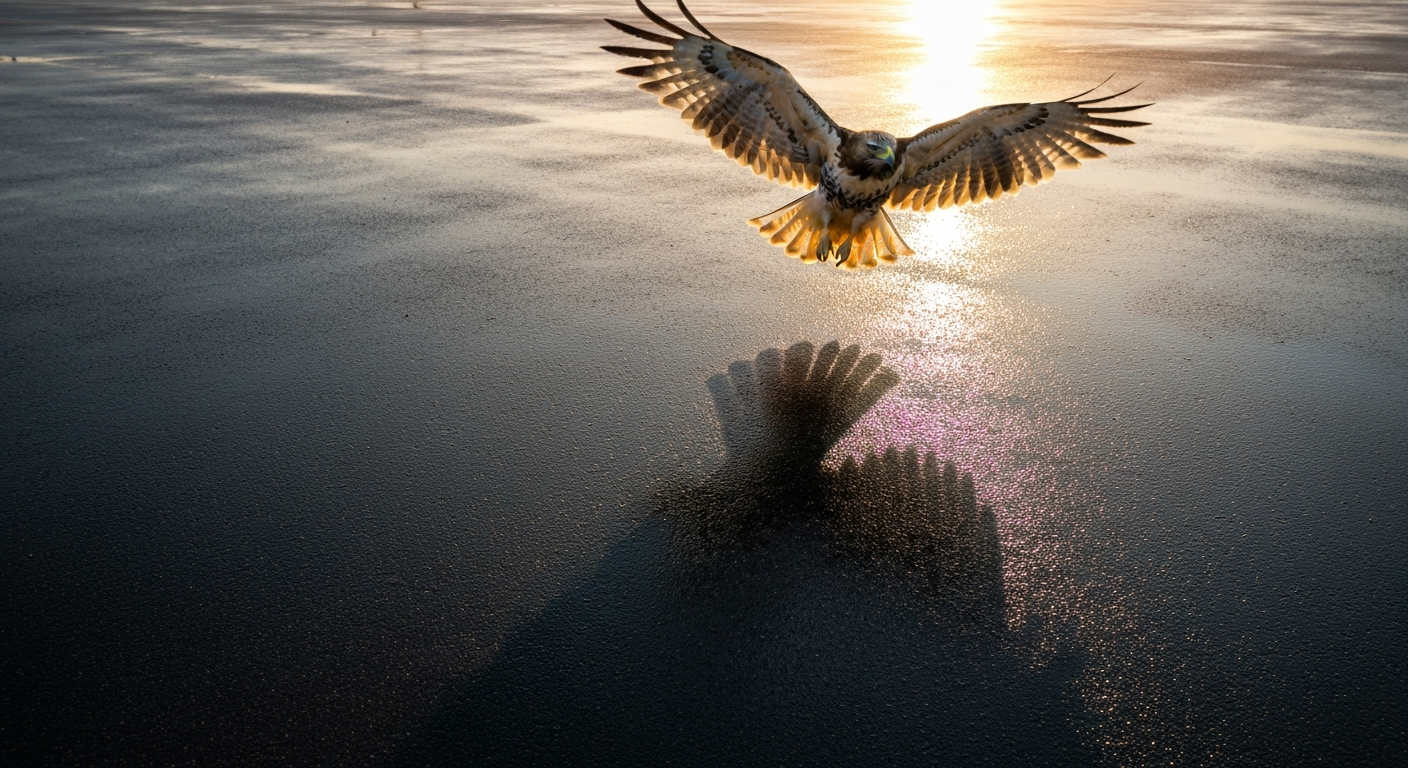
All of this is not to say bird shadows are always invisible. I have seen them clearly on several occasions, and the conditions were consistent every time. The bird was large (a red-tailed hawk or a great blue heron), it was flying low (within 10 to 15 meters of the ground), the surface below was smooth and dark (wet pavement after rain is ideal), the Sun was at a low to moderate angle, and the air was dry and clear. Common Sense Media's review of High Flying Bird offers a media-focused perspective on portrayals of high-flying birds and related themes. In that combination, a hawk banking low over a parking lot will throw a surprisingly crisp shadow that tracks across the asphalt and is briefly unmistakable.
Raptors hunting over open fields and low soaring birds over calm water are the most reliable opportunities. The water surface is smooth, has moderate albedo, and often provides strong contrast. A pelican or a large gull skimming just meters above the surface of a flat lake or calm estuary at golden-hour light is probably the single best scenario for a visible shadow. Birdwatchers and nature photographers who understand the geometry of apparent bird height (a concept explored more deeply in discussions of why a flying bird appears higher than it actually is) can use that knowledge in reverse to identify the rare moments when altitude and sun angle combine favorably.
Practical tips for spotting and photographing bird shadows
- Choose large species: herons, pelicans, hawks, and large gulls offer the biggest shadow footprints.
- Target low-flying birds: birds within 5 to 15 meters of the ground are the only realistic candidates for a visible umbra.
- Go out within two hours of sunrise or sunset: the low Sun casts the longest shadows and provides the most directional light.
- Seek smooth, dark, uniform surfaces: wet pavement, dark soil, and calm water are ideal; avoid gravel, grass, or any textured background.
- Avoid hazy or partly cloudy days: crisp shadows require direct, unscattered sunlight; haze kills shadow contrast fast.
- Use fast shutter speeds (1/1000 s or faster): this freezes both the bird and its shadow before motion blur destroys the contrast.
- Shoot in RAW format: preserves shadow detail that JPEG compression and in-camera processing often discard.
- Consider exposing slightly for the shadow: if the bird is your focus, a modest underexposure of the sky will lift shadow detail above the sensor noise floor.
- Watch for raptors hunting over parking lots or athletic fields: large paved areas with few obstructions give the shadow room to appear.
Why any of this matters beyond curiosity
Shadow visibility may seem like a niche puzzle, but it touches on real questions in avian biology and flight research. Birds themselves respond to shadows: prey species may detect an approaching predator's shadow before they see the bird, and raptors hunting over open ground are effectively shadow-casting objects whose visibility to prey is shaped by exactly the same optics discussed here. Flight altitude, wingbeat style, and approach angle all influence whether a hawk's shadow betrays it or not. The physics that makes shadows hard for us to see may, in some contexts, represent an adaptive pressure on hunting flight behavior.
For photographers and researchers using aerial imaging to study birds in flight, understanding how a bird's shadow projects onto the ground (and when it disappears) is also a calibration issue. Shadow-based methods for estimating bird altitude from photographs rely on the same solar geometry described above. Knowing the Sun's elevation angle, the ground surface type, and the camera's dynamic range allows a researcher to interpret or doubt the presence and shape of shadows in wildlife images with much greater rigor. The question that starts as idle wonder at the park turns out to have roots in optics, neuroscience, ecology, and avian biomechanics simultaneously.
FAQ
Concise answer: Why is a flying bird's shadow often difficult or impossible to see?
Because the sun is not a point source and produces soft-edged (penumbral) shadows, and because a bird's shadow is usually small, low contrast, blurred by motion and atmospheric scattering, and filled in by diffuse skylight and ground reflectance. Combined with human and camera limits (contrast sensitivity, exposure/dynamic range, motion blur), these factors make many flying-bird shadows too faint or smeared to detect.
How does the Sun's size make shadows soft instead of perfectly sharp?
The Sun subtends about 0.53° in the sky (a finite disk). Light from different parts of that disk reaches the ground along slightly different directions. That creates a central umbra (full shadow) only if the object blocks all rays, surrounded by a penumbra (partial shadow) where some rays still reach the ground. For a bird a few meters above ground, the Sun's angular size alone produces several centimeters of edge blur; higher altitude scales that blur proportionally (penumbra ≈ solar angular diameter × height).
What role does light geometry (umbra/penumbra) play for bird shadows specifically?
If a bird is low and large enough, a small umbra may form on the ground, but often the bird only produces a penumbra or a tiny umbral region. As altitude increases, the umbra can vanish and only a broad, very soft penumbra remains. Thus even geometrically produced shadows are blurred and less distinct than textbook sharp shadows from point sources.
How do skylight and atmospheric scattering affect shadow visibility?
Daylight includes a significant diffuse component from the sky (Rayleigh and aerosol scattering). Diffuse skylight fills into shadowed areas and raises their brightness relative to sunlit areas, lowering contrast. The diffuse fraction grows with solar zenith angle and with atmospheric aerosols, so shadows are weaker at low sun angles, with haze, or on overcast days.
How do ground surface properties influence whether you can see a bird's shadow?
Surface reflectance (albedo) and its angular behavior (BRDF) determine how much light is scattered into shadowed regions. High‑albedo or highly diffusing surfaces (e.g., snow, pale sand, rough concrete) fill shadows more and reduce contrast. Dark, matte, low‑reflectance surfaces (e.g., dry asphalt, short dark grass) preserve higher shadow contrast and make shadows easier to see.
How do bird size and height change the projected shadow on the ground?
The projected shadow size equals the bird's angular size from the ground. A small passerine (wingspan ~20–25 cm) at 10 m altitude projects a tiny shadow; a pigeon or gull is larger but still small unless flying very low. As height increases, the angular size shrinks and the penumbra width increases (edge blur ≈ 0.0093 × height in meters), so the shadow becomes both smaller and softer.
Next Articles
High Flying Bird Common Sense Media: Film & Bird Science
High Flying Bird, Common Sense Media–style review and plot/ending, plus clear science on why birds look higher or cast
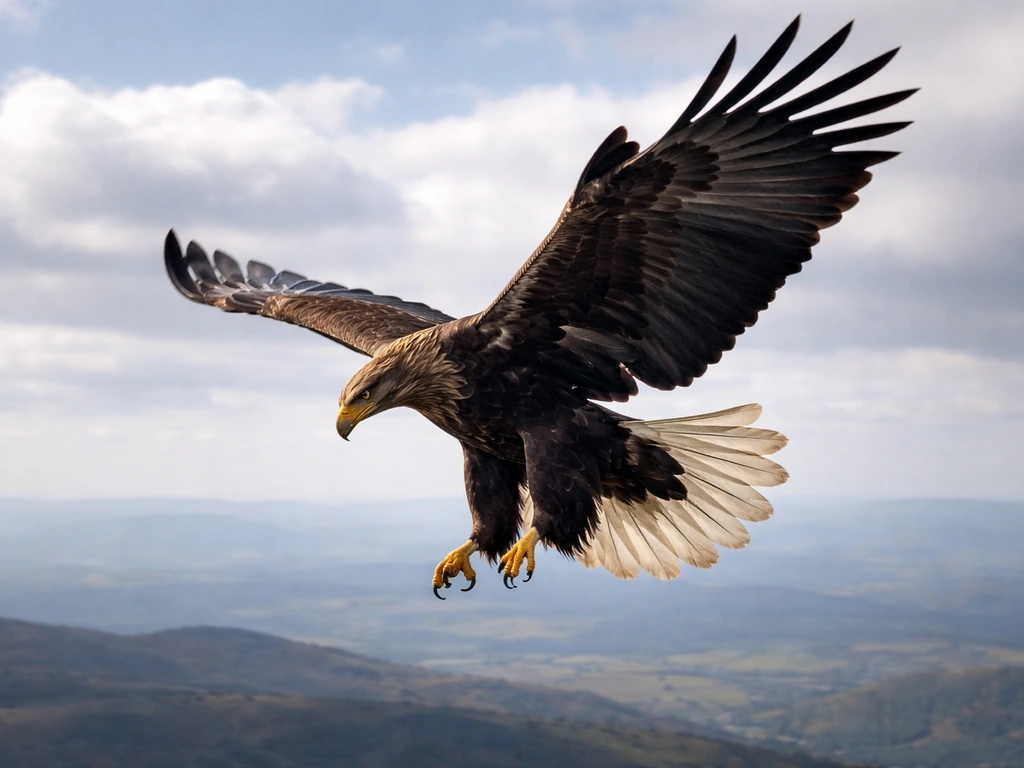
High Flying Bird Ending Explained: Literal Flight and Meaning
Disambiguate high flying bird ending: literal flight steps from lift to landing, plus story meaning and how to spot each
Bird Has Flown Meaning: Definition and How to Respond
Understand the bird has flown meaning, when it’s used, and how to reply with examples for real-life conversations.