A bird that looks like it's floating perfectly still in mid-air is almost always doing one of three things: beating its wings so fast the motion blurs into invisibility, leaning into a headwind with just enough wing adjustment to cancel its forward drift, or riding a column of rising air that does most of the work for it. Which one you're watching depends entirely on the species, the conditions, and sometimes the camera you're using to record it.
Bird Floating in Mid Air Explained: Hover vs Updrafts

Marcus Chen
11 May 2026
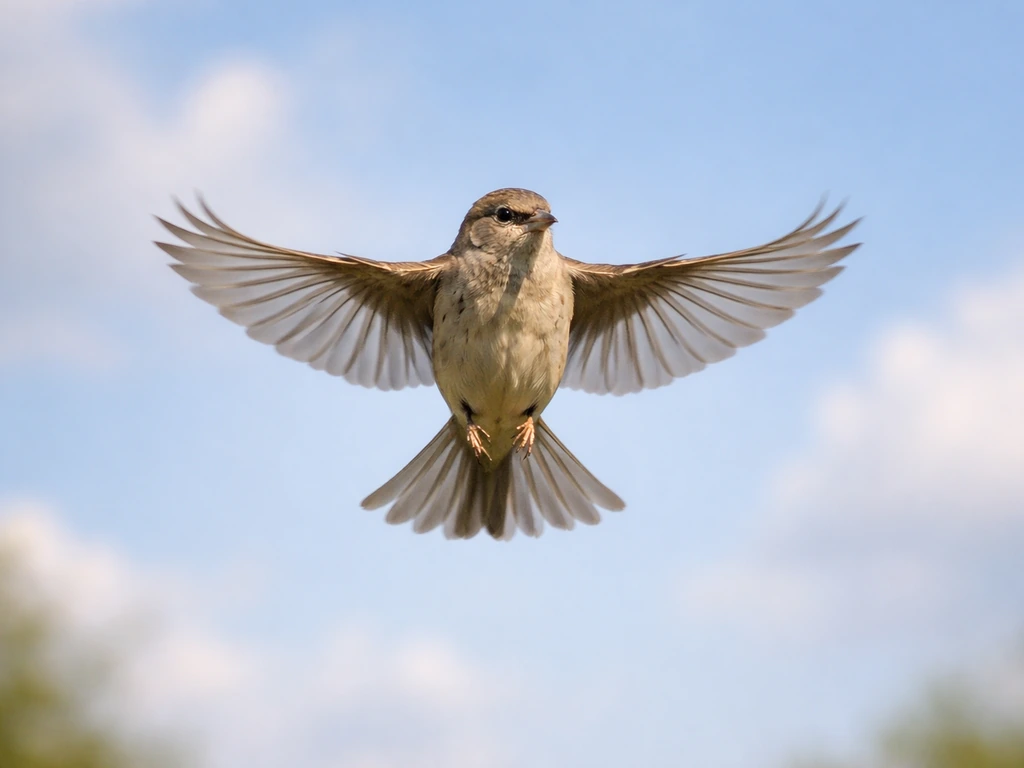
What people usually mean by 'bird floating in mid-air'
When people search for this, they're usually describing one of a handful of very different things that all look similar from a distance. It's worth naming them upfront so you can figure out which one you're actually seeing.
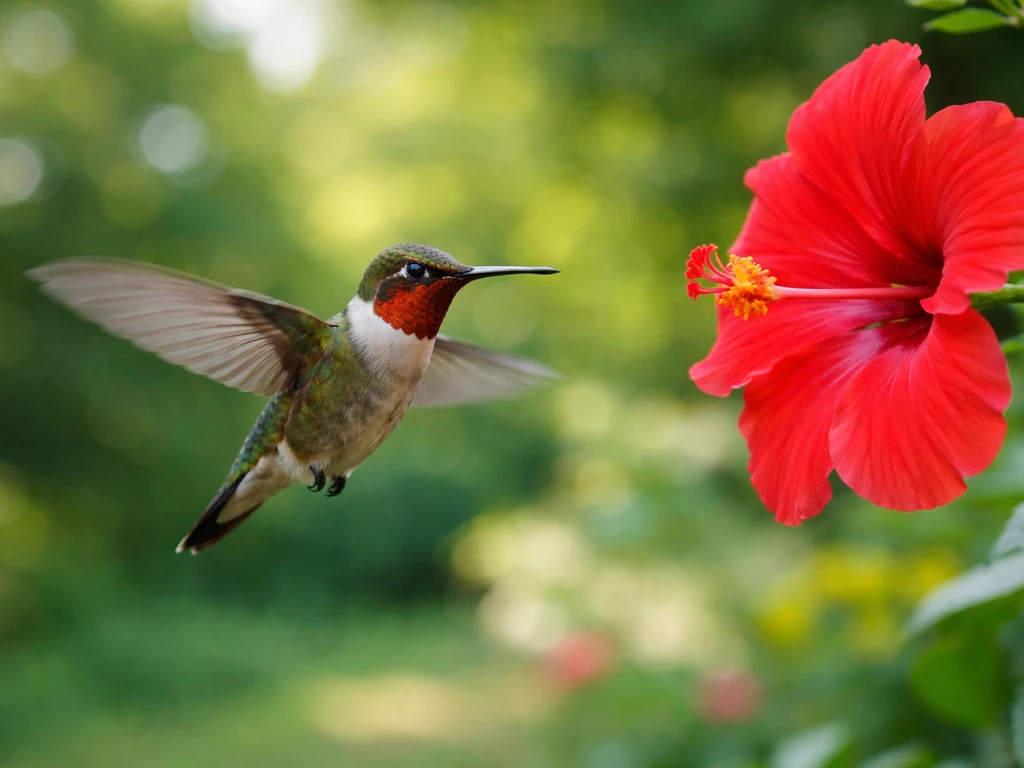
- A hummingbird hovering motionlessly in front of a flower or feeder, wings moving so fast they disappear
- A kestrel or hawk hanging in place over a field, facing into the wind with wings slightly spread and tail fanned
- A large soaring bird like a hawk or vulture that appears to freeze in a thermal, barely moving for minutes at a time
- A seabird or gull holding position in strong coastal wind, barely flapping at all
- A video or photo where a bird looks frozen mid-flap due to a camera artifact
Each of these has a completely different explanation. The hummingbird is doing something genuinely extraordinary and metabolically expensive. The kestrel is being clever and energy-efficient. The soaring hawk is essentially parasitizing the atmosphere. And the frozen video frame might be a camera illusion with no biology involved at all. Knowing which category you're in shapes everything that follows.
The physics behind hovering: lift, drag, and the wingbeat cycle
To hover, a bird has to generate enough upward lift to exactly cancel its weight, while also producing zero net horizontal force. That sounds simple, but it's actually one of the most demanding things a flying animal can do. Most of the lift during a typical wingbeat comes from the downstroke, when the wing moves forcefully downward and pushes air below. In rufous hummingbirds, blank" rel="noopener noreferrer">researchers have measured that roughly 75% of weight support happens on the downstroke and about 25% on the upstroke. That upstroke contribution is what makes hummingbirds special: they supinate the wing heavily during the upstroke so it generates lift rather than just recovering position, something most birds can't do effectively.
Drag always works against forward movement, but during hovering it actually helps stabilize the bird by resisting any drift. The bird has to continuously modulate both forces through wing shape changes, body angle, and the timing of each stroke. High-speed video and direct force measurements from labs like Stanford's Jasper Ridge preserve have shown that even tiny shifts in wing curvature and stroke plane angle change the lift-to-drag ratio significantly. There's no passive coasting in true hovering; every moment requires active correction.
For wind-hovering (what kestrels do), the physics is different. The bird faces directly into the wind and adjusts its airspeed to match the wind speed, so its ground speed drops to zero. It still needs to generate lift, but the wind is already providing a constant flow of air over the wings, so the bird doesn't need to flap nearly as hard or as fast as a hummingbird. Small adjustments to wing and tail shape maintain position rather than full powered strokes.
Which birds can actually hover, and how they do it
Hummingbirds: the only true hoverers
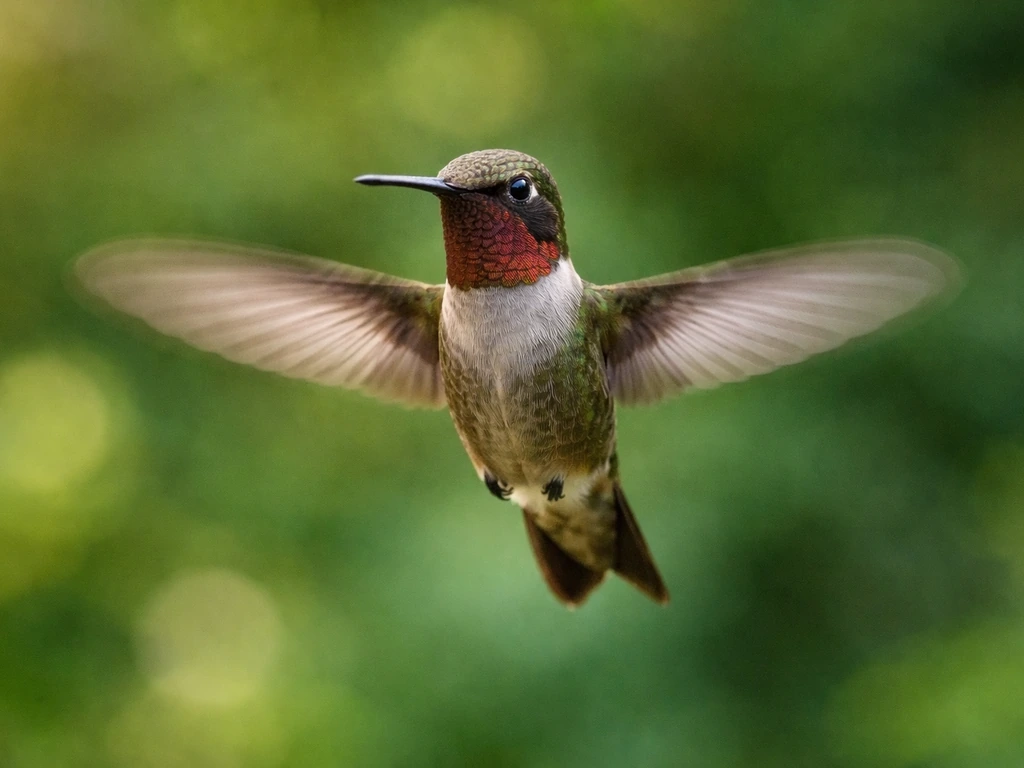
Hummingbirds are the only birds capable of sustained true hovering, meaning stationary flight under their own muscle power with no assistance from wind or updrafts.
The University of Montana's flight research summarizes why: hummingbirds have an exceptionally high wingbeat frequency (typically 20 to 80 beats per second depending on species, and up to around 90 per second during courtship displays in smaller species like the calliope), a massive ratio of flight muscle mass to body size, and a shoulder joint anatomy that allows nearly a full 180-degree rotation on each stroke. That rotation is what enables lift on both the downstroke and the upstroke.
The Smithsonian notes they evolved this ability specifically to access nectar sources other birds can't reach while stationary. Research published in the ornithology literature adds an interesting efficiency point: hovering actually lets hummingbirds move between flowers faster than a perching-and-moving strategy would, so despite the high energy cost, it pays off.
Kestrels and other wind-hoverers
The common kestrel is probably the most famous wind-hoverer, sometimes called a 'windhover' in older literature (Gerard Manley Hopkins wrote a famous poem about it). Kestrels don't hover the way hummingbirds do. Instead, they face directly into the wind and maintain a fixed position relative to the ground by using small, continuous adjustments of wing and tail shape rather than sustained rapid flapping.
Research published in the Journal of Experimental Biology in 2020 tracked the kinematics closely and found that during non-flapping wind-hovering, kestrels use morphing of the wing and tail, changing their curvature and spread to tune lift and drag in real time.
Wind tunnel experiments modeling this behavior have tested conditions with flow speeds of about 5 to 17 meters per second and turbulence intensity up to 15%, showing just how dynamic the environment can be even when the bird looks perfectly still.
Other species worth knowing
- American kestrels (North America's version of the European kestrel) use the same wind-hovering strategy and are frequently what people spot 'hanging' over roadsides and fields
- Rough-legged hawks and northern harriers regularly wind-hover while hunting, pausing to scan the ground below
- Ospreys hold briefly stationary before diving into water, using a combination of wind and short bursting wingbeats
- Kingfishers hover briefly over water in a rapid, choppy style before plunge-diving
- Terns and some gulls can kite in strong headwinds, appearing nearly motionless with barely any flapping
How birds control their position in real time
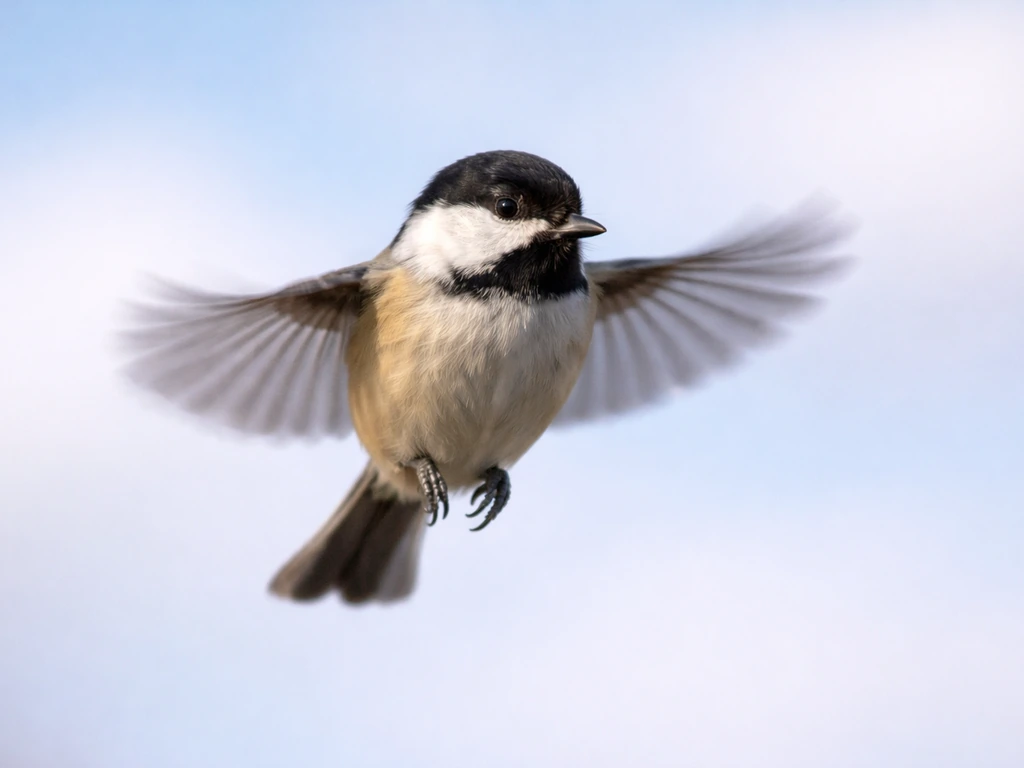
Holding a fixed point in the air is a continuous sensorimotor task, not a stable resting state. Birds use feedback from at least three systems simultaneously: their eyes (vision), their vestibular system (inner ear balance), and proprioceptors throughout the wings and body that detect changes in joint angles and muscle tension. Research published in Frontiers in 2017 on head stabilization in pigeons demonstrated how these systems work together to compensate for disturbances, with vision being particularly critical for correcting translational drift. A 2011 paper indexed on PubMed went further, showing that hovering hummingbirds actually use an aerodynamic trick during the downstroke to stabilize their visual field, essentially using their own wing motion to reduce image blur at the eye.
In practical terms, what this means is that a hovering bird is making dozens of micro-corrections per second that you can't see with the naked eye. The tail fans or narrows to adjust pitch. The wingtips spread or compress to change drag. The body angle shifts a degree or two to redirect the lift vector. In kestrels, the head stays nearly rock-solid relative to the ground even as the body rolls slightly in gusts, because stable head position is what keeps the visual lock on the prey below intact.
How the environment does the work: thermals, updrafts, and wind
A large fraction of 'floating' birds you see aren't hovering at all, biologically speaking. They're being carried or supported by the atmosphere itself. Thermals are columns of warm air that rise from sun-heated ground; a hawk circling inside one can gain altitude with nearly no flapping. When a thermal's upward velocity roughly equals the bird's sink rate, the bird appears stationary in altitude even while it slowly circles.
Orographic updrafts work similarly but are generated by wind deflecting upward off ridges, hills, or cliffs rather than by thermal heating. Research published in MDPI in 2026 on orographic updraft modeling shows how even a single hill can create a well-defined column of rising air that a soaring bird can exploit to hang in a very specific spot in the sky.
Black kites have been observed adjusting their soaring behavior at a fine spatial scale to match where updraft velocity is highest, essentially parking themselves in the most efficient column of air available. USGS research has confirmed that topography interacts with weather conditions to create predictable updraft zones, which is why you'll reliably see soaring birds 'hovering' in the same patches of sky above the same ridge lines day after day. This isn't coincidence or habit; it's the birds reading the invisible topography of the air.
Wind shear, where horizontal wind speed or direction changes with altitude, adds another layer. A bird flying into a headwind layer while descending slightly can appear to hang in place from the ground. The key environmental variables to check when you're trying to explain what you're seeing are: wind direction and speed at the bird's level, local terrain (is there a ridge, cliff, or heated surface below it?), and time of day (thermals build through mid-morning and peak in early afternoon on sunny days).
How to figure out what you're actually seeing, right now
Here's a practical workflow for identifying the hovering type you're watching. You can run through these steps in under a minute in the field.
- Check if the wings are moving at all. If you can see clear, visible wingbeats (even slow ones), the bird is actively flapping. If the wings are spread and mostly still, it's soaring or wind-hovering. If you can't see the wings clearly because they're blurred, you're likely watching a hummingbird or a very rapid flapper.
- Estimate wingbeat frequency if possible. Hummingbirds beat their wings so fast (20 to 80 times per second) that the wings are genuinely invisible to the naked eye and appear as a blur or halo. Kestrels flap at a much lower rate during wind-hovering and you can usually count the strokes. A very rough estimate: if you can count individual beats, it's not a hummingbird.
- Look at the tail. A fanned, spread tail held relatively still is a classic kestrel wind-hovering signature. A tail that's constantly twitching and adjusting indicates active position control in turbulent air. A tucked, swept tail suggests the bird is in a glide or thermal.
- Watch the body angle. A kestrel wind-hovering holds its body nearly horizontal with the head angled slightly down toward the ground to watch for prey. A hummingbird hovering in front of a feeder holds its body at roughly 45 degrees or more, nearly vertical. A soaring bird in a thermal has a much flatter, more horizontal body with wings held in a broad V or flat plane.
- Check the bird's position relative to a fixed landmark. Pick a tree, a fence post, or a rooftop edge and watch whether the bird drifts relative to it over 20 to 30 seconds. True hovering and wind-hovering maintain a near-fixed position. Thermal soaring involves slow, wide circles. A bird that's drifting slowly downwind while appearing to hang is kiting in the wind without fully compensating.
- Look at the environment. Is there a ridge or hillside upwind? That's an orographic updraft candidate. Is it a sunny afternoon with heated ground below? Thermal. Is there a strong, steady headwind? Wind-hovering is likely. Is the bird tiny and near flowers or a feeder? Hummingbird.
- If you have video, slow it down. Even smartphone slow-motion at 120 or 240 fps will reveal wingbeats invisible in real time. A camera whose frame rate happened to sync with the wingbeat will show what looks like a frozen bird; speeding up or slowing down the playback slightly will break the aliasing and reveal the true motion.
Quick comparison: hovering types at a glance
| Type | Example species | Wing motion visible? | Needs wind/updraft? | Energy cost | Key visual clue |
|---|---|---|---|---|---|
| True hovering | Hummingbirds | No (blur/halo only) | No | Very high | Wing blur, tiny body, near flowers/feeder |
| Wind-hovering (kiting) | Kestrel, rough-legged hawk | Yes, slow periodic flaps | Yes (headwind) | Low to moderate | Fanned tail, head angled down, faces wind |
| Thermal soaring | Vultures, buteos, eagles | No (wings spread still) | Yes (updraft) | Very low | Slow wide circles or near-stationary in column |
| Orographic soaring | Gulls, ravens, raptors | No or rare flaps | Yes (ridge lift) | Very low | Consistently above same ridge or cliff edge |
| Brief hovering/braking | Kingfisher, osprey, tern | Yes, rapid choppy flaps | Optional | Moderate | Short duration, directly above water or prey |
Myths and misinterpretations worth clearing up
The camera frame rate illusion
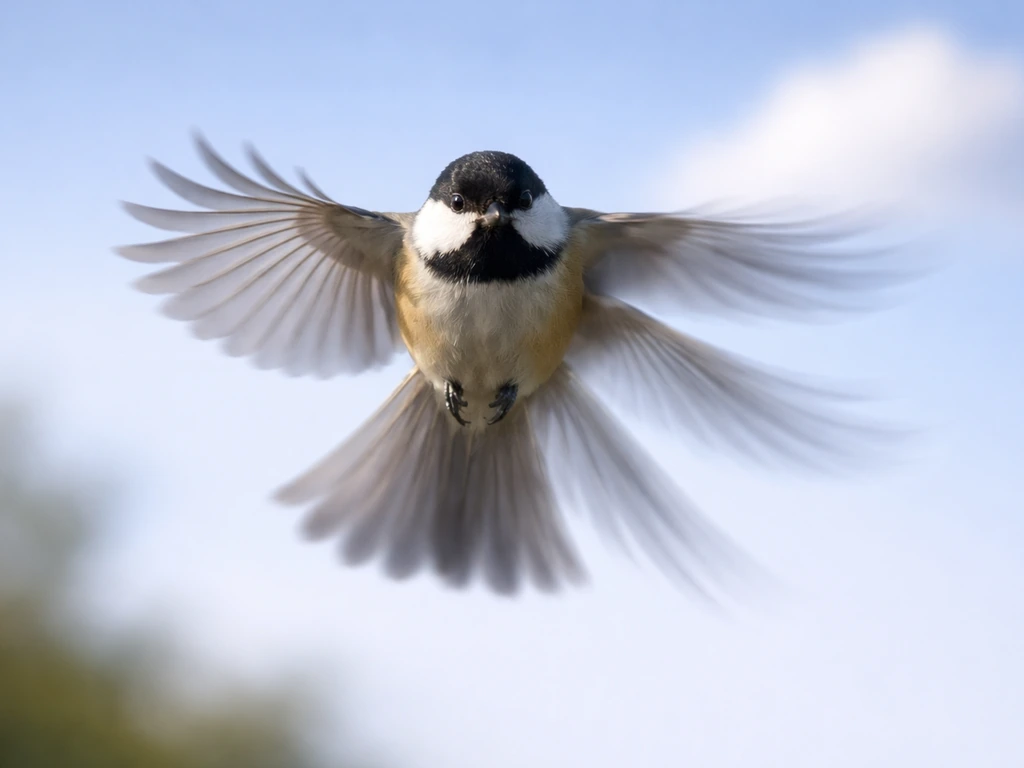
One of the most widely shared videos online of a 'floating bird' is actually a camera artifact. These “frozen bird” moments are often explained by the camera frame rate illusion, where wingbeats become hard to see. When a camera's frame rate happens to closely match a bird's wingbeat frequency, aliasing occurs: each new frame catches the wing in nearly the same position as the last, so the video looks like the bird is hovering with completely still wings.
This is the same stroboscopic effect behind the wagon-wheel illusion, where a wheel filmed at certain speeds appears to spin backwards or freeze. Colossal's coverage of this phenomenon showed exactly how striking the illusion can be. The fix is simple: if you have the original footage, play it at a different speed, look for the slight positional variation between frames, or check whether the bird's body shows any micro-oscillation. That kind of confusion is also why some videos online seem to show “flow animation” freezing what actually happened to the bird flow animation what happened to the bird.
A genuinely hovering bird still has slight body movement; a frozen-wing aliasing artifact tends to look unnaturally rigid.
Motion blur making a flapping bird look still
The opposite effect also happens: a slow shutter speed smears the wings into invisibility, making a bird that's actively flapping hard look like it's hanging serenely with no wing motion. Wildlife photographers deal with this constantly. Photography guidance consistently points to shutter speeds of at least 1/1600s to freeze fast wingbeats and 1/3200s or faster for hummingbirds. If you're looking at a still photo and the wings are perfectly invisible or uniformly blurred, the image may simply not have the resolution to show you what the bird was actually doing.
Parallax and distance
A bird flying in a large arc or wide circle can appear stationary if you're looking at it from far away and roughly along the axis of its path. This is a parallax effect: the bird is moving, but its angular position from your viewpoint barely changes. Coastal observers often notice this with distant gannets or pelicans flying slowly in a straight line directly toward or away from them. The fix here is to change your own vantage point slightly or wait; within 30 seconds the true direction of travel becomes obvious.
'Birds can float because of some mysterious force'
Occasionally this search comes from someone who's genuinely puzzled that physics allows it at all, rather than assuming magic. The answer is that there's nothing mysterious happening: birds generate lift by moving air downward faster than gravity pulls them down. What makes hovering look magical is how precisely birds balance those forces in real time, using a sensory feedback system that rivals the best stabilization software in modern drones. The engineering is breathtaking, but it's entirely mechanical. The 'frozen in place' quality is a product of continuous, rapid, invisible work, not the absence of effort.
Confusing hovering with the 'Flow' movie bird behavior
If you've been watching the animated film 'Flow' and found yourself here trying to explain something the bird character does, you're not alone. The film uses flight behavior symbolically and stylistically in ways that don't always map cleanly to biology. The bird's apparent floating or departure scenes are worth examining on their own terms as storytelling, which is a separate thread from the biomechanics.
The biology described here is the real-world foundation; what 'Flow' does with it is a different kind of explanation. If you meant the specific “flow animation what happened to the bird” clip, it helps to separate the movie's stylistic effect from the real physics of hovering and wind-hovering. If you want the real mechanism behind that illusion, the flow of air over the wings is the key part of the story Flow movie bird behavior. That flow is shaped by wingbeat timing and by the surrounding wind, which is why the same bird can look like it is floating even when the forces are constantly changing flow of air over the wings.
FAQ
How can I tell in the field whether a bird is truly hovering versus riding a rising updraft or thermal?
Look for altitude behavior over time: a true hovering bird will keep nearly the same ground position even as it changes wingbeat intensity, and you will often see small pitch and tail corrections. A soaring bird in a thermal may hold its altitude relative to the sky but typically drifts in a circle or adjusts its track to stay inside the strongest updraft, so its lateral motion relative to a fixed landmark becomes noticeable if you watch longer than a few seconds.
Can a bird “hover” in place in strong wind without looking like it is flapping hard?
Yes, but it depends on the type of hovering. Wind-hoverers like kestrels can appear relatively still because they tune lift and drag using wing and tail shape rather than relying on continuous rapid downstrokes. If the bird’s head remains locked to a prey target while the body makes subtle banking motions, that pattern often indicates wind-hovering rather than buoyant soaring.
Why do some videos show a bird with completely frozen wings even though it obviously should be beating?
That is commonly a frame-rate aliasing or shutter-related artifact, where the camera timing matches the wingbeat cycle or smears motion so the wing motion becomes invisible. A practical test is to play the clip back at a different playback speed and check whether the bird’s body shows micro-oscillations, which real hovering usually includes even when wings look frozen.
If I have only a still photo, what is the best way to avoid misidentifying hovering?
First check whether the wings are genuinely sharp or if they are uniformly blurred or invisible. A genuinely powered hover usually leaves some evidence of wing motion, even if you cannot see individual feathers. Second, compare the bird’s head stability to the apparent wing state, because a wind-hoverer may show a steadier head relative to the ground while the wing trace is hard to resolve in low shutter speeds.
Do hummingbirds really hover without any help from wind or updrafts?
They are the only birds known for sustained true hovering powered entirely by muscle, but they can still benefit from conditions. In real settings, light breezes or slight updrafts can reduce required effort, making hovering look easier. If you see a hummingbird holding position with high wingbeat frequency and continuous control, that is consistent with true hovering, but subtle environmental help is still possible.
What environmental cues should I check first when trying to explain a “bird floating in mid air explained” moment?
Start with wind direction and strength at the bird’s height, then check the nearest terrain features (heated ground, ridges, cliffs) and the time of day. Thermals are most likely mid-morning through early afternoon on sunny days, while ridge-related updrafts can appear more consistently when wind is blowing across the landform. If you see repeating “patches” where multiple birds linger, updraft structure is a strong clue.
Is parallax a common reason birds look motionless in videos?
Yes, especially when the bird is far away and you are roughly aligned with its path. If the bird is traveling along an axis toward or away from you, its angle from your viewpoint changes slowly, so it can appear stationary. Changing your viewing angle slightly, or waiting until it turns or crosses your line of sight, usually reveals the true motion quickly.
How does “head stability” help distinguish wind-hovering from other explanations?
Wind-hovering often includes visual targeting, so the head stays comparatively steady relative to the ground while the wings and tail make continuous small adjustments. In contrast, if the bird is mostly being carried by rising air, you may see more coherent drifting of the whole body track, and the bird might circle inside the updraft rather than maintain a fixed point for long periods.
Can wind shear make a bird look like it is hanging in the air even if it is not hovering?
Yes. If wind speed or direction changes with altitude, a bird can match its descent rate through the control of airspeed and lift, producing the illusion of fixed altitude from the ground. The tell is that the bird’s horizontal motion and track may still show subtle drift, and its position relative to landmarks may not remain perfectly constant over longer observations.
What are the most common mistakes people make when concluding “hovering” from a single observation?
The most common are relying on distance and angle (parallax), assuming that still wings in a video imply biology (aliasing), and ignoring the surrounding environment (wind and terrain). Another mistake is treating all “stationary” behavior as the same, when hovering, wind-hovering, and updraft riding have different control patterns you can sometimes detect with a few extra seconds of watching.