Bird flight patterns are not random. Every dip, spiral, tight formation, and hovering pause reflects a specific aerodynamic strategy, a behavioral need, or both. When you watch a vulture circle lazily over a field, a starling flock ripple like liquid smoke, or a hawk dive at a steep angle, each of those patterns has a physical explanation rooted in wing anatomy, air physics, and millions of years of evolutionary pressure. This guide walks you through the science behind those patterns, explains the ecological reasons birds fly the way they do, and gives you the tools to interpret what you are actually watching when a bird flies toward you, carries a snake, or leads a flock in a V.
Bird Flight Patterns Meaning: Interpreting Flight Behavior

Marcus Chen
29 Jul 2026
What bird flight patterns can actually tell you
Flight patterns encode information on at least three levels. At the biomechanical level, a pattern reflects what a bird's body can physically do given its wing shape, muscle mass, and body weight. At the ecological level, it reflects what the bird needs to accomplish right now: reach a food source efficiently, escape a predator, attract a mate, or conserve energy during a 3,000-kilometer migration. At the cultural level, humans have layered additional meaning onto these patterns for thousands of years, from Roman augury to modern poetry. This article is aimed at birdwatchers, biology students, and anyone who has paused outside and genuinely wondered: why does that bird fly like that? You don't need a physics degree, but by the end you'll be using terms like aspect ratio and thermal soaring the way they were meant to be used, grounded in observation.
The four forces that govern every wingbeat
Before you can interpret a flight pattern, it helps to know the four aerodynamic forces acting on any flying bird at any moment. Lift is the upward force generated when air moves faster over the curved top surface of a wing than under the flat bottom surface, creating lower pressure above. Thrust is the forward force produced mostly by the downstroke of the wing, pushing air backward. Drag is the resistance the bird's body and wings experience moving through air, and it comes in two flavors: profile drag (friction and pressure on the wing surface) and induced drag (a byproduct of generating lift). Weight is gravity pulling the bird down. Every flight style is essentially a different strategy for balancing these four forces under different conditions, and a bird's anatomy determines which strategies are available to it.
Two numbers predict a bird's flight style more reliably than almost any other measurement. Wing aspect ratio is wingspan squared divided by wing area: a long, narrow wing (high aspect ratio) is efficient at speed and over long distances. Wing loading is body mass divided by wing area: a heavy bird relative to its wing area must fly fast to stay airborne and cannot maneuver as tightly as a lighter bird. An albatross has a very high aspect ratio (around 15 to 18) and glides over oceans with almost no flapping. A forest warbler has a low aspect ratio and low wing loading, giving it the tight, nimble maneuvering it needs to chase insects through undergrowth. These relationships, formalized in Pennycuick's flight-performance models, connect wing geometry directly to the patterns you observe in the field.
Wing anatomy and the biomechanics that produce different flight styles
A bird's wing is a modified forelimb. The bones correspond roughly to your own arm: a humerus at the shoulder, a radius and ulna in the mid-wing, and fused wrist and hand bones (the carpometacarpus) at the tip. Authoritative anatomical nomenclature and labeled diagrams of the avian wing skeleton and flight musculature are collected in the Handbook of Avian Anatomy: Nomina Anatomica Avium (Julian J. Baumel, 2nd ed.) Authoritative anatomical nomenclature and labeled diagrams of the avian wing skeleton and flight musculature are collected in the Handbook of Avian Anatomy: Nomina Anatomica Avium (Julian J. Baumel, 2nd ed.).. The primary feathers attach to those hand bones and do the heavy aerodynamic lifting during the downstroke. The secondary feathers attach to the ulna and create the inner wing surface responsible for most of the lift. A small structure at the leading edge called the alula acts like the slats on an airplane wing, reducing stall at low speeds, which is why you see birds extend it during slow landing approaches.
The two dominant flight muscles sit on the deep keel of the sternum (the carina). The pectoralis, the large breast muscle familiar from any chicken, powers the downstroke and is the primary source of thrust and lift. Directly beneath it, the supracoracoideus powers the upstroke via a tendon-pulley system that passes through a foramen (hole) in the shoulder girdle, much like a rope over a pulley, allowing an upward pull despite the muscle lying below the wing. In strong fliers like pigeons, flight muscles can account for 25 to 35 percent of total body mass. The relative size of these two muscles, plus the fiber composition (fast-twitch vs. slow-twitch), directly determines whether a bird can sustain rapid hovering or is built for occasional bursts of flapping between glides.
Key wing and skeletal structures at a glance
| Structure | Location | Primary Function | Flight Relevance |
|---|---|---|---|
| Humerus | Upper arm / shoulder joint | Main wing strut; muscle attachment | Angle determines wing sweep and stroke arc |
| Radius and ulna | Mid-wing (forearm) | Support secondary feathers | Inner wing lift surface |
| Carpometacarpus | Wrist and fused hand bones | Support primary feathers | Controls tip shape, thrust generation |
| Alula (bastard wing) | Leading edge near wrist | Reduces stall at low speeds | Critical for slow flight and landing |
| Furcula (wishbone) | Shoulder girdle | Spring-energy storage and chest expansion | Helps power the wingbeat cycle |
| Carina (sternal keel) | Chest sternum | Attachment for flight muscles | Larger keel generally means stronger flier |
| Pectoralis muscle | Below carina | Powers the downstroke | Primary source of thrust and lift |
| Supracoracoideus muscle | Below pectoralis | Powers the upstroke via pulley tendon | Essential for hovering and fast takeoff |
Wind-tunnel studies using high-speed video and particle image velocimetry (a technique that maps the movement of tiny airborne particles to visualize airflow) have shown that the wake a bird leaves behind changes shape depending on its speed. At slow speeds, birds shed discrete vortex rings with each wingbeat. At higher speeds, they shed a continuous pair of trailing vortices, more like a fixed-wing aircraft. This gait change is functionally analogous to a human shifting from walking to running, and it is one reason the same bird can look very different in flight at different moments.
The main flight styles and how each one works
Ornithologists formally classify bird flight into a set of distinct modes, each with its own kinematics and aerodynamic logic. In practice, most birds mix these modes depending on speed, energy budget, and task, but understanding each one separately makes field observation far more coherent.
Flapping flight
Continuous flapping is energetically expensive but gives the bird maximum control over speed and direction. Ducks, geese, and swans rely heavily on it because their high wing loading means they need to keep generating lift actively. The downstroke generates both lift and thrust; the upstroke in most birds is more of a recovery stroke, though in hummingbirds the upstroke contributes meaningful lift as well.
Gliding
A gliding bird holds its wings extended and fixed, trading altitude for forward speed. The glide ratio (horizontal distance covered per unit of altitude lost) depends on the lift-to-drag ratio, and high aspect ratio wings maximize this ratio. A common buzzard gliding in still air loses roughly one meter of altitude for every ten meters it travels. Gliding between flapping bursts is how many species reduce energy costs during long flights.
Soaring
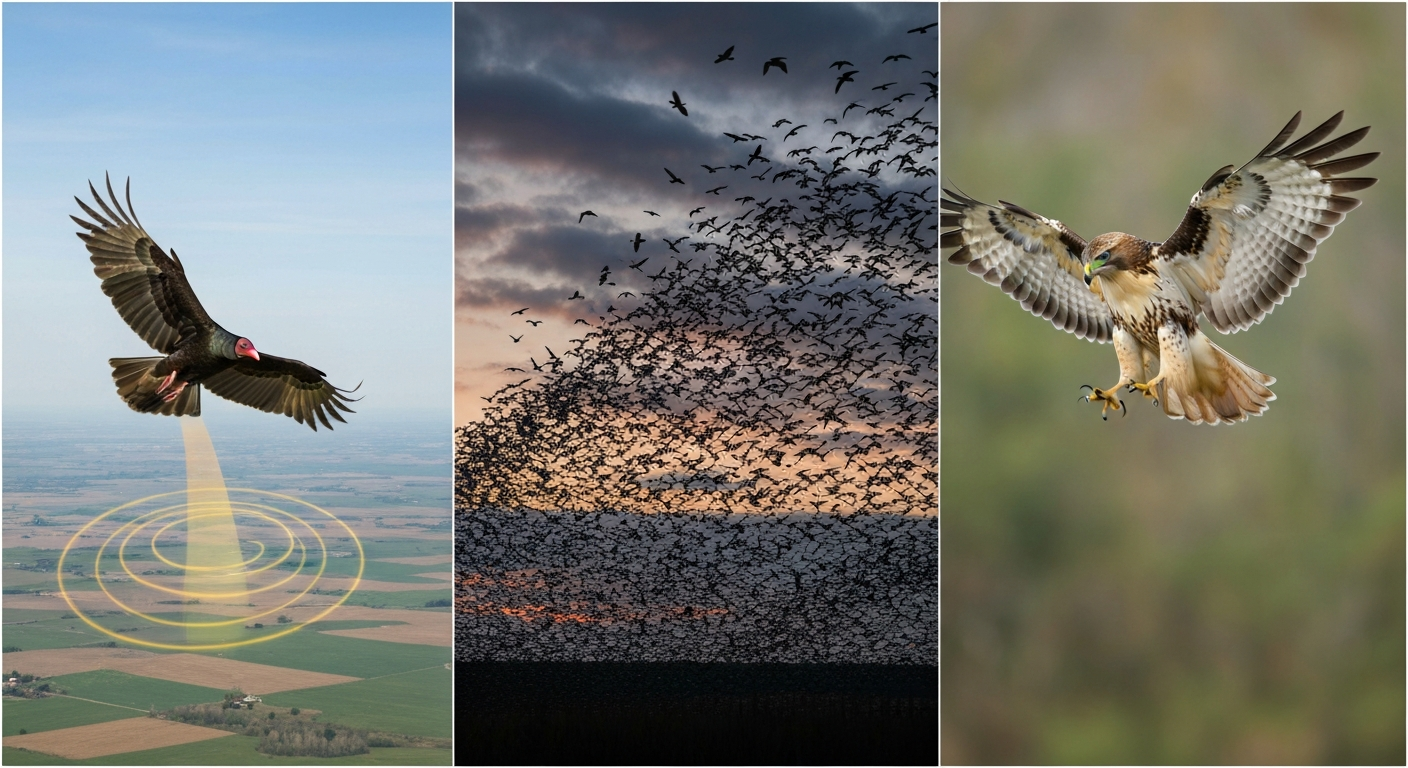
Soaring means gaining or maintaining altitude without flapping, by exploiting rising air. Thermal soaring, used by vultures, storks, and many eagles, involves circling inside a column of warm rising air (a thermal) until the bird has gained enough altitude to glide toward the next thermal. The circling radius is constrained by wing loading and the strength of the thermal: heavier birds with higher wing loading need stronger thermals and make wider circles. Dynamic soaring, used by albatrosses and petrels over open ocean, is a different mechanism entirely. The bird repeatedly dips toward the slow-moving air near the water surface, then arcs upward into the faster wind above, extracting energy from the wind shear gradient and flying indefinitely without flapping. GPS and accelerometer studies have confirmed that albatrosses can cover hundreds of kilometers this way with virtually zero active energy expenditure.
Hovering
True hovering, sustaining a fixed position in still air, is metabolically brutal. Hummingbirds are the best-known examples, and they achieve it through an unusually symmetrical wingbeat in which both the downstroke and upstroke generate lift (roughly 75 percent on the downstroke, 25 percent on the upstroke, according to particle image velocimetry studies). Their wings rotate at the shoulder through nearly 180 degrees per stroke, and their wingbeat frequencies range from around 12 beats per second in the largest species to over 80 in the smallest. Leading-edge vortices, the same mechanism used by insect wings, contribute to the lift generation. Kestrels hover too, but they cheat slightly by facing into the wind and using it to offset their forward motion, reducing the muscular demand compared to a hummingbird in still air.
Undulating and bounding flight
Many small passerines like finches, woodpeckers, and sparrows use intermittent flight gaits. In flap-glide flight, the bird alternates flapping bursts with short glides, producing a shallow wave. In flap-bound (bounding) flight, the bird folds its wings completely against its body during the rest phase, creating a pronounced roller-coaster trajectory. Studies suggest that bounding flight allows small birds to operate their flight muscles at near-optimal mechanical efficiency: the muscles work at high power during the flapping burst, then rest completely, rather than working continuously at a lower and less efficient power level. The characteristic bobbing flight of a woodpecker is a reliable field identification cue precisely because of this biomechanical logic.
Why birds fly the patterns they do: ecology and behavior
Aerodynamics sets the limits; ecology fills in the details. The same bird species may fly very differently depending on whether it is migrating, foraging, courting, or fleeing a predator.
Migration
Long-distance migrants are essentially living fuel-management systems. Optimal migration theory, developed by researchers like Thomas Alerstam, predicts that time-selected migrants should minimize time by maximizing fuel-deposition rate at stopovers and departing with large fuel loads, while energy-selected migrants should minimize total energy spent. Optimal migration theory links fuelling rates, fuel loads, stopover duration and time‑ versus‑energy minimization strategies (Alerstam & Hedenström) Optimal migration theory links fuelling rates, fuel loads, stopover duration and time‑ vs energy‑minimization strategies.. These different strategies produce measurably different flight patterns: time-selected birds fly at higher speeds, with fewer stopovers, while energy-selected birds rest more and travel slower. Navigation draws on multiple cue systems: a light-dependent magnetoreceptor in the retina (using cryptochrome proteins and a quantum-mechanical radical-pair mechanism) provides compass information; star and sun compasses supplement it; and olfactory cues help in some species. Continent-scale radar networks, processed with algorithms like vol2bird, now let researchers track millions of migrants at once and measure flight directions, altitudes, and speeds.
Foraging
Flight patterns during foraging are shaped by what the bird is hunting and where it is. A kestrel hovers over an open field using its ultraviolet-sensitive vision to detect vole urine trails invisible to us. A barn swallow traces erratic, fast-turning arcs through the air, matching the unpredictable flight of insects. A gannet climbs to around 30 meters and then folds into a near-vertical dive at over 90 kilometers per hour, using the kinetic energy of the plunge to reach fish that other birds cannot access. Each of these foraging patterns is a direct expression of wing shape, visual ability, and prey ecology.
Mating displays
Many species use flight itself as a display. A displaying male common snipe climbs high and then dives with spread outer tail feathers, which vibrate in the airflow to produce a haunting mechanical bleating sound called drumming. Male woodcocks perform a slow, fluttery roding flight at dusk, tracing the same circular route repeatedly above woodland to advertise territory. Displaying raptors perform undulating sky-dances, roller-coaster trajectories of steep climbs and drops that appear to test aerobatic capability and signal fitness. In these cases the flight pattern is communicative, not just locomotory.
Predator avoidance
When a small bird detects a predator, it does not simply flee in a straight line. Erratic, unpredictable flight paths are harder for a pursuing hawk to intercept because the hawk must constantly update its interception vector. Some shorebirds exploit their shiny, dark-and-light-flashing wings during escape flights, creating a visual flicker that may briefly disorient a predator. Flocking itself is one of the most effective anti-predator flight strategies, as discussed below.
Thermals, territorial signaling, and energy budgeting
Soaring birds often circle at territory boundaries, using altitude as a dominance signal visible to competitors kilometers away. Buzzards and red kites regularly soar over their home ranges without any foraging intent, appearing to advertise presence. Studies using GPS data loggers on vultures have shown that juveniles are significantly less efficient at thermal soaring than adults: they enter thermals at suboptimal angles, circle with less precision, and leave thermals earlier, behaviors that carry real energetic costs. This kind of biologging research, using miniaturized GPS units, tri-axial accelerometers, and machine-learning classification of behavioral states, has transformed our understanding of how flight patterns relate to daily energy budgets.
Flock dynamics: V-formations, murmurations, and circling groups
Group flight is one of the most visually striking categories of flight pattern, and it has two very different causes depending on whether the birds are in a structured formation or a reactive mass.
V-formations and energy savings
When large birds like geese, pelicans, or ibis fly in V or echelon formations, each bird except the leader is positioned to exploit the upwash (rising air) generated by the wingtip vortex of the bird ahead. GPS and heart-rate logger data from northern bald ibis have demonstrated that birds in formation positions have measurably lower heart rates than birds flying solo, confirming real energy savings. The birds also synchronize their wingbeat phase with the bird ahead to maintain the optimal upwash position, which requires active monitoring and adjustment. The lead position is rotated among flock members, distributing the cost of being out front.
Murmurations and collective anti-predator behavior
Starling murmurations are the result of each bird following a small set of local interaction rules, primarily: match the speed and direction of your nearest six or seven neighbors, maintain a minimum separation distance, and align with the flock center. No leader directs the shape. The result is a self-organizing system that responds to perturbations (a falcon attack, for instance) with wave-like turning maneuvers that propagate through the flock at speeds faster than any individual bird's reaction time. The flock's fluid, unpredictable shape makes it very difficult for a predator to single out and target an individual, which is the functional explanation for the behavior. The question of why flocks fly in circles specifically is closely tied to these predator-response dynamics and to pre-roost staging behavior as birds assess safe landing sites. For a focused explanation that combines thermal physics, anti-predator dynamics, and collective decision-making, see why do bird flocks fly in circles.
Circling flocks and what they usually mean
When you see a group of birds circling, context is everything. A loose group of large birds circling silently over open country is almost certainly thermaling: they are riding a column of rising warm air and gaining altitude for free. A tight, swirling flock of smaller birds near trees at dusk is likely a pre-roost gathering, where birds aggregate before selecting a safe communal roost site. A circling group mobbing a perched owl is doing something else entirely, using flight to harass a predator and drive it away. The wing shape of the circling birds, the time of day, and the habitat will usually let you distinguish between these three scenarios.
When a bird flies toward you: what is actually happening
A bird flying directly toward you is startling and has accumulated layers of cultural meaning across many traditions, some treating it as an omen, others as a message from the dead. Before reaching for symbolism, it is worth running through the biological causes, which are both more common and more interesting. For a quick, practical guide to why a bird might approach, see bird flying towards you meaning.
The most frequent cause is simply that you are in the bird's flight path and it has not yet registered you as a threat. Birds optimize their routes between food sources, roost sites, and territories, and those routes often cross areas where humans walk. A bird flying directly toward you and then veering off at the last moment was not targeting you; it was following a habitual flight line and adjusted when you resolved as a distinct object in its visual field. Robin redstarts, for example, regularly use the same perch-to-perch routes in gardens and will approach a person to within a few meters before noticing them.
A second cause is territorial or curious behavior. Some species, particularly robins, wrens, and certain raptors, will actively approach large animals including humans when near a nest or a favored feeding area. This is not directed aggression in most cases but investigatory behavior. Robins in particular have evolved to associate large foraging mammals with disturbed soil that reveals invertebrates, so approaching a human digging a garden is a foraging tactic, not a supernatural visitation. A third cause, less common, is genuine defensive flight: some ground-nesting species will use distraction displays that include flying low and directly toward a perceived threat before veering away to lead it from the nest. A lapwing or killdeer doing this is performing a broken-wing display, and the approach flight is intentional misdirection.
| Scenario | Behavioral Cause | What to Look For |
|---|---|---|
| Bird flies at you and veers last second | Habitual flight path, did not see you | Bird continues on its trajectory after passing you |
| Bird repeatedly circles and approaches | Territorial investigation near nest | Alarm calls, repeated returns, nearby dense vegetation |
| Small bird approaches while you dig or walk | Foraging association with large mammals | Bird watching the ground, not you; lands nearby after approach |
| Low, erratic approach by ground-nesting bird | Distraction display / broken-wing lure | Bird drops wing, moves away from a specific ground spot |
| Raptor stoops toward you | Nest defense (e.g., nesting red kites, ospreys) | Breeding season, near large nest structure, repeated passes |
The cultural tradition of reading meaning into a bird flying toward you is ancient and widespread, from Roman augurs who interpreted bird flight directions as divine signals to Celtic and Native American traditions where certain birds carried spiritual messages. These interpretive frameworks have genuine historical and anthropological interest. Scientifically, however, the direction a bird happens to fly relative to a human observer is not causally related to future events; it is the outcome of the bird's own navigation, energy management, and behavioral state at that moment.
Birds carrying or interacting with snakes: predator, transport, or mob?
Few sights in birdwatching are as dramatic as a large raptor carrying a snake in flight, and it triggers the same interpretive instinct as a bird flying toward you: surely this means something? Again, the behavioral explanation is both clear and fascinating.
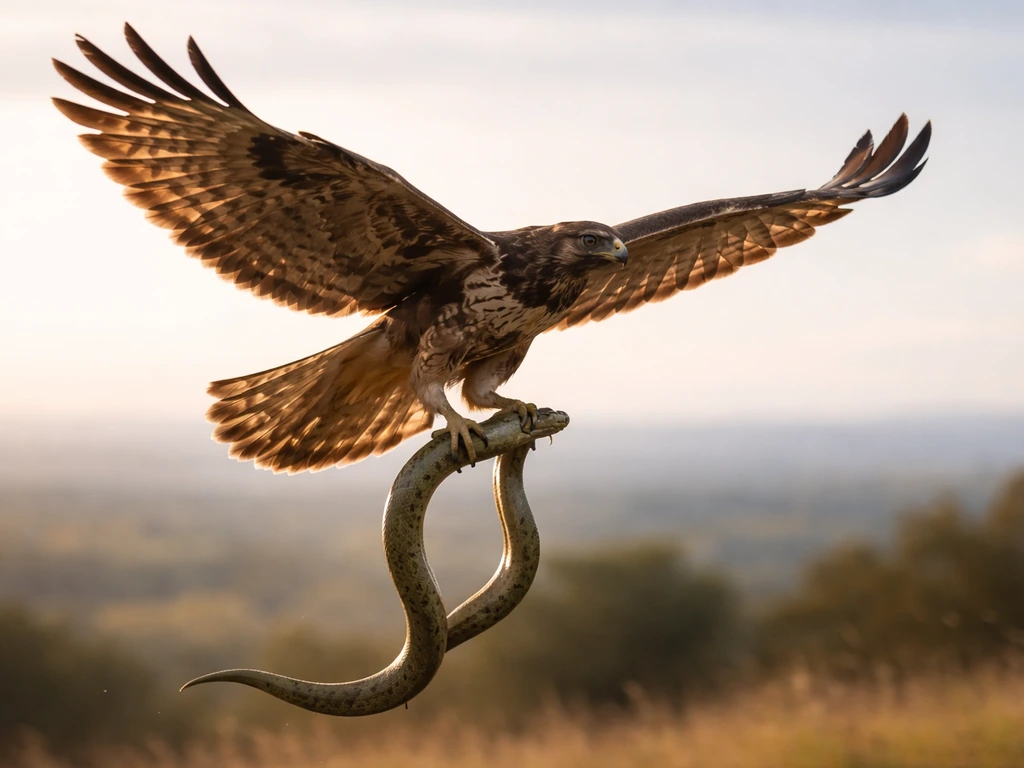
For raptors, snake-carrying is almost always predatory transport. For cultural and symbolic interpretations as well as traditional meanings of a bird flying with a snake, see bird flying with snake meaning. The short-toed snake eagle of Eurasia and Africa specializes in snakes almost exclusively, carrying them in its talons or sometimes in its bill, back to a nest or a favored eating perch. Secretary birds in Africa have a different technique: they use their long legs to stomp snakes into submission on the ground before taking flight. Ospreys carry fish rather than snakes, but the aerial transport mechanics are the same: prey secured in talons, carried with the body oriented parallel to the bird's direction of flight to reduce drag. A snake hanging from a bird's talons aerodynamically functions like any elongated payload, and experienced observers note that long snakes are often manipulated mid-flight to a more compact configuration.
A second category is mobbing. Small and medium-sized birds, from crows to mockingbirds to blackbirds, will mob snakes on the ground or in vegetation, dive-bombing and harassing them to drive them away from nest sites. This is the same behavioral mechanism as mobbing a perched owl, and the flight patterns are similar: repeated low passes, alarm calling, and coordinated attacks from multiple individuals. The snake is not being transported; the birds are attempting to drive it out of territory.
A third, rarer scenario is accidental entanglement. There are documented cases of birds, typically egrets or herons, catching a snake while foraging and then taking flight with it still writhing, creating the impression of deliberate transport. The snake may bite back, and dramatic aerial struggles have been photographed and widely misinterpreted as supernatural omens in various traditions. The mundane reality is a heron that misjudged its lunch.
- Large raptor (eagle, kite) carrying snake in talons: almost certainly active predation, transporting prey to a nest or feeding perch
- Multiple small birds diving repeatedly at a snake in vegetation: mobbing behavior, defensive nest protection
- Wading bird (heron, egret) airborne with snake: likely accidental mid-flight struggle after a foraging catch
- Snake hanging from a bird of prey during breeding season: may be food being delivered to a mate or chicks at a nest
How to observe and record flight patterns yourself
You do not need expensive equipment to start building a meaningful picture of local flight patterns. Binoculars with a magnification between 8x and 10x and a wide field of view are more useful than a spotting scope for tracking moving birds. For photography, a camera with a burst mode and continuous autofocus will capture wingbeat sequences that slow things down considerably when reviewed on a screen. Even a smartphone on a tripod pointed at a thermal will document circling behavior effectively.
A simple field notebook with time, weather conditions (wind speed and direction matter enormously for soaring behavior), species, and a rough sketch of the flight trajectory will accumulate usable data faster than you expect. Researchers using biologging devices on individual birds now record GPS positions every few seconds alongside three-axis accelerometer data that can distinguish flapping from gliding, foraging dives from level transit flight, even individual wingbeat cycles. Machine-learning algorithms classify these behavioral states automatically. You are essentially doing a lower-resolution version of the same thing with your notebook.
- Choose a consistent observation point with a clear sky view, ideally above surrounding vegetation
- Note the time, temperature, cloud cover, and estimated wind direction before you begin
- Record the species (or best identification), the flight mode (soaring, flapping, bounding, hovering), and the direction of travel
- Sketch the flight path: straight, circling, undulating, erratic
- Note any social context: alone, in a pair, in a flock, near a nest, near a predator
- Review your notes at the same location across different times of day and seasons to identify patterns
Common myths versus the science
Several persistent myths about bird flight patterns are worth addressing directly.
| Myth | What the Science Shows |
|---|---|
| Birds fly in circles before a storm because they sense disaster | Circling is almost always thermal soaring; thermal activity is driven by surface heating, which does change with approaching weather fronts, but the birds are responding to air column dynamics, not predicting catastrophe |
| A bird flying into your house means death | Window strikes and indoor entries are caused by transparent glass confusing bird navigation; millions occur annually with no predictive value for human mortality |
| Migratory birds are led by an elder who knows the route | Migration routes are genetically encoded and supplemented by learned landmarks; young birds on their first migration use innate compass and star-map information, not a leader |
| Flocking birds are controlled by a single leader | Murmurations and V-formations operate on local interaction rules between neighbors; no individual directs the whole flock |
| A bird carrying a snake is an omen of conflict | Snake-carrying is documented predatory behavior in specialist raptor species and has no causal relationship to human social events |
Flight patterns in culture: metaphor, literature, and folklore
The cultural meanings attached to bird flight patterns are a separate layer of reality from the biomechanics, but they are not unimportant. Human beings have watched birds for as long as we have been human, and the patterns we have seen in the sky have consistently served as templates for thinking about freedom, death, navigation, and transcendence. The V-formation of migrating geese has appeared in literature as a symbol of collective purpose and shared burden. The murmuration appears in contemporary writing and film as an image of emergent order from apparent chaos. The diving hawk maps readily onto ideas of precision and decisive action. None of these metaphors require the birds to be doing anything other than what they are doing, which is managing aerodynamics and survival with extraordinary elegance. If anything, understanding the mechanics makes the metaphors richer, not flatter.
The augury traditions of ancient Rome, in which the direction and behavior of birds in flight was formally interpreted as divine communication (a practice called taking the auspices, literally meaning bird observation), are the origin of our word auspicious. Medieval European falconry texts described the flight characteristics of different hawk species with remarkable biomechanical accuracy, because falconers needed to predict and exploit those characteristics. And contemporary poets from Ted Hughes to Mary Oliver have grounded flight imagery in observed, specific behavior rather than generic bird symbolism. The detail is what carries the meaning. A kestrel hovering with its tail splayed and wingtip primaries spread, painted by Gerard Manley Hopkins in his 1877 poem The Windhover with the line the achieve of, the mastery of the thing, is a precise behavioral description of a bird exploiting wind for near-stationary flight. The poetry and the biomechanics are not in competition.
A quick reference: flight styles by species group
| Species Group | Primary Flight Style | Wing Aspect Ratio | Key Adaptation | Representative Example |
|---|---|---|---|---|
| Hummingbirds | Hovering | Low | Near-symmetric wingbeat, high frequency (12-80 Hz) | Ruby-throated hummingbird |
| Swifts | Continuous fast flapping | Very high | Scythe-shaped wings, extremely low wing loading | Common swift |
| Albatrosses | Dynamic soaring | Very high (15-18) | Long narrow wings exploit ocean wind shear | Wandering albatross |
| Vultures / large eagles | Thermal soaring | High and broad | Long slots between primary feathers reduce induced drag | Griffon vulture |
| Geese / ducks | Sustained powered flapping | Medium, high loading | Large pectoralis for continuous flapping over long distances | Canada goose |
| Falcons | High-speed stooping dive | Medium-high | Streamlined body, pointed wings, notch reduces stall at speed | Peregrine falcon |
| Passerines (small songbirds) | Bounding / flap-glide | Low to medium | Wing-folding rest phase optimizes muscle efficiency | European goldfinch |
| Kestrels | Wind hovering | Medium | Facing into wind offsets forward motion, lower cost than true hovering | Common kestrel |
Putting it all together: reading the sky with more confidence
Every flight pattern you observe is the product of an animal solving an engineering problem with a body that evolution has been refining for around 150 million years. The broad-winged hawk circling above a field is not aimlessly drifting: it is executing a thermaling strategy shaped by its specific wing geometry, reading air temperature gradients invisible to you, and conserving energy for a foraging flight that may cover dozens of kilometers. The murmuration of starlings at dusk is not magical, but it is genuinely remarkable: a self-organizing computation running on thousands of tiny brains simultaneously, producing a shape no individual designed. The robin that flies toward you in the garden is most likely following a foraging association that evolved alongside large herbivores long before gardens existed. Once you have the conceptual vocabulary, these patterns become legible in a way that is, frankly, more interesting than any omen.
If this article has sparked questions about the underlying anatomy that makes these flight styles possible, the mechanics of specific wing structures are worth exploring in detail. For a concise, accessible overview of these concepts, see bird flight explained, which summarizes key mechanics and common flight patterns for further reading. If you are curious about why certain birds are heavy, slow, and seemingly ill-designed for the air, the evolutionary pressures behind flightless species offer a fascinating counter-narrative. And if the behavioral ecology of flocking has caught your interest, the question of why bird flocks specifically choose to fly in circles pulls together thermal physics, anti-predator behavior, and collective decision-making in ways that reward deeper reading. The sky, once you know what you are looking at, never quite looks the same again.
FAQ
What are the main flight modes birds use and what causes each mode?
Birds use several distinct flight modes: continuous flapping (sustained thrust for cruising or fast flight), flapping‑glide and flap‑bound (intermittent gaits to save power or increase speed at intermediate ranges), gliding (convert altitude into forward motion with wings fixed), thermal or convective soaring (circling in rising warm air to gain altitude with minimal flapping), dynamic soaring (extracting energy from wind shear over water for near‑flapless long flights), and hovering (stationary flight using rapid wingbeats or specialized aerodynamics). The mode a bird uses is determined by its wing morphology (aspect ratio, wing loading), muscle power capacity, immediate aerodynamic environment (thermals, wind shear), and behaviour (foraging, migration, predator avoidance).
Which anatomical and biomechanical features control flight style?
Key anatomical features are wing span and area (which determine aspect ratio), wing shape (rounded vs pointed), and wing loading (body mass/wing area). High aspect‑ratio, low‑drag wings favor efficient fast or long‑range flight (albatross), low aspect‑ratio and broad wings favor slow, maneuverable flight (forest insectivores). Major flight muscles—the pectoralis (downstroke) and supracoracoideus (upstroke)—provide power; skeletal elements (furcula, coracoid, carina) form the mechanics of wing motion. Aerodynamic outcomes (lift, drag, turning radius) follow from these morphologies and the kinematics of wingbeat, which can be quantified with high‑speed video and wind‑tunnel studies.
How do morphology metrics (aspect ratio and wing loading) predict flight behaviour?
Aspect ratio (span^2/area) and wing loading (mass/wing area) are primary predictors: high aspect ratio and low wing loading favor efficient gliding/soaring and long ranges (seabirds, migrants); high wing loading requires more power for takeoff and steady flapping but supports faster level flight (ducks, swans). Low aspect ratio and low wing loading produce high maneuverability and slow flight useful in cluttered habitats (wrens, tits). These relationships explain why species occupy different ecological niches and select particular flight modes.
What behavioural and ecological reasons produce specific flight patterns (migration, foraging, mating, escape)?
Migration flights are long, often direct movements optimized by fuel load and wind use; birds time departures and use navigation cues to reach destinations. Foraging flight patterns depend on food type: hovering or slow, agile flight for gleaning insects; fast continuous flapping for aerial insectivores; low, direct flight for ground foragers. Mating displays often include conspicuous flights (sky‑dances, figure‑8s) to signal quality. Predator avoidance leads to erratic, rapid maneuvers or flocking. Soaring in thermals reduces energy cost for heavy raptors and vultures, while dynamic soaring lets albatrosses cross oceans efficiently.
What does it mean when birds fly toward you, or fly carrying or interacting with snakes?
A bird flying toward an observer can indicate territorial defense, mobbing, or curiosity—mobbing often occurs when predators or nests are present. Seeing a bird carry a snake usually indicates nest provisioning or removal of a threat; species like shrikes and some raptors or corvids may transport prey or carrion. Birds interacting with snakes (harassment, strikes) often are mobbing behaviour to protect nests. Always observe at a safe distance—mobbing and defensive flights can escalate if the bird perceives continued threat.
Why do flocks circle, form lines, or produce murmurations?
Flocking patterns serve aerodynamic, navigational and anti‑predator functions. V‑formations reduce individual aerodynamic cost for large migratory birds through upwash exploitation. Circling commonly indicates thermal use (gaining altitude); lines and streamlined formations reduce collision risk and maintain cohesive navigation. Murmurations (starlings) are rapid, coordinated changes in direction driven by local neighbour alignment rules that provide collective predator detection and dilution benefits; they are not mystical but emergent group dynamics with measurable information transfer.
Next Article
Bird Flying With Snake Meaning: Folklore and Real Explanations
Understand bird flying with snake meaning: folklore, real wildlife reasons, biomechanics, and how to verify what you saw