
If you just watched a brown bird lift off and flash a bright white tail, you're almost certainly looking at one of a handful of North American species that use white tail patches as a signature field mark. The most likely candidates, depending on where you are and what time of day it is, are the Eastern Whip-poor-will, Eastern Towhee, Common Poorwill, or one of a few brown sparrows like Cassin's Sparrow. Each of them shows white at the tail in flight, but the shape, placement, and behavior around that white patch are different enough that you can nail down the ID if you know what to look for. Here's how to do it.
Bird With White Tail When Flying: How to Identify It

Marcus Chen
19 Apr 2026
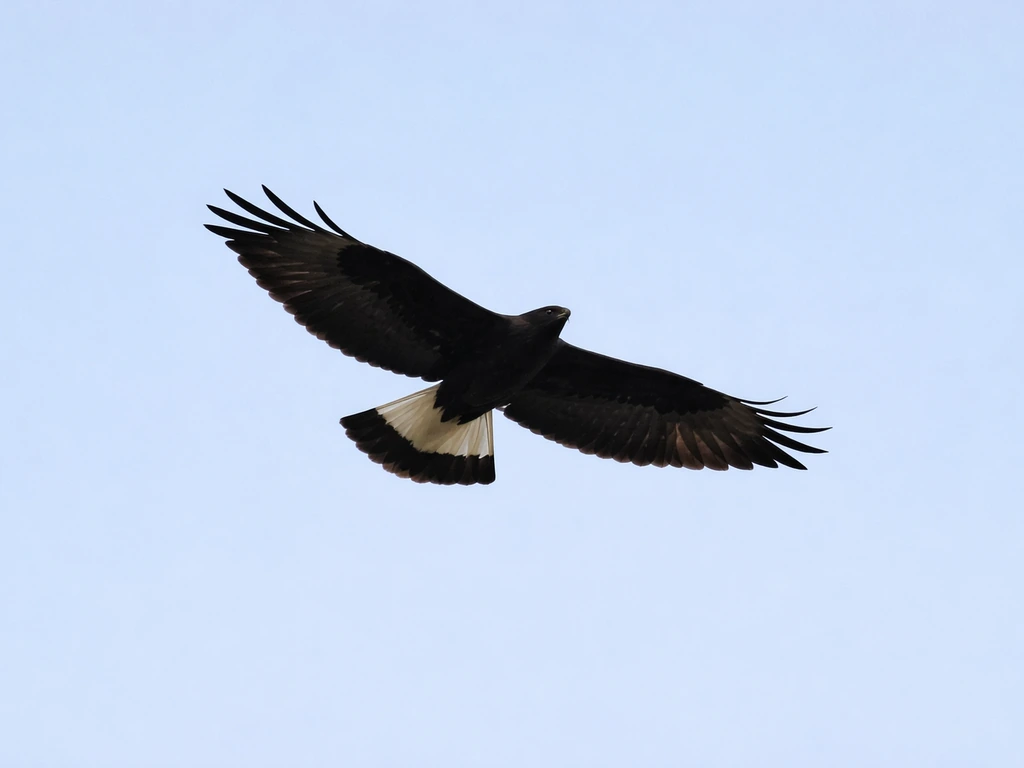
How to identify a brown bird with a white tail in flight
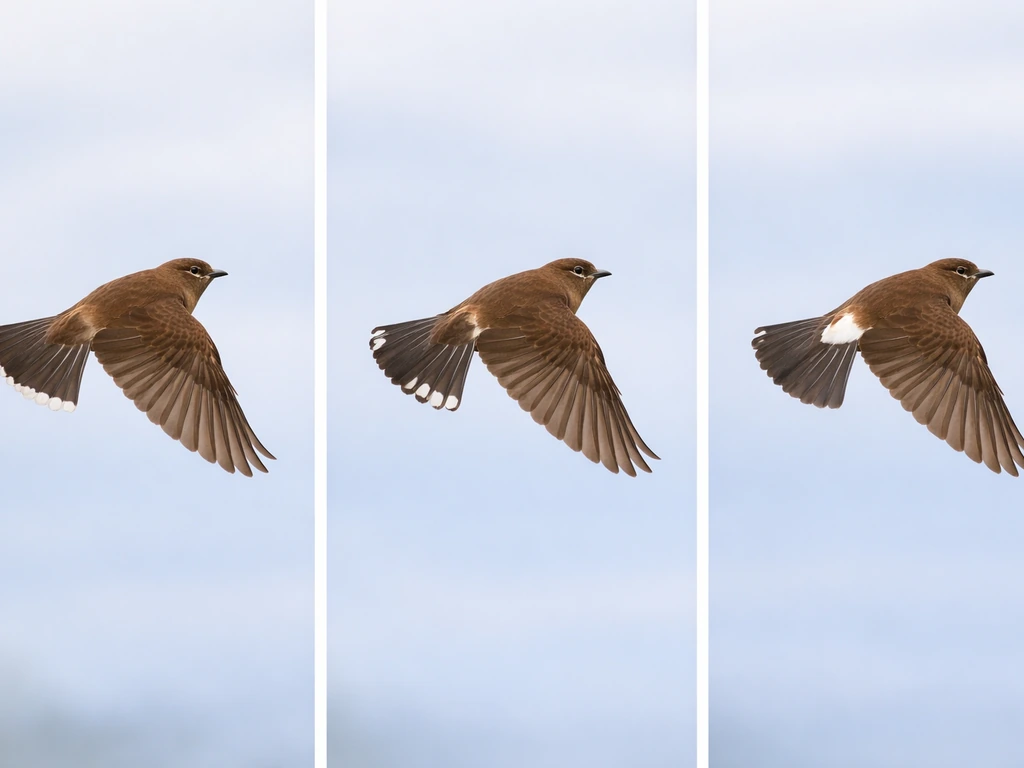
The phrase 'white tail when flying' usually means one of two things: a white patch at the base or tip of the tail feathers (a terminal band), or white corners on the outer tail feathers that flash open when the bird fans its tail for braking or turning. Both are real and both show up on brown birds, but they point to different species. Terminal bands across the whole tail tip are characteristic of nightjars like the Eastern Whip-poor-will and Common Poorwill. White outer corners are the signature of towhees and some sparrows.
Body color is your first filter. 'Brown' covers a lot of ground here. The nightjars are a cryptic, leaf-litter brown with heavy mottling, almost camouflaged. Towhees are more contrasty: males have a bold black hood and rufous flanks, but females and juveniles are a rich brown above with rusty sides. If the bird you saw looked uniformly dull brown, think nightjar or sparrow. If it had a strong two-tone look, lean toward towhee.
Size matters a lot in the field. The Eastern Towhee is noticeably stocky and robin-sized, bigger than most sparrows. Nightjars are medium-sized but long-winged and flat-looking in flight, almost like a flying leaf. Cassin's Sparrow is small and streaky, flushing weakly from grassland. Getting a sense of size relative to familiar birds, a house sparrow, a robin, a crow, anchors everything else.
Field marks: tail shape, wing pattern, and flight behavior
The tail mark itself is the headline, but the supporting details close the case. For the Eastern Whip-poor-will, the male shows a broad white band across the outer tip of the tail, clearly visible from below or behind when the bird banks. Both sexes also carry a bright white throat patch. The flight style is erratic and moth-like: low, silent glides interrupted by quick flaps, usually at dusk or dawn near woodland edges.
The Common Poorwill is smaller and rounder-winged than the Whip-poor-will, and the white shows up as white tips on the outer tail feathers rather than a full terminal band. Britannica describes poorwills as having mottled gray plumage and a short tail with a bit of white at the corners, along with a narrow bib that is white in the male and buffy in the female blank" rel="noopener noreferrer">poorwills with mottled gray plumage and white at the tail corners. Males also show some white in the throat. Cornell Lab of Ornithology notes that Common Poorwill identification includes a white band mark on the throat, which is often difficult to see some white in the throat. If you're west of the Rockies in dry, rocky terrain and the bird flushed from the ground at night, Poorwill is the first name to write down.
Eastern Towhees, especially males, have extensive white tips to the outer tail feathers that spread into a visible white flash when the bird fans its tail during landing or a sharp turn. The flight itself is direct but not fast, with a characteristic flicking wingbeat. In heavy brush habitats, towhees often make short, low flights between cover. The combination of a big brown (or black-hooded) bird, rufous flanks, and white-tipped outer tail feathers is very distinctive once you've seen it.
Cassin's Sparrow shows dull white tail corners, not a dramatic flash. It's a grassland bird with a habit of skylarking, fluttering up into the air to sing then parachuting back down. In faded summer plumage, the white tail corners can be quite muted. If you're on open grassland in the southern Great Plains and the bird was performing that display flight, Cassin's Sparrow fits.
| Species | White tail feature | Body/plumage | Habitat | Flight style |
|---|---|---|---|---|
| Eastern Whip-poor-will | Broad white terminal band (male) | Cryptic brown-gray mottled | Woodland edges, second growth | Erratic, moth-like, crepuscular |
| Common Poorwill | White outer tail tips (male) | Gray/brown/buff dead-leaf mottling | Dry rocky slopes, western desert | Low, fluttery, nocturnal/crepuscular |
| Eastern Towhee | White tips on outer tail feathers | Black hood (male) or brown (female); rufous flanks | Dense brush, forest edges | Direct, flicking wingbeat; low between cover |
| Cassin's Sparrow | Dull white tail corners | Dull streaky brown, faded in summer | Open grasslands, southern Great Plains | Weak flush; distinctive skylark display |
Species that look alike at a distance
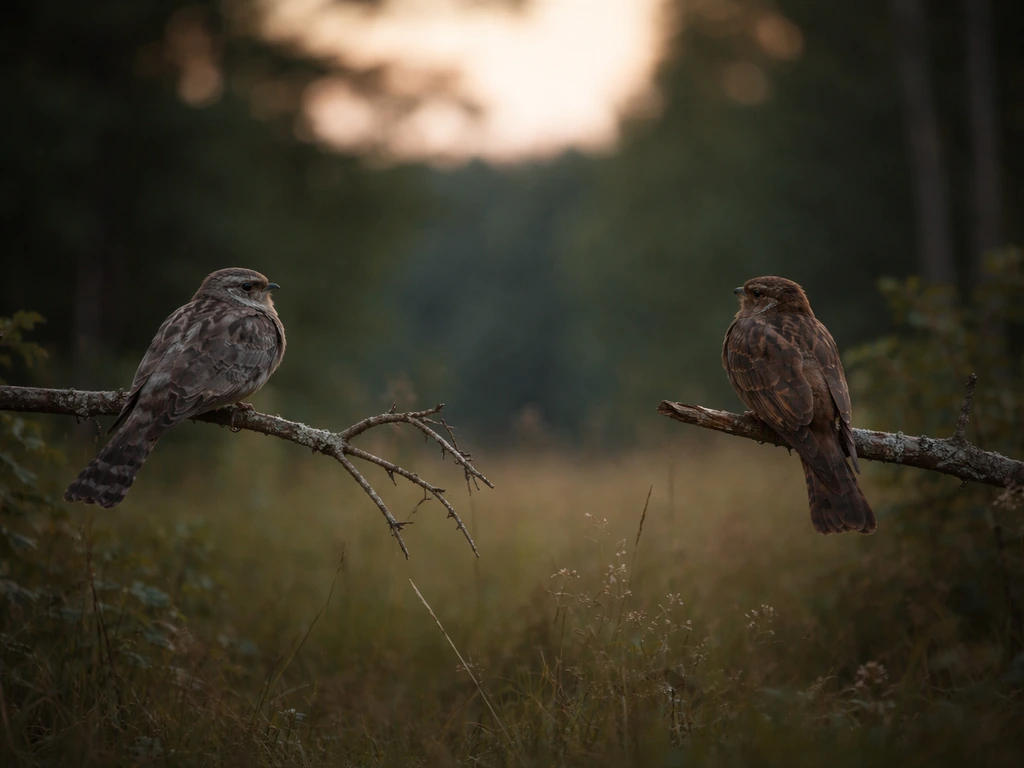
The most common mix-up is between the two nightjars. Eastern Whip-poor-will and Common Poorwill overlap in range in parts of the Great Plains and Rocky Mountain foothills, and both will flush from the ground at dusk as a brown blur with white tail. The key split: Whip-poor-will is noticeably larger, has longer wings that look pointed in flight, and the white band goes all the way across the tail tip. Poorwill is compact, almost round-winged, and the white is restricted to the outer feathers.
Towhee females and juveniles are regularly misidentified as large sparrows or even thrushes by new birders. The rufous flanks and the white tail corners set them apart, but a juvenile towhee can look streaky and confusing. The stocky build and the habitat (dense shrubby cover rather than open fields) are strong clues. If you're looking at an open-field bird with tail-corner white and it's the size of a house sparrow, think Cassin's or another grassland sparrow, not a towhee.
The Northern Harrier is worth a mention because it shows a bold white rump patch (not tail tip) in flight and hunts low over open country. If the white you saw was centered over the rump and the bird was large and long-winged, that's likely what you had. The harrier's body and wings are gray (male) or brown (female), so a female harrier hunting a marsh can briefly look like a 'brown bird with a white tail' to a glancing eye. But the harrier's size, slow rocking flight, and rump-not-tip white location separate it quickly.
What to observe in the moment
You've got maybe 10 to 30 seconds before the bird is gone. Here's how to spend them.
- Lock onto the tail first. Is the white at the very tips of the outer feathers (corners), or is it a full band across the tail tip, or is it more of a rump patch above the tail base? This single observation narrows your list dramatically.
- Estimate size against something you know. Is it sparrow-sized, robin-sized, or crow-sized?
- Note the flight style: flapping cadence (fast and fluttery vs. slow and rowing), gliding behavior, whether it's flying low or high, and whether it's making quick turns or traveling straight.
- Note time of day and habitat. Nightjars flush at dusk/dawn from ground; towhees flush from brush at any time; grassland sparrows flush weakly from open ground.
- Get photos or video if you can. Shoot from below for the underwing and tail spread. Shoot a side profile to capture wing shape and length. A burst sequence through a takeoff or landing often catches the tail fully fanned, which is when the white pattern is most visible.
For photos, the most useful single frame is the bird banking away from you with the tail fanned: this shows the full extent of the white and its position on the tail. A second-best angle is a direct underside shot, which also shows the wing pattern clearly. If you can only get one shot, aim for the moment of takeoff or landing, when birds fan and brake and the tail opens fully.
Flight biomechanics: why the white tail shows up the way it does
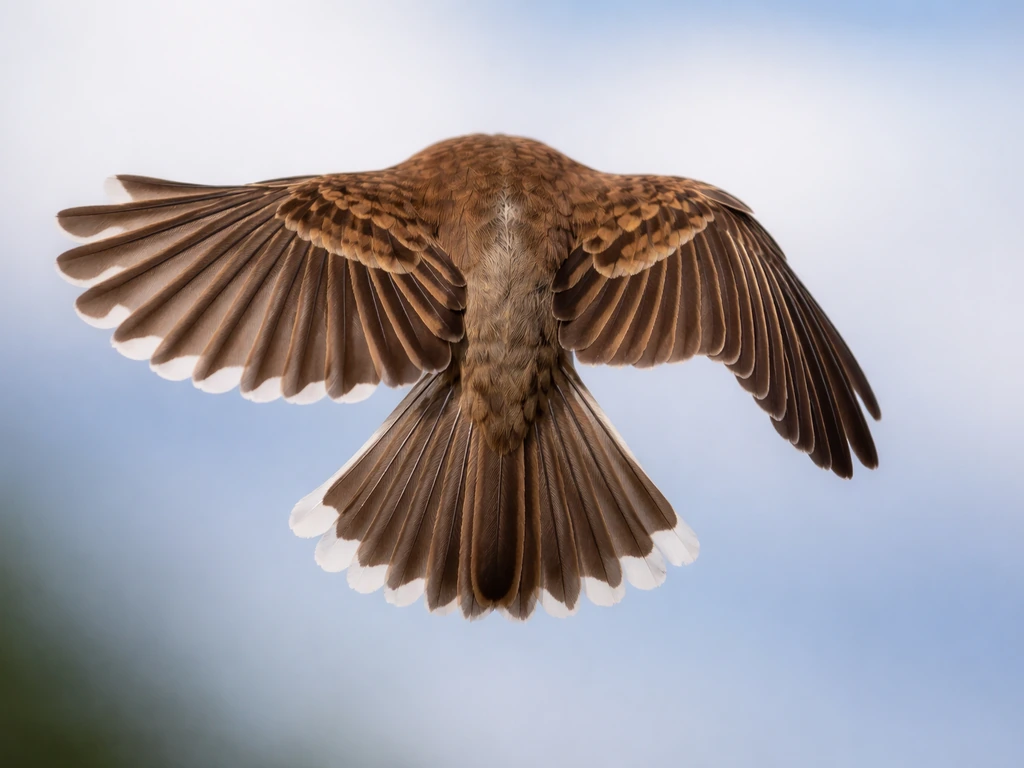
The tail is not just a rudder. In bird flight, the tail is an active control surface that fans open during braking, steering inputs, and landing, and folds into a narrow point during fast cruising. This means the white tail pattern you see is not constant: it flashes on and off depending on what the bird is doing with its tail feathers at each moment of the wingbeat cycle. A clear sign like a bird is flying with a flashed white tail pattern often points to specific tail-fanning behavior. If you want a quick visual comparison, also check what the bird is doing when the bird is flying above the house. If you want a quick visual comparison, also check what the bird is doing when the bird is flying above the house the bird is flying above the tree.
When a bird brakes, it spreads the tail feathers wide to increase drag, and that's when corner whites or terminal bands become maximally visible. During a glide, the tail is often held in a medium fan, so the white shows at partial intensity. During fast flapping flight straight ahead, the tail is often closed or nearly so, and the white can disappear entirely. This is why a bird that looked strikingly white-tailed on takeoff can look uniformly brown seconds later when it's in full flapping flight. If the bird's movement seems to match the moment it stops flapping and the tail flashes, it can help to compare against what it does when the bird is bored of flying.
The nightjars, especially, use tail-fanning as part of their agile hunting maneuvers. When a Whip-poor-will pivots to chase an insect in dim light, the tail spreads and the white band shows up sharply, almost like a flicker signal. Towhees use a similar fanning during their abrupt landings in dense brush. What this means practically is that your best look at the tail pattern comes at the beginning and end of a flight, not the middle. If you can position yourself to watch a landing rather than a flush, you'll get a much cleaner look at the white pattern and its extent.
Wing motion also plays into this. During the downstroke, a bird's tail is often leveled or slightly raised. During the upstroke recovery, the tail can drop and fan slightly, which is another moment when tail whites catch the light differently. This biomechanical interplay is part of why flight identification is both harder and more interesting than perched identification. The bird is essentially showing you its anatomy in motion, and if you know the mechanics, you can predict the moments when the diagnostic features will be visible.
It's worth noting that for site readers who've explored how birds manage different altitudes and weather conditions, the same tail-as-control-surface principle applies whether a bird is hunting insects at head height or soaring well above the treeline. The white tail is just more visible to us at low altitudes. One birding question this helps clarify is which bird can fly over Mount Everest, since flight and altitude can change what you notice in the air.
How to confirm the ID after the sighting
Check your local range first
Before anything else, filter by geography and season. Pull up eBird's species maps for the candidates above and check what's actually been recorded in your county or region in the current week. This step alone rules out most confusion: Common Poorwill won't be in New England, Cassin's Sparrow won't be in Pacific coastal forests, and Eastern Whip-poor-will is absent from most of the West. Range context is the fastest shortcut in bird ID.
Use Merlin Photo ID
If you got a photo, open the Merlin Bird ID app (from Cornell Lab) and upload it. Merlin's Photo ID tool uses computer vision trained on millions of labeled bird photos. It draws a bounding box around the bird in your photo and assigns species IDs with confidence scores. Merlin suggests the correct species in the top 3 results about 90 percent of the time for supported species, which covers most of North America's common birds including all the species discussed here. Even a blurry flight shot often returns a usable result. If Merlin flags multiple candidates, look at the score differences: a top result with a high score and a large gap to the second is a strong ID. Close scores mean you need more evidence.
Log it on iNaturalist
Upload your photo to iNaturalist and click 'Suggest an Identification.' The AI will surface species suggestions based on visual similarity and your location. iNaturalist's guidance is to accept a suggestion only if the AI is 'pretty sure,' and to browse the top visually similar candidates if the top result isn't a good match. The observation detail page lets you compare suggested taxa side by side, which is especially useful for telling apart similar nightjars or brown sparrows. Once you post the observation, community identifiers (real birders who volunteer to help) can add their own IDs and comments, which often confirms or corrects a tricky in-flight shot within a day or two.
When to ask a human expert
If Merlin and iNaturalist both come back uncertain and the sighting matters to you, the right move is to post the photo to a regional birding group, either a local Audubon chapter's Facebook group, a state birding listserv, or a subreddit like r/whatsthisbird. Include your location, date, time of day, habitat description, and your written notes on what the bird did (how it flew, where it landed, any sounds). Experienced local birders can often close out a 'possible whip-poor-will vs. poorwill' question in minutes just from knowing which species is likely at a given location in April versus October. If the sighting is genuinely rare or out of range, your local rare bird committee can advise on whether a full documentation report is worth submitting.
The full workflow is simple: notes in the field, photo if possible, range check on eBird, photo upload to Merlin, observation post on iNaturalist, and community confirmation if still uncertain. Most 'brown bird with a white tail' sightings resolve cleanly at the range-check or Merlin step. The ones that don't are often the most interesting, and that's when the expert community earns its keep. If you want a deeper look at species behavior as it relates to the white tail flash, see bird is flying.
FAQ
How can I tell if the white patch I saw was actually the tail versus the rump or throat?
Yes, but it helps to know what you are seeing. A white throat patch can exist on both nightjars, yet only towhees typically show a white tail-corner flash that spreads widely during tail fanning in dense cover. If your “white tail” was actually a white rump or a bright patch that stays centered on the back as the bird flies level, that is more consistent with a harrier than with tail-tip patterns.
Why does the white tail flash sometimes, then vanish moments later?
Avoid relying on the first glimpse. Tail whites can disappear when the tail is tightly closed during fast flapping, then reappear when the bird brakes, lands, or turns. If you can, wait for a landing or a bank and watch for an open-fanned moment where the white pattern looks most complete.
What is the single best way to decide between a terminal band and tail-corner whites?
If the bird is a nightjar, the most reliable marker is whether the white looks like a band across the full outer tail tip (terminal band) or limited to the outer corners (outer-feather corners). For towhees, look for a broader outer-tail white that fans into a visible flash during sharp landings or quick turns.
What should I do if the tail white looks faint or washed out in the photo?
Light and distance can wash out the contrast that separates these species, especially for muted summer plumage. Try to judge relative contrast first (nightjar mottling versus towhee two-tone look), then confirm with tail extent during a fanning moment. If the tail white is only barely visible at range, prioritize behavior and size over the tail mark alone.
How should I frame a photo or video to capture the “white tail when flying” feature reliably?
A white flash is easiest to confirm from a moment when the bird is braking or fanning its tail wide, not from continuous straight flight. If you shoot video, scrub to the frames where the tail appears spread and compare how much of the tail edge is white, not just whether any white appears.
Can I use the time of day or sounds to rule out the wrong species?
Sound and timing can be strong supports. Nightjars are most likely around dusk or dawn and may sound like a repetitive call in the dark (whip-poor-will type) near woodland edges or rocky terrain. Towhees are not nightjars, and their activity often centers on daylight in brushy habitats.
If I cannot get a clear tail view, what habitat clues help most?
Yes, by using habitat as a tiebreaker when the tail mark is brief. Nightjars are strongly associated with leaf litter or dry rocky or woodland edge settings where they flush from the ground. Towhees are tied to dense shrubby cover, and sparrows like Cassin’s Sparrow fit open grassland and skylarking behavior.
How should I interpret Merlin’s confidence scores when it gives multiple similar candidates?
Merlin is often helpful, but treat close-score results as uncertainty. When the top two species have similar confidence, do not pick the top one automatically, instead compare the tail-mark description you observed (terminal band versus outer corners) and match it to what each suggested species typically shows in flight.
What is the safest way to use iNaturalist suggestions for tricky in-flight photos?
iNaturalist can be conservative, especially with short or blurry views. If the top suggestion is not “pretty sure,” check the list of visually similar candidates and verify whether their tail white is expected to appear as a corner flash or a terminal band during fanning. The best decision aid is consistency between tail extent, body size impression, and habitat.
Could other birds cause a false impression of a “white tail when flying,” and how do I avoid that mistake?
A single “white tail” sighting could also be confusing if you actually had a different white location that flashes with movement. Before posting or running apps, note whether the white was on the outer tail feathers, across the whole tip, centered on the rump, or on the underside of the bird. This one detail can prevent common mix-ups like harrier versus tail-tip patterns.
If I want expert help, what exact notes should I include in my birding post?
When you are unsure, your most useful field notes are (1) whether the white looked like a full band across the tail tip or just on outer corners, (2) the bird’s size impression relative to a robin or house sparrow, (3) habitat (dense brush, woodland edge, dry rocky ground, or open grassland), and (4) whether it was flush from the ground at dusk or performing a daytime display flight. Those four points usually resolve the ID faster than extra details.
Next Articles
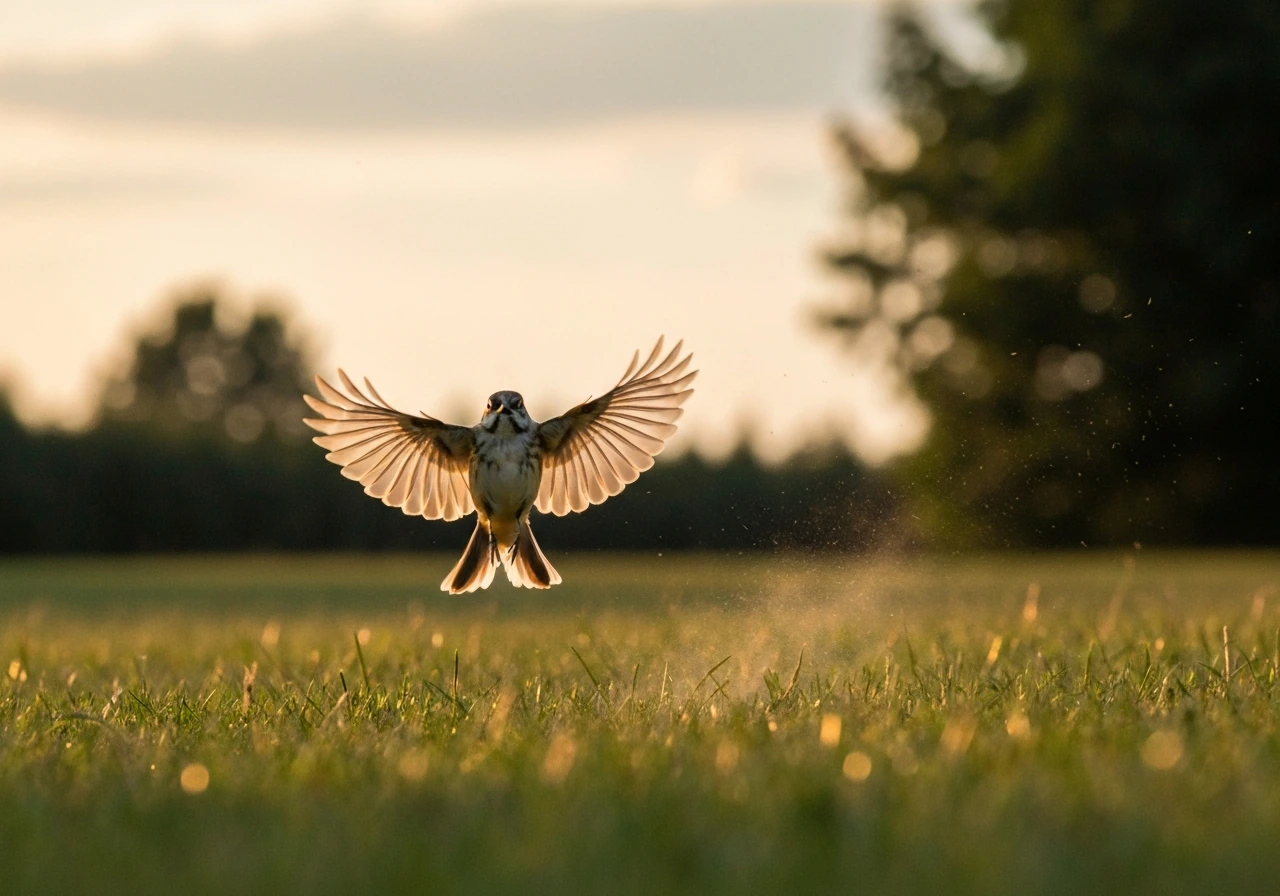
Bird Is Flying: What It Means and How Flight Works
Understand what bird is flying means and how wings, lift, thrust, and control pitch roll and yaw in flight.
The Bird Is Flying Above the Tree: What To Do Now
Figure out why a bird is flying above a tree and get do-this-now steps for safety, deterrence, and when to call wildlife
Which Bird Can Fly Above the Clouds? Top High Soarers
Find which birds soar highest, from eagles and condors to albatrosses, plus tips to spot them above local cloud height.