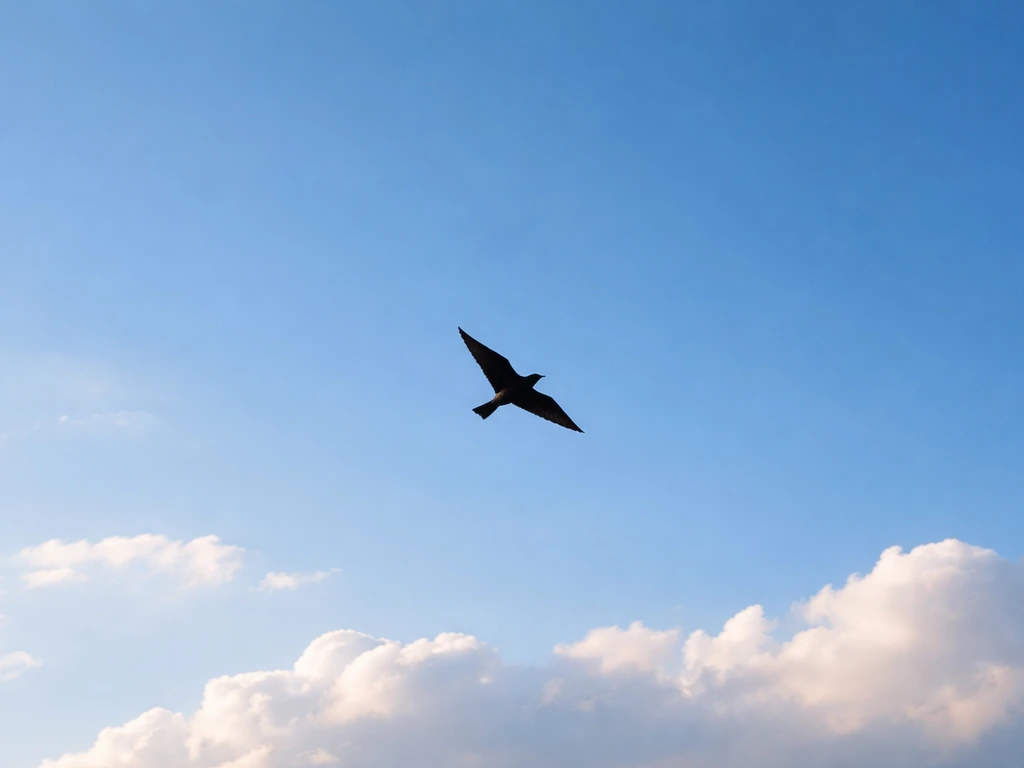
When a bird glides across the sky, it is flying without flapping its wings, converting stored height or rising air into forward movement through pure aerodynamics. That smooth, effortless-looking path is the result of precise anatomy, atmospheric conditions, and millions of years of evolutionary refinement. Whether you are watching a red-tailed hawk hang motionless over a ridge or a pelican skim inches above the water, the mechanics driving that glide are the same at their core. This guide will help you read exactly what you are seeing, understand why the bird is doing it, and give you concrete tools to observe and document it starting today.
When the Bird Glides Across the Sky: Field Guide to Gliding

Marcus Chen
3 May 2026
What "a bird glides across the sky" actually means
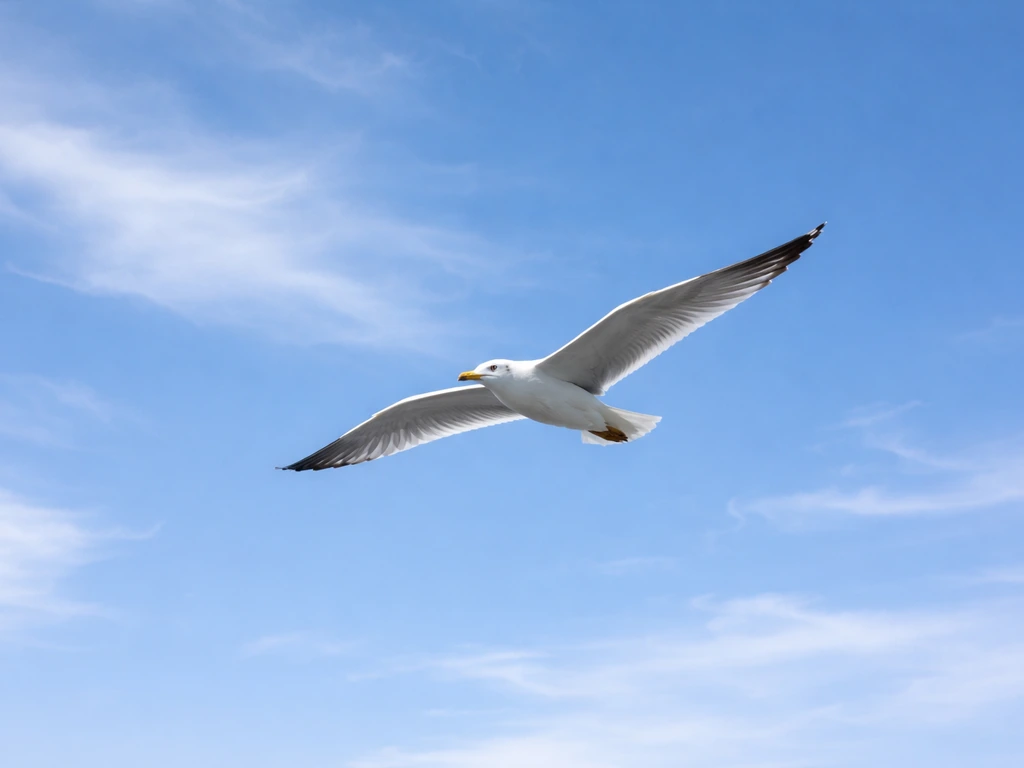
In practical observation terms, gliding means the bird's wings are extended and held relatively still while it moves through the air, trading altitude (or riding a rising air mass) for forward motion. No flapping is happening. The bird is not adding mechanical energy through its muscles the way it does during powered flight. Instead, it is managing the relationship between lift (upward aerodynamic force), drag (resistance), and gravity. The angle at which it descends relative to still air is called blank" rel="noopener noreferrer">the glide ratio, and in skilled gliders like albatrosses, that ratio can be extraordinary: roughly 20:1, meaning 20 meters of horizontal travel for every 1 meter of altitude lost.
The phrase itself also shows up in a gaming context in Wuthering Waves (often searched as "when the bird glides across the sky wuwa"), which is a separate topic entirely. Here, we are talking about real avian flight: living birds, actual aerodynamics, and the biology behind what you are watching unfold above you.
Why birds glide: energy savings and flight control
Flapping is expensive. A PubMed-indexed study models the energetic effects of wing flapping in vertebrate flight, helping explain why flapping is energetically costly compared with gliding Flapping is expensive.. The metabolic cost of sustained powered flight is one of the highest energy demands in vertebrate biology. Gliding lets a bird cover distance or maintain position without burning that fuel. For a large bird like a vulture or a stork, the flight muscles that drive flapping can represent 15 to 25 percent of total body mass. Running those muscles continuously over a long migration or a day-long foraging session would require enormous caloric input. Gliding bypasses that cost almost entirely.
Control during a glide is equally important and often underappreciated. The bird is constantly making micro-adjustments: spreading or folding individual primary feathers to manage turbulence, tilting the tail like a rudder, and shifting its center of mass to initiate turns. These adjustments happen fast and mostly unconsciously, the product of a nervous system tuned over evolutionary time to read airflow. The result looks effortless from the ground, but it is a continuous, active process.
Gliding vs. soaring vs. intermittent flapping: how to tell them apart
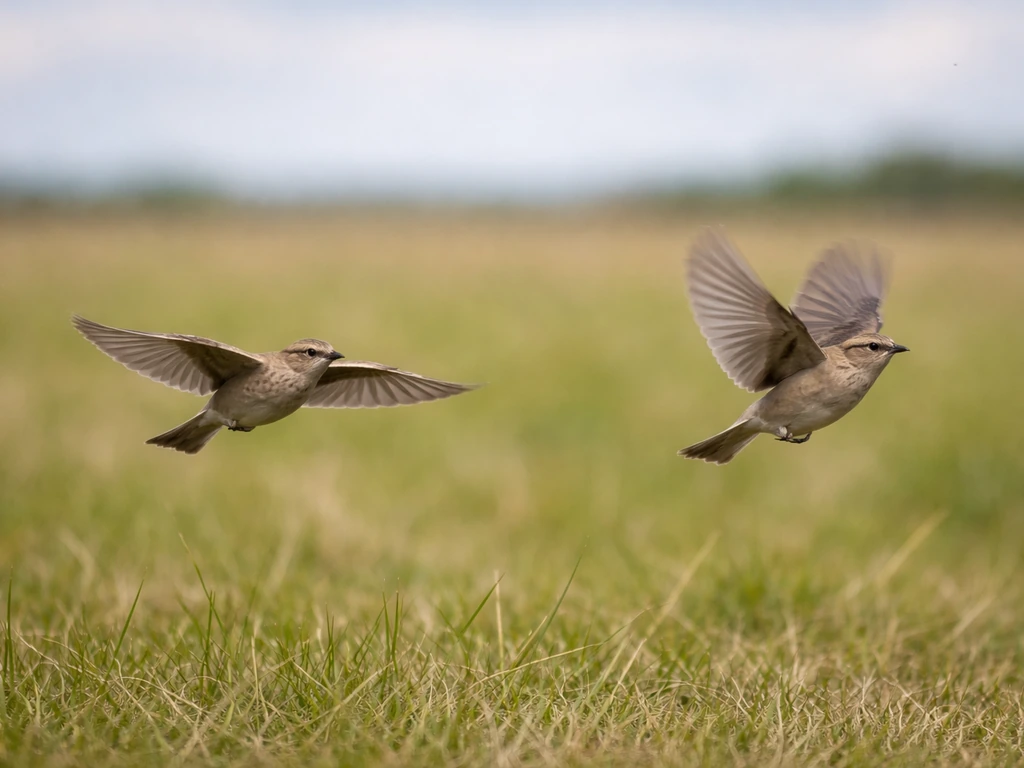
This is where most casual observers get confused, and honestly it is easy to mix up. The three modes feel similar to watch but are meaningfully different in what the bird is doing and why. Here is how I think about it in the field.
True gliding
The bird holds its wings out with no flapping and gradually loses altitude over time. It is trading height for distance. In calm air with no lift available, a true glide always descends. A bird flying in the sky in that no-flap style is performing gliding or soaring motion, depending on whether it is losing or gaining altitude. Watch the horizon: if the bird is steadily, slowly sinking relative to trees or buildings in the background, that is a gravitational glide. The wings may flex slightly at the wrist but the characteristic rowing motion of flapping is absent.
Soaring
Soaring looks like gliding from the outside, but the bird is gaining or maintaining altitude without flapping. It is extracting energy from the atmosphere, usually from a thermal (a column of warm rising air) or from slope lift (wind deflected upward by a ridge or cliff). If you watch a bird in a no-flap mode and it is circling upward, or holding a fixed position over a ridge while barely moving its wings, that is soaring. The distinction matters: soaring birds are doing something energetically that pure gliders cannot sustain in calm air.
Intermittent flapping (bounding or flap-glide flight)
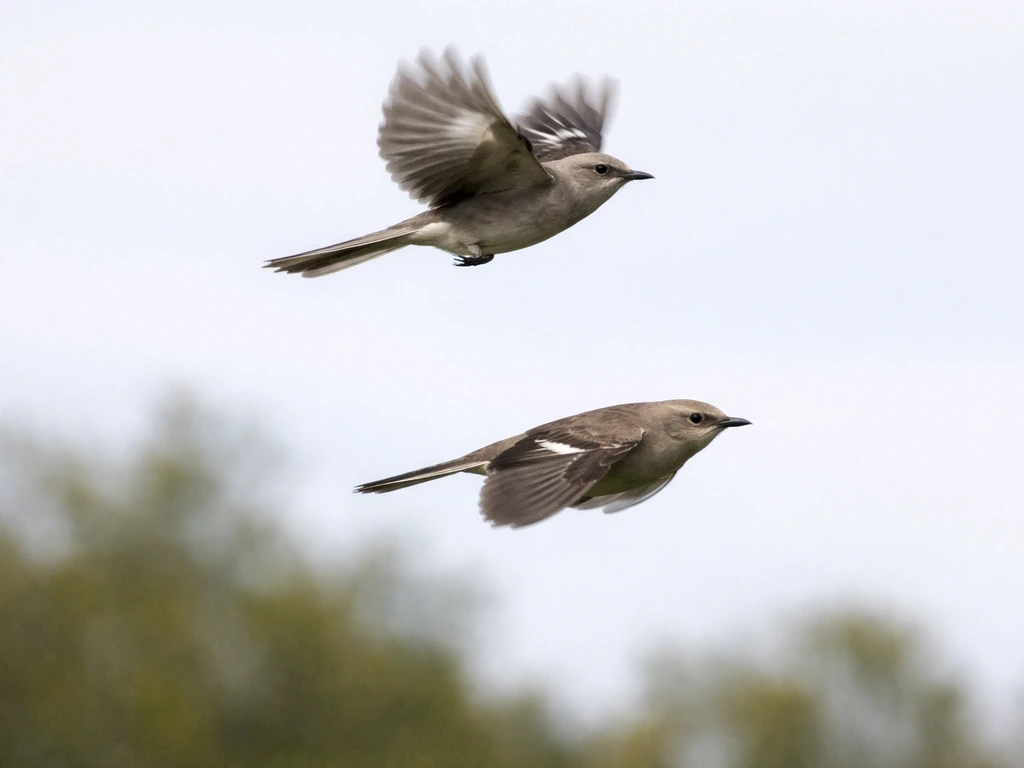
Many birds use a rhythmic pattern of flap-flap-flap, then a brief glide, then flap again. This is intermittent flight, and it is common in medium-sized birds like woodpeckers, starlings, and many raptors during active travel. The glide phases are short, often just a second or two, and the bird's trajectory often shows a slight undulation: rising during the flap phase, dipping slightly during the glide. Once you know to look for that gentle wave pattern in the flight path, you will spot it everywhere.
| Flight Mode | Wing movement | Altitude trend | Tell-tale field sign |
|---|---|---|---|
| True gliding | Still, held extended | Slowly descending | Gradual, steady sink against fixed background |
| Soaring | Still or very slight flex | Maintaining or gaining | Circling upward or stationary over ridge |
| Intermittent flapping | Alternates flap and hold | Undulating path | Visible wave pattern in flight trajectory |
Birds most likely to produce long, obvious glide paths
Not every bird glides well or often. Long, impressive glide paths tend to come from species with specific physical traits (more on anatomy below), so knowing which birds to expect helps you make sense of what you are watching.
- Raptors (hawks, eagles, vultures): These are the classic gliders most people see. Turkey vultures in particular are almost always soaring or gliding, rarely flapping. Their wings form a distinctive shallow V shape (called a dihedral) that is a reliable field identification clue.
- Albatrosses and large seabirds: Masters of dynamic soaring over open ocean, using the wind gradient above waves to stay aloft for hours without a single flap. Wandering albatrosses can cover 500 miles a day this way.
- Pelicans: Often glide in formation inches above the water, exploiting ground effect (the cushion of compressed air between the wing and the water surface) for added efficiency.
- Storks and cranes: Large migratory birds that depend on thermals and gliding to cross continents without exhausting their energy reserves.
- Swifts and swallows: Surprisingly capable gliders between bursts of fast flapping, especially during descent toward a roost or nest.
- Gulls: Frequently seen in extended glides along coastlines and ridgelines, exploiting slope lift from sea cliffs.
How wind, thermals, and terrain shape the glide
A bird does not glide in isolation from its environment. The path, duration, and shape of a glide are almost entirely determined by the air mass the bird is moving through. Understanding these environmental drivers turns a mysterious sky-arc into something you can actually predict and anticipate.
Thermals
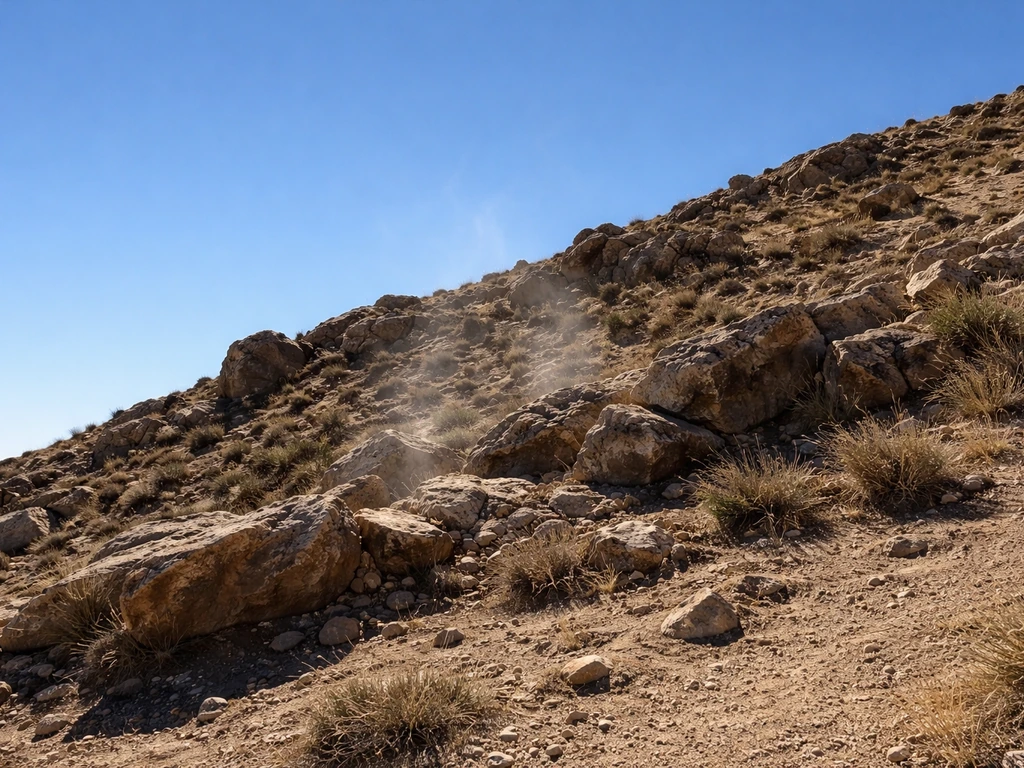
Thermals are invisible columns of warm air that rise from sun-heated ground surfaces: dark fields, asphalt roads, parking lots, or rocky hillsides. They form most reliably on sunny afternoons between about 10 a.m. and 4 p.m. Raptors and vultures locate thermals by watching other birds already circling in them, or by sensing the rising warm air directly. Once inside a thermal, they spiral upward with no flapping, then peel off and glide toward the next one. The resulting cross-country path looks like a series of spirals connected by long, descending straight glides, a pattern called dolphin soaring or thermal gliding.
Slope lift and ridge lift
When wind hits a hill, cliff, or dune at the right angle, it is forced upward. Birds that understand their local terrain exploit this relentlessly. Gulls patrolling coastal cliffs, hawks lined up along an Appalachian ridgeline during migration, condors riding the updrafts off canyon walls: all of these are using slope lift. The bird essentially parks itself in the rising air and glides without losing altitude, sometimes for extended periods.
Dynamic soaring and wind gradients
This is the most technically impressive atmospheric trick, and albatrosses wrote the rulebook. Wind speed increases with altitude above the ocean surface. By gliding down into the slower air near the surface, then turning upwind and climbing back into faster air, a bird can harvest energy from the wind gradient in a continuous loop. It requires no flapping at all once the cycle is established. It is one of the most elegant physical solutions in all of biology.
The anatomy and physiology that make gliding possible
What makes one bird a spectacular glider and another a poor one comes down to a handful of measurable physical characteristics. These traits are so predictive that you can make a reasonable guess about a bird's flight style just from a silhouette.
Aspect ratio
Aspect ratio is wingspan squared divided by wing area. High aspect ratio means long, narrow wings, like an albatross or a swift. These wings generate a lot of lift relative to drag, which translates directly into efficient, long-distance gliding. Low aspect ratio means short, broad wings, like a pheasant or a grouse. Those birds are built for rapid takeoff and maneuverability in dense vegetation, not sustained glides. When you see a bird with very long, slender wings holding a flat glide across open sky, high aspect ratio is doing the work.
Wing loading
Wing loading is body mass divided by wing area. A lighter bird with large wings has low wing loading and can stay aloft more easily in weak lift, glide slowly, and turn in tight circles inside a thermal. A heavier bird with smaller wings (like a gannet or a peregrine) has high wing loading, glides faster, and needs stronger air currents to soar effectively. Wing loading is why you see vultures circling in gentle thermals over sunny fields while gannets plunge-dive from height: their bodies are designed for very different relationships with the air.
Tail as a control surface
The tail is the bird's primary pitch and yaw control during a glide. Spreading the tail increases drag and lift toward the rear of the body, slowing descent and helping the bird flare before landing. Folding it narrows the profile and reduces drag, increasing speed. Many raptors fan their tails during slow soaring turns and pull them tight during steep, fast glides. Watch the tail shape carefully: a fanned tail usually signals the bird is slowing down, maneuvering, or preparing to land.
Body posture and center of mass
A bird's center of mass is positioned just forward of the wing's center of lift, which creates an inherent nose-down tendency that the tail corrects for. During gliding, the bird holds its head slightly elevated and the body angled to manage this balance. Shifts in leg position (dangling legs create drag and lower the center of mass) are used to make quick adjustments during approach and landing. Watching what a bird does with its legs in a glide can tell you whether it is in a steady-state glide or preparing to transition to another mode.
Primary feather slots
Many soaring raptors have deeply slotted wingtips: the outer primary feathers are separated like fingers rather than fused into a smooth surface. These slots reduce induced drag and improve low-speed stability, letting the bird glide slowly in tight thermal columns without stalling. Broad-winged hawks and condors show this beautifully. Contrast that with a swift's swept, pointed wingtips, which are built for speed rather than slow thermal soaring.
What you can do today to observe and document a glide
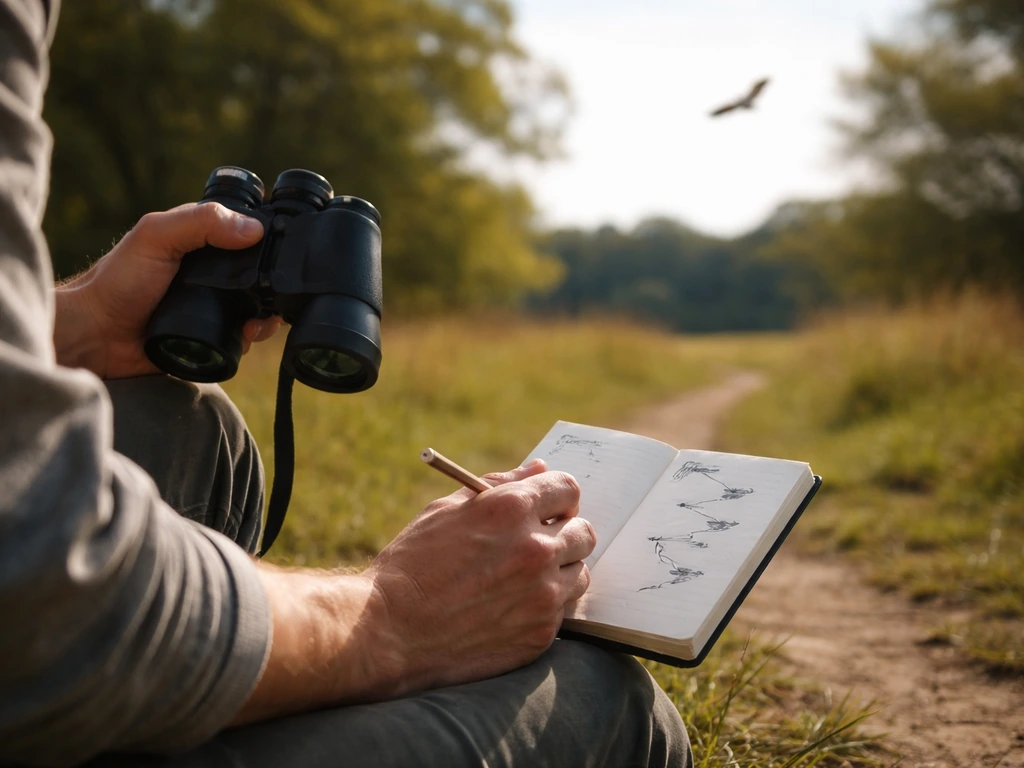
You do not need specialized equipment to start building real understanding of bird gliding. Most of what I have learned came from paying closer attention to ordinary sightings. Here is a practical sequence for getting the most out of your next observation.
- Pick your timing and location: Head out on a sunny afternoon (10 a.m. to 4 p.m.) to an open area with good sky views, ideally near a ridge, coast, open field, or water body. These environments concentrate gliding birds and provide the atmospheric conditions that drive the behavior.
- Note the wing shape first: Before you try to identify the species, describe the wing shape. Are the wings long and narrow or short and broad? Are the wingtips pointed or slotted? Is the silhouette a flat T shape or a slight V (dihedral)? These clues are more reliable for understanding what you are seeing than a rushed species ID.
- Time the glide: Use your phone's stopwatch and count how many seconds pass between flaps. A glide lasting more than 5 to 10 seconds with no flapping is significant. A glide lasting 30 seconds or more, especially with altitude gain, is soaring.
- Watch the altitude trend: Track the bird against a fixed reference point (a tree, a building edge, the horizon). Is it sinking, holding steady, or rising? This single observation tells you whether you are watching a true descending glide, slope soaring, or thermal soaring.
- Record a short video clip: Phone video is invaluable. A 15 to 30 second clip captures wing position, tail movement, body posture, and the altitude trend all at once. Slow it down afterward to catch details you missed in real time.
- Log the context: Note the time, weather (sunny/cloudy, wind direction and strength if you can estimate it), and terrain. These environmental variables will help you connect what you saw to the mechanics that produced it, and they are useful if you want to share the sighting with a birding community or naturalist app like eBird or iNaturalist.
- Compare wing and tail behavior at different moments: Does the tail fan out at certain points and close at others? Do the wing tips flex or spread differently during turns versus straight glides? These micro-behaviors are where the most interesting biomechanics live, and watching for them turns a casual sighting into a genuine field study.
If you find yourself drawn to the grammatical or linguistic side of describing bird flight, there are related threads worth exploring: how to describe these movements in other languages, whether phrases like "a bird is flying in the sky" are grammatically correct in English, and what type of motion bird flight represents in physics. If you want the French phrasing, you can say the bird is flying in French in a natural way when discussing bird flight a bird is flying in the sky. If you want to say “that bird is learning to fly” in Spanish, focus on the same kind of verb form and motion wording how to describe these movements in other languages. These questions share the same root curiosity about what it means when a bird moves through the air, just approached from different angles.
The more you watch, the faster your eye calibrates. After a few sessions of deliberately timing glide phases and noting wing shapes, you will start to pick up gliding behavior almost automatically, and the mechanics behind it will make intuitive sense in a way that no amount of reading alone can fully deliver.
FAQ
How can I tell if the bird is gliding because of declining energy, or soaring because it is gaining altitude?
Use the background as a reference and look at more than one second. If the bird’s head stays level and the whole body tracks slightly downward relative to fixed landmarks, it is likely a gravitational glide. If it holds position or climbs while wings remain mostly still, that indicates it is extracting energy from thermals or slope lift. Also check whether it spirals upward before transitioning into a straight no-flap leg, that pattern usually signals soaring.
What should I do if the air is windy and everything looks messy, how do I still classify the flight?
Classify by behavior, not by smoothness. In turbulent wind you can still identify gliding by lack of sustained flapping and by a clear downward trend through several landmark points. For soaring, look for repeated circling or ridge-hugging orientation into the updraft. If the bird is repeatedly changing wing angle to stay in place, it is likely dealing with lift sources, not simply descending.
Can a bird “glide” even if it makes small wing movements, like brief flutters?
Yes. Micro-adjustments (feather angle changes, slight wrist flex, tail and head adjustments) can happen during both glides and soars. What matters is whether there is a rhythmic wingbeat pattern driving the motion. If the bird shows long periods with no full flap cycles, it is still functioning as a glide or soar even if the wings look alive at the feather tips.
Why do some birds seem to glide for a long time, then abruptly flap hard, what causes that switch?
Most switches happen when the lift source weakens or the bird has to change direction or altitude. A thermal can fade, the bird can overshoot a ridge updraft, or it can approach an area with less favorable wind direction. The next flap burst is usually not “random,” it is a repositioning step, such as climbing back to a usable altitude before resuming no-flap travel.
Are flocks ever “playing” with glides, like trading positions to help each other?
Yes, and it can look like synchronized gliding. Raptors and other soaring species may use nearby birds to locate thermals, then enter the same rising airflow. Once inside, individuals may hold different spacings, so one bird’s glide leg can look connected to another bird’s spiral and exit. If you see multiple birds converging into the same circular motion, that is a strong sign of shared lift conditions.
What does the tail do during a real glide versus right before landing?
During steady gliding, the tail primarily stabilizes pitch and yaw, so it stays relatively consistent aside from small corrections. Right before landing or a steep approach, tails often fan wider or tighten depending on speed and descent control, and the legs may hang lower to increase drag. Look for a transition from long steady segments to shorter, more controlled adjustments near the ground.
How accurate is using “wing shape from silhouette” to predict gliding style, are there common misreads?
It is a useful shortcut, but lighting and distance can fool you. A bird can look broad-winged in one angle yet still have high aspect ratio. Misreads are common when feathers are splayed from wind or when a bird is mid-turn. To improve accuracy, combine wing shape with behavior: high-efficiency gliders usually show long straight legs with minimal wingbeat, while maneuver-oriented birds tend to change direction frequently and use shorter glide segments.
How should I measure a glide ratio in the field without special equipment?
You can do a rough approximation by using visual “yardsticks.” Pick a fixed reference point, note the horizontal distance traveled between two identifiable vertical levels (for example, from rooftop edge to tree line), and estimate altitude change using known height cues like building stories or hill contours. It will be approximate, but repeated observations will let you see relative differences between species and between glide versus soar legs.
Do different glide types have consistent body postures, like head angle and leg position?
Often, yes. During steady glides, the bird tends to hold a stable posture with the head slightly elevated to manage balance, and legs are usually kept in a way that minimizes extra drag. During approach or transition, leg position may change, and the bird may lower the body angle or angle the tail more actively. If the body posture is clearly changing while wings stay mostly still, it often signals a shift toward landing rather than a pure glide.
When should I stop assuming “no flapping equals gliding,” and consider other modes?
Stop and reassess if the bird is circling upward for extended periods, hugging a ridge in a way that maintains altitude, or showing a repeated flap-then-short-glide rhythm. Those are signs of soaring or intermittent flight rather than pure gravitational gliding. Another red flag is frequent reorientation against or with the wind, because that suggests the bird is actively managing lift conditions.
Is there a safe way to document glides, and what errors ruin observation notes?
Write down time, location, wind direction (if you can estimate it), and the bird’s behavior pattern (straight no-flap descent, circular ascent, ridge-travel, or flap-flap-glide cycles). Common mistakes include judging altitude change from a single glance, not accounting for parallax when the bird is closer or farther than you think, and ignoring whether the bird is turning, which can disguise whether it is gaining or losing altitude.
Next Article
The Bird Is Flying in French: Oiseau Vole dans le Ciel
How to say the bird is flying in French: Oiseau vole dans le ciel, with dans l’air options and examples.