
Birds move in four main ways: they walk or hop on the ground, perch and balance in trees, fly through the air, and swim or dive in water. Each mode uses a different set of body mechanics, and many birds switch between two or more of them depending on what they're doing at any given moment. If you want a quick mental model, think of a bird's body as a system that can toggle between locomotor "modes"—legs for ground movement, wings for air, and feet or wings (or both) for water. The sections below break down how each mode actually works, with enough mechanical detail to give you a real picture of what's happening.
How Does a Bird Move? Walking, Flying, Perching, Swimming

Marcus Chen
22 Mar 2026
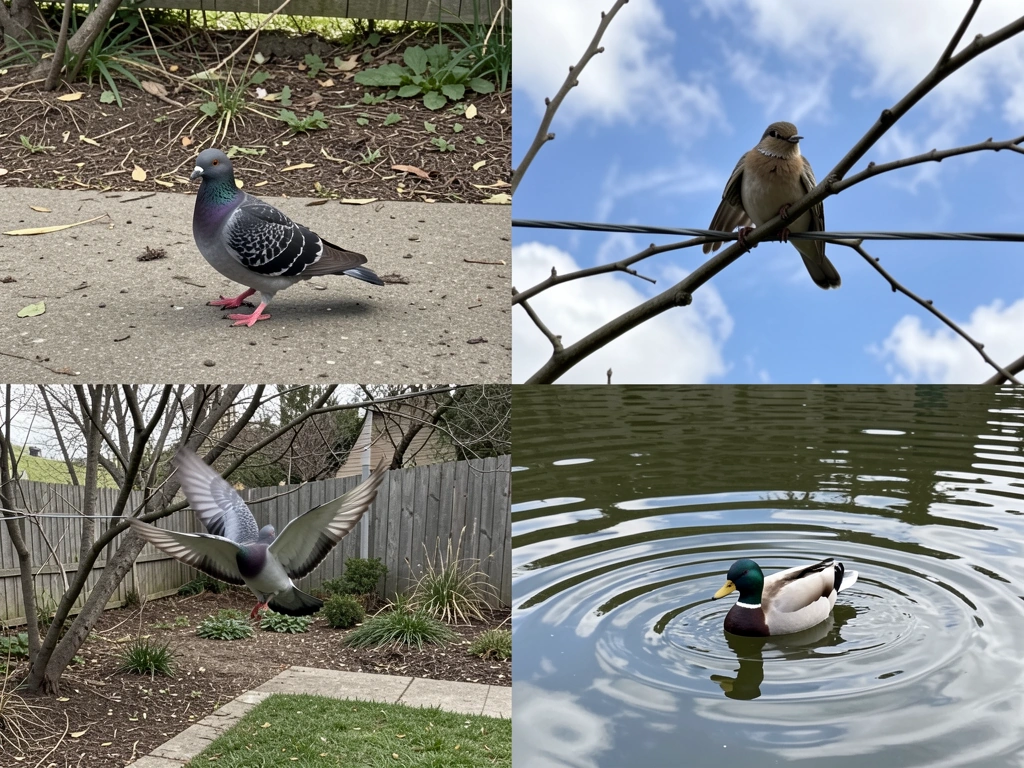
The four ways birds get around
Most people think of birds primarily as fliers, but a huge number of species spend the majority of their time on the ground or in water. Ostriches almost never fly. Penguins can't fly at all. Even common backyard birds like robins and sparrows do a surprising amount of walking and hopping. The point is that flight is just one mode among several, and birds are remarkably good at switching between them. Flight is one mode among several, and birds are remarkably good at switching between them. Here's the big picture before we go deeper into each one.
- Walking and hopping: bipedal locomotion on the ground, using legs as the primary propulsors
- Flying: wing-powered aerial locomotion, including takeoff, flapping, gliding, and landing
- Perching: static balance on branches or wires, using specialized foot and tendon mechanics
- Swimming and diving: aquatic locomotion using webbed feet, wings, or a combination of both
Walking, hopping, and running on the ground
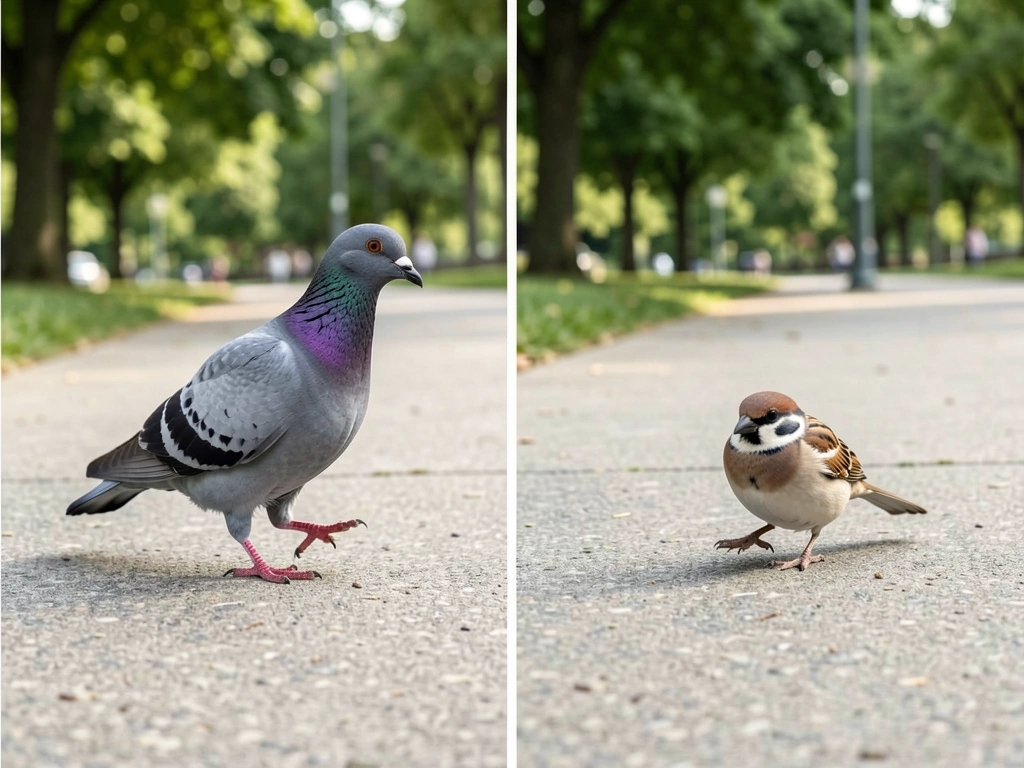
Birds are bipedal, which means they walk on two legs the way we do, but the mechanics are a bit different. When a bird walks slowly, its center of mass vaults over each supporting leg in an arc, which is mechanically similar to an inverted pendulum. You can actually see this in a pigeon's head-bobbing walk: the head stays still while the body swings forward, helping maintain stable vision. At faster speeds, birds switch to a bouncing gait where the legs behave more like springs, storing and releasing elastic energy with each stride. This is sometimes called a spring-loaded inverted pendulum model, and it helps explain why running and hopping can be surprisingly energy-efficient.
The hopping you see in sparrows and robins is a distinct gait from walking. In a hop, both feet leave and land at the same time, and the body behaves like a bouncing mass-spring system. Research on avian bipedal locomotion shows that the resonant frequency of this bouncing system is actually tuned to the bird's body size and leg posture, meaning a small bird's preferred hopping rhythm is mechanically optimal for its body in a way that minimizes energy cost. This is why small birds hop rather than walk: for their body mass, it's the more efficient choice.
What to watch for: next time you're near a sidewalk with pigeons and sparrows, notice that the pigeons walk (alternating feet) while the sparrows hop (both feet together). That difference reflects two distinct locomotor strategies shaped by body size and evolutionary history. For more on the specifics of gait and balance during walking, the mechanics of avian bipedal locomotion go deep.
How birds fly: wings, lift, and the mechanics of flapping
Flight is the most complex of the four movement modes, and it's worth breaking into stages: takeoff, powered flapping, gliding, and the transitions between them. To understand how does a bird fly, it helps to follow the steps from takeoff through wingbeats, lift, and transitions into gliding. (Landing is its own fascinating topic that deserves separate attention.) The short version is that a bird generates lift by moving its wings through the air in a way that creates a pressure difference between the upper and lower wing surfaces, and it generates thrust by flapping. But the real picture is messier and more interesting than that.
Takeoff
Most birds launch from the ground or a perch with a powerful leg push combined with the first downstroke of the wings. The legs do more of the initial work than people realize: for small birds, the jump itself provides a significant fraction of the initial velocity. The wings then take over immediately, generating both lift and thrust in those first critical wingbeats. Larger birds, especially heavy ones like swans, need a running start to build enough airspeed for the wings to generate sufficient lift, which is why you see them sprinting across water before getting airborne.
Flapping: frequency, amplitude, and aerodynamic forces
During powered flapping flight, the wing moves in a complex three-dimensional stroke that isn't just up and down. The primary feathers at the wingtip generate most of the thrust, while the inner wing (closer to the body) generates most of the lift. On the downstroke, the wing pushes air down and back, driving the bird forward and up. On the upstroke, smaller birds fold their wings slightly to reduce drag, while larger birds may use the upstroke for additional lift depending on flight speed.
Two key parameters describe a bird's flapping gait: wingbeat frequency (how many times per second the wings complete a full cycle) and amplitude (how large each stroke is). These two variables can be adjusted independently to modulate force and efficiency. Increasing frequency at the same amplitude increases power output; increasing amplitude at the same frequency changes the aerodynamic forces in a different way. Research on wingbeat kinematics shows that birds actively tune these parameters to handle different conditions, including headwinds, turbulence, and the need for rapid acceleration.
A useful way to think about efficient cruising is the Strouhal number, a dimensionless ratio that relates flapping frequency, amplitude, and forward speed. Efficient cruising flight in birds tends to fall in the range of roughly 0.2 to 0.4 on this scale. A European starling in steady cruising flight, for example, has been measured at around 0.3. What this means practically is that when you watch a bird in level, steady flight, its wingbeat rhythm and forward speed are actually locked together in a mechanically efficient relationship, much like a car engine running at its optimal RPM for highway driving.
Turbulence disrupts this. Studies of birds flying through turbulent air show that they increase their mean wingbeat frequency or amplitude and show more stroke-to-stroke variation, essentially making real-time adjustments to stay stable. You can observe this directly: a bird crossing an open field in calm air will have a remarkably consistent wingbeat rhythm, while the same bird flying near trees in a gusty wind will show a noticeably more variable, effortful stroke pattern.
Gliding and soaring
Gliding is what happens when a bird stops flapping and lets its fixed wings generate lift from forward momentum alone. The wing acts as an airfoil: its curved cross-section and angle to the oncoming air create a pressure difference (lower pressure above, higher below) that produces lift. The bird gradually descends as it trades altitude for airspeed, unless it finds rising air (a thermal or a ridge updraft) that replaces what it loses. Large birds like hawks and eagles are built for this: their long, broad wings have a high lift-to-drag ratio that makes soaring energetically cheap.
The transition between flapping and gliding is a key decision point for a bird. At slow speeds, a fixed wing can stall (lose lift suddenly), so birds must keep their airspeed above a minimum threshold when gliding. You can demonstrate the basic principle of how wing shape creates lift at home: hold a strip of paper just below your lower lip and blow across the top surface. The paper lifts. The curved shape of the paper and the faster airflow over the top create the same pressure difference that lifts a bird's wing.
How birds perch and balance
Perching looks passive, but there's some genuinely clever engineering going on in a bird's foot. blank" rel="noopener noreferrer">Passerines (songbirds) have a toe arrangement called anisodactyl: three toes point forward and one (the hallux) points backward, which lets them wrap around a branch from both sides. But the really interesting part is what happens when they land.
Birds have a passive perching mechanism driven by tendons. When a bird lands on a branch and lowers its body weight, the ankle joint flexes, which pulls a set of tendons that run through the leg and into the toes. This automatically causes the toes to curl closed around the branch. The bird doesn't have to actively grip: the weight of its own body creates the grip through a tendon-locking system. This is why a bird can sleep on a branch without falling off even when its muscles are relaxed. When it stands up and straightens its leg, the tendons release and the toes open again.
Different birds have different toe arrangements suited to different tasks. Woodpeckers have a zygodactyl arrangement (two toes forward, two back) that gives them a stronger grip on vertical tree trunks. Raptors have powerful curved talons that clamp with enormous force for catching prey. Ducks have webbed feet that are less effective for perching on branches but work well for paddling. The shape of the foot tells you a lot about how a bird spends its time.
Balance while perching also involves subtle weight shifts. Watch a bird sitting on a wire: it constantly makes tiny adjustments, shifting its weight and repositioning its toes in response to movement of the wire or changes in wind. The tail often acts as a counterbalance, and wings may open slightly to stabilize when a gust hits. For more detail on exactly how gait and balance work during walking, the mechanics of how birds walk covers this in depth.
Swimming, diving, and moving through water
Waterbirds face a mechanical challenge that land birds don't: water is about 800 times denser than air, which means drag is enormous compared to flying. Different species have evolved very different solutions to this problem, and even a single species may use different propulsion strategies depending on whether it's at the surface or underwater.
Surface swimming
Most surface-swimming birds (ducks, geese, swans) use their webbed feet as paddles. On the power stroke, the foot spreads open and pushes back against the water. On the recovery stroke, the toes fold together to reduce resistance. At moderate speeds, this drag-based paddling is the dominant mechanism.
But at faster speeds, something more interesting happens: the webbed foot can generate hydrodynamic lift in a way similar to how a delta wing works on an aircraft. The foot, oriented at an angle to the flow, generates a pressure difference that contributes to forward thrust rather than just pushing against the water. This lift-based propulsion is more efficient at higher speeds, which is why fast-swimming birds can generate impressive speed without enormous energy cost.
One challenge for surface swimmers is buoyancy. Their low body density means they float easily, which is great for resting but actively works against diving. You can see diving ducks at the surface essentially fighting their own buoyancy: they paddle continuously to stay low in the water before a dive, and they must push hard downward against the upward buoyant force to get underwater at all.
Underwater propulsion
Once underwater, different birds use different strategies. Many diving ducks fold their wings tightly against the body (to streamline) and use only their feet for propulsion, kicking backward with webbed feet spread wide to push through the water. The wings stay tucked and contribute nothing to propulsion in these species. Other birds, like penguins and auks, use their wings as underwater "flippers," essentially flying through the water with the same basic motion as aerial flight but adapted to a much denser medium.
Even within a single diving duck species, the propulsion mechanics can shift. Near the surface, feet provide the main thrust. But when a diving duck is holding position in the water column with its body oriented vertically and forward speed near zero, propulsion shifts to a predominantly drag-based mode: the feet push with their area oriented perpendicular to the direction of motion, essentially pushing against the water rather than generating lift from it. In cases where wings do contribute to underwater movement, birds often keep them partially folded to reduce the effective wing area, which helps manage forces in the denser medium.
Supporting all of this is physiology. Diving birds have evolved a set of responses that let them stay underwater longer: heart rate slows significantly (bradycardia), blood flow is redirected away from non-essential tissues, and muscles are loaded with higher concentrations of myoglobin (the protein that stores oxygen in muscle tissue). These adaptations don't change how the bird moves, but they determine how long it can keep moving underwater before it has to surface.
Movement by environment: what to look for
The same bird often moves differently depending on its environment, and once you know what to look for, watching birds becomes a much richer experience. Here's a practical guide to what each environment reveals about movement mechanics.
| Environment | Typical movement mode | Key thing to watch for |
|---|---|---|
| Open ground | Walking or running (alternating feet) | Head bobbing; gait shift from walking to running as speed increases |
| Dense ground cover | Hopping (both feet together) | Short bursts of two-footed hops; tail used for balance |
| Tree branches | Perching with passive tendon grip; short hops | Toes clamping at landing; tiny weight-shift adjustments on the branch |
| Vertical tree trunks | Climbing with zygodactyl or semi-zygodactyl toes and stiff tail support | Woodpecker spiraling up trunk; tail pressed against bark for support |
| Open air, calm | Steady flapping or gliding at consistent Strouhal number (~0.2–0.4) | Rhythmic, even wingbeats; transitions to full glide on thermals |
| Windy or turbulent air | Flapping with variable frequency and amplitude adjustments | Irregular wingbeat timing; partial wing extensions to stabilize |
| Water surface | Foot paddling (drag-based or lift-based at speed) | Feet spreading and folding with each stroke; low body position before diving |
| Underwater | Foot paddling (wings tucked) or wing-based propulsion (wings as flippers) | Streamlined body; wings tight against body in foot-paddlers; penguin-style wing strokes in wing-divers |
How to actually observe this yourself
You don't need specialized equipment to start noticing these mechanics. Here are concrete things you can do right now to build a better feel for how birds move.
- Go somewhere with both pigeons and small sparrows or finches. Watch for ten minutes and note which species walk (alternating feet) and which hop (both feet). This reveals the walking-vs-hopping gait difference directly.
- Watch a bird land on a wire or branch and zoom in if you can (binoculars or a phone camera works). Look for the moment the toes close: it happens right as the body weight settles, not before, because the grip is driven by the tendon-locking mechanism.
- Find a duck pond with both dabbling ducks (mallards) and diving ducks (scaup, buffleheads, or ring-necked ducks if you're in North America). Watch how the divers work to stay low at the surface and then notice how cleanly they tuck into a dive compared to the dabblers, which tip forward with their tails in the air.
- On a calm day, watch a large bird like a red-tailed hawk or turkey vulture soaring. Try to find the moments where it flaps versus glides, and notice that the flapping bursts are usually short: the bird is spending most of its energy budget in the glide, using rising air to maintain altitude.
- For the wing-lift demonstration: hold a strip of paper (about 2 cm wide and 20 cm long) just below your lower lip and blow steadily across the top. The paper rises. This is the same pressure differential that a bird's wing generates, and it works whether the air moves over the wing or the wing moves through the air.
- Time the wingbeats of a bird in steady cruising flight if you can (counting in your head or using a video). Then watch the same bird during a gust or a steep climb. The rhythm will noticeably shift, showing the kinematic adjustment in real time.
Understanding bird movement is really about learning to see what's already happening in front of you. Once you have the mental model (legs for ground, wings for air, feet or wings for water, tendons for perching), you'll notice the mechanics playing out in every bird you see. To understand how a bird actually flies, focus on how its wings generate lift and thrust during takeoff, flapping, and gliding how does a bird fly. The biology is doing something genuinely sophisticated, and the best part is that it's on display for free, every day, in any park or backyard you happen to be near.
FAQ
Can birds switch between walking, flying, perching, and swimming instantly, or is there a time/energy cost?
Yes. Birds often switch modes within seconds, but transitions have constraints. For example, a pigeon can walk on land immediately because legs provide propulsion and support, while switching to flight requires building enough airspeed for wing lift, which is why birds run or use a strong perch rather than lifting off from a standstill.
How can I tell whether a bird is walking or hopping without slowing the video down?
A “walk” versus “hop” distinction is easiest when you watch foot timing. If both feet leave and land together, it is typically a hop gait, especially in smaller birds, while alternating footfalls usually indicates walking. Also look at body motion, head bobbing often accompanies slow walking, while hopping shows more whole-body bouncing.
What do people usually get wrong about how birds glide?
Common mistakes include assuming all birds fly the same way or thinking gliding is just “falling.” In gliding, the bird must maintain sufficient airspeed to avoid a stall, and many gliders adjust wing angle and posture continuously to trade height for forward speed safely.
Why do some birds perch well but swim poorly, and others swim well but struggle to perch?
Not all “bird feet” are interchangeable. Webbed feet are excellent paddles for surface swimming but are usually poor for grasping branches, which is why ducks rarely perch like songbirds. Conversely, perching specialists have tendon-locking toe arrangements, so their gripping strategy is built into the anatomy.
How does a bird stay gripping a branch if it is not constantly “clenching” its toes?
During perching, the tendon-driven grip mainly locks when the bird loads its weight and flexes the ankle. If a bird is startled upright or shifts its body so the tendon tension is reduced, it can loosen and re-grip quickly, which is why you may see tiny toe adjustments right after a repositioning.
If turbulence makes wingbeats vary, how does a bird still maintain direction and stability?
Turbulence makes wing motion more irregular, but birds also change control surfaces and body posture, not just wingbeat rhythm. You may notice the bird altering its wing angle or stance relative to the wind while the flapping becomes less uniform stroke to stroke.
When birds appear motionless, are they truly not moving at all?
Yes, resting posture changes movement. When birds stand still on the ground or a branch, many are not “moving,” but their legs and joints may still perform micro-adjustments to counter balance drift. This is especially visible on wires, where tiny weight shifts and tail position corrections keep the center of mass controlled.
How can I tell whether a bird is just cruising versus actively accelerating?
Birds can generate lift and thrust differently depending on whether they are accelerating or cruising. If you observe a bird gaining altitude or speed, you are more likely seeing larger amplitude strokes or altered wing kinematics, while steady level cruising often shows a consistent relationship between wing rhythm and forward speed.
Why does a diving bird sometimes seem to “kick differently” at the surface compared to underwater?
Yes, underwater movement mechanics can differ with depth and speed. A diving duck near the surface may rely more on foot paddling, but when it holds position in the water column with low forward speed, the strategy can shift toward pushing against water using a drag-like mode.
Is the paper-and-breath experiment a good substitute for understanding bird wings?
The easiest at-home demo is not to compare it to a bird directly, but to visualize pressure differences. Blowing across a curved surface shows lift because air speeds up over the top, lowering pressure, but real wings also involve angles, wing twist, and continuous control, so the demo will not match a bird’s exact mechanism.
Why do some birds need a run-up to take off, but others lift off more easily?
Environmental context matters a lot. A swan may need a running start over water to build airspeed for lift, while smaller birds may launch with less or no running because their leg jump contributes more of the initial velocity. The body size and wing loading differences determine how much pre-launch work is required.
Does “energy efficiency” explain why small birds hop instead of walk?
If a bird is very small, it may hop rather than walk because the resonant, spring-like gait can be energetically favorable for its size. This means “efficient” is not universal, it is tied to body mass, leg posture, and the mechanical rhythm that best matches the bird’s bouncing system.
Can I use wingbeat frequency or Strouhal number to predict how a specific bird is flying?
Be careful when applying measurements. Wingbeat frequency and amplitude can change independently for force versus efficiency, and different species can have different “sweet spots.” So a number like an efficient Strouhal range can guide expectations, but your best observational check is whether the bird looks steady and level over time.