
A bird can appear completely frozen in air for several real and distinct reasons. True sustained hovering exists but is rare, with hummingbirds being the clearest example. Most other birds that seem to hang motionless are either exploiting wind and updrafts to hold position, stabilizing their heads so precisely that the whole animal looks still, or they are the subject of a photographic or cinematic trick. In film and animation, including in the 2024 animated feature Flow, the 'frozen bird' image is often deliberately crafted through slow motion, freeze-frame, or CGI to carry symbolic weight. And occasionally, a truly motionless bird on a branch or the ground is neither hovering nor filmed: it may be injured and in need of help.
Bird Frozen in Air Explained: Hovering, Illusions & Meaning
Marcus Chen
13 Jul 2026
Can a bird truly 'freeze' in midair?
The honest answer is: not quite, but close enough to be startling. No bird achieves literal stillness in the air. At the microscopic level, every hovering or station-holding bird is in constant motion, making rapid, tiny adjustments with its wings, tail, and body to counteract gravity and air movement. What we perceive as 'frozen' is a brain-level illusion produced by a combination of real biomechanical precision, environmental physics, and sometimes the limits of our own visual system or the camera being used. For a concise, illustrated explanation of why a bird can appear to float in mid air, see bird floating in mid air explained. That said, the illusion is so convincing that even experienced birdwatchers stop and stare.
The key distinction worth keeping in mind throughout this article is between true hovering (powered, sustained, independent of wind), wind-assisted station-holding (kiting), soaring in updrafts, and the purely optical or cinematic impression of stillness. Each has a different mechanism, and knowing which one you are seeing changes how you interpret what the bird is doing.
How true hovering actually works
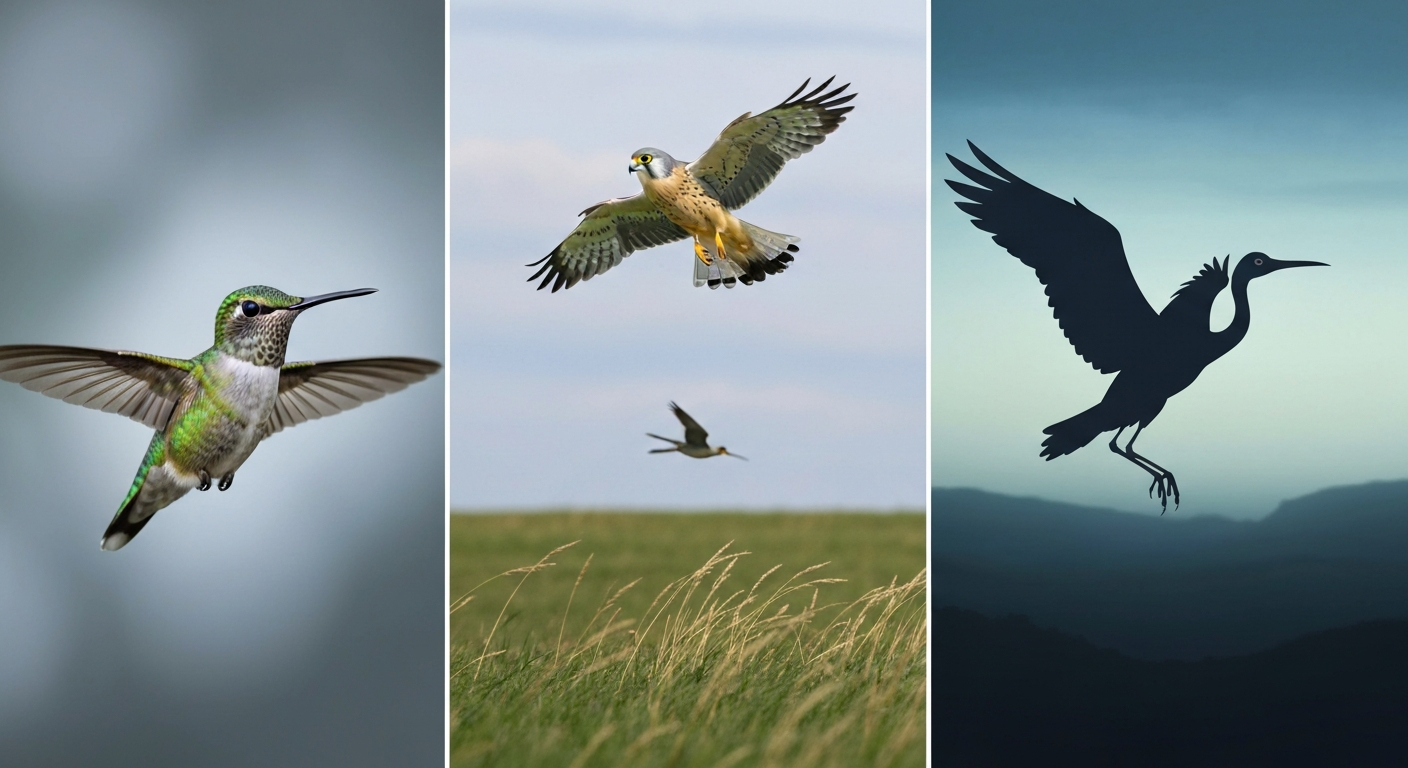
True sustained hovering by flapping is one of the most energetically expensive things a bird can do, and very few species manage it well. Hummingbirds are the gold standard. Using blank" rel="noopener noreferrer">synchronized stereo high-speed cameras running at around 500 frames per second alongside particle image velocimetry (a laser-based technique that maps air movement around the wings), researchers have shown that hummingbird hovering is a continuous, rapid oscillatory motion. High-speed imaging and DPIV studies (500–1000+ fps and very short exposures) have been used to quantify instantaneous flow and lift in hovering hummingbirds, revealing measurable micro-motions even when the bird appears motionless (Three‑dimensional flow and lift characteristics of a hovering ruby‑throated hummingbird, PMC) blank" rel="noopener noreferrer">Three‑dimensional flow and lift characteristics of a hovering ruby‑throated hummingbird — PMC (high‑speed camera / DPIV methods). The wings beat roughly 40 to 80 times per second depending on species and conditions. On the downstroke the wing generates the majority of lift, but the upstroke contributes roughly 25 percent as well, an asymmetric but surprisingly efficient arrangement. The body appears still to our eyes because all that energy is being directed straight down into counteracting gravity, not forward into locomotion. Sub-wingbeat micro-motions of the body and wing joints are measurable in lab reconstructions but invisible to the naked eye and even to regular video.
Kestrels achieve something that looks almost identical but works very differently. A kestrel wind-hovers, or kites, by facing into a headwind and continuously morphing its wings and tail to stay in one spot relative to the ground. Detailed motion-tracking research has quantified just how many degrees of freedom the bird uses: the primary feathers spread and retract, the tail fans or narrows, and the wrist angle shifts by small but precisely controlled amounts many times per second. The bird is riding the wind rather than fighting gravity with pure flapping power. On a calm day kestrels do not hover well; on a gusty day they look almost supernatural.
Other raptors, including some kites and certain terns, use variations of this strategy. The common thread is continuous, active adjustment rather than passive stillness. The bird is working hard; we just cannot see the work at normal time resolution.
| Species / Group | Mechanism | Wind Dependent? | Wing Beat Rate (approx.) |
|---|---|---|---|
| Hummingbirds | True flapping hover, symmetric figure-8 wing stroke | No | 40–80 beats/sec |
| Kestrels | Wind-kiting, continuous wing/tail morphing | Yes | Low, intermittent |
| Black kites / Soaring raptors | Thermal and orographic updraft soaring | Yes (thermals) | Minimal flapping |
| Albatross | Dynamic soaring / wind shear exploitation | Yes (wind gradient) | Rare flapping |
| Some terns | Wind-hovering before dive | Partly | Moderate |
Wind, lift, and air currents: when the sky itself holds a bird still
Even species that are not specialized hoverers can look frozen under the right atmospheric conditions. Thermal updrafts, orographic lift (air pushed upward by a hillside or cliff), and wind shear layers can all produce localized upward air movement that exactly counteracts a bird's tendency to descend. Studies tracking black kites in fine-scale airspace show a tight match between where birds slow or station-hold and where updraft cores are located. The bird is not generating extra lift; it is simply finding the air that is already rising fast enough to carry it.
Wind shear and small-scale turbulence add another layer. Research published in The Auk demonstrated that intermittent, shear-induced turbulence can act as a genuine flight subsidy for soaring birds, allowing them to maintain altitude or even gain height with minimal flapping. From the ground, a bird riding such a patch of turbulence may appear completely motionless against the sky for seconds at a time, especially if it is also facing into the wind so it has no apparent lateral movement. The visual system anchors the bird against the background and perceives no change: frozen.
Why a moving bird can look frozen: kinematics, head stabilization, and visual perception
One of the most underappreciated contributors to the frozen-bird illusion is head stabilization. Many birds, including pigeons, raptors, and owls, can hold their heads almost perfectly still relative to the world while their bodies and wings move actively beneath them. This is not a trick or conscious effort: it is driven by deeply integrated reflexes including the vestibulo-ocular reflex (which counters head rotation), the vestibulo-collic reflex (which stabilizes neck muscles against body motion), and the optokinetic reflex (which uses visual flow to make fine corrections). Research on pigeons has shown that these systems work in concert to correct for both translational and rotational disturbances, keeping the retinal image stable for sharp visual processing.
The practical result: a hovering kestrel's head does not bob even as the rest of the body pitches and rolls with each wing stroke and gust. Because our visual attention is drawn to the animal's face and eyes, the stillness of the head creates a powerful impression that the whole bird is stationary. Wing motion, which is peripheral and rhythmic, gets neurally suppressed in a way similar to how we stop consciously noticing a ceiling fan after a few seconds. The bird's body may be in continuous micro-motion, but the head anchors our perception to a fixed point.
Photographic and optical illusions that create 'frozen' birds
Still photography can genuinely freeze a bird in a way the human eye cannot. A shutter speed of 1/1000 of a second or faster will stop all visible wing motion in a single frame, producing an image of a bird that looks suspended in space with no motion blur whatsoever. Wildlife photographers routinely use 1/2000s or 1/4000s for this reason. Off-camera strobes with very short flash durations can do the same thing even when ambient light requires a slower shutter.
Video introduces a different kind of illusion: temporal aliasing, also known as the wagon-wheel or stroboscopic effect. When a camera samples a periodic motion (like a wingbeat) at a frame rate that is a near-multiple of the motion's frequency, the wings can appear to slow dramatically, reverse direction, or stop entirely in the footage. Consumer cameras typically record at 24, 30, or 60 frames per second, which is far too slow to resolve a hummingbird's 40+ beats per second. The result can look uncannily like a motionless bird floating in frame.
Perspective and parallax add another layer. A bird flying directly toward or away from the camera, or moving exactly parallel to it at the same speed as a panning shot, will appear stationary against a blurred background. This is pure geometry, not biology, but it is responsible for many compelling 'frozen bird' clips shared online. The bird is moving; the framing hides the fact.
How filmmakers and animators make a bird appear frozen
Cinema has a long toolkit for suspending time, and birds are a favorite subject. The most technically demanding method is time-slice photography, sometimes called bullet-time, which uses an array of still cameras positioned around a subject and fired nearly simultaneously. The result is a moment in time seen from a moving virtual camera angle, with the subject completely frozen. For birds in open air this requires careful synchronization and usually some compositing to clean up the background.
More commonly in wildlife documentary work, high-speed digital cameras such as the Vision Research Phantom series capture footage at hundreds or even thousands of frames per second. A wingbeat that takes 1/50 of a second in real time becomes several seconds of smooth slow-motion footage when played back at 24 fps. Editors can then hold a single frame, creating a freeze-frame that can last as long as the story requires. The feathers, the droplets of water, the curvature of the wing: all rendered with scientific accuracy in apparent stillness.
In animation the tools are different but the intent is similar. Rotoscoping, where animators trace over real footage frame by frame, can produce hyper-realistic bird motion and allows precise control over when and how movement slows or stops. CGI rigs built from photogrammetry of real birds allow animators to pose a bird at any point in its wingbeat cycle and hold it there indefinitely. In Flow (2024), the recurring large wading bird (identified by many reviewers as a secretarybird-like character) appears at moments of narrative stillness in ways that feel deliberately poetic rather than naturalistic. The secretarybird in real life is primarily a terrestrial, stomping predator that soars but is not a specialized hoverer, so any extended midair pause in that film is a stylized choice by the animators, not a natural-history claim.
The frozen bird in Flow and in similar animated or cinematic works is worth thinking about separately from the biological question, because the image carries symbolic cargo: stillness as threshold, the moment before transformation, or the suspension of ordinary time. Readers curious about what the bird in Flow specifically represents and why it leaves or stays will find that reading the film through its visual language is at least as rewarding as tracking its biology. The narrative context of the film's bird has generated genuinely interesting interpretive discussion worth exploring alongside the biomechanics. For more on the bird's narrative exit and its interpretations, see the discussion titled 'Flow movie: why did the bird leave'.
Is the bird alive or injured? What to actually look for
A bird that is genuinely motionless in an unusual place, on the ground, on a windowsill, or slumped on a branch, is a different situation entirely from a kestrel kiting over a field. The frozen look in an injured bird comes not from aerodynamic mastery but from shock, concussion, or physical trauma. Window collisions are among the most common causes: the American Bird Conservancy notes that many birds that strike glass and appear to fly away afterward still die from internal injuries, including brain hemorrhage, within hours.
Distinguishing a healthy hovering bird from an injured or stunned one is usually straightforward if you know what to look for.
| Sign | Healthy / Hovering Bird | Injured or Stunned Bird |
|---|---|---|
| Wing symmetry | Both wings held and moving symmetrically | One or both wings drooping or asymmetric |
| Body posture | Upright, alert, weight centered | Hunched, tilted, unable to right itself |
| Eye and head tracking | Eyes open, actively tracking surroundings | Eyes half-closed, dull, not tracking |
| Breathing | Normal, not visible from a distance | Labored, open-beak panting at rest |
| Response to approach | Flies away or adjusts position immediately | Does not move or barely reacts |
| Bleeding or visible damage | None | Feathers matted with blood, swelling |
| Duration of stillness | Brief station-hold, then moves | Prolonged immobility on ground or low perch |
A quick field checklist
- Is the bird in the air or on a solid surface? (Air = likely natural; ground without movement = possible injury)
- Are both wings held symmetrically and close to the body when resting?
- Do the eyes look open, bright, and tracking your movement?
- Does the bird respond to your approach from 3 to 4 meters away?
- Is there any visible blood, swelling, or obviously broken feathers?
- Has it been in the same spot for more than 10 to 15 minutes without moving?
If the answers point toward injury, the next section covers what to do.
What to do if you find a 'frozen' bird: safe, legal, and effective next steps
The first and most important step is to observe without touching. Many stunned birds are simply concussed from a window strike and will recover on their own within 30 to 60 minutes if they are in a safe, quiet spot. Keep people and pets away, note the time, and watch from a comfortable distance. Do not offer food or water to a stunned bird: an unconscious or semi-conscious animal can aspirate liquid and the intervention does more harm than good.
If the bird is on the ground in an exposed location where cats, traffic, or other hazards are present, or if it shows signs of serious injury (bleeding, a broken wing, inability to stand), gentle containment is appropriate. Place the bird carefully in a ventilated cardboard box lined with a clean cloth or paper towel. Keep the box in a warm, quiet, dark location. Darkness reduces stress significantly. Do not check on it repeatedly.
Then contact a licensed wildlife rehabilitator. In the United States, handling wild birds without a permit is regulated under the Migratory Bird Treaty Act, and most native species are federally protected. Providing short-term emergency shelter while arranging transfer to a licensed rehabber is generally considered acceptable under the law, but keeping the bird or attempting ongoing care is not. The Cornell Lab of Ornithology's All About Birds website and the Wildlife Rehabilitators Association of your region maintain directories of licensed rehabilitators by location. In the UK, the RSPCA operates a wildlife emergency line. In most countries, your national or regional wildlife authority can provide a referral.
If a bird struck a window and flew away but you are concerned, mark the time and check the area again in an hour or two. Birds with internal injuries from glass collisions often settle nearby and deteriorate over several hours. If you find the bird again in a worse condition, the containment-and-referral steps above apply.
When NOT to intervene
- A bird hovering in open air over a field or water: this is normal behavior, leave it alone
- A fledgling sitting on the ground near a bush: fledglings are meant to be on the ground for days while parents feed them, intervention separates families unnecessarily
- A raptor perched unusually low after a hunt: raptors often rest on low perches with prey; proximity to humans does not mean injury
- A bird that moves away normally when you approach from several meters: a bird that can flee does not need rescuing
Wildlife rehabilitation laws exist because well-intentioned handling causes real harm: stress-induced death, imprinting, nutritional errors, and disease transmission between birds are all documented risks. The best thing most observers can do is watch carefully, minimize disturbance, and make one informed phone call to a professional rather than attempting treatment. That applies whether the bird in question is a real stunned thrush on your windowsill or a beautifully rendered secretarybird suspended in a frame of an animated film, each image prompts the same good question: what is actually happening here, and what does it mean?
FAQ
Can a bird truly “freeze” in midair, or is that an illusion?
No—birds do not literally stop all motion in midair. Some species can hold position relative to the ground for extended periods (true hovering or station‑holding), but that is achieved by rapid wingbeats, subtle wing/tail morphing and exploiting wind or thermal lift. High‑speed studies show continuous, often asymmetric, unsteady motions and vortex shedding even during sustained hovering; what looks motionless to the eye is rapid micro‑motion that ordinary vision or standard video frame rates cannot resolve.
What natural/biomechanical mechanisms make a bird appear frozen in air?
There are three main natural causes: 1) Active hovering: e.g., hummingbirds produce lift mostly on the downstroke with continuous wingbeats at very high frequency; careful kinematic studies and flow measurements show nonzero motion each wingbeat. 2) Wind‑hovering or kiting: raptors like kestrels face into a wind and use small wing and tail adjustments to stay stationary relative to the ground, exploiting wind gradient and orographic lift. 3) Environmental lift (thermals, shear, tiny updrafts): some birds can station‑hold with little flapping by riding localized lift. In all cases the bird is making fast or small adjustments—what appears ‘‘frozen’’ is an unresolved, rapid, or subtle motion.
How do head‑stabilization and perception make the whole bird look motionless?
Many birds actively stabilize their heads using vestibular and visual reflexes so the eyes remain fixed on a target while the body and wings move. That stable head and eye position reduces perceived motion for an observer and increases the illusion that the entire bird is still, even though wings and body are oscillating at high frequency.
What photographic or optical effects can make a bird look frozen in photos or video?
Several man‑made factors cause the impression of frozen motion: 1) Fast shutter speeds or short flash durations (e.g., 1/1000 s or shorter) remove motion blur and capture a single wing position. 2) High‑speed cameras record many frames per wingbeat and can be played back frame‑by‑frame or composited to appear frozen. 3) Temporal sampling and stroboscopic aliasing (wagon‑wheel effect) can make cyclic wing motion appear slowed, reversed or stationary on lower frame‑rate video. 4) Rolling shutter, frame blending, or pulsed lighting can also create odd apparent stillness or stepwise motion.
How can I tell if a bird that looks motionless is alive and healthy, stunned/injured, or dead? What should I do?
Signs a bird is actively hovering/healthy: symmetric, regular wingbeats; active head/eye tracking; ability to perch or fly off quickly when disturbed. Signs of injury or being stunned: asymmetric or drooping wings, labored breathing, visible bleeding, inability to perch, or prolonged immobility (minutes to hours). Practical steps: 1) Observe from a distance for a few minutes without crowding. 2) If it flies off or perches and behaves normally, no action needed. 3) If it is stunned (e.g., window collision) or clearly injured, place it in a dark, ventilated box in a quiet warm place and contact a licensed wildlife rehabilitator or local bird rescue for instructions. Do not force feed or give water. Many organizations (Cornell Lab, American Bird Conservancy) provide guidance on window collisions and rehab referral.
Which bird species actually hover and which rely on wind or thermals?
True sustained flapping hoverers are specialized—hummingbirds are the classic vertebrate example. Other species achieve station‑holding differently: kestrels and some small raptors kite into the wind to hold position; terns and kingfishers may briefly suspend, and many large birds (kites, vultures, albatross) use thermals or wind gradients to remain over a spot with minimal flapping. Species matter: a long, stationary hover depicted for a non‑hovering bird in nature is usually stylized.