When people search 'when black bird fly,' they're usually asking one of two things: when during the day or year do birds called blackbirds actually take flight, or they're echoing the Beatles lyric 'Blackbird fly' from Paul McCartney's 1968 song. If you actually meant the specific query 'when a bird flies lsat', see the related note when a bird flies lsat for a focused explanation. Both are worth answering. In nature, the timing of blackbird flight depends on which species you mean, the time of year, the weather, and even whether the bird lives in a city or a forest. The short version: most birds called blackbirds are active from dawn, begin migrating in response to changing daylength and fat reserves, and can switch to night flight entirely during migration season.
When Black Bird Fly: Why, How, and Where Blackbirds Travel

What 'blackbird' actually means (it's complicated)
The word 'blackbird' doesn't point to a single species. It overlaps two completely separate bird families on opposite sides of the Atlantic, which causes real confusion in searches and field guides alike.
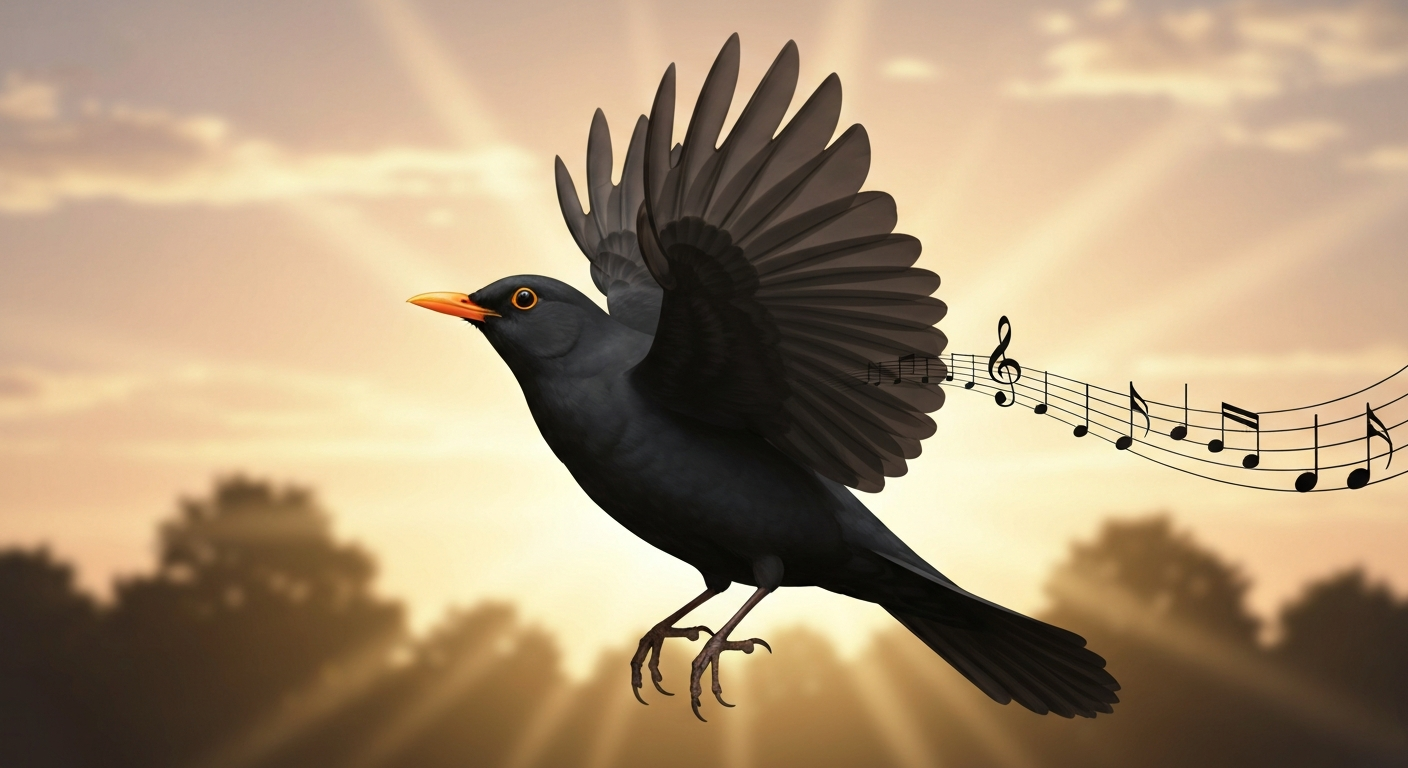
In Europe and much of Africa and Asia, 'blackbird' almost always means the Common Blackbird, or Eurasian Blackbird (Turdus merula), a thrush in the family Turdidae. The male is entirely glossy black with a bright orange-yellow bill and eye ring. The female is brown with a streaked breast. This is the bird Paul McCartney almost certainly had in mind, and the one singing before dawn in British gardens.
In North America, 'blackbird' is a looser common name applied to several species in the family Icteridae, a New World group that isn't closely related to Turdus merula at all. The most frequently encountered include the Red-winged Blackbird (Agelaius phoeniceus), Brewer's Blackbird (Euphagus cyanocephalus), Rusty Blackbird (Euphagus carolinus), and Common Grackle (Quiscalus quiscula). Authoritative North American checklists list these species under common names containing 'blackbird' or 'grackle' (Avibase / AOS Checklist (North America)) Authoritative North American checklists list these species under common names containing 'blackbird' or 'grackle' (Avibase / AOS Checklist (North America)).. These birds share dark plumage but differ enormously in size, ecology, migration, and flight style.
| Species | Family | Range | Migration status | Notable flight behavior |
|---|---|---|---|---|
| Common Blackbird (Turdus merula) | Turdidae | Eurasia, N. Africa; introduced Australasia | Partial migrant; resident in urban/western areas | Nocturnal migration in migratory populations; dawn song flights |
| Red-winged Blackbird (Agelaius phoeniceus) | Icteridae | North America | Migratory in northern populations | Large mixed-flock migrations; dawn roost departures |
| Brewer's Blackbird (Euphagus cyanocephalus) | Icteridae | Western/central North America | Partially migratory | Open-country forager; tight flock movements |
| Rusty Blackbird (Euphagus carolinus) | Icteridae | Boreal North America | Long-distance migrant | Migrates through forested wetlands; declining population |
| Common Grackle (Quiscalus quiscula) | Icteridae | Eastern North America | Partially migratory | Forms massive communal roosts; keel-shaped tail in flight |
How to tell these birds apart in the field
If you're watching a black bird fly overhead and wondering what it is, a few quick cues help narrow it down fast.
Common Blackbird (Turdus merula)
- Size: roughly that of a starling, about 24–29 cm; plump, round-bodied
- Male: all black with vivid orange-yellow bill and eye ring; female brown with pale throat and faint streaking
- Flight: relatively direct, with shallow undulating bounds; wings pulled in briefly between flap sequences
- Call in flight: a loud, rattling 'chink-chink-chink' alarm call, especially at dusk when flushed from cover
- Behavior: tends to run across open ground then fly to cover; pumps tail on landing
Red-winged Blackbird (Agelaius phoeniceus)
- Size: 17–23 cm; stocky build with a conical bill
- Male: black with red-and-yellow shoulder patches (epaulets) visible in flight; female heavily streaked brown
- Flight: direct with steady flapping; red shoulder patches flash conspicuously when the wings open
- Call: a harsh 'check' or the distinctive 'konk-la-ree' song from perches
- Behavior: forms enormous mixed flocks in autumn; mass departures from wetland roosts at dawn are a dramatic sight
Common Grackle (Quiscalus quiscula)
- Size: noticeably larger than a Red-winged Blackbird, up to 34 cm; long keel-shaped tail is the best flight ID feature
- Iridescent purplish-green sheen visible in good light; pale yellow eye
- Flight: long tail gives a distinctive cross or kite shape in silhouette
- Call: a harsh, creaky 'readle-eak'
When blackbirds actually take off: daily patterns
For non-migratory blackbirds, the daily flight schedule is driven by foraging needs and predator pressure. Common Blackbirds are dominantly diurnal, with peak activity starting at dawn, sometimes before first light in urban areas where artificial lighting tricks their internal clocks into an earlier start. A long-term experimental study found that chronic light pollution advanced dawn activity and shifted seasonal functions in European Blackbirds (Turdus merula) Long-Term Effects of Chronic Light Pollution on Seasonal Functions of European Blackbirds (Turdus merula) — PMC. Urban Turdus merula consistently begin dawn song and foraging activity earlier than their forest counterparts, a well-documented effect of chronic light pollution on their circadian timing.
At dusk, blackbirds of most species fly to communal roost sites. This produces one of the most visually striking behaviors in birding: large flocks of Red-winged Blackbirds, grackles, and Brewer's Blackbirds streaming in from feeding areas to gather in a chosen grove of trees or reed bed. The roost approach is noisy, chaotic, and often involves thousands of birds. The reverse happens at dawn, when the roost erupts in a mass departure that spreads birds across the surrounding landscape.
When disturbed, blackbirds use explosive escape flights. A Common Blackbird flushed from a hedge produces that sharp rattling alarm call mid-flight, which alerts nearby birds and often triggers a cascade of departures. Red-winged Blackbirds flushed from a marsh lift as a flock, spreading in a wave across the water. These escape flights are low, fast, and direct, prioritizing speed over energy efficiency.
Seasonal timing: when do blackbirds migrate?
Not all blackbirds migrate. The Common Blackbird is a partial migrant: populations in the UK, urban western Europe, and milder coastal zones are year-round residents, while birds from Scandinavia, northern and eastern Europe, and higher altitudes move south and west for winter. This is why British gardens get a rush of 'extra' blackbirds in October and November as continental birds arrive.
Red-winged Blackbirds breeding in northern North America show a more predictable seasonal movement. Geolocator studies tracking male Red-winged Blackbirds found that spring migration typically begins between mid-February and late March, with birds using the Central and Mississippi flyways as primary corridors. Fall departure runs from mid-October through late November. Interestingly, females often migrate farther south than males, and spring migrations can take longer than fall journeys, possibly because birds are moving more cautiously into breeding territories.
One of the most remarkable migration behaviors in the Common Blackbird is the switch from daytime to nighttime activity. For most of the year, this is a strictly diurnal bird. But in the days immediately before departure on migration, individuals shift into nocturnal restlessness, a state called Zugunruhe (from German, meaning 'migratory restlessness'). Field actogram studies have confirmed this as an abrupt behavioral switch, not a gradual change, coinciding with the bird's physiological readiness to depart. This is part of why radar screens across Europe light up with passerine migrants on clear autumn nights.
What triggers flight: photoperiod, fat, weather, and hormones
Migration timing isn't random. It runs on a biological clock calibrated by daylength (photoperiod), then fine-tuned by a set of proximate cues that tell the bird when conditions are safe and favorable to actually depart.
Photoperiod is the master signal. As days lengthen in spring or shorten in autumn, light-sensitive cells deep in the brain trigger hormonal cascades that restructure the bird's physiology: gonads enlarge, fat deposits increase through hyperphagia (the bird eats substantially more), and the circadian clock is reset toward migratory timing. This process is largely innate and endogenously programmed, meaning the bird doesn't need to experience cold temperatures to know migration is coming.
Fat stores are the key gating mechanism at stopovers. A bird with insufficient fuel reserves won't depart even if the calendar says it should. Studies across passerine migrants show that higher fat reserves predict higher departure propensity. Hormones including ghrelin (which signals hunger and fat mobilization), corticosterone (a stress hormone that also fuels endurance behavior), and melatonin (which governs night-time physiology) all interact to regulate migratory departure decisions.
Weather matters enormously at the departure decision. Favorable tailwinds substantially reduce the energy cost of a night's flight. Falling barometric pressure, precipitation, or strong headwinds cause birds to delay. This is why migration watchers and radar operators know that a high-pressure ridge moving through after a cold front will produce a massive 'fall' of migrants the following dawn. Temperature alone is a weaker trigger than photoperiod, but cold snaps can accelerate departure from northern stopover sites.
How blackbirds actually fly: wings, wingbeats, and lift
A Common Blackbird's wings are moderately rounded with a medium aspect ratio, a shape that balances maneuverability through trees and shrubs with enough aerodynamic efficiency for sustained flight. Compare this to a swift's long, narrow, scythe-like wings, which are optimized for continuous aerial life, or the broad, slotted wings of a buteo hawk, which are built for thermalling. Wing shape is a direct record of evolutionary pressure.
The aerodynamics of bird flight follow the same physical principles as aircraft: the curved upper surface of the wing creates lower pressure above than below, generating lift. But birds add something no fixed-wing aircraft can: continuous morphing. During a single wingbeat, a blackbird adjusts primary feather spread, camber, and wing area in real time, generating thrust on the downstroke and reducing drag on the upstroke by partially folding the wing.
Radar and acoustic studies measuring Turdus merula wingbeat frequency during migratory flight report values around 8.9 Hz, meaning roughly nine complete up-down cycles per second. This is lower than many smaller passerines, consistent with the blackbird's larger body mass and rounder wing shape. By comparison, thrush wingbeat frequency (around 11 Hz for the thrush family as a group in some radar analyses) is still higher than that of larger birds like ducks or pigeons.
Blackbirds use at least three distinct flight modes depending on context:
- Continuous flapping: used for takeoff, short bursts across open ground, and escape flights. Energetically expensive but necessary for rapid acceleration.
- Bounding flight: alternating flap bursts with brief closed-wing glides, creating the undulating path common in many small passerines. This reduces average power consumption compared to constant flapping over medium distances.
- Sustained migratory flight: during nocturnal migration, blackbirds maintain relatively steady flapping with occasional short glides, optimizing for distance rather than agility. Radar studies show most passerine migrants fly below 300 m on typical nights, though favorable tailwinds can push altitudes to 1,000–2,000 m or higher.
Energy and metabolism: how blackbirds power their flights
Flight is metabolically the most expensive activity any bird performs. A passerine in sustained migratory flight burns energy at roughly 8 to 10 times its basal metabolic rate. This is why the pre-migration hyperphagia phase matters so much: a Red-winged Blackbird or Common Blackbird heading south must carry sufficient fat to fuel potentially hundreds of kilometers of overnight flight, sometimes without a refueling stop.
Wing morphology directly predicts how efficiently a species can do this. Research comparing wing loading (body mass divided by wing area) and aspect ratio (wing length squared divided by wing area) across migrants confirms that species with lower wing loading and higher aspect ratios tend to accumulate more fuel relative to body mass before migration, because efficient wings allow them to carry heavier fuel loads without catastrophic aerodynamic penalties. Blackbirds sit in a middle range: capable of meaningful migration, but not optimized for the multi-thousand-kilometer nonstop flights of species like shorebirds.
Short local flights, like the daily commute from a roost to a feeding field, are powered almost entirely by carbohydrates and recently consumed food. The physiological systems for these two flight regimes (daily foraging vs. migratory endurance) are quite different. During migration, birds shift to fat oxidation as their primary fuel, a metabolic mode that also produces metabolic water as a byproduct, which partially offsets dehydration over long flights.
There's a genuine trade-off in flight style here. Bounding flight saves energy on medium-distance trips but produces variable ground speeds. Sustained flapping, used during intense migratory bouts, is costly but predictable and powerful. Birds modulate which mode they use partly based on the distance they need to cover and partly based on how much fuel they're carrying. A fat, fuel-loaded bird before departure actually flies more efficiently with a higher wing loading than a lean bird, because the extra mass is mostly in the fuselage, not the wings.
The Beatles, the phrase, and what else people might be asking
It's worth pausing on the cultural dimension of this search. Paul McCartney's 'Blackbird,' recorded in 1968, includes the famous lines 'Blackbird fly, blackbird fly, into the light of the dark black night.' McCartney has said the song was partly inspired by hearing a real blackbird's song, and the lyrical image of a bird taking flight toward freedom has made it one of the most referenced bird metaphors in popular music. When people search 'when black bird fly,' some are genuinely looking for that song lyric, not a field guide. If you meant the lyric or background on the song, see who bird fly for more on the song's meaning and history.
Related searches on this site touch on other flight questions worth connecting here. For broader questions about where birds fly, see where does bird fly. The question of birds flying in V-formation, for instance, doesn't apply to blackbirds at all. If you're asking which bird fly in v shape, that question is covered on the page about species that use V-formation flight (for example, geese, pelicans, and swans). Blackbirds fly in dense, swirling flocks called murmurations or loose aggregations, not the organized V-formations used by geese, pelicans, and swans. The aerodynamic logic of V-formation flight, where each bird recovers energy from the wingtip vortex of the bird ahead, requires large birds with relatively slow wingbeats. Blackbirds fly too fast and too erratically for this strategy to work. Similarly, the question of whether swans, as flying birds, are comparable to blackbirds is an interesting size and wing-loading contrast: a mute swan outweighs a Common Blackbird by roughly 50 to 1, flies at much lower wingbeat frequencies, and uses almost exclusively flapping flight without the bounding gait typical of smaller passerines. For more on how a swan is a flying bird and how its flight contrasts with blackbirds, see swan is flying bird.
The idea of an 'iron bird' flying belongs to a different conversation entirely, one that involves human aviation metaphors, Tibetan prophecy, and the history of aircraft design rather than ornithology. See the related page "when the iron bird flies" for more on aviation metaphors, Tibetan prophecy, and the history of aircraft design. And the extinct elephant bird, a flightless giant from Madagascar, never flew at all, regardless of what its name might suggest. For more detail on whether the extinct elephant bird could fly, see Can elephant bird fly. These are connected questions about what flight means and which birds can actually do it, and they're worth exploring in their own right across this site's related pages. For a contrasting take, see the related page titled "every bird that flies is green".
A few common misconceptions, cleared up
- Not all black birds are blackbirds: crows, ravens, starlings, ani, and many others are black but belong to completely different families and have different flight styles, migration behaviors, and ecologies.
- Black plumage doesn't affect flight performance in any meaningful aerodynamic way: feather color relates to melanin and UV protection, not lift or drag.
- Blackbirds are not nocturnal by default: they become nocturnal migrants seasonally, but outside of migration they are strictly day-active birds whose schedule shifts with artificial light in cities.
- Female and male blackbirds of many species look completely different: a streaky brown bird at your feeder in winter may well be a female Red-winged Blackbird, not a sparrow.
- The communal roosts of North American icterid blackbirds can number in the millions and span several states: what looks like a local flock is often part of a much larger continental-scale movement visible on weather radar.
FAQ
What does the query “when black bird fly” usually mean?
The phrase is ambiguous. It commonly returns two intents: (1) cultural/lyrical — references to songs or poetry (for example The Beatles’ “Blackbird” lyric “Blackbird… fly”), and (2) natural-history — practical questions about when birds called “blackbird” take flight (daily activity, seasonal migration timing, triggers). Search results often mix pages about the song with field‑naturalist information about species named “blackbird.”
Which species are people referring to when they search “blackbird”?
“Blackbird” names several taxonomically distinct birds. In Eurasia/Africa it usually means the Eurasian or Common Blackbird (Turdus merula, a thrush). In the Americas it commonly refers to members of the Icteridae family (e.g., Red‑winged Blackbird Agelaius phoeniceus; Brewer’s Blackbird Euphagus cyanocephalus; Rusty Blackbird Euphagus carolinus; Common Grackle Quiscalus quiscula). Identification cues: Turdus merula — solid black (male) with yellow bill and eye‑ring, thrush shape and melodious song; Icterids — slimmer, often iridescent, may show wing or shoulder patches (red, yellow), different calls, flocking behavior.
When do blackbirds take off each day (daily timing)?
Most blackbird species are diurnal: they forage and sing by day with peak activity at dawn and in the morning. Eurasian/Common Blackbirds show strong dawn activity (dawn song, foraging). Many Icterids also show dawn and dusk movement, but large communal roosts of Icterids can produce very visible mass departures at dawn and mass arrivals at dusk. Urban blackbirds may start earlier and sometimes forage into night under artificial light.
When do blackbirds migrate (seasonal timing) and how do they depart?
Timing depends on species and population. Many thrushes (Turdus merula populations) and many passerines are partial migrants — some individuals are resident, others migrate. In temperate zones, migration seasons are typically spring (Feb–May depending on latitude) and fall (Aug–Nov). Icterids such as Red‑winged Blackbirds often begin spring migration in late winter–early spring (mid‑Feb to late Mar) and fall migration in mid‑Oct to late Nov. Departures are controlled by an internal circannual/circadian program (photoperiod) plus proximate cues (fat stores, hormones, weather). Some thrushes show an abrupt switch to nocturnal migratory activity (Zugunruhe) immediately before departure.
Do blackbirds migrate at night or during the day?
Most small landbird migration (including many thrushes and blackbird‑type passerines) is predominantly nocturnal in temperate regions. Radar studies show dense nocturnal layers of passerine migrants. However, some species and populations also move during the day (especially raptors, waterfowl, and flocking Icterids during local dispersal or communal roost movements).
How high and how far do blackbirds fly during migration?
Flight altitude and distance vary. Radar studies show passerine migration layers commonly below ~300 m AGL, but many migrants concentrate between ~300–2,000+ m depending on night and weather; occasional records show migrants above 3–4 km in extreme cases. Distances depend on species and population: some are short‑distance or partial migrants (local shifts), while others travel hundreds to thousands of kilometers along flyways (Red‑winged Blackbirds use Central and Mississippi flyways; individuals show breeding–wintering site fidelity). Flight distance and daily range are influenced by wing morphology, fat stores and stopover opportunities.
Who Bird Fly: Which Birds Fly, How, and Why They Do - Flight Science & Myths
Explore which birds fly, how they do it, flightless species, V-formations, and migration basics.