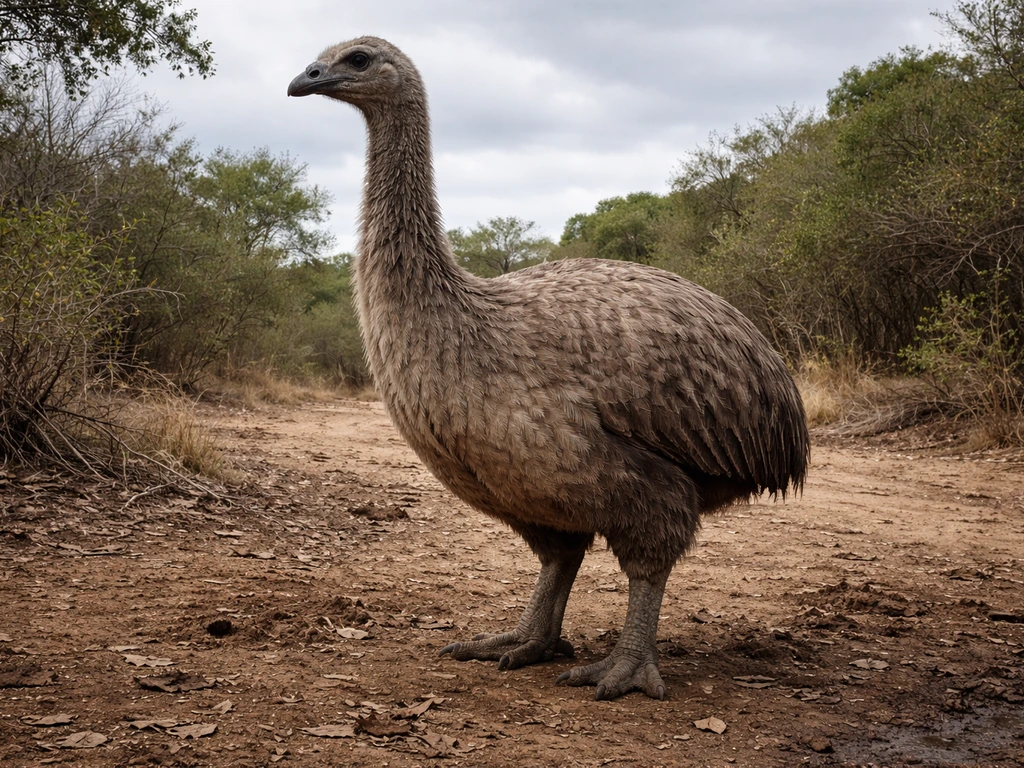
No, elephant birds could not fly. These massive Madagascan birds were completely flightless, and every piece of anatomical and evolutionary evidence we have confirms it. They lacked the keeled sternum needed to anchor powerful flight muscles, their wing bones were dramatically reduced, their feathers were soft and downy rather than stiff and aerodynamic, and the largest species weighed up to around 540 kg, which is roughly the mass of a large horse. Powered flight was never an option for them, and there is no credible scientific evidence that any elephant bird species ever took to the air.
Can Elephant Bird Fly? Why It Was Flightless Explained

Marcus Chen
2 Jul 2026
Why elephant birds stopped flying in the first place
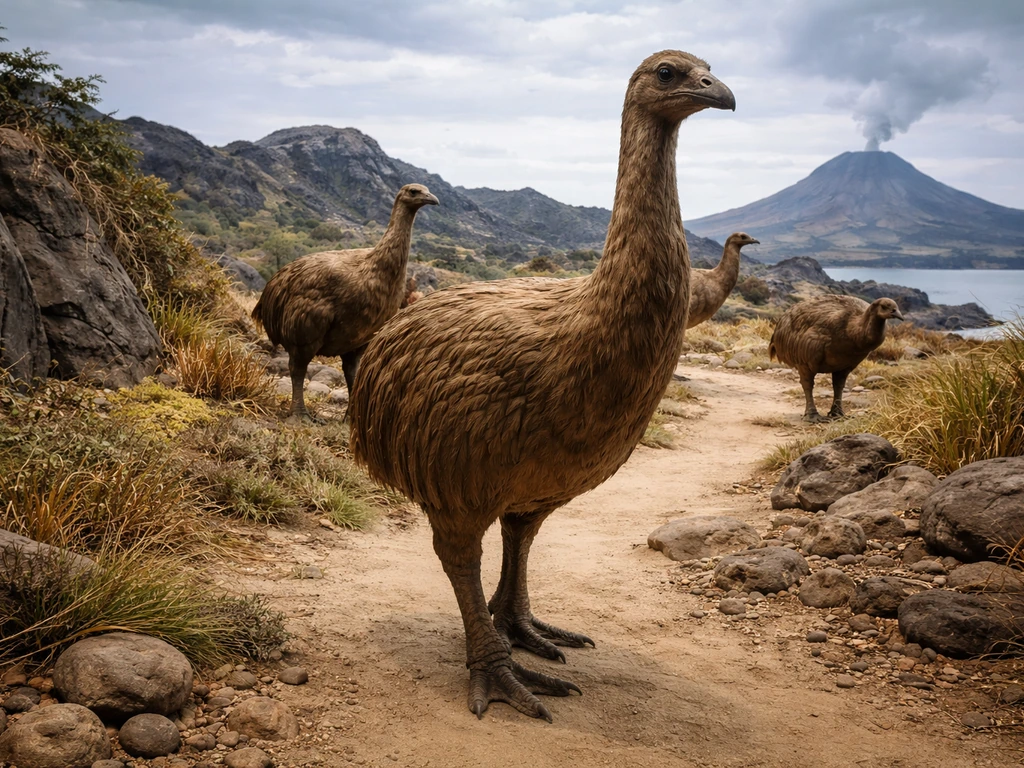
Elephant birds (order Aepyornithiformes, genera Aepyornis and Mullerornis) belong to a group called ratites, which also includes ostriches, emus, rheas, cassowaries, and kiwis. What's genuinely interesting here is that ratites did not start out flightless. Phylogenomic research has made it clear that their ancestors almost certainly could fly, meaning flightlessness in ratites evolved independently, multiple times, through secondary loss. Elephant birds lost flight; they didn't simply never evolve it. As for whether a bird like the elephant bird could ever fly, the evidence points strongly to flightlessness.
The most widely accepted ecological driver for flightlessness in island birds is the absence of predators. On Madagascar, elephant birds evolved in an environment where terrestrial threats were relatively limited, meaning the enormous energetic cost of maintaining flight-capable anatomy offered little survival return. Over generations, selection pressure relaxed, and the traits needed for powered flight were gradually shed. Island ecology is consistently cited as one of the strongest general triggers for flightlessness across bird lineages, and elephant birds fit that pattern well. Brain reconstruction studies also suggest elephant birds were likely nocturnal, with reduced visual processing and a locomotor strategy built around moving efficiently on the ground rather than taking off from it.
It's worth noting that the fossil record for elephant birds is frustratingly thin. Most confirmed fossil material dates only to the last 80,000 years or so, even though molecular evidence suggests the lineage diverged from kiwis back in the mid-Palaeocene. So while we can reconstruct a broad evolutionary narrative, the exact moment and mechanism of flight loss in elephant birds is hard to pin down from bones alone. What we can say with confidence is that by the time elephant birds appear in the fossil record, they were already committed to a fully terrestrial lifestyle.
The anatomy that made flight impossible
The missing keel and what it means
In any bird that flies, the sternum (breastbone) has a prominent ventral ridge called the keel. This is the anchor point for the two major flight muscles: the pectoralis, which drives the powerful downstroke, and the supracoracoideus, which pulls the wing back up. Without a substantial keel, there is simply nowhere to attach muscles large enough to generate lift. Elephant birds, like all ratites, had a flat sternum with no keel. The name 'ratite' itself comes from the Latin 'ratis,' meaning raft, a reference to that flat, unkeeled breastbone. This single anatomical absence effectively rules out powered flight regardless of anything else.
Wing bones, pectoral girdle, and the flight subassembly
In flying birds, the sternum and pectoral girdle (including the coracoids and wishbone) form what researchers sometimes call a near-rigid 'flight subassembly,' a mechanically integrated structure that transfers the forces of muscle contraction into useful wing motion. In elephant birds, this architecture was modified away from flight function. The coracoid and surrounding structures were not built for the compressive and tensile loads that wing-beat propulsion demands. Rheas, close relatives in the ratite family, have been shown experimentally to be incapable of wing-assisted incline running, a basic flapping behavior that even young flight-capable birds can perform. Elephant birds would have been no different, and very likely far more limited given their greater mass.
Feathers that couldn't generate lift
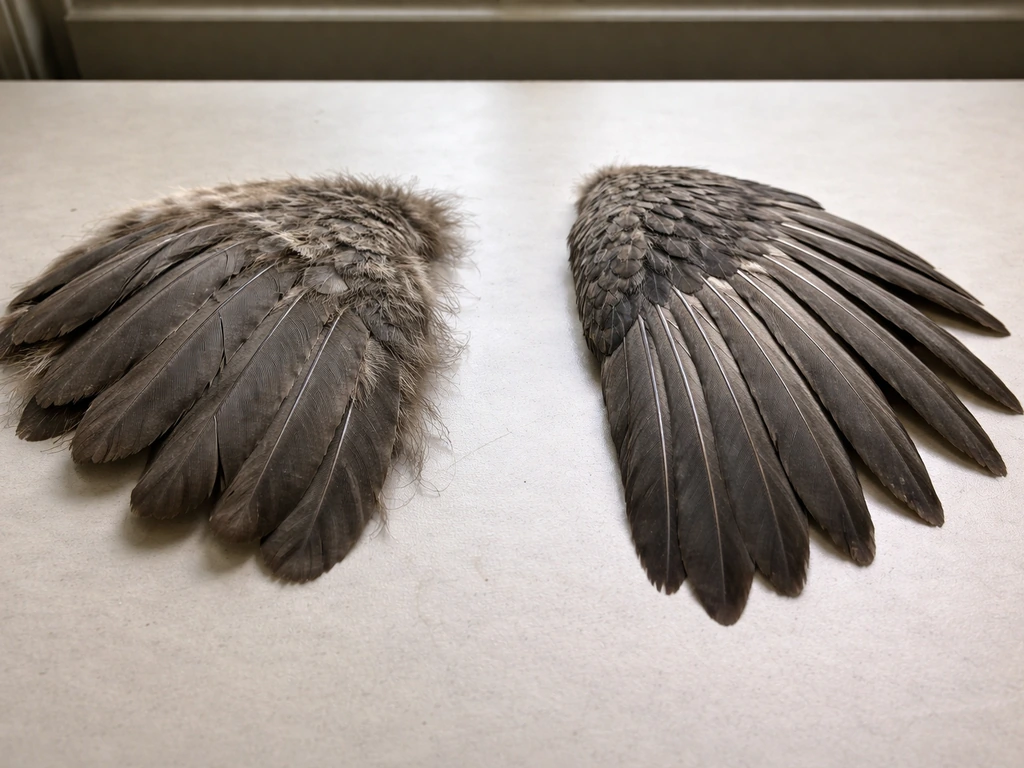
Flight feathers in birds that actually fly are structurally remarkable: long, stiff, asymmetrically shaped, and locked together by microscopic interlocking barbules that form a smooth aerodynamic surface. Ratite wing feathers are nothing like this. Although birds can vary in color, the idea that every bird that flies is green is not supported by what we know about bird species and their pigmentation. They are soft, loose, and downy, lacking the stiffening hooks and the structural integrity needed to push against air. You can't generate meaningful lift or thrust with feathers that behave more like insulation than airfoils. Elephant bird wing feathers were almost certainly the same kind of structurally reduced, decorative remnants seen across other ratites.
Weight and wing loading
Aepyornis maximus, the largest elephant bird species, stood up to around 3 meters tall and weighed as much as 540 kg. A Smithsonian Magazine report discussing a giant elephant bird egg notes that the largest elephant birds could reach sizes like Aepyornis maximus being up to about 10 feet tall, underscoring how immense body size would amplify the lift requirement if wings were inadequate up to about 10 feet tall for Aepyornis maximus. Wing loading, the ratio of body weight to wing area, is one of the core constraints on powered flight. Even if elephant birds somehow had functional keel muscles and proper flight feathers (they didn't), the wing surface area required to lift 540 kg off the ground would be physically impossible to achieve within a bird's body plan. The largest flying birds today, like the great bustard and kori bustard, max out at around 20 kg and are already at the ragged edge of what powered flight can support. Elephant birds were 25 times heavier. The math simply doesn't work.
Hindlimbs built for the ground
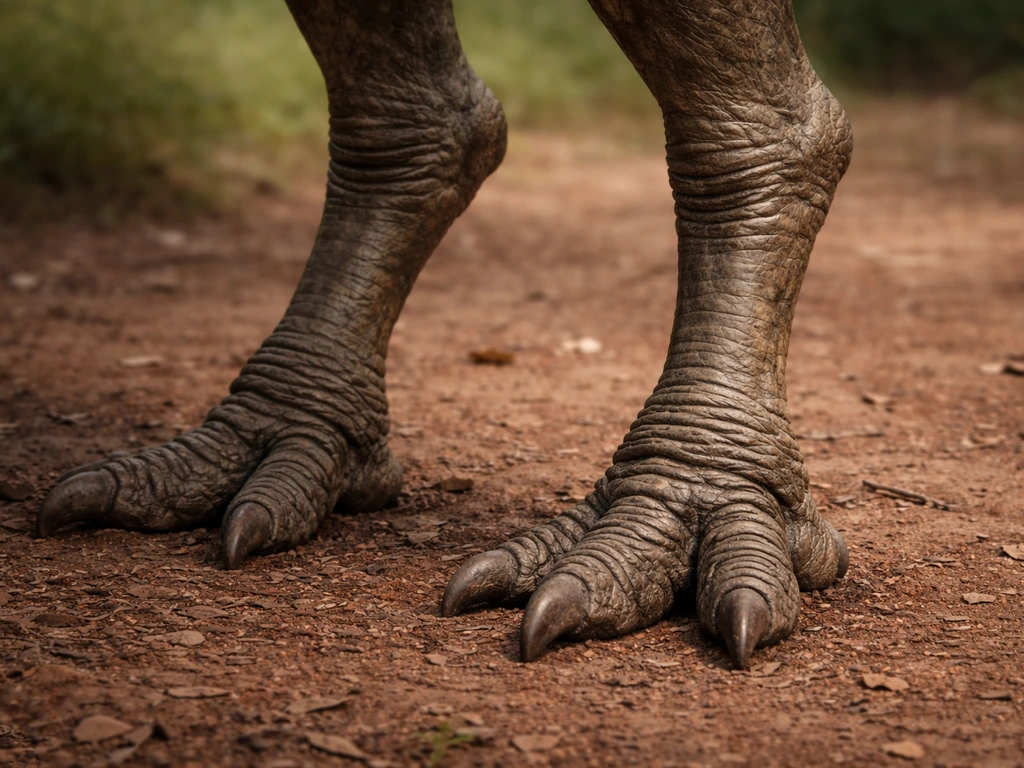
Where the forelimb anatomy of elephant birds was reduced and flight-irrelevant, their hindlimbs were the opposite: robust, heavily muscled, and clearly built for terrestrial locomotion. Their femur was described as short and thick, a configuration associated with load-bearing cursorial animals rather than the lighter, more flexible hind limbs of birds that launch themselves into the air. Everything about the skeletal proportions points to a body designed around walking and running, not flying.
How elephant birds actually got around
Elephant birds were walkers and likely slow runners. Their robust hindlimbs suggest they moved with a deliberate, heavy gait, somewhat like a very large ostrich. They were herbivores foraging across Madagascar's varied landscapes, and their sheer size meant that adult birds had relatively few natural predators to run from. Think of them less as sprinters and more as large, steady foragers covering ground efficiently on foot. Their nocturnal tendencies (suggested by brain endocast studies showing enlarged olfactory regions and reduced optic lobes) also suggest they navigated at night using smell and hearing more than vision, moving through forested and open environments in ways that never required getting airborne.
There is no evidence that elephant birds glided, either. Gliding requires a functional aerodynamic surface, which means stiff, properly structured wing feathers and enough wing area relative to body mass to slow a descent. Elephant bird wings had neither. The idea that a bird this heavy could simply throw itself off a cliff and coast to safety is a fun thought experiment, but it contradicts everything we know about their feather structure and wing anatomy. Their wings were evolutionary vestiges, not backup flight systems. This matters because the bird often asked about in a V-shape flock is usually the migratory goose, not a flightless species like elephant birds.
How elephant birds compare to other flightless birds
Comparing elephant birds to other ratites is one of the best ways to understand why flightlessness happens and what different versions of it look like. All ratites share the flat sternum, but the degree of wing reduction and the reasons for flightlessness vary considerably across the group.
| Bird | Approximate Weight | Height | Wing Status | Notable Locomotion Trait |
|---|---|---|---|---|
| Elephant bird (Aepyornis maximus) | Up to ~540 kg | Up to ~3 m | Tiny vestigial wings, soft feathers | Slow, heavy terrestrial walking |
| Ostrich (Struthio camelus) | Up to ~156 kg | Up to ~2.8 m | Small wings, used for display and balance | Fastest running bird, up to 70 km/h |
| Emu (Dromaius novaehollandiae) | Up to ~60 kg | Up to ~1.9 m | Tiny vestigial wings | Strong sustained runner |
| Kiwi (Apteryx spp.) | Up to ~3.3 kg | ~25–45 cm | Extremely reduced, nearly invisible | Nocturnal ground forager, slow mover |
| Cassowary (Casuarius spp.) | Up to ~85 kg | Up to ~1.8 m | Reduced wings with quill-like shafts | Powerful runner, can swim |
The kiwi comparison is particularly striking. Kiwis share a close evolutionary relationship with elephant birds, a finding confirmed through ancient DNA extracted from elephant bird eggshell. Yet kiwis are tiny nocturnal ground-dwellers while elephant birds were enormous. Both lost flight, but through separate developmental pathways driven by different ecological pressures. This is exactly what the research means when it says flightlessness evolved independently multiple times within ratites. It's not one event; it's a repeated evolutionary solution to similar ecological problems.
Ostriches offer a useful contrast in terms of what a flightless bird can still do with good hindlimbs. They are the fastest running birds alive, capable of sustained speeds around 45 km/h and bursts up to 70 km/h. Elephant birds, given their enormous mass and short femur proportions, were almost certainly not fast runners. They traded speed for bulk, which worked fine in an environment without large predators. The ostrich strategy and the elephant bird strategy are both successful answers to the same evolutionary question, just arrived at through different body plans.
Clearing up the common misconceptions
Did any elephant bird ever fly, even ancestrally?
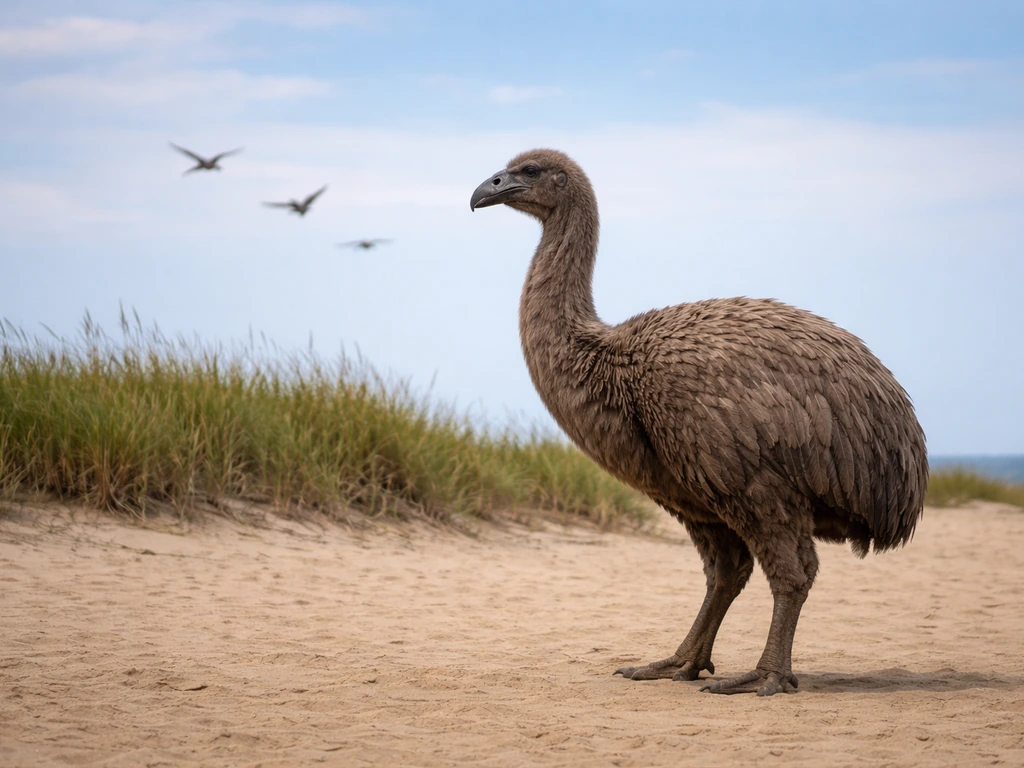
This is the most important misconception to address. The ancestors of elephant birds almost certainly could fly. This helps clarify why the idea of birds flying is tied to specific anatomy and ecology, not just a loose resemblance to other species The ancestors of elephant birds almost certainly could fly.. Palaeognath ancestors are inferred to have been flight-capable, based on the fact that a keeled sternum appears to be ancestral for the group and was lost secondarily. But 'ancestors could fly' does not mean 'elephant birds could fly.' By the time the Aepyornithiformes lineage was established, flight had been lost completely. No member of the elephant bird clade, at any point in its known fossil history, shows evidence of flight capability. Every anatomical feature of every specimen we have is that of a committed terrestrial bird.
Could they glide, even if they couldn't flap?
No. Gliding is not simply a scaled-down version of powered flight that any bird can default to. It requires a genuinely aerodynamic wing surface with properly structured, stiff flight feathers. Elephant bird wings had neither the feather structure nor the area-to-mass ratio that gliding demands. Even for early birds like Archaeopteryx, researchers debate whether gliding was possible because feather structure and wing geometry matter so much. For elephant birds, the feathers were soft and loose, the wings were tiny relative to body mass, and the center of mass was far forward and low, in no configuration suited to a controlled glide. The idea of a 540 kg bird launching itself off a tree and gracefully coasting down is not supported by any anatomical evidence.
Does being very large automatically mean a bird can't fly?
Size matters enormously, but it's not the whole story. The research on ratite flightlessness is clear that flight was not lost simply because these birds got too big. The multiple independent losses of flight within ratites happened through different developmental mechanisms and different pectoral apparatus changes. Some smaller bird lineages have also lost flight (rails on islands, for example) while some genuinely large birds like the Andean condor with a 3-meter wingspan still manage powered flight. What makes elephant birds definitively flightless is the combination of their absent keel, degraded pectoral architecture, non-functional wing feathers, and reduced wing bones, all on top of an extreme body mass. Size sealed the deal, but the anatomy had already made the decision.
Could elephant birds ever evolve flight back?
This is more of a thought experiment since elephant birds are extinct, having disappeared likely within the last few centuries after humans arrived in Madagascar. But the theoretical answer is: extremely unlikely, and certainly not quickly. Re-evolving powered flight would require simultaneous reversals across multiple complex traits: rebuilding a keeled sternum, re-evolving large pectoral muscles, restructuring the coracoid and pectoral girdle, and re-developing stiff aerodynamic flight feathers. Evolutionary science treats regaining flight after complete loss as a near-impossibility in practice, even if it's not technically ruled out by any law of biology. It would require the kind of multi-trait reversal that has essentially never been documented in bird lineages.
What this tells us about bird flight more broadly
Elephant birds are a compelling case study precisely because they represent flight loss taken to its absolute extreme. Every anatomical trait that makes a bird capable of flight was reduced, modified, or absent in these animals. The keeled sternum gone. The flight muscles without a proper anchor. The flight feathers replaced with soft, loose plumage. The wings shrunk to near-vestigial size. And all of this in a body that weighed as much as a large horse. If you want to understand why flight is so special and so costly to maintain, elephant birds show you what happens when evolution decides it's not worth the investment. So if you are wondering where a bird flies when it cannot sustain powered flight, elephant birds show how evolutionary pressures can end up grounding an entire lineage flightlessness.
If you're curious about how other birds navigate the spectrum between full flight and complete flightlessness, it's worth exploring how birds that do fly manage their wing geometry and feather structure to stay airborne, or how formation fliers like those that travel in V-shapes use aerodynamics to reduce the energetic cost of staying aloft. In the discussion of “when black bird fly,” the same principles explain how and why certain bird lineages stop being able to fly flightlessness. The contrast between a V-formation of geese and the grounded bulk of an elephant bird captures the full range of what avian evolution has produced. Elephant birds are the end point of one evolutionary path, and understanding them makes everything else about bird flight sharper and more meaningful.
FAQ
Could an elephant bird briefly lift off if it ran really fast or flapped hard?
Highly unlikely. Without a keeled sternum to anchor the main downstroke and upstroke muscles, and with flight feathers that were soft and non-aerodynamic, even a sprint would not produce the lift and thrust needed for takeoff.
Did elephant birds ever use their wings for anything, like balance or display?
Most evidence points to wings functioning as remnants rather than propulsion. Like other ratites, they could use the forelimbs for balance during ground movement and possibly for courtship or intimidation displays, but that is not the same as powered flight.
Why is “wing size” not enough to explain flightlessness by itself?
Because the key limitations are structural, not just surface area. Elephant birds lacked multiple flight-critical components at once (keel, proper pectoral and coracoid architecture, and stiff aerodynamic feathers), so the body plan could not generate or transmit the forces needed for flight.
Could they have been capable of gliding from trees, even if they could not flap?
No strong anatomical basis supports gliding. Controlled gliding needs stiff, aerodynamic wing feathers, adequate wing geometry, and a body mass distribution that allows stable descent, all of which do not match what is known about elephant bird wings and feather structure.
What about smaller elephant bird species, were they more likely to fly?
Even the smaller forms were still large ratites with the same core flight-limiting anatomy. The absence of a keel and the reduced, non-aerodynamic wing and feather setup would prevent powered flight regardless of modest differences in body size.
Are there any myths or misleading claims that say elephant birds could fly?
The most common misconception is confusing “bird-like” body plans with flight capability, often reinforced by artistic depictions. Scientific reconstructions focus on specialized flight anatomy, and for elephant birds that specialized toolkit is missing or degraded across multiple systems.
How certain are researchers that elephant birds were fully flightless, not partially capable?
The certainty is high because the conclusion is supported by several independent lines of evidence. When the sternum, pectoral attachment architecture, wing bone reduction, and feather structure all point the same way, a partial flight ability becomes inconsistent with the overall anatomy.
If their ancestors could fly, why didn’t elephant birds regain flight later as conditions changed?
Re-evolving flight would require coordinated, large-scale reappearance of multiple complex traits, like a functional keel, flight muscle arrangement, and stiff aerodynamic feathers. Once a lineage is committed to terrestrial life, regaining all those components in the right sequence is considered extremely improbable.
When did elephant birds become flightless, and can we pinpoint the timing?
The fossil record is too patchy to identify a single exact moment when flight was lost. What researchers can say is that by the time their remains are reliably documented, they already had the full terrestrial anatomy consistent with permanent flightlessness.
How did elephant birds compare with other flightless birds like ostriches in terms of what they could still do?
Ostriches retain strong hindlimbs and can run extremely fast, while elephant birds were built for heavy walking or slow running with reduced capability for rapid escape. Both are terrestrial solutions, but their locomotion strategies differ because their bodies evolved under different constraints.