Birds fly virtually everywhere on Earth: over open oceans, through mountain passes, across city skylines, above wetlands, and deep into forests. From the albatross riding wind currents over the Southern Ocean to the house sparrow darting between rooftops, birds occupy almost every airspace the planet offers. When they fly depends on the species and the season, governed by biological clocks, weather, and the ancient pull of migration. A small but fascinating group, including ostriches, penguins, and the long-extinct elephant bird, never fly at all.
Where Does Bird Fly: Places, Flight Mechanics & Examples

Marcus Chen
12 Aug 2026
Where birds actually fly: habitats and airspaces
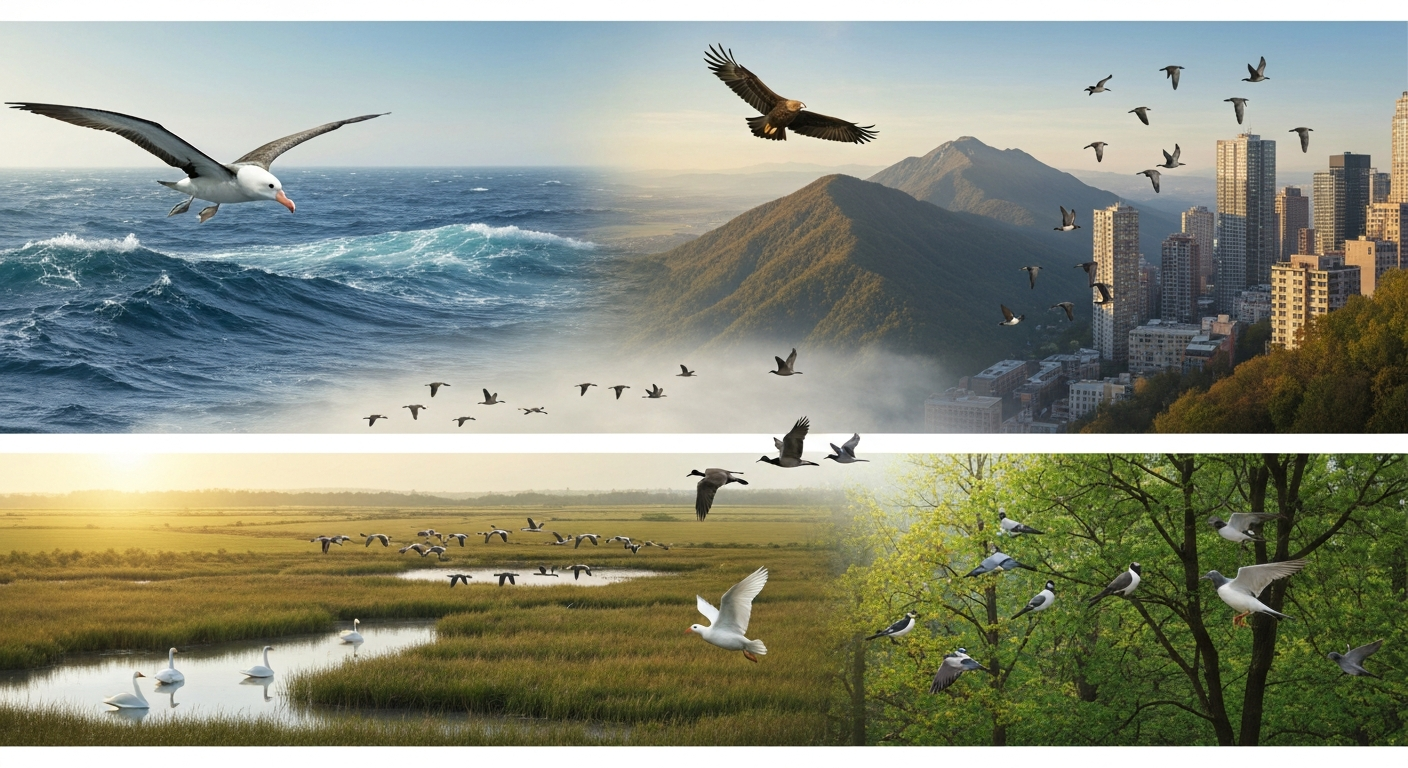
No single habitat belongs exclusively to birds, and that is part of what makes them so captivating to watch. BirdLife International's Area-of-Habitat mapping and global occurrence databases like GBIF confirm that bird species occupy and fly through virtually all terrestrial and aquatic habitat types on the planet. The specific airspace a bird uses tells you a great deal about its anatomy, diet, and evolutionary history.
- Open ocean and coastlines: Albatrosses, petrels, and shearwaters spend weeks or months airborne over the open sea, using dynamic soaring to harvest energy from wind gradients just above the waves.
- Wetlands and freshwater systems: Herons, egrets, pelicans, and waterfowl patrol rivers, lakes, and marshes, with flight paths often following watercourses. Swans are a textbook example here, with powerful wingbeats carrying them low over open water.
- Forests and woodlands: Warblers, woodpeckers, and raptors like Cooper's hawks weave through tree canopies, relying on short, rounded wings for tight maneuvering.
- Mountains and uplands: Golden eagles and lammergeiers exploit thermal currents rising off heated slopes, soaring at altitudes that would challenge a light aircraft. Bar-headed geese cross the Himalayas during migration, sometimes flying above 7,000 meters.
- Grasslands and farmland: Larks, harriers, and kites hunt low over open ground, taking advantage of unobstructed sightlines and predictable prey.
- Urban areas: Peregrines nest on skyscrapers and stoop at speeds exceeding 320 km/h. Swifts feed entirely on the wing above cities. Pigeons and starlings form dense flocks between buildings.
What ties all of these contexts together is that birds are not randomly distributed in them. Citizen-science platforms like eBird provide week-by-week seasonal maps showing exactly where species are flying, breeding, and wintering at scales from a local park to a continent. These tools reveal that a bird's presence in a particular airspace is highly predictable once you understand its ecology.
When birds fly: daily rhythms and seasonal migration
Daily timing: dawn, dusk, and night
Most birds are diurnal, meaning they fly and forage during daylight hours, with peaks of activity around dawn and dusk. The dawn chorus is not just singing but a burst of movement: birds leaving roosts, establishing territories, and beginning foraging runs. Strictly nocturnal fliers, including owls, nightjars, and kiwis, represent only a small percentage of total avian diversity. Many species, though, fall into an interesting middle ground of crepuscular or partially nocturnal behavior, particularly during migration.
Migration timing is where daily patterns get genuinely surprising. Many long-distance passerines (warblers, thrushes, sparrows) and shorebirds migrate predominantly at night. Flying after dark offers real advantages: cooler temperatures reduce overheating, stars and the Earth's magnetic field provide navigational cues, and daytime aerial predators are grounded. Raptors, swifts, and many waterfowl, by contrast, migrate by day, exploiting thermals and favorable winds visible to them in real time. Ornithologist Thomas Alerstam's research captures the energetic and ecological tradeoffs that push species toward one strategy or the other.
Seasonal migration: what triggers the journey
The deep driver of seasonal migration is photoperiod, the changing length of daylight through the year. Changing day length kicks off a cascade of hormonal changes, including fattening, enlargement of the pectoral muscles, and a state called Zugunruhe (migratory restlessness) that pushes birds toward movement. This is an endogenous circannual program, essentially a biological calendar, first characterized rigorously by Eberhard Gwinner. Seasonal migration and preparatory flights are primarily governed by endogenous circannual programs synchronized to photoperiod, with physiological changes such as hormonal cascades, fattening, and pectoral muscle enlargement preparing birds for long flights (see Circannual rhythms in birds, Eberhard Gwinner (review)) Circannual rhythms in birds — Eberhard Gwinner (review). It means a caged migratory bird kept under constant conditions will still show seasonal restlessness roughly on schedule.
But photoperiod sets the broad window; weather determines the exact departure night. Tailwinds, rising temperatures after a cold spell, and improved food availability at stopovers all act as proximate triggers. A warbler may be physiologically ready to migrate for a week before the right wind finally pushes it off. This interplay between internal clock and environmental cue is why radar ornithologists can sometimes predict mass nocturnal migration events 24 to 48 hours in advance by watching weather models.
How birds fly: the biomechanics behind every wingbeat
Lift, drag, and the physics of a wing
A bird's wing is an airfoil: curved on top, flatter below. As air moves faster over the curved upper surface than beneath, a pressure difference is created that generates lift, the upward force that counteracts gravity. Drag is the opposing force that resists forward motion. Flight is fundamentally the management of this tradeoff. Two key measurements summarize how a wing handles it: wing loading (body mass divided by wing area, typically expressed in N/m²) and aspect ratio (wingspan squared divided by wing area, a dimensionless number). Bret Tobalske's foundational review in the Journal of Experimental Biology (2007) remains the clearest synthesis of these relationships.
High aspect-ratio wings, long and narrow like those of an albatross, are efficient at generating lift with minimal drag. They excel at sustained gliding and soaring over long distances. Short, broad, low-aspect wings, like those of a woodcock or a woodland hawk, sacrifice efficiency for tight-radius turning and burst acceleration through cluttered environments. High wing loading means a bird must fly faster to stay aloft and needs more power to take off, which is why a mute swan needs a long running take-off across water while a kestrel can launch from a fence post. Studies linking wing shape to migration distance, behavior, and habitat confirm these patterns across thousands of species.
Muscles and skeleton: the machinery of flight
Powered flight demands enormous muscular output, and bird anatomy reflects this. The pectoralis (breast muscle) is the primary downstroke driver; in strong fliers it can account for 15 to 25 percent of total body mass. It attaches to a deeply keeled breastbone called the carina or keel. The supracoracoideus, a smaller muscle running beneath the pectoralis, drives the upstroke by routing its tendon through a pulley-like coracoid foramen to the top of the humerus. Bones are pneumatized, hollow and connected to the respiratory system, keeping structural mass low without sacrificing strength. The AVONET morphological database, compiled by Tobias and colleagues (2022), quantifies these traits across all living bird species, making it possible to draw comparisons between fliers and flightless birds at scale.
Flight styles in action: soaring, flapping, hovering, and formation flying
Not all flight looks the same, even within a single species. Birds switch between modes depending on energy budget, task, and conditions.
- Continuous flapping: The workhorse mode for ducks, geese, and most songbirds. Energy-expensive but allows sustained speed and direct travel.
- Flap-glide and flap-bound: Many passerines alternate brief bursts of flapping with short glides (flap-glide) or wing-folded bounds (flap-bound). Bounding reduces drag during the ballistic phase, saving net energy at higher speeds.
- Thermal soaring: Vultures, condors, storks, and many raptors circle inside columns of rising warm air to gain altitude for free, then glide in the direction of travel. A turkey vulture can travel hundreds of kilometers on migration using almost no flapping at all.
- Dynamic soaring: Albatrosses exploit the wind gradient above ocean waves, diving downwind to gain speed and pulling up into the wind to gain height in a repeating cycle. The wandering albatross can cover over 1,000 km per day this way.
- Hovering: Hummingbirds are the specialists here, rotating the wing so both the downstroke and upstroke generate lift. Their figure-eight wingbeat traces are unlike any other bird, and the supporting musculature and shoulder joint morphology are uniquely adapted for sustained stationary flight.
- V-formation flight: Geese, pelicans, ibises, and some other large birds fly in V-shaped or echelon formations during migration. The bird behind and to the side of a leader benefits from upwash generated by the leader's wingtip vortex, effectively getting a free boost. Aerodynamic modeling by Lissaman and Shollenberger (1970) and empirical work on pink-footed geese by Cutts and Speakman (1994) estimate that birds in optimal formation positions can reduce energy expenditure measurably compared to solo flight.
V-formation flying is a good example of collective intelligence in the air. The position matters: only birds behind and slightly to the side of the leader benefit from upwash. When the lead bird tires, another takes over. This rotating leadership is documented in northern bald ibis and has been measured with onboard data loggers that track wingbeat frequency in real time.
Species in focus: swans, blackbirds, geese, and more
Swans: power and grace over water
Swans are among the heaviest flying birds in the world. The whooper swan and trumpeter swan can weigh over 12 kg, and their high wing loading means take-off requires a long, splashing run across water, feet slapping the surface while the wings build speed. Once airborne, though, they are formidable travelers. See swan is flying bird for a focused look at swan flight mechanics and behavior (internal reference ID 8a6a484d-5ac5-4a0f-9e25-6fab0b8ce7b9). Bewick's swans migrate thousands of kilometers between Arctic breeding grounds and temperate winter wetlands, flying in family groups that preserve the social bonds formed on the breeding ground. Watching a skein of whooper swans pass overhead at dusk, calling as they go, is one of the more visceral reminders that flight is not just mechanical but deeply behavioral.
Blackbirds and songbird flight patterns
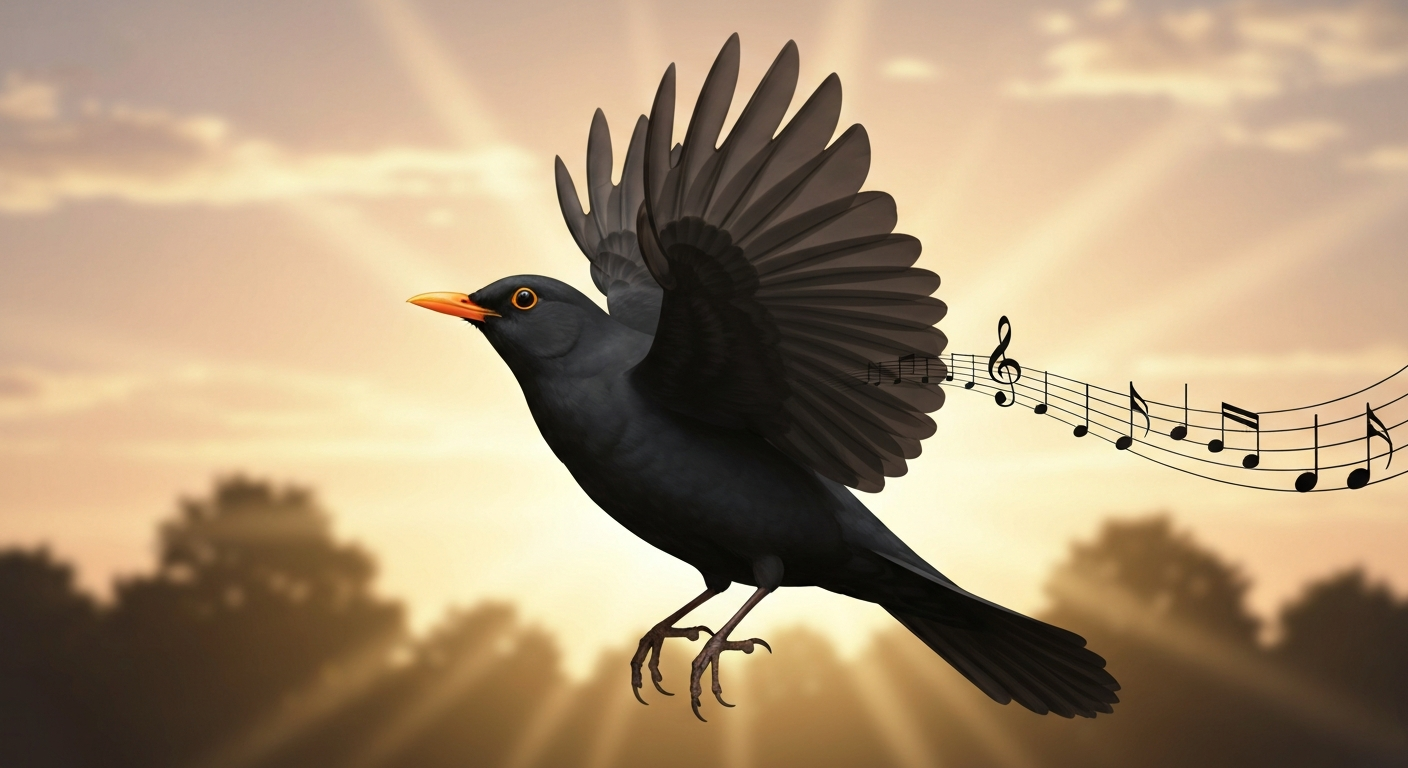
The common blackbird (Turdus merula) is a useful study in everyday bird flight. Over short distances, it uses rapid flapping with sudden, exaggerated undulations when alarmed. In migration (many northern European blackbirds are partially migratory), it shifts to sustained nocturnal flight, fattening beforehand and departing on suitable nights in autumn. Its flight profile is typical of many medium-sized thrushes: direct, moderately fast, and not particularly specialized but effective across a wide range of habitats. The phrase 'when black bird fly' captures something real about the mystery of nocturnal migration, that sense of unseen movement in the dark sky above. The related term who bird fly is often used in discussions of nocturnal migration and captures that same sense of unseen movement (see resource aaf82092-c549-49d3-a5d7-0661049cffb3). See the piece titled when black bird fly for more on the mystery of nocturnal migration. See more on when a bird flies lsat.
Geese and pelicans: masters of the V
Canada geese and pink-footed geese are the textbook V-formation fliers, but pelicans deserve equal attention. American white pelicans frequently fly in tight echelon lines over water, and studies have documented their use of upwash in ways that parallel geese. Both groups also use thermal soaring to gain altitude before long glides over land, combining formation flying with soaring in ways that minimize total energy expenditure over a migration route.
Birds that fly and birds that don't
Flight evolved early in bird history, but it has been independently lost more than 60 times across the avian family tree. Every flightless bird living today shares a convergent suite of anatomical changes: a reduced or absent sternal keel, smaller wings relative to body mass, denser (less pneumatized) bones, and locomotion shifted to the legs or, in penguins, the flippers. Paleontological and genomic studies confirm that flightlessness is not a primitive holdover but a derived adaptation, one that tends to occur on islands or in environments where aerial predators are absent and ground resources are rich.
- Ostriches (Struthio camelus): The heaviest living bird at up to 156 kg. No keel, tiny vestigial wings, and legs built for running at up to 70 km/h. Native to African savannas and arid zones.
- Emus and cassowaries: Large flightless ratites of Australia and New Guinea, with similarly reduced wing and keel structures.
- Kiwis: Small, nocturnal, and virtually wingless. New Zealand's isolation allowed their evolution without mammalian ground predators.
- Penguins: All 18 species are secondarily flightless; their wings are stiff, dense flippers optimized for 'flying' underwater. A gentoo penguin can swim at over 35 km/h. BirdLife International notes they are aquatic, flightless seabirds.
- Elephant bird (Aepyornis maximus, extinct): The largest bird known to have ever lived, standing up to 3 meters tall and weighing an estimated 650 to 730 kg. Flightless, native to Madagascar, and extinct by roughly the 17th century, almost certainly due to human hunting and habitat loss. Genomic and osteological analyses published in Nature Communications confirm unexpected diversity within the elephant bird family.
Flying vs. flightless: a trait comparison
| Trait | Flying birds (e.g., swift, goose) | Flightless birds (e.g., ostrich, penguin, elephant bird) |
|---|---|---|
| Sternal keel (carina) | Prominent, deep keel for large pectoralis attachment | Reduced or absent; flat sternum |
| Wing size relative to body | Proportionally large; generates sufficient lift | Tiny or flipper-shaped; insufficient for aerial lift |
| Bone pneumatization | Hollow, air-filled bones reduce weight | Denser bones; less or no pneumatization (penguins have solid bones for diving) |
| Pectoral muscle mass | Large (up to 25% of body mass in some species) | Greatly reduced; legs or flippers dominate locomotion |
| Body mass / wing loading | Calibrated to support airborne flight | Very high wing loading; aerial flight energetically impossible |
| Primary locomotion | Aerial flight (most travel and foraging) | Running (ostriches, emus), swimming (penguins), walking (kiwis) |
| Habitat context | All terrestrial, aquatic, and aerial habitats globally | Islands, isolated landmasses, or marine environments with reduced aerial predators |
| Example species | Wandering albatross, bar-headed goose, ruby-throated hummingbird | Ostrich, emperor penguin, emu, kiwi, elephant bird (extinct) |
Myths and misconceptions about bird flight
Not every bird that flies is green
The phrase 'every bird that flies is green' sounds like a logical proposition but is straightforwardly false as a biological claim. It likely circulates as a logical exercise or riddle, but in practice birds that fly span every color in the spectrum, from the scarlet of a male northern cardinal to the jet black of a common raven to the white of a gannet in full breeding plumage. Plumage color is driven by pigments (melanins, carotenoids, porphyrins) and structural coloration (as in hummingbirds and kingfishers), and it relates to mate choice, camouflage, species recognition, and thermoregulation. It has nothing to do with the capacity for flight.
Could the elephant bird fly?
No. Aepyornis maximus was definitively flightless. At an estimated 650 to 730 kg and around 3 meters tall, it was physically impossible for it to generate sufficient lift with its proportionally tiny wings. Its skeletal structure confirms the absence of a meaningful keel and the presence of legs built for walking and weight-bearing, not for the demands of flight. The elephant bird is a powerful case study in how flight can be permanently abandoned when the ecological pressures that once favored it disappear. For more detail on whether the elephant bird could fly, see can elephant bird fly. Madagascar's isolation, with its lack of large mammalian predators for much of the Cenozoic, made ground life a perfectly viable strategy.
The 'iron bird' and flight in culture
In Tibetan prophecy, the phrase 'when the iron bird flies' refers to the arrival of aircraft as a marker of a prophetic era, an evocative metaphor that uses bird flight as the archetype of extraordinary, sky-spanning movement. Airplanes borrow from bird aerodynamics in real ways: the swept wing, the cambered airfoil, and the use of flaps to modify lift at low speeds all have biological parallels in bird wing morphology. The comparison is not merely poetic. Early aviation pioneers including Otto Lilienthal studied birds systematically, and modern computational fluid dynamics studies of bird flight continue to inform drone and micro-aircraft design.
Watching birds fly: practical tips for observers
Understanding where and when birds fly pays off directly when you are trying to find them. Knowing that most passerine migrants fly at night means you should look at dawn at coastal watchpoints, where overnight migrants 'fall in' to the first available shelter. Knowing that raptors soar on thermals means late morning to early afternoon, once the ground has warmed, is peak time at ridge hawkwatches. A few practical principles:
- Watch habitat transitions: Birds concentrate at edges between habitats, woodland margins, shorelines, and ridge lines, where food, shelter, and navigational cues converge.
- Use weather as a guide: A cold front passing through in autumn produces ideal nocturnal migration conditions the following night (clear skies, northwest winds in the northern hemisphere). Check radar apps designed for birders to see actual migration intensity.
- Learn wingbeat patterns: Many species can be identified at distance by flight style alone. A woodpecker's undulating bounding flight, a heron's slow deep wingbeats, a swift's stiff-winged flickering. These are as diagnostic as plumage features.
- Visit wetlands and coasts in autumn and spring: These act as staging and stopover sites where species concentrations are highest during migration, giving you the best chance to observe a variety of flight behaviors in a short time.
- Dawn and dusk are generally best for forest and farmland species; mid-morning is best for soaring raptors; coastal headlands can produce excellent flight-watching at any daylight hour during peak migration periods.
Flight is the defining feature of birds as a group, even if not every bird does it. Understanding where birds fly, the habitats they move through, the timing that governs their journeys, the mechanics that make it possible, and the handful of species that have traded wings for other advantages gives you a richer lens for watching every bird you encounter, whether it is a swan hauling itself skyward over a winter marsh or a swift threading through a summer city at dusk.
FAQ
Primary answer — Where do birds fly (places and contexts)?
Birds fly across virtually all terrestrial and aquatic habitats: over open ocean and coastal seas, across inland lakes and wetlands, through forests and mountains, across grasslands and agricultural landscapes, and within cities and suburban areas. They fly for daily activities (feeding, territorial patrols, commuting between roosts and foraging sites), for seasonal movements and migrations between breeding and non‑breeding ranges, and during special behaviors (dispersal, flocking, predator avoidance). Authoritative range and habitat products (BirdLife AOH, eBird Status & Trends, GBIF) combine occurrence data with habitat types to map where species occur and fly at global to local scales.
How does wing anatomy and biomechanics determine where and how birds fly?
Wing anatomy (shape, area, aspect ratio, and feather arrangement) plus body mass determine flight performance through wing loading (mass ÷ wing area) and aspect ratio (wingspan^2 ÷ wing area). High aspect‑ratio, low‑wing‑loading wings favor efficient long‑distance flight and dynamic soaring (albatrosses, shearwaters). Short, broad wings favor maneuverability in cluttered habitats (forest passerines). Flight modes—continuous flapping, flap‑glide, bounding, thermal soaring, dynamic soaring, hovering—are produced by conserved musculoskeletal features (keeled sternum, large pectoral muscles) and specific kinematics. These biomechanical principles explain why some species routinely cross oceans while others remain in dense forest patches.
When do birds fly during the day and year (daily and seasonal timing)?
Most species are primarily diurnal and fly mainly during daylight hours for feeding and social activities. A minority are nocturnal (owls, nightjars, kiwis), and many species show crepuscular (dawn/dusk) activity. Migration timing depends on taxon: many long‑distance passerines and shorebirds migrate at night, while raptors, swifts and many waterfowl migrate by day. Seasonal migration is driven by internal circannual programs synchronized to photoperiod, with proximate departure decisions influenced by weather, winds, temperature, food availability and energetic state (fat stores).
Which habitats and ranges do birds use when flying (detailed habitat contexts)?
Birds use: 1) Open ocean and coastal seas for pelagic species (albatrosses, shearwaters, terns); 2) Wetlands, estuaries and inland lakes for waterbirds and waders; 3) Forests and woodlands for canopy and understory species that fly between perches and forage sites; 4) Mountains for raptors and high‑altitude migrants using thermals and ridgelift; 5) Grasslands and agricultural landscapes for ground‑feeding species and migrants; 6) Urban and suburban areas where many adaptable species (pigeons, starlings, swifts) fly and breed. Spatial occurrence maps from BirdLife, eBird and GBIF illustrate these contexts at global and local scales.
What are representative species examples and characteristic flight behaviors?
Examples: 1) Swans and geese — large waterfowl that use strong, continuous flapping for long flights; many geese form V‑formations for energetic savings. 2) Pelicans — soar and flap in groups; use thermal and slope lift. 3) Blackbirds and many passerines — short, maneuverable flights among vegetation; some use flap‑glide or bounding. 4) Hummingbirds — specialized hovering with rapid wingbeats. 5) Raptors (eagles, vultures) — thermal soaring and gliding with broad wings. Species accounts from Cornell Lab All About Birds and BirdLife provide specific behavior, habitat and seasonal occurrence details.
Which birds do not fly (flightless species and extinct exceptions)?
Extant flightless birds include ostriches, emus, cassowaries, kiwis, rheas and penguins (penguins are secondarily flightless and adapted for underwater 'flight'). Flightlessness correlates with reduced/absent keel on the sternum, small relative wings, and ground‑specialized locomotion. Extinct flightless giants include the elephant birds (Aepyornis) and moa; paleontological and genomic studies document multiple independent losses of flight across avian evolution.
Next Article
When Black Bird Fly: Why, How, and Where Blackbirds Travel
When do blackbirds fly? A science-based guide to timing, flight mechanics, migration and ID tips.