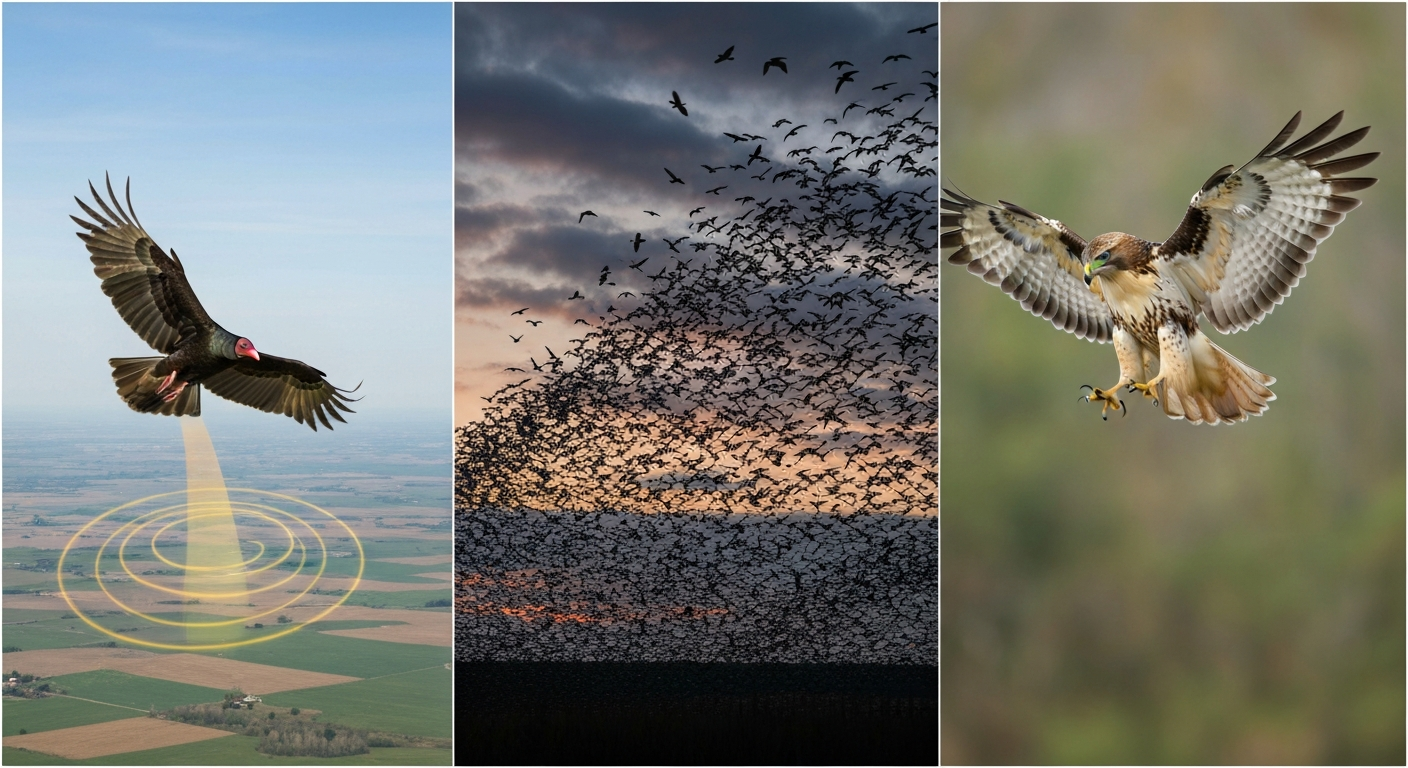
Birds fly by generating lift through the shape and motion of their wings, which redirect airflow to create a pressure difference that pushes them upward. They produce thrust by flapping, and they manage drag through feather arrangement, body posture, and wing folding. The mechanics are elegant but not magic: every species carries roughly a billion years of evolutionary tinkering in its bones, feathers, and chest muscles. This guide walks through the full picture, from aerodynamics and anatomy to flight styles, flocking behavior, and even the cultural meanings humans have built around birds in the air.
Bird Flight Explained: How Birds Fly, Styles, Behavior & Evolution

Marcus Chen
6 Aug 2026
What we mean by bird flight, and who this guide is for
"Bird flight" covers a surprisingly wide territory. It includes the physics of how wings work, the anatomy that makes wings possible, the behavioral decisions birds make in the air, and the evolutionary history that produced everything from the hovering hummingbird to the flightless ostrich. If you are a curious reader who has ever watched a red-tailed hawk hang motionless above a highway median and wondered how it does that, this is for you. If you are a student trying to connect physics class to the living world, this is for you too. And if you have noticed a murmuration of starlings rippling across a winter sky and felt the need to understand the rules behind that apparently spontaneous choreography, keep reading.
We will move through the physics first, then through anatomy, then into the major flight styles and how they differ across species, and finally into the behavioral and cultural dimensions of flight. Technical terms are defined as they appear. Where the science is still contested or genuinely complicated, I will say so rather than paper over it.
Aerodynamics for curious readers: lift, thrust, drag, and the physics of wings
When a bird moves through the air, four forces act on its body: lift, thrust, drag, and weight. Lift acts upward (roughly), thrust acts forward, drag acts backward opposing motion, and weight pulls everything down. Sustained flight means managing these four forces so that lift balances weight and thrust overcomes drag.
There are two complementary ways to understand how wings produce lift, and both describe the same physical reality. The airfoil (circulation) model explains that the curved upper surface of a wing forces air to travel faster over the top than the bottom, lowering pressure above and raising it below; the net upward pressure difference is lift. The momentum (Newtonian) model says the wing deflects air downward, and the equal-and-opposite reaction pushes the bird upward. Neither story is wrong. They are two mathematical formalisms applied to the same event, and current aerodynamics research on bird flight uses both frameworks depending on what is being measured. Forward flight of birds revisited. Part 1: aerodynamics and performance (J. Exp. Biol., 2015) reviews how circulation (airfoil) and momentum (downwash) frameworks describe the same forces on wings and synthesizes evidence for both approaches.
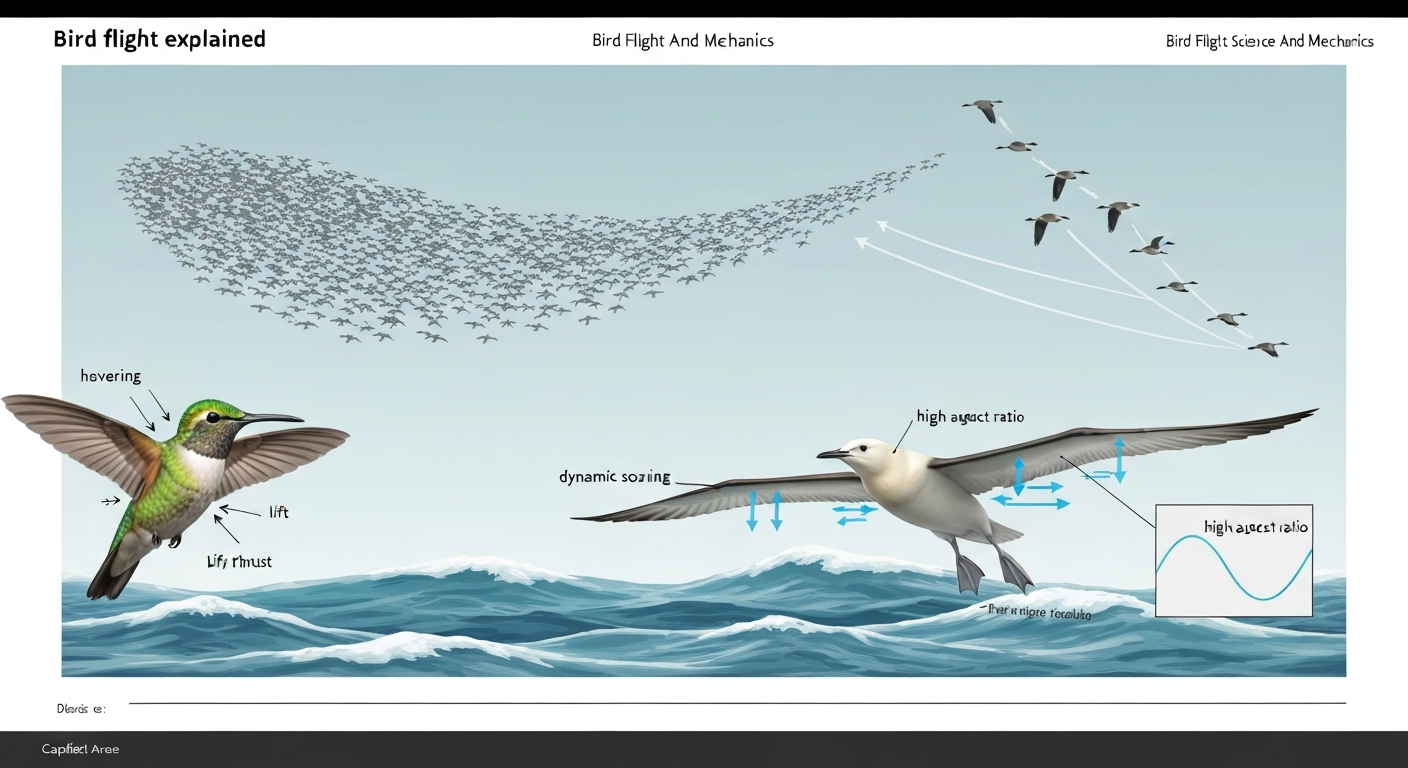
Drag comes in two main flavors for flying birds. Profile drag is the resistance the body and wings create by pushing through air. Induced drag is a byproduct of lift itself: generating lift produces wingtip vortices that trail behind the bird and represent wasted energy. Birds have evolved several strategies to reduce induced drag, including the winglet-like spread of primary feathers at the wingtip and the V-formation flying used by geese, which allows each bird (except the leader) to partially recover energy from the vortex wake of the bird ahead.
One more concept worth knowing: Reynolds number (Re) is a dimensionless value that describes the ratio of inertial to viscous forces in airflow around an object. A tiny hummingbird operates at Re roughly 10,000 to 100,000, while a wandering albatross operates closer to 10,000,000. This matters because the boundary layer of air around the wing behaves differently at low versus high Re, affecting when flow separates, how vortices form, and which aerodynamic mechanisms dominate. The physics of a hummingbird wing and an albatross wing are not quite the same physics, even though both involve lift.
How wings generate lift: camber, angle of attack, airflow, and stall
Two geometric properties of a wing control how much lift it produces at any moment: camber and angle of attack. Camber is the curvature of the wing's cross-section from leading to trailing edge, measured as the maximum height of the curve as a fraction of chord length (the straight-line distance from front to back). A more cambered wing produces more lift at low speeds but also more drag. Angle of attack (AoA) is the angle between the wing's chord line and the oncoming airflow. Increasing AoA increases lift, up to a point.
That point is the stall. When AoA exceeds roughly 15 to 20 degrees (varying by species and wing shape), airflow over the upper surface separates from the wing and becomes turbulent and chaotic rather than smooth and attached. Lift drops abruptly. Birds stall all the time on purpose, actually: landing involves a controlled stall at low speed and low altitude, with the tail spread wide as a brake. Watch a pigeon come in to land on a ledge and you will see the wings tip steeply upward in the final moment, deliberately dumping lift.
For flapping birds, the aerodynamics are more complicated than a simple fixed airfoil. During the flapping stroke, parts of the wing encounter rapidly changing angles of attack, and at slow speeds or during stroke reversal, unsteady vortex effects become significant. In particular, leading-edge vortices (LEVs) can form on the upper wing surface and temporarily boost lift well beyond what steady-state airfoil theory predicts. Research has documented these LEV structures in birds as well as insects and bats, and they appear especially important during hovering, takeoff, and landing when air speed is low and flapping amplitude is high.
Suggested diagram: A cross-section of a bird wing showing chord line, camber arc, and the angle of attack relative to oncoming airflow, with arrows indicating the high-pressure zone below and low-pressure zone above, plus a secondary illustration of a leading-edge vortex during a slow flapping stroke.
Wing shapes, aspect ratio, and wing loading: form following function
Two numbers go a surprisingly long way toward explaining why different birds fly differently. Aspect ratio (AR) is calculated as wingspan squared divided by wing area. A long, narrow wing (like a swift's or an albatross's) has a high aspect ratio. A short, broad wing (like a pheasant's or a sparrowhawk's) has a low aspect ratio. Wing loading (WL) is the bird's weight divided by its wing area, expressed in Newtons per square meter. A heavy bird with small wings has high wing loading and needs to fly fast to stay airborne. A light bird with large wings has low wing loading and can fly slowly and efficiently.
The wandering albatross (Diomedea exulans) sits near one extreme: an aspect ratio of roughly 15 to 17 and a wing loading around 112 to 206 N/m² depending on body condition and age. These numbers are tuned for dynamic soaring, a technique where the bird alternates between fast glides low over the ocean surface and rising climbs into the wind, harvesting energy from the wind gradient without flapping. A ruby-throated hummingbird, by contrast, has short, stiff, high-AR-equivalent wings that beat 40 to 80 times per second and generate lift on both the downstroke and upstroke, enabling stationary hovering.
Maneuverability and high-aspect-ratio efficiency trade off against each other. Forest birds hunting in cluttered environments tend toward low AR and low WL combinations: shorter wings that can be folded and redirected quickly, at the cost of gliding efficiency. Open-country or oceanic birds trend toward high AR for sustained, economical travel.
Muscles and mechanics of flapping: what actually powers each wingbeat
The muscular system behind a wingbeat is an engineering solution I find genuinely beautiful. Two muscles dominate bird flight: the pectoralis major and the supracoracoideus. The pectoralis major is the downstroke engine. It is the largest muscle in the bird's body, originating on the broad keeled sternum (the carina) and inserting on the humerus. When it contracts, it drives the wing downward and forward, generating the aerodynamic force that produces most of the lift and thrust during forward flight. This is the muscle you eat when you eat chicken or turkey breast.
The supracoracoideus handles the upstroke, but it does so through a remarkable mechanical trick. Rather than pulling the wing up directly, its tendon threads through the triosseal canal, a foramen formed where the coracoid, scapula, and clavicle meet, effectively creating a pulley system. This redirects the supracoracoideus's pull so that a muscle on the underside of the bird elevates the wing. The arrangement keeps the bird's center of mass low and stable. EMG (electromyography) studies in pigeons confirm that the pectoralis dominates the downstroke while the supracoracoideus fires during the upstroke, though the exact timing and workload vary with flight speed and mode.
The skeleton provides the rigid levers and flexible joints that muscles act through. The major wing bones are the humerus (upper arm), radius and ulna (forearm), and carpometacarpus (a fused wrist-hand element supporting the outer primary feathers). The fused clavicles form the furcula (wishbone), which acts as a spring during the wingbeat, storing and releasing elastic energy. Recent high-speed 3D kinematic studies show that small adjustments in wing twist and camber during each stroke significantly alter the aerodynamic output and the workload on individual muscles, which helps explain how birds modulate power so precisely.
Suggested diagram: An annotated ventral view of a bird's flight musculature, highlighting the pectoralis major, supracoracoideus, triosseal canal, and the skeletal elements (sternum/carina, coracoid, furcula, humerus) each muscle connects to.
Feathers and microstructure: the aerodynamic surface in detail
A flight feather is a structural marvel built from keratin. The central shaft is called the rachis. Branching from the rachis on both sides are barbs, and branching from each barb are barbules. For a detailed description of these branch hierarchies and the interlocking hooklet–barbule morphology that forms the aerodynamic vane, see The Making of a Flight Feather: Bio‑architectural Principles and Adaptation (Open access review, 2019). The barbules on the distal side of each barb carry tiny hook-like projections that interlock with the proximal barbules of the adjacent barb row, creating a continuous, flexible, aerodynamically smooth vane. When a feather is damaged or the hooks separate (from preening or pressure), a bird can re-zip the vane by drawing the feather through its bill. This is why birds spend so much time preening: they are literally re-engaging the hooks.
Flight feathers fall into functional categories. The primaries are the long outer feathers attached to the carpometacarpus and digits; they generate most of the thrust during flapping. The secondaries attach along the ulna and form the inner wing surface that generates much of the lift. The tail feathers (rectrices) function as a rudder and brake, spreading to increase drag on landing and twisting to steer. Coverts are smaller feathers that overlap in layers across the wing surface, smoothing airflow transitions between the leading edge and the flight feathers.
The rachis cross-section under a scanning electron microscope reveals a hollow, honeycomb-like medullary pith surrounded by a compact keratin cortex, a structure that achieves high stiffness relative to its weight. This means the feather resists bending forces during the power stroke without adding unnecessary mass. The outer vane and inner vane (the two sides of the rachis) are often asymmetric in primary feathers: the leading-edge vane is narrower and stiffer, and this asymmetry is thought to promote passive pitch control during the stroke.
Suggested micrograph or diagram: An SEM cross-section of a primary feather rachis showing the cortex and medullary pith, alongside a labeled illustration of barb, barbule, and hooklet arrangement forming the vane.
Annotated anatomy: wing skeleton, feather types, and major flight muscles
The table below summarizes the key anatomical structures involved in bird flight, their location, function, and the species contexts in which they are most notable. A suggested companion image would be a labeled lateral-view illustration of a bird skeleton and wing, with the pectoralis and supracoracoideus indicated on a separate ventral-view insert.
| Structure | Location / Attachment | Primary Function | Notable Features |
|---|---|---|---|
| Humerus | Upper wing; connects to pectoral girdle at shoulder joint | Proximal lever arm for wing movement | Pneumatized (hollow, air-filled) in most flying birds, reducing mass |
| Radius and Ulna | Forearm; radius leads, ulna trails; secondaries attach to ulna | Forearm lever; anchors secondary feathers | Ulna bears quill nodes where secondary feather calami insert |
| Carpometacarpus | Fused wrist/hand; distal wing | Anchors primary feathers; forms leading edge of wingtip | Fusion of multiple wrist and hand bones reduces degrees of freedom, adding rigidity |
| Furcula (wishbone) | Fused clavicles; pectoral girdle | Elastic spring during wingbeat; spacing strut for shoulder joints | Flexes outward on downstroke, storing and releasing energy |
| Sternum / Carina | Ventral thorax; large keeled plate | Origin of pectoralis and supracoracoideus muscles | Keel height roughly correlates with flight muscle mass and flight power |
| Coracoid | Pectoral girdle; connects sternum to shoulder | Structural strut; forms part of triosseal canal | Critical for the pulley mechanism elevating the wing |
| Pectoralis major | Chest; origin on carina, insertion on humerus | Powers the downstroke (primary source of flight force) | Largest muscle in the body; red (slow-oxidative) or mixed fibers depending on species |
| Supracoracoideus | Beneath pectoralis; tendon through triosseal canal | Powers / assists the upstroke via pulley redirection | Relatively small but mechanically critical; EMG-confirmed upstroke activator |
| Primary feathers (remiges) | Carpometacarpus and fused digits; outer wing | Thrust generation during flapping; also used in soaring efficiency control | 10 primaries typical; asymmetric vane in fast-flight birds; individually controlled |
| Secondary feathers (remiges) | Ulna; inner wing | Lift generation; form the inner wing airfoil surface | Number varies (6 in hummingbirds; up to 40 in albatrosses) |
| Tail feathers (rectrices) | Pygostyle (fused tail vertebrae) | Steering, braking, and lift augmentation at low speed | Spread fan-like on landing; twisted laterally for yaw control |
| Coverts (primary and secondary) | Overlapping rows on dorsal and ventral wing surface | Smooth airflow transition; prevent leading-edge separation | Alula (bastard wing) is a group of small feathers that acts as a slot to delay stall |
Caption: Anatomical structures of the avian wing and flight system, organized by skeletal, muscular, and feather categories. Pneumatization (hollow bones connected to the respiratory air-sac system) appears in the humerus and other major bones of most flying birds, reducing skeletal mass without sacrificing strength.
Comparative flight styles: how different birds use the same basic toolkit
"Flight" is not one thing. A common swift and a turkey vulture and a ruby-throated hummingbird all fly, but they are doing very different things aerodynamically and anatomically. The table below maps the main flight modes to their key physical and anatomical characteristics, with representative species and rough metric ranges where data exist.
| Flight Style | Mechanism | Aspect Ratio (typical range) | Wing Loading (N/m²) | Species Examples | Key Adaptations |
|---|---|---|---|---|---|
| Continuous flapping | Repeated downstroke/upstroke cycles generate both lift and thrust; no extended glide phases | Low–moderate (4–8) | Moderate–high (20–60) | European starling, mallard duck, pigeon | Large pectoralis, moderate-length wings, high flapping frequency |
| Thermal soaring | Circles within rising columns of warm air (thermals); wings fully extended; minimal flapping | Moderate–high (6–10) | Low–moderate (15–40) | Turkey vulture, bald eagle, white stork | Broad, slotted wings; separated wingtip primaries reduce induced drag; low wing loading |
| Slope / ridge soaring | Glides in updrafts deflected upward by terrain or waves; low flapping | High (8–15) | Moderate (30–80) | Golden eagle (ridge soaring), large gulls | Long wings; efficient glide ratio; strong cross-wind correction ability |
| Dynamic soaring | Alternates fast low glides (downwind, fast) with climbing arcs into headwind; harvests wind-gradient energy | Very high (15–17) | High (100–200+) | Wandering albatross, black-browed albatross | Extremely long narrow wings; low body drag; can travel thousands of km with minimal flapping |
| Hovering | Symmetric or near-symmetric wingbeat with horizontal stroke plane; generates lift on both down- and upstroke | Moderate–high for body size (often 6–10 in hummingbirds) | Very low (6–12 in hummingbirds) | Ruby-throated hummingbird, kestrel (wind-hovering) | Rotating shoulder joint; symmetric wingbeat; extremely high wingbeat frequency; large relative heart and flight muscles |
| Bounding / undulating flight | Alternates brief flapping bursts with wings-folded ballistic arcs; reduces average drag | Low (4–7) | Moderate (15–40) | Woodpeckers, finches, tits | Short rounded wings; energy savings at moderate speeds by eliminating drag during folded glide phase |
| Gliding (passive) | Extended wings held fixed; descends at shallow angle; no flapping | Variable (5–15) | Variable | Hawks, albatrosses between thermals, swifts between flap bursts | Efficient at high aspect ratio; sink rate determined by glide polar of wing |
Caption: Major avian flight modes with approximate aerodynamic metrics and representative species. Aspect ratio and wing loading values are illustrative ranges drawn from comparative studies; actual values vary with sex, age, and condition within species. The wandering albatross's high wing loading combined with very high aspect ratio is unusual and reflects specialization for dynamic soaring over open ocean.
Flightless birds: when evolution says "not worth it"
Flightlessness has evolved independently more than 60 times in birds. Ostriches, emus, kiwis, penguins, and the extinct moas and elephant birds all gave up aerial flight. The common thread is ecological: when the energy cost of maintaining large flight muscles and lightweight hollow bones outweighs the survival benefit, evolution tends to favor heavier, more muscular bodies adapted for running, swimming, or burrowing. Island populations are especially prone to flightlessness when predators are absent and flight confers no escape advantage.
Flightless birds reveal what flight costs. The keel on the sternum, the elaborate furcula spring, the pneumatized skeleton, the massive pectoralis: all of these are expensive structures that flightless birds have reduced or eliminated. Penguins kept their wings but repurposed them as stiff flippers for underwater propulsion; their "wing loading" in water is actually quite reasonable. The ostrich redirected energy into legs capable of reaching 70 km/h. These are not failures of flight. They are successful alternatives.
Flocking, murmurations, and why birds fly in circles
Flocking behavior is where aerodynamics meets social behavior in spectacular fashion. The V-formation used by geese and pelicans has a documented aerodynamic basis: each bird except the leader positions itself in the upwash generated by the wingtip vortex of the bird ahead, effectively reducing the induced drag it experiences and lowering its energy cost by estimates of 10 to 30 percent. Birds in V-formations also coordinate wingbeat timing, adjusting their stroke phase to maximize the benefit of the upwash they are riding.
Murmurations, the rolling, shape-shifting flocks of starlings, operate on a different logic. Each bird tracks its six or seven nearest neighbors and adjusts position according to simple rules of attraction (don't get too far), repulsion (don't get too close), and alignment (match your neighbors' velocity). These local rules produce the emergent global patterns that look almost liquid from a distance. There is no leader, no central coordination, just thousands of individuals following the same local protocol. The apparent waves that sweep through a murmuration are information propagating through the flock faster than any individual bird moves.
When birds of prey or vultures circle in rising thermals, they are doing something aerodynamically rational: thermals are narrow columns, and circling tightly keeps the bird within the warm rising air while losing as little altitude as possible between flaps. The tightness of the circle is a trade-off between staying inside the thermal (tighter is better) and minimizing induced drag (wider is better at any given speed). The question of why bird flocks fly in circles connects directly to this thermal-riding behavior, explored in more depth elsewhere on this site.
Predator and prey in the air: birds carrying snakes and other aerial dramas
Some of the most striking aerial behaviors involve birds carrying prey. Raptors that take snakes, such as short-toed snake eagles (Circaetus gallicus) in Europe and Asia or secretary birds in Africa, must manage the aerodynamic and weight-distribution consequences of carrying a long, writhing object. A large prey item changes the bird's effective wing loading, shifts its center of mass forward or backward, and can create asymmetric drag if the prey is positioned unevenly. Birds compensate by adjusting their grip position, folding the prey close to the body, and sometimes killing prey before takeoff to prevent injury and aerodynamic disturbance.
The image of a bird carrying a snake has accumulated a rich layer of symbolic meaning across cultures, from the Mexican flag's eagle and serpent to ancient Mesopotamian iconography. The science behind it is striking on its own terms: a bird of prey accurately striking and gripping a fast-moving snake from the air is a feat of precision flight control, timing, and talon biomechanics that we are only beginning to model computationally. The aerodynamics of the final strike approach, including rapid speed reduction and foot deployment, involve the same stall mechanics described earlier, executed with extraordinary precision.
What it means when a bird flies toward you (science and folklore)
People have assigned meaning to bird flight behavior for as long as there have been people. The Roman practice of augury read omens from the direction and species of passing birds. Many Indigenous traditions treat bird appearances as messages or signs. A bird flying directly toward you remains a potent image in folklore worldwide, typically interpreted as a warning, a message, or an impending change depending on the tradition.
The biological explanation is usually simpler: birds fly toward humans because they are curious (corvids especially), because you are near a food source or territory they want to reach, or because a disturbance behind them is pushing them in your direction. Some species, like robins in UK gardens, have genuinely evolved to associate human digging activity with exposed invertebrates and will fly directly toward gardeners as an opportunistic feeding strategy. None of this makes the moment feel less charged, and that tension between observable biology and felt meaning is part of what makes watching birds interesting.
Flight patterns, the directions birds travel and the shapes they trace, carry symbolic weight in many cultures and practical information for birders who know how to read them. Understanding the aerodynamic logic behind a particular pattern, whether a kestrel hovering into the wind or a heron flapping in slow, deep beats at low altitude, gives you a richer vocabulary for making sense of what you are seeing.
The evolutionary origins of flight: ground up, trees down, or something else?
Bird flight evolved from theropod dinosaurs, and the fossil record from the past three decades has transformed our understanding of how that happened. We now know that feathers evolved well before flight, appearing in non-flying theropods as insulation, display structures, and possibly for brooding. Archaeopteryx, the famous Jurassic fossil from 150 million years ago, had asymmetric flight feathers essentially like modern birds, suggesting active aerodynamic function, but it also had teeth, clawed fingers, and a long bony tail.
The debate between "ground up" (cursorial) and "trees down" (arboreal) origins of flight has largely given way to a more nuanced picture. Evidence now suggests early feathered theropods may have used their wings in a "wing-assisted incline running" (WAIR) mode, flapping to gain traction on steep surfaces, and that gliding from elevated perches and flap-running from the ground were probably both important at different stages of the transition. The neural and muscular hardware for controlling complex wing movements was assembled gradually, not in a single evolutionary step.
Myths worth correcting, and where the science actually lands
A few persistent misconceptions about bird flight are worth addressing directly.
- "Bernoulli's principle explains lift": Bernoulli's principle is part of the explanation, but it is not sufficient on its own. It does not, for example, explain how a symmetrically cambered wing or a flat plate at an angle of attack generates lift. The full picture requires both pressure-based and momentum-based frameworks, and for flapping birds, unsteady vortex mechanisms also matter.
- "Birds have hollow bones to be lighter": True but incomplete. Not all bird bones are hollow; leg bones in many species are denser. The pneumatized bones (humerus, spine, pelvis in many birds) are connected to the respiratory air-sac system, meaning they serve both structural and respiratory functions simultaneously.
- "Hummingbirds are the only birds that can hover": Several other birds hover in still air or near-still air, including kestrels (Falco tinnunculus), kingfishers, and some terns, though hummingbirds are uniquely efficient at sustained hovering because of their unusual shoulder joint rotation and symmetric wingbeat.
- "Birds navigate by following magnetic field lines like a compass needle": The magnetic sense in birds is real, but the mechanism appears to involve cryptochrome proteins in the eye that detect magnetic field orientation as a visual overlay, not a simple compass needle. Birds also use solar position, star patterns, olfactory cues, and topography, integrating multiple systems.
Flight in literature and culture: the science behind the metaphor
Human beings have been watching birds fly for the entirety of our species' existence, and we have never quite gotten over it. The Icarus myth encodes a real aerodynamic truth: fly too high (into warm, turbulent, thermostat-disrupting air) and your control surfaces fail. Jonathan Livingston Seagull is, at its heart, a story about optimizing glide ratio and learning to read updrafts. The crane that appears in East Asian poetry as a symbol of longevity is the same bird whose trachea coils inside its sternum like a wind instrument, producing one of the most resonant calls in nature.
What I find most satisfying about bird flight science is that understanding the mechanics does not deflate the wonder. Knowing that a swift can sleep on the wing during multi-year non-stop flights, or that an alpine swift can stay airborne for ten months at a stretch, makes the sight of one more extraordinary, not less. The physics and the poetry are, in this case, pointing at the same thing.
FAQ
What are the basic forces that let birds fly (lift, thrust, drag, weight) and how are they generated?
Bird flight results from four forces: lift (upward), weight (gravity), thrust (forward), and drag (resistance). Lift arises because wings are shaped and angled to create pressure differences (airfoil/camber + angle of attack) and by redirecting airflow downward (downwash). Thrust is produced by the flapping motion and wing rotation that accelerates air rearward. Drag (profile, induced, parasite) opposes motion and is minimized by wing shape and posture. Both classical airfoil/circulation theory and Newtonian momentum descriptions explain the same forces; at bird scales unsteady effects (leading‑edge vortices, wake capture) often modify lift and thrust during parts of the wingbeat (see J. Exp. Biol. 2015; Ann. Rev. Fluid Mech. 2024).
How do steady (airfoil) and unsteady aerodynamic mechanisms differ in bird flight?
Quasi‑steady (airfoil) models treat each wing position as a fixed wing—with lift predicted from instantaneous geometry—useful for cruising flight and first approximations. Unsteady mechanisms (leading‑edge vortices, rotational circulation, added‑mass and wake capture) appear during rapid wing rotation, high angles of attack, slow flight or hovering and can produce transient high lift beyond quasi‑steady predictions. Modern studies show flapping bird wings often use a hybrid of both, with unsteady effects important at low speeds and during maneuvering (J. Exp. Biol. 2010; Ann. Rev. Fluid Mech. 2024).
What are key wing metrics (aspect ratio and wing loading), and what do they predict about flight style?
Aspect ratio (AR = span^2/wing area) and wing loading (WL = weight/wing area) strongly predict flight performance. High AR and low to moderate WL favor efficient soaring and fast gliding (e.g., albatrosses). Low AR and low WL favor maneuverability and slow-speed flight (e.g., forest songbirds, hummingbirds). High WL requires faster flight to generate lift and suits powerful, direct flight (e.g., ducks, swans). These parameters underpin performance models and field comparisons (Pennycuick; comparative studies).
What are the main flight styles and which species exemplify each? (Include a compact table.)
Main flight styles: - Soaring/gliding: use rising air or waves to stay aloft with minimal flapping (wandering albatross, turkey vulture, condor). - Flapping cruise: continuous wingbeats for sustained forward flight (pigeons, gulls). - Intermittent flight: flap‑glide or flap‑pause cycles to save energy (many passerines, pigeons). - Hovering: sustained or rapid small‑amplitude wingbeats to stay stationary (hummingbirds, some kestrels/mousebirds in brief hover). - Powered high‑maneuverability flight: rapid wingbeat and wing morphing for quick turns (swifts, swallows, raptors during pursuit). Table (flight style vs typical anatomy/adaptations): {Soaring: high AR, long narrow wings, strong locking tendons; Flapping cruise: moderate AR, continuous pectoralis work; Hovering: low WL, high wingbeat frequency, large pectoralis relative mass; Intermittent/maneuver: low to moderate AR, flexible wing tips for rapid twist}. (Sources: Pennycuick; comparative field studies).
How do wing and feather structures produce aerodynamic surfaces?
A flight (pennaceous) feather has a central rachis with paired barbs forming the vane; barbules and hooklets interlock to make a continuous aerodynamic surface. The wing skeleton (humerus, radius, ulna, carpometacarpus, fused digits) supports primary and secondary feathers. Wing camber and twist are produced by feather geometry and muscular control of the skeletal joints. Feather microstructure (light medullary pith and stiff cortex) provides high stiffness‑to‑mass ratio for effective loading. (See Prum & Dyck; Lucas & Stettenheim).
What are the main flight muscles and how do they work in the wingbeat?
The pectoralis major produces the powerful downstroke, attaching to the humerus from the keeled sternum. The supracoracoideus (deep muscle) elevates the wing during upstroke via a tendon passing through the triosseal canal—this pulley-like arrangement stores and transmits force efficiently. EMG and mechanical work studies show the downstroke produces most aerodynamic force, but timing, muscle fiber type and relative size vary among species and flight modes (pigeons, hummingbirds, raptors). (J. Exp. Biol.; anatomy texts).
Next Article
Bird Flight Patterns Meaning: Interpreting Flight Behavior
Bird flight patterns meaning: decode flight styles, behaviors, and what flocks, migrations, and maneuvers reveal.