
If something is flitting around at dusk with a jerky, stuttering flight and you're not sure what you're looking at, check the wings first. That same kind of winged, directional movement can also show up when a little bird was flying south for the winter. Bats have thin, dark, rubbery-looking wing membranes that stretch between elongated finger bones, giving their wings a slightly translucent, angular quality with no feather texture visible. Birds, even small ones, show a more solid, paddle-shaped wing with visible feather edges when the light catches them. That one detail alone will settle most cases before you even think about anything else.
How to Tell a Bat From a Bird When Flying: Quick Cues

Marcus Chen
30 Apr 2026
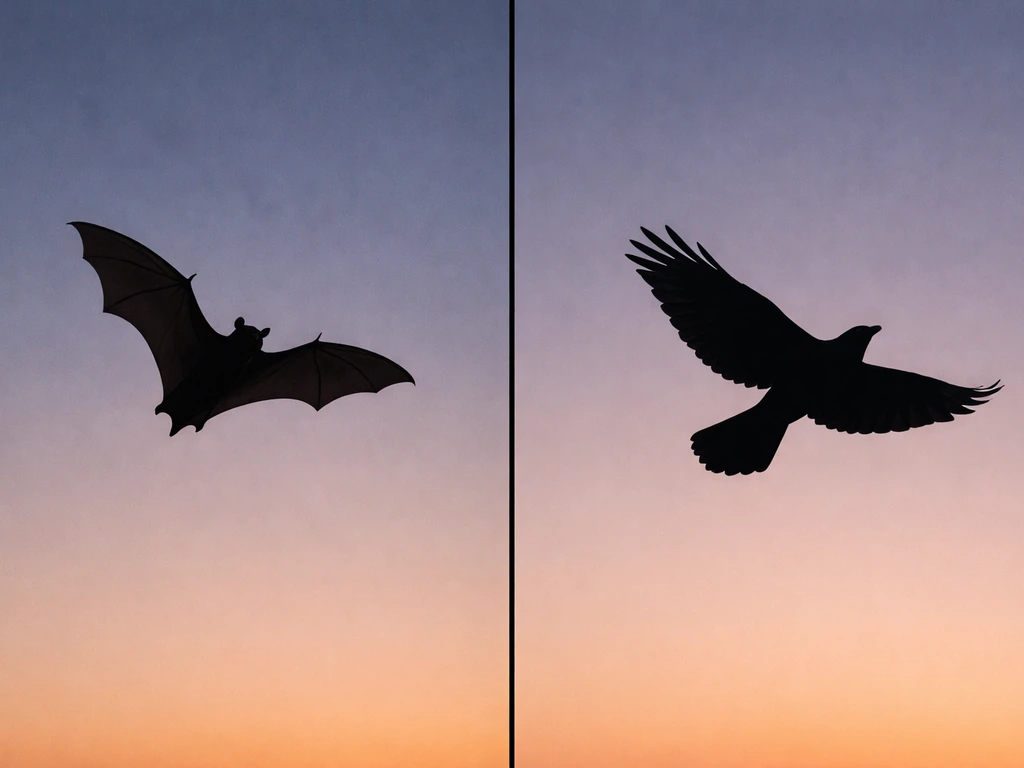
Instant field check: flight silhouette and motion
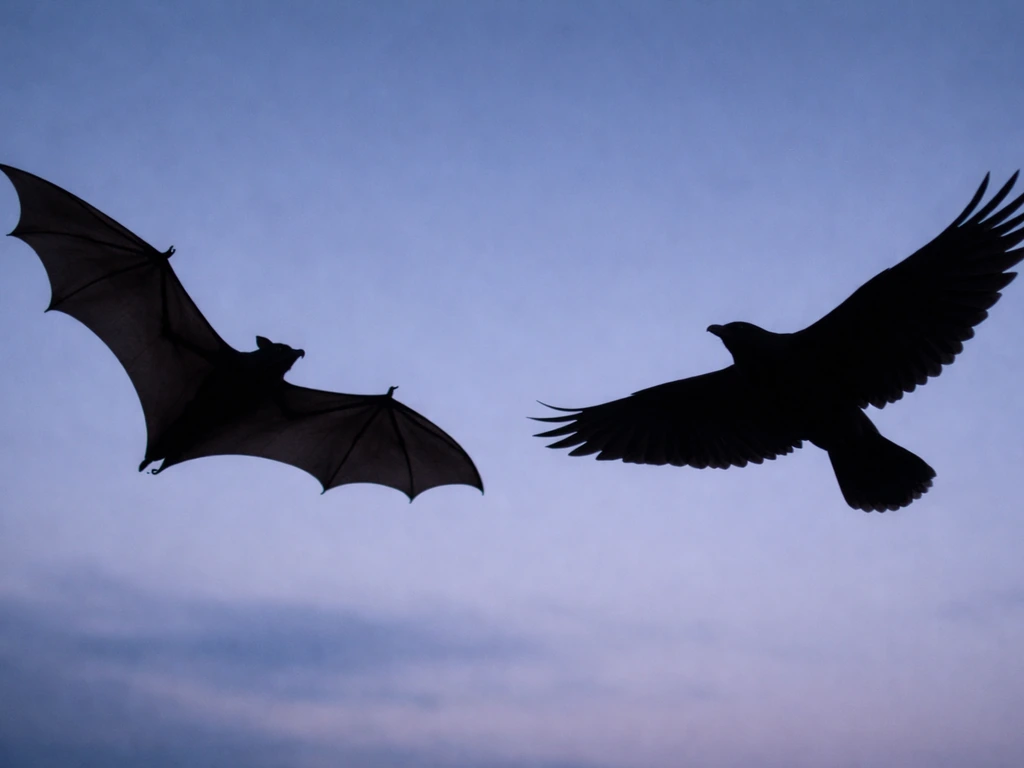
The silhouette is your fastest clue. Bat wings look like outstretched hands with very long fingers, because that's essentially what they are. Bats belong to the order Chiroptera, which literally means "hand-wing," and their wing membranes are stretched across dramatically elongated finger bones. In silhouette against a pale dusk sky, this produces wings that taper sharply to irregular, almost jagged-looking tips rather than the smooth, rounded, or pointed but aerodynamically tidy tips you see on birds. Bird wings are primarily built on arm and wrist bones with feathers doing most of the structural work, so they look comparatively solid and uniform.
Body shape matters too. Bats tend to look like a flying blob with big wings and no real tail projection. Birds almost always show a distinct tail fanning out behind the body. Even a swallow with a deeply forked tail or a swift with a tiny stub shows a clear body-to-tail line. If the flying animal looks like it's all wing and no tail, lean toward bat. If there's an obvious tail, even a short one, lean toward bird.
Color and texture are helpful when the light is decent. Bat wing membranes are darkly pigmented and almost leathery in appearance, with visible blood vessels creating faint lines across the surface in close views. Bird wings, by contrast, catch light differently because feathers reflect and diffuse it. A bird's wing often shows subtle color variation, patterning, or at minimum a consistent matte texture. The shiny, slightly waxy look of a bat's wing membrane is genuinely distinctive once you've seen it.
Wingbeat patterns vs hovering and gliding behavior
This is where bat flight gets really recognizable. Watch for what birders sometimes call a "stutter-stop" wingbeat: a rapid, somewhat erratic flapping that doesn't have the smooth, metronomic rhythm most birds produce. Bats often alternate short bursts of fast flapping with brief pauses, especially when they're hunting insects. The overall impression is jittery and unpredictable. Scientific analysis of bat wing kinematics confirms that the way bat wings generate lift differs fundamentally from how bird wings do it, and that difference shows up visually as a distinct motion pattern.
Birds flap with much more visible muscular regularity. A robin has its cadence, a pigeon has its own faster one, and a heron is slow and deliberate. Even species that look irregular, like flickers or woodpeckers with their bounding undulating flight, are doing something consistent and repeatable you can clock. Bats hunting in the open air appear more spontaneous, changing direction mid-flap to track insects. That constant subtle redirection is hard to fake.
Gliding is another dividing line. Most medium-to-large birds glide with locked-out wings, using thermals or momentum to coast for seconds at a time. Many songbirds fold their wings in brief undulating pulses. Bats rarely do either of those things cleanly. They can slow and adjust, but extended flat glides with rigid wings are not a common bat behavior. If you see something glide in a long, flat arc for several seconds, that's almost certainly a bird.
Ears, face, and other small cues you can spot in the air
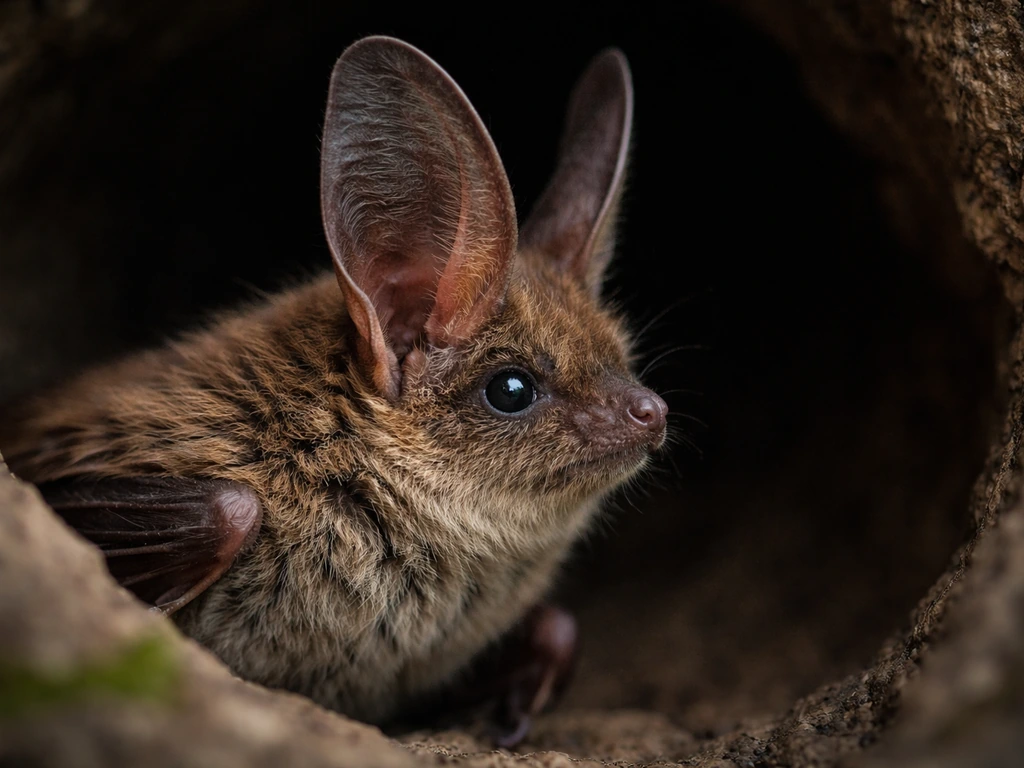
At close range or with good binoculars, a bat's face is unmistakable. Most bats have relatively large, prominent ears that stick up noticeably from the head. These ears are key to echolocation, helping bats analyze the directional information coming back from their ultrasonic calls. When a bat is flying toward you or banking close overhead, those ears often read as two small protrusions on top of an oddly flat, wide head. Birds' heads, by contrast, are rounder and their ears are hidden under feathers with no external ear structure at all.
The face angle also differs. Many bat species have distinctly upturned or pushed-in nose structures. Even without being able to see the nose clearly, the overall head profile of a bat looks different from a bird's: blunter, wider, and without any hint of a bill. If you catch a side view and see anything resembling a beak or bill, even a tiny stub, you're looking at a bird.
One more subtle but useful cue: the wing attachment point. Bat wings attach all the way down to the body and sometimes to the legs, so in flight you'll occasionally see the membrane connecting to the lower body or legs during a banking turn. Bird wings attach cleanly at the shoulder and the body remains visually separate from the wing surface. If a banking turn reveals a wing that seems to "wrap" around the body, that's a bat.
Size, speed, and maneuvering patterns (and what they usually indicate)
Most bats you'll encounter in North America or Europe are small, roughly sparrow-to-starling sized, and they move fast over short distances with tight, rapid turns. The kind of agility you'll see from a little brown bat hunting mosquitoes over a pond is extraordinary, maybe the most agile flight you'll witness from any vertebrate in your local area. They can turn in fractions of a second, drop suddenly, and recover instantly. Birds can be agile, but very few small birds match a bat's ability to reverse direction mid-air without losing speed.
Speed-wise, bats hunting insects aren't moving in a straight line long enough to clock their top speed. It's the constant directional change that sets them apart. A swallow or swift moves fast but mostly in arcing, flowing trajectories. A bat hunting insects looks almost random in comparison, zigging and zagging in response to prey you can't even see.
A bird that is clearly flying toward north would be expected to show more regular, directional flight patterns than the near-random zigzagging typical of bats hunting insects. If the winged subject is moving straight at you in a way that suggests a focused approach rather than erratic pursuit, that can point toward a bird-like flight path a bird is flying directly toward a stationary.
If you track its heading, a bird may fly in a steady direction, such as a bird is flying due east.
Larger bats can create more confusion because their size puts them into bird territory visually. But even large bats tend to have that membrane-wing silhouette and erratic hunting motion. Conversely, small birds like warblers or house sparrows don't usually show the extreme maneuverability of bats, and their wingbeat cadence is more regular.
Roosting context: where it's flying and when
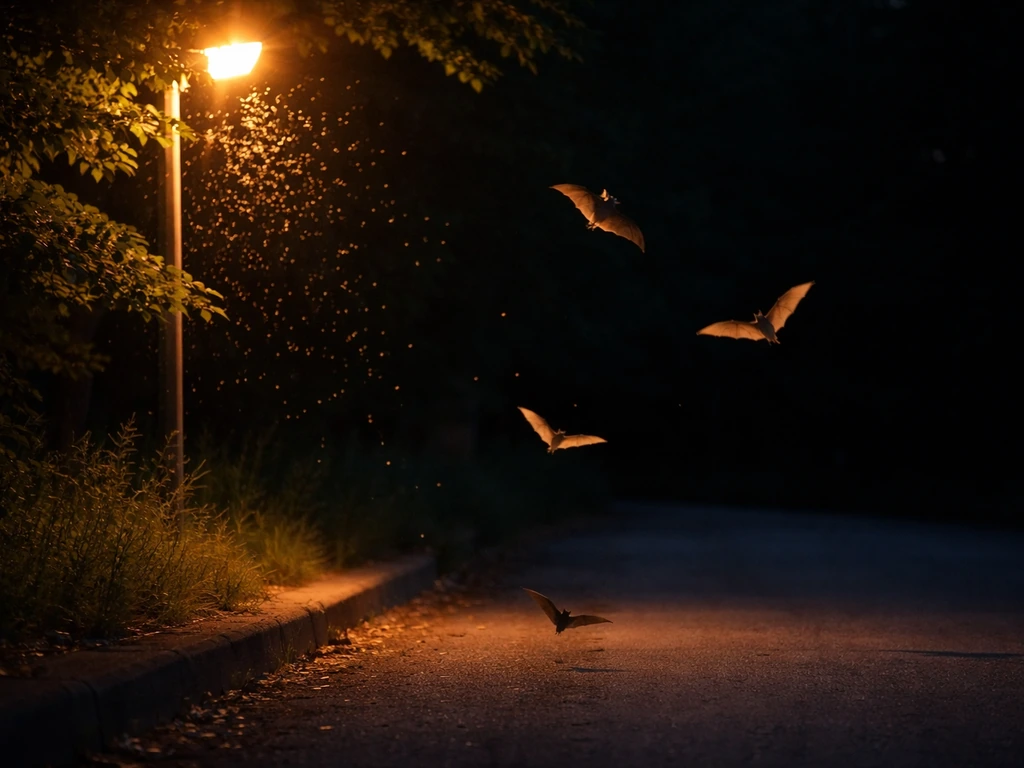
Time of day is one of the most reliable single cues you have. If it's dusk or dark and something is flying, bats become significantly more likely than birds. The Natural History Museum’s bat identification guide notes bats are typically seen “between dusk and dawn,” when the chances of spotting bats rather than birds are much higher [Natural History Museum notes bats are typically seen between dusk and dawn](https://www. nhm.
ac. uk/take-part/identify-nature/bats-in-flight-id-guide. html). Nearly all common bat species are nocturnal, and the window just after sunset is when bats typically emerge from roosts to begin hunting.
Most birds are wrapping up for the night at that point. If you're watching something erratic in the air fifteen minutes after sunset, bat is the safe first guess.
Location matters just as much. Bats concentrate their hunting where insects do, which means over water like ponds, streams, and lakes, along woodland edges, in open meadows, and near bright artificial lights that attract moths and beetles. If you're standing at the edge of a pond on a warm summer evening and something is making low passes over the surface, it's almost certainly a bat. That's a textbook foraging scenario for small insectivorous bats across most of the Northern Hemisphere.
Birds, of course, fly in all kinds of contexts and at all hours. But most bird flight you observe during daylight is purposeful: traveling between trees, foraging on the ground and returning to a perch, following a regular patrol route. It helps to note whether the bird is traveling straight toward a stationary observer rather than making erratic hunting passes traveling between trees.
If a bird stays put and does not fly away when you approach, that behavior can still fit the broader bird behavior described in this guide bird flight you observe during daylight. The intense low-altitude circling and rapid banking over a specific patch of air is much more characteristic of a bat chasing insects than of any common bird behavior.
If you are dealing with the bird side of things, this is also a good moment to compare behavior like a bird not flying away when approached, which people often discuss on bird identification threads such as bird not flying away when approached reddit. A bird that keeps its ground when you approach is still consistent with the daytime behavior patterns discussed earlier in this guide a bird not flying away when approached.
Quick rule-of-thumb decision flow and common lookalikes
Here's the decision flow to run through in your head when you spot something airborne and aren't sure what you're seeing:
- What time is it? If it's after sunset and before sunrise, bat is now your default hypothesis until something disproves it.
- Where is it flying? Over a pond, meadow edge, or around a streetlight at dusk? Strongly bat. High overhead in the afternoon? Strongly bird.
- What does the wing shape look like? Thin, dark, angular membrane with irregular tips and no visible feather texture means bat. Solid, uniform wing with feather edges means bird.
- Is there a visible tail? A distinct tail extension from the body points to bird. Little to no tail visible, with the wings seeming to dominate the whole silhouette, points to bat.
- What's the wingbeat doing? Jerky, stuttering, irregular flap pattern with rapid direction changes suggests bat. Regular, rhythmic, consistent cadence suggests bird.
- Is there a glide? Long, flat glides with rigid wings are birds. If there's no clean gliding phase and the animal just keeps flapping and redirecting, bat is more likely.
- Can you see the head? Prominent upright ears and no visible beak mean bat. Any hint of a beak, or a round smooth head with no ear projections, means bird.
The most common confusion case is the nighthawk, a bird that's genuinely bat-like in its flight. Nighthawks are active around dusk, have an erratic, bouncy, twisting flight style, hunt insects in the open air, and can look like a large bat at first glance. Missouri wildlife biologists literally nicknamed them "flying bullbats" because the resemblance can be so strong.
The key tells for nighthawk: look for the white wing bar, a prominent slash of white across each wing visible in decent light, a clearly defined tail, and a tendency to call loudly with a nasal peent sound. They're also larger than most common bats and move a bit more fluidly in their erratic-ness, if that makes sense. A true bat's redirection has an insect-chasing quality to it; a nighthawk's has more of a display and opportunistic sweep quality.
Common swifts create a similar puzzle in Europe and the UK. They're small, dark, extremely fast, and fly in tight flocking groups at dusk. But swifts have a screaming call you can hear clearly, show a very distinct crescent-shaped wing silhouette, and tend to fly in loose social groups rather than solo. Bats hunting are almost always solitary or loosely spaced, each following its own insect. If you see a tight screaming group of fast dark shapes, those are swifts.
| Feature | Bat | Bird (general) | Nighthawk (common lookalike) |
|---|---|---|---|
| Wing surface | Thin dark membrane, no feathers, visible finger structure | Solid, feathered, uniform texture | Feathered but narrow and pointed |
| Wingbeat | Jerky, stuttering, stop-start | Regular, rhythmic cadence | Erratic, bouncy, but less stutter than bats |
| Tail | Minimal or none visible | Distinct tail present | Short forked tail visible |
| Gliding | Rare; mostly constant active flight | Common in many species | Some gliding between bursts |
| Head/face | Prominent upright ears, no beak | No external ears, beak visible | Tiny beak, rounded head, no ear protrusions |
| Active hours | Dusk through night primarily | Mostly daytime, species-dependent | Dusk and dawn, sometimes day |
| Typical habitat | Over water, meadows, near lights | Highly variable | Open sky, fields, rooftops |
| Markings | Plain dark, membrane visible | Varied, often patterned | White wing bar diagnostic |
One last thing worth knowing: once you've watched a bat hunt over a pond at dusk once, you don't really struggle with the ID again. The flight style is so distinctive that it imprints quickly. Everything about how a bat moves in the air reflects the biomechanics of those membrane wings and the demands of catching fast, evasive insects in low light. It looks purposeful but chaotic in a way that birds, even the most agile ones, simply don't replicate. Give yourself a few dusk sessions near a pond or a park light this summer and the distinction will feel obvious.
FAQ
What should I use if it is not dusk, and I still cannot tell a bat from a bird when flying?
If it is broad daylight and the animal is still flying erratically, don't rely on dusk being the deciding factor. At that point, prioritize wing structure (feather edges and a more solid wing vs a thin, angular membrane) and look for tail visibility, since time of day stops being as reliable when birds are active.
I watched it flap fast, does that automatically mean it is a bat or a bird?
A common mistake is judging only wingbeat speed. Some birds flap in short bursts and some bats can flap more steadily than expected, so the more consistent discriminator is the wingtip shape and overall outline, plus tail presence (bat looks like “hand wings” with jagged-looking membrane tips, bird shows a defined tail projection).
What are the best cues when I only have a silhouette and no close-up view?
If you can only get a silhouette, focus on whether the wing tips look irregular and “torn” (membrane) or tidy and aerodynamically uniform (feathered wing). Also watch whether the outline tapers to a sharp, hand-like finger effect rather than a smooth, bird-like wing taper.
What if I cannot clearly see a tail, how can I decide between bat and bird?
Tail visibility can fail when the animal is far away or banking toward the light. Instead of insisting on a clearly fanned tail, look for the overall body-to-tail line, and check whether the wing seems to wrap down toward the legs or lower body during a turn (that wrap is more consistent with bats).
Can bats glide, and how long is too long before I should suspect a bird?
Yes. Some bats can appear to glide briefly, especially when adjusting to airflow or after a capture attempt, but long rigid, flat-wing coasting for multiple seconds is uncommon. If you see repeated, purposeful changes in wing angle and direction, that behavior still leans bat even if it pauses briefly.
Does being near a streetlight or porch light change the odds of bat versus bird?
If the animal is near bright artificial lights, it is more likely bat activity because many insectivorous bats forage under street lamps and around moth-attracting lights. For identification, combine that with solitude or wide spacing (bats often forage individually) and the “stutter-stop” rhythm.
How do I rule out a nighthawk (a bird that looks bat-like)?
If you see large white flashes across the wing, that is a strong sign of nighthawk-like bird behavior rather than a typical small bat. For nighthawks, also look for a clearly defined tail and a more fluid, sweeping flight style compared with the jittery insect-chasing redirections that bats show.
How can I tell bats from swifts when they are flying in fast dark groups?
Use spacing and sound if possible. Swifts can look like dark moving dots at dusk, and they often fly together in tight groups with audible high-pitched calls. Bats more often appear solo or loosely spaced, and their pursuit tends to look like independent zigzag hunting.
If I cannot decide in a moment, what should I watch for over the next few seconds?
A reliable next step is to watch behavior for 10 to 30 seconds and track direction changes. If it repeatedly reverses course or changes heading in a way that looks reactive to unseen insects, that points to bats. If it maintains steady travel between points with consistent pacing, that points to birds.
How can I use zoom/binoculars to improve accuracy when color is misleading?
When you are using binoculars or zoom, check texture rather than color alone. Bird wings usually show a feathered edge and a more uniform matte surface at that distance, while bats show a thin, membrane-like look that can catch light in a more waxy or leathery way.
Next Articles

A Little Bird Flying South for Winter: Real Migration Explained
See how a small bird flies south for winter: timing, routes, food cues, and real migration flight mechanics to spot.
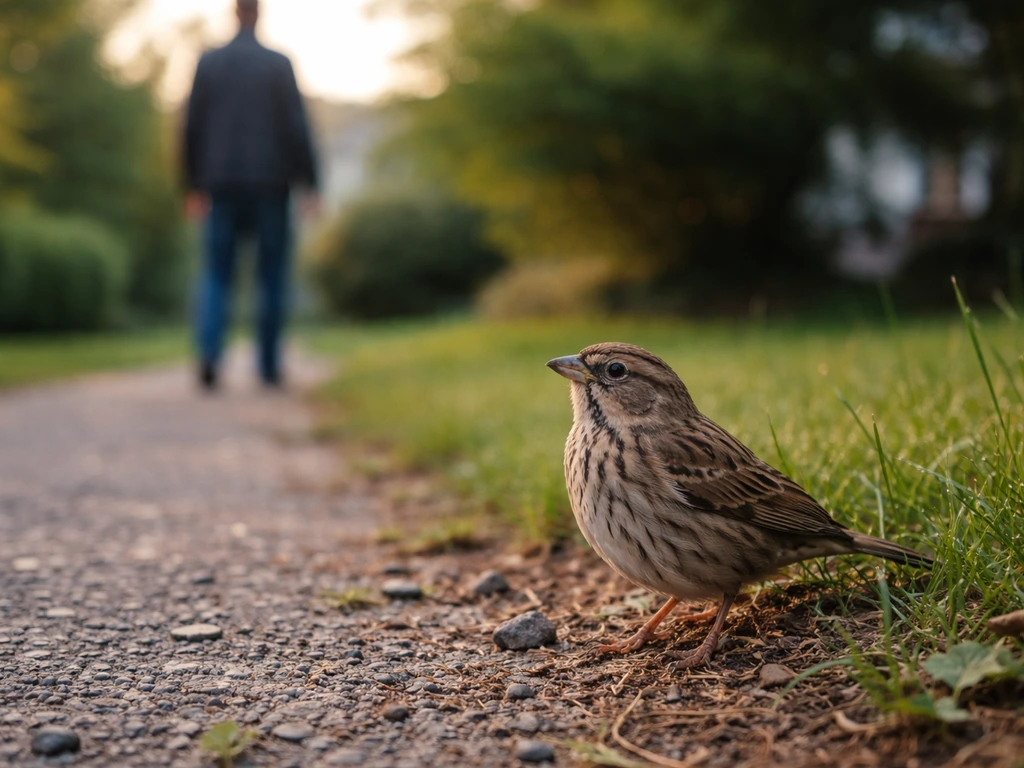
Bird Not Flying Away When Approached: What to Do Now
Step-by-step fixes for a bird that stays put when approached: check injury vs young vs guarding, ensure safe shelter

Some Birds Were Flying and Met a Bird: What Likely Happened
Identify what caused birds to converge, assess injury safely, and learn flight biomechanics behind midair encounters.