
When some birds were flying and met a bird, what you likely witnessed was one of a handful of very common avian interactions: a mobbing event, a mid-flight territorial dispute, a flock absorbing a new bird, or a collision. Each one looks different in the field, and the clues you need to tell them apart are already right in front of you. This guide walks you through reading those clues, understanding the flight mechanics that make these encounters happen, and knowing exactly what to do next, whether the bird you're watching is perfectly fine or clearly in trouble.
Some Birds Were Flying and Met a Bird: What Likely Happened

Marcus Chen
4 Apr 2026
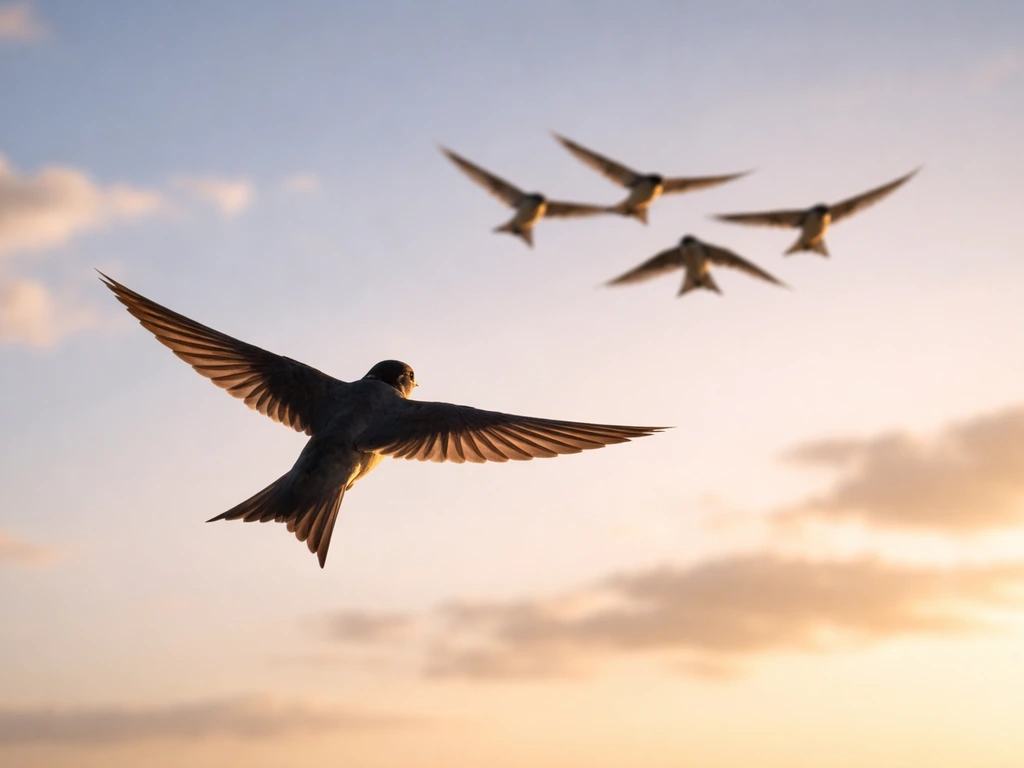
Real-world encounter or metaphor? What the phrase probably means
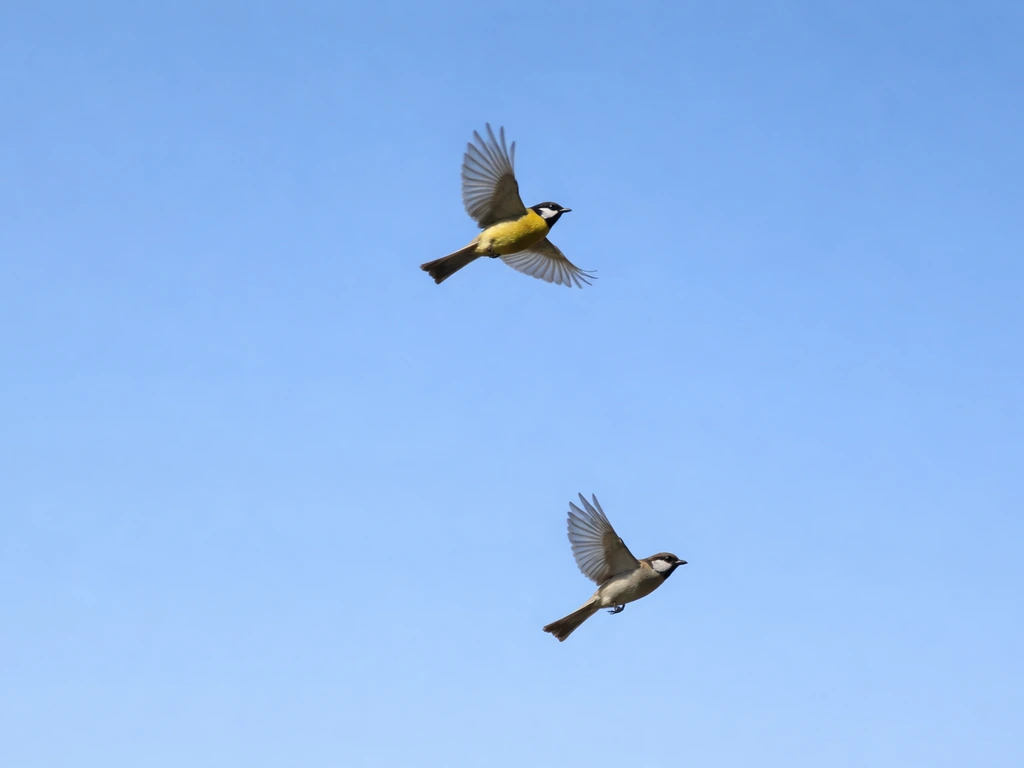
The phrase "some birds were flying and met a bird" sits in an interesting middle space. Literally, it describes a group of birds in flight encountering a single bird, which is a genuinely common wildlife observation. Figuratively, it echoes the kind of imagery found in fables, lyrics, and folklore, where birds meeting in the sky serve as stand-ins for unexpected connection, collision of worlds, or the lone outsider joining a group. If you're here because you're reading a story or poem that uses this phrasing, the metaphor almost always points to a chance encounter between a community and a stranger, often one that changes both parties.
But if you actually watched this happen outside your window or on a walk, you're dealing with real bird behavior, and that's where things get genuinely interesting. The rest of this article is built around the real-world scenario: a group of birds in active flight crossed paths with a single bird, and you want to know what happened and what (if anything) you should do.
Read the scene first: immediate clues to identify what kind of "meeting" you saw
Before you can act, you need to know what you're looking at. The good news is that bird interactions in flight have very readable signatures. Run through these questions quickly.
- How many birds were in the group, and how many were in the "met" bird? A tight flock of 20 starlings intercepting a single crow looks completely different from two sparrows briefly chasing a hawk.
- Did the single bird change direction, land, or seem distressed after the meeting? A bird that veers sharply and keeps going was likely just navigating shared airspace. A bird that drops to the ground needs your attention.
- Was there noise? Alarm calls, chattering, and persistent scolding almost always signal a mobbing event. Silence usually means the interaction was incidental.
- What time of day is it? Dusk and dawn encounters near buildings, especially during April and May (peak spring migration), are the most likely to involve a disoriented or collision-affected bird.
- Are the birds different species? Cross-species encounters almost always mean territorial defense or predator harassment. Same-species encounters more often mean flock joining or competition for a resource.
- Is any bird on the ground, fluttering, or holding a wing at an odd angle? That's your most urgent clue and the one that drives the next steps.
If you're watching a bird that seems frozen near a person, that behavior itself carries information. A bird not flying away when approached is often a sign of illness, injury, or extreme exhaustion from migration, not tameness. Keep that in mind as you read the rest of this guide.
Why birds come together in flight: the most common causes
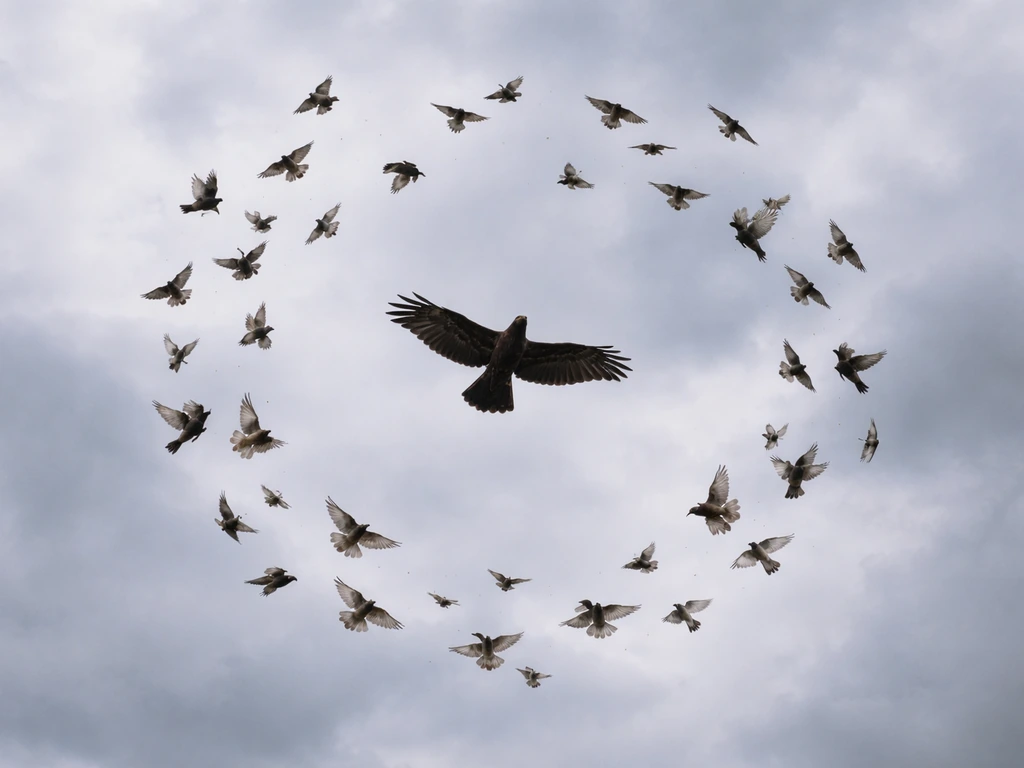
Birds don't just randomly share the sky. When a group meets a single bird, one of these mechanisms is almost always at work.
Mobbing: the group drives off a threat
This is probably the most visually dramatic encounter you'll see. Smaller birds, think crows, jays, mockingbirds, or blackbirds, join together to chase, dive-bomb, and harass a larger bird, usually a hawk, owl, or falcon. The goal isn't injury; it's harassment. They want the predator gone. What makes mobbing especially interesting is how it scales: a single smaller bird might start the chase, and as the larger bird crosses other territories, additional birds join in. The chase can involve dozens of birds pursuing one. If you saw what looked like a coordinated aerial assault on a single bird, you almost certainly watched a mobbing event.
Flock joining and navigation convergence
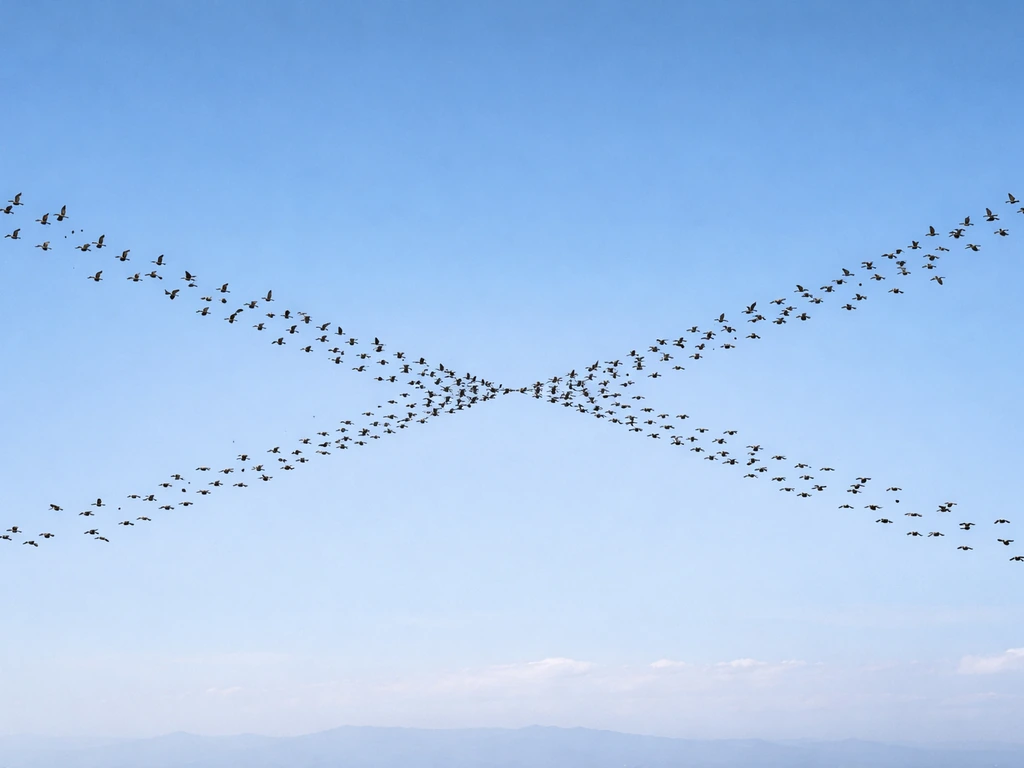
During migration, birds traveling the same corridor naturally converge. A lone bird flying south for the winter might link up with a passing flock of the same species, slotting into formation because the aerodynamic and navigation benefits are real. If you want a closer look at how that solo migrant experience works before the join-up, the concept of a little bird flying south for the winter covers the mechanics and risks of that solo leg beautifully. In spring (like right now, early April 2026), you're just as likely to see northbound migrants converging near food sources, water, or favorable wind corridors.
Territorial disputes and mating competition
Spring is peak territorial season. A resident bird defending its nesting area will actively intercept any intruder of the same species. This looks like two birds flying in tight, aggressive circles, with one clearly pursuing the other. Mating displays can also involve multiple males pursuing a single female, which from a distance looks like a group meeting a single bird but is really a competition.
Light-disoriented collision events (especially at night)
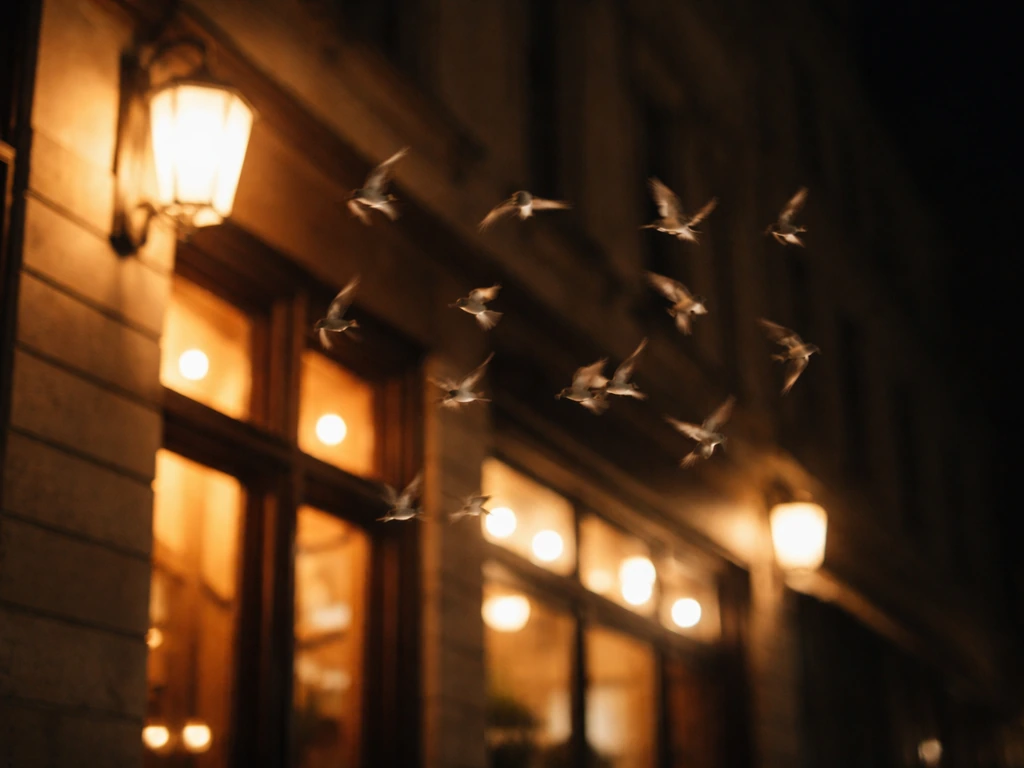
This one is less obvious to witness but more serious in outcome. Artificial lights disorient migrating birds, drawing them off course and toward lit buildings. Research into building collision drivers shows that migration magnitude, light output, and wind conditions all predict how many birds end up disoriented or colliding in urban areas. The U.S. Fish & Wildlife Service specifically flags spring (April–May) and fall as the highest-risk windows. A "meeting" that ends with a bird on the ground near a building at dawn almost certainly involved light disorientation.
How bird flight biomechanics shape where and when these encounters happen
Flight physics directly determines which birds can avoid, pursue, or intercept others. Two concepts matter most here: wing loading and turning radius.
Wing loading is the ratio of a bird's body weight to its wing area. Birds with low wing loading (large wings relative to body mass, like buteos or vultures) soar efficiently but turn slowly. Birds with high wing loading (small wings relative to body, like ducks or pigeons) fly fast in straight lines but can't pivot quickly. When a group of agile, low-wing-loading birds like crows mobs a high-wing-loading hawk, the hawk can't turn tightly enough to escape the harassment, which is exactly why mobbing works.
Turning radius also determines collision risk. A bird flying toward the north into a headwind has a different energy budget and maneuverability profile than one flying with a tailwind. Crosswind conditions narrow the effective turning radius for most species, pushing birds into tighter corridors and increasing the chance they'll converge on the same airspace. Add a building or treeline to that corridor and you get a natural bottleneck where encounters, planned or otherwise, become almost inevitable.
Takeoff and landing constraints matter too. Larger birds need runway, so they're more committed to their flight path and less able to dodge sudden obstacles. Smaller birds can abort and restart quickly. This asymmetry is part of why a bird flying due east along a building face might veer around a smaller bird without incident, while the same large bird would be unable to avoid a window in the same scenario.
Species and behavior patterns that change the odds of midair contact
Not all birds are equally likely to "meet" another bird in a dramatic way. Species-specific behavior patterns stack the deck considerably.
| Species or group | Likely interaction type | Why it happens |
|---|---|---|
| Crows, jays, mockingbirds | Mobbing hawks or owls | Strong territorial instinct; alarm calls recruit nearby individuals quickly |
| Starlings, blackbirds (murmurations) | Flock absorption of lone birds | Highly social; cohesion behavior pulls in same-species individuals nearby |
| Raptors (hawks, falcons) | Being mobbed; occasionally intercepting prey birds | High wing loading limits evasion; predatory behavior triggers mobbing response |
| Migrating warblers, thrushes | Light-disoriented collisions near buildings | Nocturnally migrating; highly susceptible to artificial light confusion in spring/fall |
| Hummingbirds | Direct territorial intercept of intruder | Extremely high wing loading for their size; fast turns; aggressively defend feeders and flowers |
| Geese, ducks | Flock joining during migration corridors | Fly in formation for aerodynamic benefit; lone birds actively seek groups |
One scenario worth calling out separately: if what you saw involved something that moved differently from the birds around it, you might be dealing with a bat rather than a bird. It's a more common confusion than people expect, especially at dusk. Knowing how to tell a bat from a bird when flying can save you a lot of misidentification headaches. The key tells are wing shape (bats have no feathers and flex differently), flight pattern (bats tend to erratic loops rather than directed paths), and timing (bats emerge after most birds have settled for the night).
One more scenario worth noting: if a single bird seems to be flying directly at a person or stationary observer, that's almost always a territorial display or a bird that's disoriented. Understanding the physics of what happens when a bird is flying directly toward a stationary bird-watcher explains why these encounters feel so startling even when the bird veers off at the last second. The bird is using you as a reference point, not a target. Similarly, if you notice a bird locked on a straight approach toward something stationary, the concept of a bird flying directly toward a stationary object is worth understanding because it explains how fixed-point navigation can end badly near windows and glass.
What to do next: practical steps for wildlife, yourself, and your pets
If no bird appears injured
Watch from a distance and enjoy it. Most bird encounters in flight resolve themselves in seconds. If it was a mobbing event, the target bird will leave the area and the group will disperse. If it was flock joining, they'll carry on together. There's nothing you need to do, and moving closer will likely disrupt the behavior you're trying to observe.
If a bird is grounded or showing signs of injury
This is where you shift from observer to first responder, carefully. Here's the sequence that holds up across all the major wildlife guidance sources.
- Don't chase the bird. Chasing causes additional stress and can worsen internal injuries that aren't visible from the outside. A bird that hit a window may have head trauma that isn't obvious.
- Don't give food or water. This applies whether the bird is a fledgling, an adult, or anything in between. Feeding an injured bird without guidance from a rehabilitator can cause aspiration or nutritional harm.
- Look for obvious external injuries: bleeding, a wing held at a wrong angle, or a bird that can't stand. If you see any of these, contact a wildlife rehabilitation agency right away.
- If you need to move the bird for its safety (off a road, away from a cat), place it gently in a ventilated box (a shoebox with holes works) lined with a cloth. Keep it dark, quiet, and warm, but do not handle it more than necessary.
- Call a licensed wildlife rehabilitator. The American Bird Conservancy notes that most birds that strike windows require professional medical assessment, not home care. Your local wildlife rehabilitation network or state fish and wildlife agency can connect you with a permitted rehabilitator.
- Keep pets away. Cats especially will instinctively pursue a grounded bird, and even a bite that doesn't break the skin can introduce bacteria that are fatal to small birds within 24–48 hours.
There's a useful community discussion around this exact situation, including the common question of whether a bird that isn't fleeing is actually injured or just stunned. In an r/Ornithology discussion about an injured bird, commenters commonly advise avoiding feeding or giving water and instead contacting a wildlife rehabilitator as soon as possible blank" rel="noopener noreferrer">avoid feeding or giving water and instead contacting a wildlife rehabilitator as soon as possible. The thread on bird not flying away when approached from a community forum perspective captures a lot of practical real-world experience from people who've dealt with exactly this scenario.
If the encounter happened near a lit building at night or at dawn
Light pollution is the context that changes your assessment most significantly. Artificial lights can trap migrating birds in disorienting loops, causing them to call out and burn energy until they collide with structures or simply exhaust themselves. If you found a bird near a lit building during spring or fall migration, assume disorientation or collision until proven otherwise, even if the bird looks physically intact.
A bird that seems stunned but upright may still have internal injuries or be too exhausted to fly safely. Box it, keep it quiet, and call a rehabilitator. If you own or manage a building, turning off non-essential lights during peak migration windows (April–May in spring) is one of the most effective things you can do to prevent this class of encounter.
Cornell Lab of Ornithology also recommends window-related steps to reduce collisions, including using markers or film on glass to break up reflections turning off non-essential lights during peak migration windows.
When to step back entirely
If the bird is upright, alert, and moving away from you on its own, it probably doesn't need help. The FWS guidance is clear: observe from a safe distance first, and only intervene when there are clear signs of injury or vulnerability. Well-meaning intervention with a healthy bird almost always causes more harm than good, including stress-induced injury and the risk of the bird imprinting on humans.
Putting it all together: what you most likely saw
If the encounter was noisy, fast, and ended with the lone bird leaving the area, you watched a mobbing event. If it was quiet and the birds ended up traveling together, you saw flock joining or a navigation convergence, especially likely right now in early April during spring migration. If a bird ended up on the ground near a building, light disorientation or a window collision is the most probable cause. BirdSavers is marketed as a bird-friendly visual glass treatment designed to reduce window collisions. And if the whole thing happened in a few seconds at altitude with no drama, it was almost certainly just two flight paths crossing in shared airspace. Birds do that constantly.
The flight biomechanics, the species behavior, the time of year, and the location all point toward one of these explanations. You don't need to have been a birder for years to read these clues. You just need to pause, look at what's in front of you, and work through the questions laid out here. Most of the time, the birds have already sorted it out before you finish asking.
FAQ
How can I tell whether the “single bird” was just involved in the encounter or actually hurt?
Yes, and the timeline matters. If the “lone bird” can keep flying normally once the other birds pass, it usually indicates a brief interaction like shared airspace, a territorial intercept, or a momentary convergence. If it repeatedly drops altitude, spirals down, lands near the same spot, or cannot resume sustained flight within minutes, treat it as more than “just a scare” and switch to first-responder steps.
Is mobbing ever dangerous for the bird being chased?
Mobbing is usually harassment, not predation. Typical signs include multiple smaller birds diving in short bursts, a target that changes direction rapidly, and the group dispersing after the larger bird exits the area. If you see the target injured on the ground immediately, or blood, or ongoing attempts to grapple it after the pursuit ends, that pattern shifts away from normal mobbing.
What quick clues distinguish a territorial fight from a flock joining or migration convergence?
Look for synchronized behavior and the target’s body language. In territorial disputes or mate competition, you often see repeated pursuit loops or one bird consistently chasing another of the same species, sometimes with multiple “would-be rivals” showing up. In flock-joining, the behavior is more like adjustment and spacing, with birds merging into a shared flight line rather than sustained one-on-one harassment.
If a bird doesn’t fly away when I’m near, does that always mean injury?
Birds can look “stuck” even when they are not. If the bird is actively calling, blinking normally, keeping its posture upright, and you notice it making small movements (head turns, shuffling, repositioning) but it does not fly off immediately, that can still be exhaustion. A key difference is whether it makes a clear attempt to leave once it has room or light levels change. If you are near windows or heavy traffic, give space and reassess from farther back rather than moving in closer repeatedly.
Why is a bird near a lit building at dawn treated differently than a bird in a yard?
Artificial lights can turn normal navigation into repeated circling. If you find a bird on the ground near a building at dawn or in the evening during migration windows, assume disorientation until proven otherwise, even if it appears upright. Keep bystanders away, reduce noise, and consider covering it with a breathable container to limit further looping once it regains some calm.
I saw something flying that looked like a bird, but it acted weird. Could it be a bat, and what should I do?
If you suspect a bat, the safest move is to avoid close handling. Bats typically have more erratic, looping flight paths, and they emerge when most birds have settled, especially around dusk. If it is on the ground, look for a flexible, finger-like wing structure and a different “wing beat” look than feathered birds. When in doubt, treat it as wildlife that should be handled by trained help, because bats can carry diseases and can be easily injured.
A bird flew directly at me, then veered off at the last second. Should I be worried?
Do not treat “flying toward me” as aggression. Often the bird is using you as a visual reference point or responding to its own navigation or territorial goal, then veering at the last moment. Watch how it behaves relative to other landmarks. If it follows a straight approach toward a window or reflective surface, it may be fixed on the object rather than you, and the most useful action is preventing window collisions rather than trying to “move it away” manually.
What are the best rules of thumb for when to intervene versus simply watching from a distance?
Avoid touching an apparently healthy bird. If you intervene, do it only for clear vulnerability, for example, inability to fly, visible trauma, entanglement, or high likelihood of immediate hazards like construction zones, cats, or glass. Healthy birds often resume normal flight once you step back, and repeated close approach can cause stress-induced injuries or lead them to associate people with safety.
What practical steps can reduce the chances of these encounters happening at my building?
Turning off non-essential exterior lights during peak migration hours can materially reduce the number of birds that disorient and circle into buildings. If you manage a property, focus on the lights that shine upward or outward and keep interior lights low where possible. Also consider adding window treatments (for example, curtains) to reduce reflections during those windows, since reflections can mimic open sky.
If nothing seems wrong afterward, could it still have been something serious?
If the encounter was over quickly and ended with the birds separating without landing nearby, it is often just shared airspace crossing or a brief altitude adjustment. The “meeting” may not mean anything is wrong, especially if no bird appears grounded or visibly impaired. A useful check is whether any single bird lingers in one place after the others leave; lingering suggests an issue worth investigating.
Next Articles

Bird Has Flown Meaning: Definition and How to Respond
Understand the bird has flown meaning, when it’s used, and how to reply with examples for real-life conversations.
Prefix Meaning Flight or Bird: Definition and Examples
Learn the flight or bird prefix meaning, origin, examples, and a checklist to decode new words and avoid look-alikes.
Flyer Meaning Bird: What It Says About Flight Ability
Clarifies flyer meaning for birds and explains which species fly well and why, plus a checklist to verify in context.