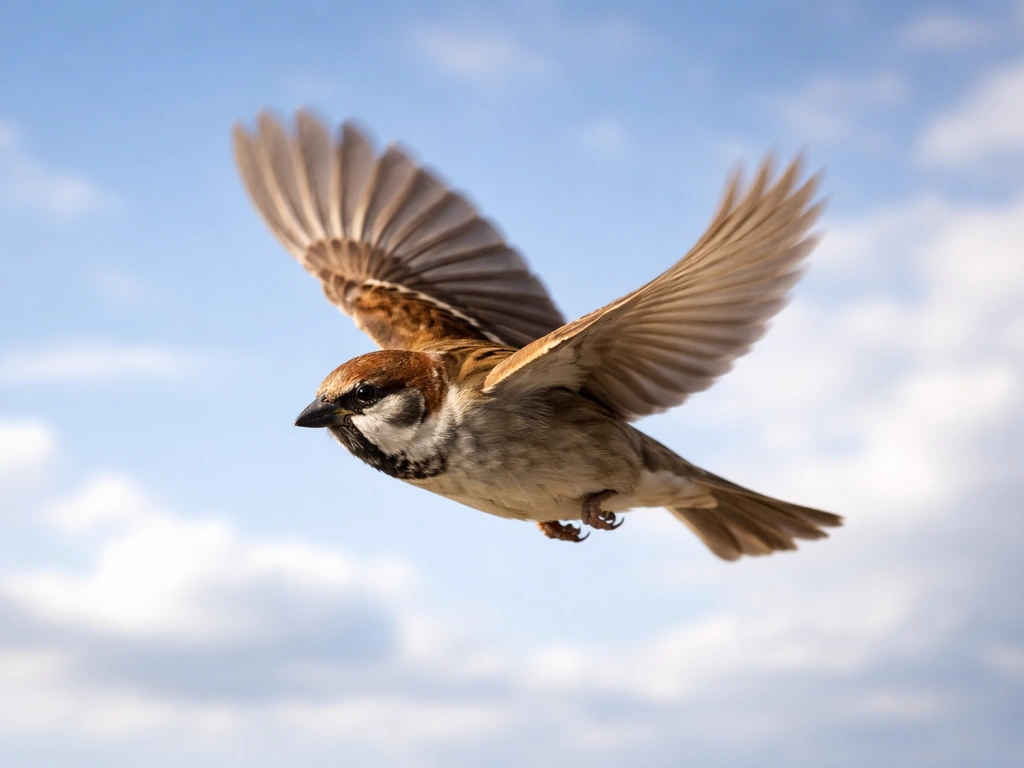
When a bird flaps its wings downward, it pushes air downward and backward. The air, in return, pushes the bird upward and forward with an equal and opposite force. That upward push is the reaction force, and it is what keeps the bird aloft. It is Newton's third law in feathers and bone: every action has an equal and opposite reaction, and for a flying bird, the action is deflecting air downward while the reaction is lift.
What Is the Reaction Force of a Flying Bird: Lift Explained

Marcus Chen
21 Jul 2026
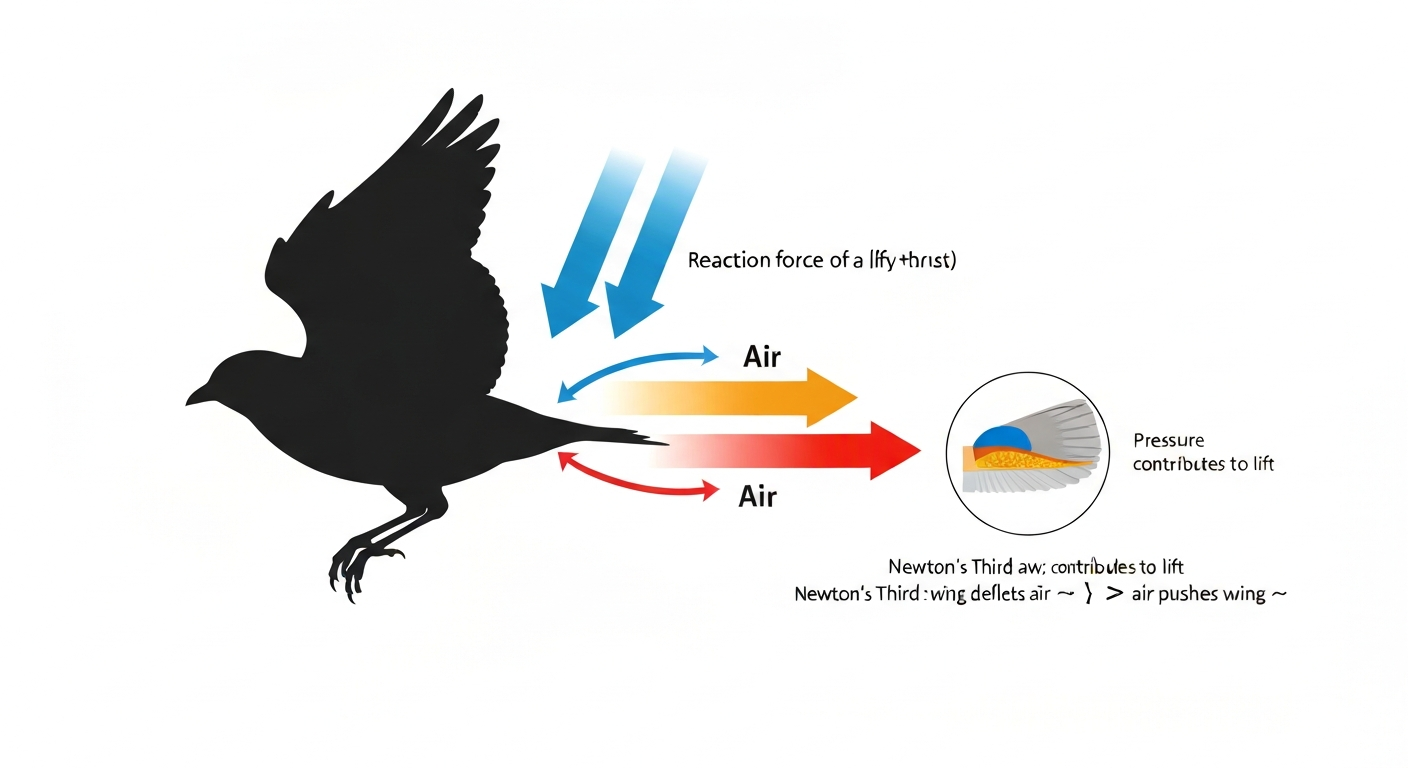
Newton's Third Law and the Reaction Force
Newton's third law states that for every force one object exerts on another, the second object exerts an equal force in the opposite direction. In the context of bird flight, the bird's wing is the first object and the surrounding air is the second. When the wing pushes a parcel of air downward, changing its momentum, that air pushes back on the wing with exactly the same magnitude of force, directed upward. That upward force is what aerodynamicists call lift, and it is the primary reaction force that counteracts gravity and keeps the bird flying.
This is not a metaphor or an approximation. NASA's Beginner's Guide to Aeronautics explicitly frames lift this way: a wing deflects air downward, the change in the air's momentum is real and measurable, and the equal and opposite response is the net upward force on the wing. No mysterious suction, no magic. Just momentum exchange between a wing and the air it moves through.
How Wings Produce the Reaction Force
A bird's wing is an airfoil: curved on top, flatter below, and tapered toward the tip. When the wing moves through air, two things happen simultaneously that both contribute to the reaction force. First, the camber and angle of attack of the wing force air to travel a longer path over the top surface than the bottom. By Bernoulli's principle, faster-moving air has lower pressure, so pressure above the wing drops relative to pressure below. That pressure difference pushes the wing upward. Second, and more fundamentally, the wing deflects the oncoming airflow downward. The net result is the same from both perspectives: a net upward reaction force on the wing.
Circulation theory, specifically the Kutta-Joukowski theorem, formalizes this elegantly. It states that the lift per unit span equals the product of air density, free-stream velocity, and the wing's circulation (a measure of how much the wing organizes the airflow around itself into a rotating pattern). Mathematically: L/span = ρ × V × Γ. The circulation Γ captures both the pressure-difference picture and the momentum-deflection picture in a single quantity, which is why it is so central to aerodynamic analysis of bird wings.
Downwash and Momentum Change
Watch a bird fly over a still pond and you will sometimes see the surface ripple behind it. That disturbance is partly caused by downwash, the trail of air that the bird has shoved downward. Every kilogram of air that gets deflected downward carries downward momentum. The rate at which the bird imparts that downward momentum to the air equals the upward reaction force on the bird. In steady forward flight this reaction force must exactly equal the bird's weight, otherwise the bird accelerates up or down.
Particle image velocimetry (PIV) experiments confirm this beautifully. Researchers train laser sheets on the wake behind birds flying in wind tunnels, then photograph tiny seeding particles to reconstruct the velocity field. When you integrate the downward momentum flux across the entire wake cross-section, you recover a number that closely matches the bird's weight. Spedding and colleagues showed this with robins (Erithacus rubecula), and Hedenström's group extended similar analyses to a range of passerines. The downwash in the wake is not incidental: it is the physical record of every reaction impulse the bird has delivered to the air.
Flapping Kinematics and Unsteady Effects
A gliding bird is relatively simple to analyse. A flapping bird is not. During a wingbeat, the wing changes speed, angle of attack, and shape continuously. The downstroke typically generates most of the lift and some thrust; the upstroke in many birds is partially folded to reduce drag, though in fast-flying species it still contributes meaningfully to force production. The pectoralis muscle drives the downstroke and is, by mass, the single largest muscle in most flying birds. In pigeons, strain-gauge studies show the pectoralis generating peak forces consistent with the aerodynamic forces needed for weight support throughout the downstroke.
At the tip of each wing, the pressure difference between upper and lower surfaces causes air to curl around the wingtip and shed as a trailing vortex. These tip vortices, combined with the start and stop vortices shed at the beginning and end of each half-stroke, form the bird's vortex wake. The wake carries the record of all the reaction impulses the bird has produced. Integrating the momentum in those vortex rings or undulating vortex sheets gives you back the bird's weight support, which is a satisfying experimental closure.
Unsteady aerodynamic mechanisms add complexity beyond the simple quasi-steady picture. Leading-edge vortices (LEVs), rotational circulation at stroke reversal, wake capture (the wing re-encountering its own previously shed wake), and added-mass forces all contribute to instantaneous force production. Revolving-wing experiments on pigeon wings measured lift coefficients up to CL ≈ 1.64, which is substantially higher than typical cruising values of around 0.5 to 0.8, suggesting that delayed stall and LEV-like mechanisms allow birds to extract more reaction force per unit wing area than classical steady theory predicts. The quasi-steady lift formula L = 0.5 ρ V² S CL is still a useful first estimate, but real flapping flight involves unsteady corrections that can shift instantaneous forces considerably.
Lift, Thrust, and Drag: Keeping the Forces Straight
People sometimes use 'reaction force' loosely to mean any aerodynamic force on the bird. It is worth being precise. The total aerodynamic reaction from the air on the bird can be decomposed into components based on direction, and each component has a distinct role.
| Force | Direction | Role in flight | Primary source |
|---|---|---|---|
| Lift | Perpendicular to flight path (mainly upward) | Counteracts gravity; supports weight | Pressure difference across wing; downwash momentum change |
| Thrust | Parallel to flight path (forward) | Overcomes drag; maintains or increases speed | Backward push of air during downstroke; angled lift vector |
| Drag | Opposite to flight direction (backward) | Resists forward motion; must be overcome | Skin friction, pressure drag, induced drag from tip vortices |
| Weight | Straight down | Must be balanced by lift in level flight | Gravity acting on bird's mass |
In a flapping bird, the resultant aerodynamic force vector rotates through the wingbeat cycle. During the downstroke, the force vector tilts forward, providing both lift and thrust simultaneously. During the upstroke, the contribution shifts. Pennycuick's flight modelling framework separates these components carefully, treating lift and thrust as the two useful outputs of the wing-air interaction and drag as the cost. The reaction force in the strict Newtonian sense is the total aerodynamic force on the bird, but in common usage, and in most flight mechanics texts, 'reaction force' in the context of what keeps a bird up refers specifically to lift.
Key Formulas and Variables
Three equations are especially useful when thinking about the reaction force of a flying bird. First, the standard lift equation:
- Lift equation: L = 0.5 × ρ × V² × S × CL, where L is lift force (Newtons), ρ is air density (kg/m³), V is airspeed (m/s), S is wing area (m²), and CL is the dimensionless lift coefficient
- Momentum relation: F = Δp/Δt = (mass flow rate of air deflected) × (downward velocity imparted to that air) — the rate of change of air momentum equals the upward reaction force
- Impulse definition: J = F × Δt = Δp, meaning the reaction impulse delivered per wingbeat equals the change in downward momentum of the air shed in that wingbeat
- Kutta-Joukowski lift per span: L/b = ρ × V × Γ, where b is wingspan and Γ is circulation (m²/s)
In steady level flight, L must equal body weight (m × g), where m is body mass in kilograms and g is 9.81 m/s². This equality is the basic constraint that links the bird's morphology (S and CL) and flight speed (V) to the reaction force it needs to produce. If you know three of these quantities, you can solve for the fourth.
Quantifying the Reaction Force
Using the lift equation gives an immediate, concrete sense of the forces involved. In level flight, the lift force equals the bird's weight. So L = m × g. The lift equation then tells you what combination of speed, wing area, and lift coefficient delivers that force. You can also think about it from the momentum side: if the bird flies at speed V and imparts a downward velocity w to a tube of air with cross-sectional area equal to the wing disc area, the mass flow rate through that disc is ρ × A × V. Multiplying that by the induced downwash w gives force, and setting it equal to weight gives the induced velocity needed for weight support. This is the actuator-disk momentum approach used in Pennycuick's flight models, and it underpins estimates of induced power in bird flight energetics. Pennycuick lists recommended inputs, body mass m, wing area S, flight speed U, air density ρ, lift coefficient CL, and wingbeat frequency, for his actuator-disk and quasi-steady flight models in Modelling the Flying Bird, recommended inputs and Flight model (Pennycuick, Elsevier) Modelling the Flying Bird — recommended inputs and Flight model (Pennycuick, Elsevier).
Worked Example: A Pigeon in Cruise Flight
The rock pigeon (Columba livia) is one of the most thoroughly measured birds in aerodynamics research, which makes it a natural choice for a worked example. Published wind-tunnel and propeller-experiment data give typical parameters for an adult bird. Representative morphometrics and experimental data for Columba livia are summarized in blank" rel="noopener noreferrer">Dynamic pressure maps for wings and tails of pigeons in slow, flapping flight (data table; Biewener et al. / ResearchGate copy).
| Parameter | Symbol | Value | Source |
|---|---|---|---|
| Body mass | m | 0.330 kg (330 g) | Usherwood 2009 / Biewener et al. |
| Total wing area (both wings) | S | 0.059 m² | Biewener et al. wind-tunnel data |
| Cruise airspeed | V | 12 m/s (~43 km/h) | Typical pigeon cruise speed |
| Air density (sea level) | ρ | 1.225 kg/m³ | Standard atmosphere |
| Lift coefficient (cruise) | CL | 0.75 (mid-range cruise estimate) | Between ~0.5 and 1.64 measured range |
| Wingbeat frequency | f | ~7 Hz (period ≈ 0.143 s) | Typical pigeon wingbeat |
Step 1: Required lift force
In steady level flight, lift must equal weight. Weight = m × g = 0.330 × 9.81 = 3.24 N. So the bird needs to produce 3.24 N of upward reaction force to stay aloft.
Step 2: Lift from the lift equation
L = 0.5 × ρ × V² × S × CL = 0.5 × 1.225 × (12)² × 0.059 × 0.75. Working through: 0.5 × 1.225 = 0.6125. Then 0.6125 × 144 = 88.2. Then 88.2 × 0.059 = 5.20. Then 5.20 × 0.75 = 3.90 N. At CL = 0.75, the formula gives 3.90 N, which is somewhat above the required 3.24 N, which is consistent: in real cruise, CL adjusts downward toward ~0.61 to exactly balance weight at this speed. The calculation confirms the order of magnitude is right, and you can solve backwards to find the cruise CL needed: CL = (2 × m × g) / (ρ × V² × S) = (2 × 3.24) / (1.225 × 144 × 0.059) = 6.48 / 10.41 ≈ 0.62. So the pigeon cruises at roughly CL ≈ 0.62 at 12 m/s.
Step 3: Downward reaction impulse per second and per wingbeat
By Newton's third law, the upward reaction force of 3.24 N on the bird equals the rate at which the bird is imparting downward momentum to the air. Over one second, the downward reaction impulse delivered to the air is: Jpersecond = F × t = 3.24 N × 1 s = 3.24 N·s (or equivalently 3.24 kg·m/s of downward momentum deposited in the air per second). Per wingbeat, with a frequency of 7 Hz (period T = 1/7 ≈ 0.143 s): Jperwingbeat = 3.24 × 0.143 ≈ 0.46 N·s. This means each complete wingbeat cycle imprints roughly 0.46 kg·m/s of downward momentum into the air as a vortex structure, exactly what PIV wake studies measure when they integrate the momentum in discrete vortex rings shed by flapping birds.
Energy in a Flying Bird: A Quick Scorecard
Flight involves several forms of energy simultaneously, and questions about which type is 'the' energy of a flying bird come up often. See the related note titled "the form of energy possessed by a flying bird is" for a concise definition that lists the bird's kinetic, potential, metabolic, and wake (downwash) energy components. See the article what type of energy is a flying bird for a focused discussion of the different energy forms involved in flight. The honest answer is: all of them, at the same time. For a focused discussion on whether a flying bird's energy is best described as potential or kinetic, see the article titled "is a bird flying potential or kinetic energy.". For a concise overview of which energies a bird flying in the sky has, see the article on bird flight energetics. A bird in level flight at constant speed has kinetic energy by virtue of its forward motion (KE = 0.5 m V², so for our 330 g pigeon at 12 m/s that is about 23.8 J). It has gravitational potential energy by virtue of its height above the ground (PE = m g h). It also consumes metabolic energy stored in chemical bonds in muscle glycogen and fat, converting that into mechanical work done by the flight muscles on the wings. The wings then do work on the air, imparting kinetic energy to the downwash. In thermodynamic terms, the bird is an engine converting chemical energy into the kinetic energy of wake air, with some of that energy recovered as lift to counteract gravity.
During a glide, the bird trades height (potential energy) for speed and the lift needed to stay aloft, no muscle work required beyond minor adjustments. During climbing flight, the bird invests additional metabolic energy to increase both speed and height. During landing, kinetic energy is deliberately dissipated. The interplay between these energy forms is central to understanding why different species have evolved different flight styles, wing shapes, and wingbeat patterns. Longer, narrower wings (high aspect ratio) reduce induced drag and are metabolically cheaper for sustained soaring. Shorter, broader wings allow high lift coefficients and maneuverability at lower speeds.
Can Lightning Strike a Flying Bird?
It is an uncommon but real risk. See the article Can lightning strike a flying bird? for detailed discussion of risks, documented incidents, and avoidance behaviors. A bird in flight is an isolated conductor in midair, and if it is in the wrong place during a lightning discharge, it can be struck or affected by a nearby bolt. Direct strikes are rare and typically fatal. More commonly, birds are affected by the electromagnetic pulse of a nearby strike or ground the charge through contact with a structure. Large soaring birds like eagles and storks, which fly at higher altitudes in thermals, face greater exposure than small passerines that typically fly below cloud base. Most bird species appear to have evolved behavioral avoidance rather than physical protection: they land or shelter before storms develop. The physics of the reaction force does not change near a storm, but the risk environment for the bird certainly does.
What the Reaction Force Tells Us About Bird Evolution
The need to generate a specific reaction force (equal to body weight) under real-world constraints has been a powerful driver of avian evolution. Wing shape is not arbitrary. A high-aspect-ratio wing (long and narrow, like an albatross) produces a large span for a given area, reducing the strength of tip vortices and minimizing induced drag, the drag penalty that comes directly from generating lift. A short, broad wing (like an accipiter hawk's) allows rapid force modulation and tight maneuverability by changing angle of attack quickly, at the cost of higher induced drag. Wingbeat frequency, stroke amplitude, and the muscle mass devoted to flight all reflect the mechanical demand of producing the reaction impulse needed to support the bird's weight continuously.
Heavier birds need more reaction force, which requires either larger wing area, higher flight speed, a higher lift coefficient, or some combination of the three. This is partly why large birds like swans and bustards have minimum flight speeds well above those of sparrows, and why some very large birds (ostriches, emus) have abandoned powered flight entirely: the metabolic and structural cost of producing enough reaction force to support a 100 kg body outweighs any survival benefit. The reaction force is not just physics, it is the central constraint around which avian body plans have been sculpted over millions of years.
Biomimetic Design: Reaction Forces Inspire Engineering
Understanding how birds generate and control their reaction forces has been directly useful in drone and aircraft design. Ornithopters (flapping-wing aircraft) are designed explicitly by modelling the unsteady aerodynamics that birds exploit. The discovery that leading-edge vortices stabilize force production during the downstroke has influenced the design of micro air vehicles (MAVs), where conventional fixed-wing aerodynamics at low Reynolds numbers performs poorly. Wingtip winglets on commercial aircraft are a direct engineering application of the insight that tip vortices represent wasted reaction-force energy, and reducing them reduces induced drag. Multi-rotor drones are essentially many small actuator disks producing reaction forces by pushing air downward, the same physical mechanism a hovering hummingbird uses, just realized in aluminum and carbon fiber rather than bone and feather.
The momentum approach to computing reaction force, developed in the context of bird flight modelling by researchers like Pennycuick, is also the same theoretical foundation used to compute rotor efficiency in helicopter design. When engineers want to know how much power a drone rotor needs to hover, they solve the same momentum balance equation that predicts the induced velocity in a bird's wake. The biology and the engineering are genuinely unified at the level of Newton's third law.
Explore Further
The reaction force of a flying bird connects to a wide network of related topics worth exploring in depth. See the article 'will to power fly bird' for a focused discussion. Airfoil lift and circulation theory unpacks the Kutta-Joukowski theorem in more detail. Wake vortex structures in bird flight shows exactly how PIV experiments visualize the momentum the bird deposits in the air. Bird flight energetics covers how metabolic power relates to the mechanical work done against drag and gravity, which ties directly into the energy questions touched on here. A dedicated article on the lift equation with a numerical example for bird flight gives you a broader worked-problem context. Wing morphology and flight modes explains why different wing shapes produce different reaction-force profiles across species, connecting the physics back to evolution and behavior.
FAQ
What is the reaction force of a flying bird (short definition)?
The reaction force is the aerodynamic force the air exerts on the bird when the bird’s wings change the air’s momentum. By Newton’s third law, when a wing pushes air downward (or accelerates it), the air pushes the wing upward with an equal and opposite force — this upward component is lift and one manifestation of the reaction force.
How exactly do bird wings produce that reaction force?
Several linked mechanisms produce the reaction force: (1) Downwash — wings deflect air downward so the wake carries downward momentum; the opposite upward force supports the bird’s weight. (2) Pressure differences — wing shape and motion create higher pressure beneath and lower pressure above the wing, producing lift. (3) Circulation — bound circulation around the wing (Kutta–Joukowski view) links velocity/pressure distribution to lift. (4) Unsteady/flapping effects — during flapping, added‑mass forces, leading‑edge vortices (LEV), rotational circulation and wake capture augment and vary the instantaneous reaction force through the wingbeat.
Is the reaction force the same as lift, thrust or drag?
The reaction force is the general aerodynamic force from the air on the wing. It can be resolved into components: lift (approximately vertical, supports weight), thrust (forward, overcomes drag) and drag (rearward resistance). In flapping flight the resultant aerodynamic force varies over the wingbeat and its components change with wing orientation and kinematics.
What formulas quantify the reaction force (lift) for a bird?
Common formulas and approaches: (1) Quasi‑steady estimate (engineering): L = 0.5 ρ U^2 S CL, where ρ is air density, U a characteristic velocity, S planform area and CL lift coefficient. (2) Circulation form (per unit span): L' = ρ U Γ (Kutta–Joukowski). (3) Momentum / actuator‑disk perspective: integrated wake momentum flux (ρ × area × downwash velocity × flow speed) equals the lift. Note: for flapping wings unsteady terms (added mass, rotational circulation, LEV) require corrections to quasi‑steady estimates.
Worked example: how large is the reaction force for a representative pigeon in level flight? (numbers)
Pick a representative pigeon: mass m = 0.33 kg (typical), gravity g = 9.81 m/s^2, so required vertical force L = mg = 0.33×9.81 = 3.24 N. Use air density ρ = 1.225 kg/m3, projected two‑wing area S ≈ 0.06 m2 and cruise speed U = 10 m/s. Rearranging L = 0.5ρU2S CL gives CL = L/(0.5·ρ·U2·S) = 3.24/(0.5·1.225·100·0.06) ≈ 0.88. That CL is plausible for steady cruising; higher instantaneous CLs occur during downstrokes in flapping flight.
How big is the downward reaction (downwash) in that example?
Approximate the mean wake downwash w from a momentum balance: L ≈ ρ·S·U·w, so w ≈ L/(ρ·S·U) = 3.24/(1.225·0.06·10) ≈ 4.4 m/s downward (order of m/s as reported in wake PIV studies). The impulse imparted to the air per wingbeat equals weight×period: for a wingbeat period of 0.2 s (5 Hz) impulse ≈ L·0.2 ≈ 0.65 N·s.
Next Article
The Form of Energy in a Flying Bird: Kinetic Energy
Flying birds are moving, so the best answer is kinetic energy, from converting food energy into flight motion.