
Almost every bird you can name is a flying bird. Out of the roughly 10,000 known bird species on Earth, only around 60 are truly flightless. So if you're trying to figure out the name of a bird that can fly, the honest answer is: pick almost any bird and you'll be right. But if you're trying to identify a specific bird you saw in flight, or wondering why a particular bird doesn't seem to fly at all, that's a much more interesting question, and this guide is built to answer it.
Bird Can Fly Name: Which Birds Can Fly and Why

Marcus Chen
10 Jul 2026

What 'bird can fly name' actually means (and why it's a surprisingly layered question)
When people search 'bird can fly name,' they're usually doing one of two things: either they want to know which birds are capable of flight (as opposed to flightless ones like penguins or ostriches), or they spotted a bird in the air and want to pin down its species name using what they observed. These are genuinely different questions, but they overlap in a useful way. Understanding whether a bird flies, how it flies, and what its flight looks like are all clues that point you toward the right species name. This article handles both threads, so whether you're curious about the biology or trying to ID a bird you just saw, you're in the right place.
What 'can fly' really means for birds
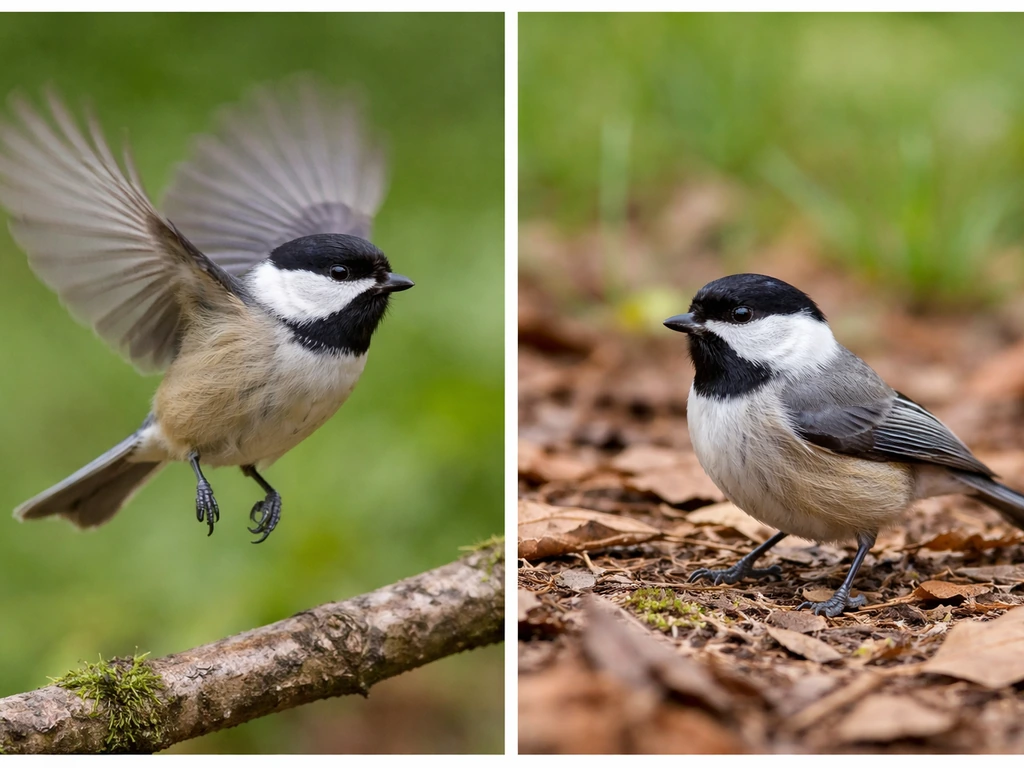
Flight isn't just a yes/no property. When biologists say a bird 'can fly,' they generally mean it can generate enough lift and thrust with its wings to become and stay airborne under its own power. That requires a specific set of anatomical features working together: a keeled sternum (the breastbone ridge that anchors the flight muscles), large pectoral muscles that power the downstroke, hollow bones filled with extensions of the bird's air sac system rather than solid marrow, and wings shaped to interact with airflow in a way that produces lift. Take any one of those away or reduce it significantly, and the bird's flight capability drops, sometimes to zero.
It's also worth knowing that 'flying' covers a wider range of behaviors than most people picture. A bird flapping hard to stay aloft is doing something mechanically very different from a vulture circling for hours without a single wingbeat. Both are flying, but the anatomy and the energy demands are different. Knowing this distinction will help you identify birds in the field and make sense of why certain species look so effortless in the air while others seem to be working very hard.
The flight capability spectrum: from world-class flyers to grounded for life
Think of bird flight as a spectrum rather than a binary. At one end are species built almost entirely around aerial performance. At the other end are birds that have traded flight for other advantages entirely. Here's how that spectrum breaks down in practical terms:
| Flight Category | Description | Example Species | Key Traits |
|---|---|---|---|
| Strong powered flyers | Sustained flapping flight; long migrations possible | Peregrine falcon, Arctic tern, swift | Large keel, strong pectorals, lightweight hollow bones, high wing loading |
| Soaring and gliding specialists | Minimal flapping; ride thermals or updrafts for hours | Bald eagle, albatross, California condor | Long broad wings, high aspect ratio, reduced flapping muscle endurance |
| Intermittent flyers | Short bursts; prefer walking or running but can fly | Pheasant, wild turkey, domestic chicken | Adequate keel but relatively heavy body, limited sustained flight |
| Weak flyers | Technically airborne but barely; rarely leave the ground voluntarily | Takahē, some rails | Reduced wing size, diminished keel, heavier body mass |
| Truly flightless | Cannot fly at all; wings repurposed or vestigial | Ostrich, emu, penguin, kiwi | No functional keel, minimal or absent flight muscles, dense or fused bones |
Most birds you encounter in a park, backyard, or forest fall somewhere in the strong-to-intermittent range. Seeing a bird fly, even briefly, is itself an identification clue because how it flies tells you a lot about which group it belongs to. A good way to think about the best flying plane like bird idea is to focus on how effectively it generates lift and sustains flight rather than whether it looks dramatic for a moment.
Why some birds can't fly: the biomechanics and anatomy behind flightlessness
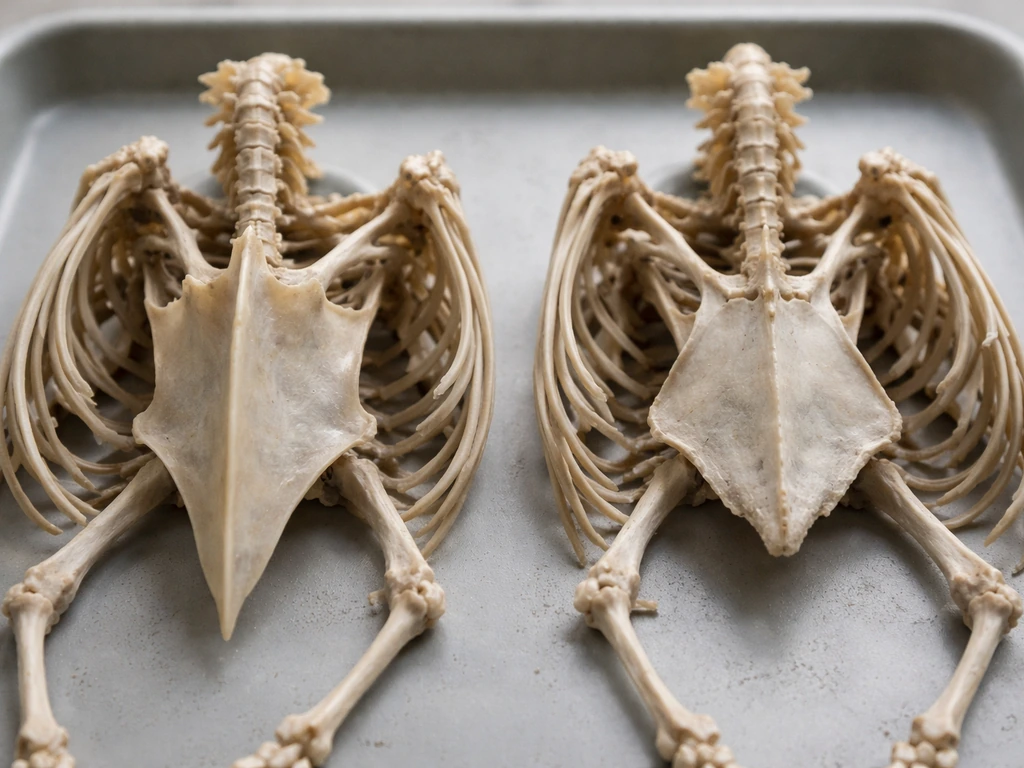
Flightlessness is not a design flaw. It's an evolutionary solution to specific environmental pressures, and the anatomy reflects that trade-off precisely. There are four main structural differences between flying and flightless birds, and once you know them, you can read a bird's body almost like a blueprint.
The keeled sternum (or lack of one)
Flying birds have a prominent ridge running down the center of their breastbone called the keel, or carina. The large pectoral muscles that power each wingbeat anchor directly to this ridge. Flightless birds, particularly the ratites (ostriches, emus, rheas, cassowaries, kiwis), lack this keel entirely. Without it, there's nowhere for powerful flight muscles to attach, and without those muscles, sustained flight is physically impossible. Phylogenomic research confirms that ratites evolved this keel-less anatomy through multiple independent losses of flight from ancestors that could fly, not from a single ancestral flightless lineage.
Bone density and skeletal pneumaticity
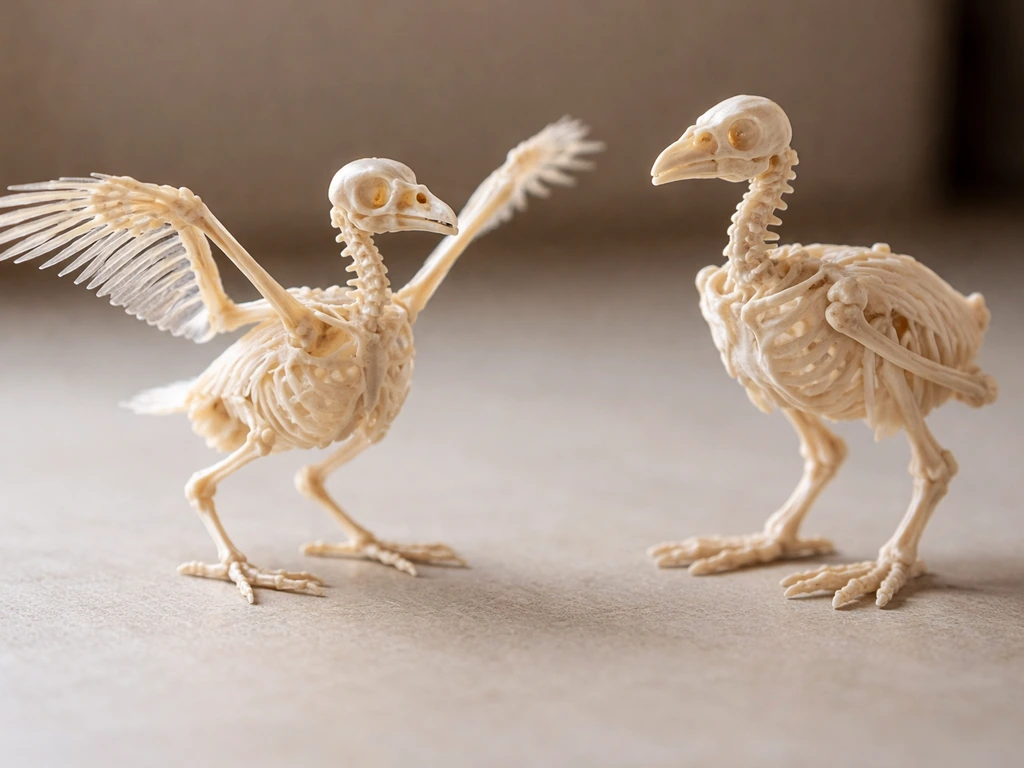
Flying birds have hollow bones, not because they're fragile, but because the hollow spaces are filled with extensions of their air sac system, a network of thin-walled sacs connected to the lungs. This is called postcranial skeletal pneumaticity, and it does two things at once: it makes the skeleton dramatically lighter and integrates the respiratory system with the skeleton in a way that supports the enormous oxygen demands of powered flight. Penguins went in exactly the opposite direction. Their wing bones are dense and in some cases fused, making them rigid and powerful for underwater propulsion but completely unsuitable for generating lift. The Smithsonian Ocean notes that penguins have flattened, dense bones devoid of the air pockets that flying birds rely on.
Wing size relative to body mass
Wing loading, the ratio of body weight to wing surface area, determines whether a bird can get airborne at all. A bird that's too heavy for its wing area simply cannot generate enough lift to take off. Ostriches are the extreme example: they can reach 345 pounds, with small vestigial wings that couldn't lift that body mass in any scenario. But even within flying birds, wing loading creates the difference between a species that launches easily off the ground and one that needs a running start or a height advantage to get airborne. The mute swan, one of the heaviest flying birds at around 30 pounds, needs a long water run-up to generate enough speed for takeoff.
Muscle mass and control
Flight muscles in strong flyers can make up 25 to 35 percent of total body weight. In flightless birds, that muscle mass has often been redistributed to the legs, which is why an ostrich can run at 45 miles per hour. In penguins, the same basic muscle group was repurposed for swimming rather than flying. The Field Museum research puts it well: when birds lose the ability to fly, their bodies change faster than their feathers, meaning the internal structural changes happen rapidly under selection pressure once flight is no longer advantageous. The Field Museum explains that scientists infer whether extinct birds could have powered flight using clues such as the size and shape of wing and arm bones and wishbones, along with feather characteristics The hidden rule for flight feathers.
How to identify the right bird name using observable traits
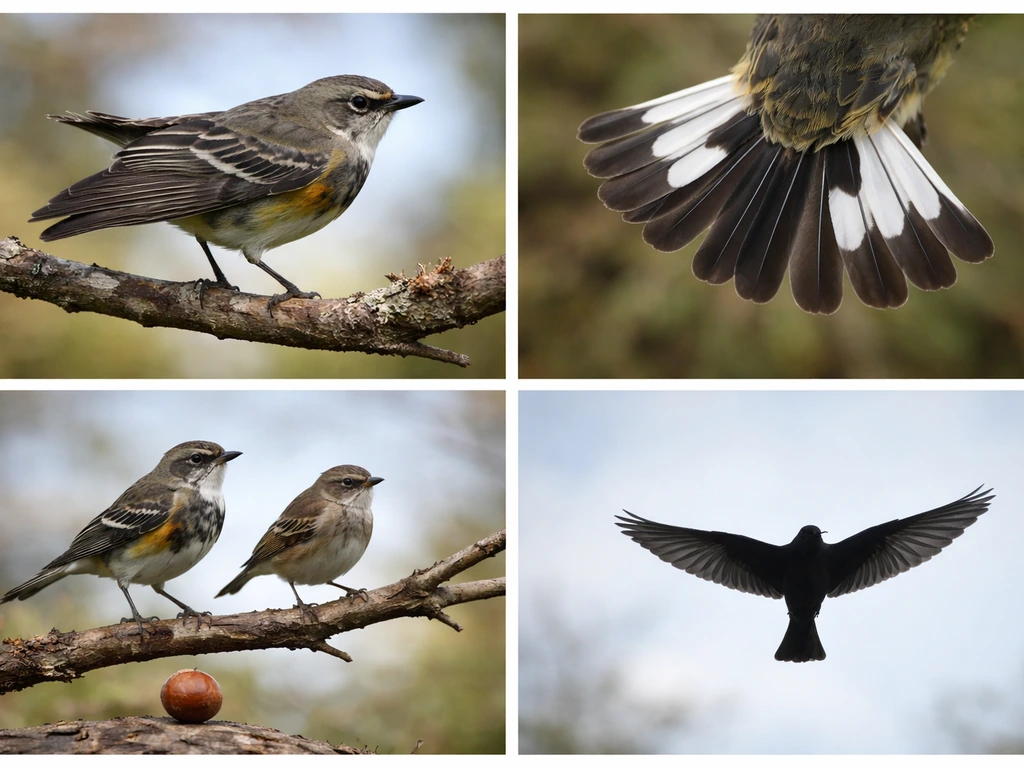
If you're trying to name a specific bird you saw flying (or not flying), 'it can fly' is not enough on its own. If you want a quick, fun starting point, you can also try making an origami bird that can fly easy and observe how its movement mimics simple lift and glide. But flight behavior, combined with a few other observations, gets you to a species name surprisingly fast. Birding experts consistently recommend the same core checklist.
- Size and shape: Compare the bird to something familiar, like a sparrow, a crow, or a pigeon. Note the overall proportions, how long the tail extends past the wings, and how the head and neck relate to the body.
- Wing shape: Are the wings long and narrow (built for soaring), short and rounded (built for maneuvering through trees), or broad and fingered at the tips (built for thermal soaring)? Wing shape alone can narrow you down to a family.
- Wingbeat cadence: Is the bird flapping continuously and rapidly, or does it flap a few times and then glide? Woodpeckers have a distinctive undulating flight. Falcons have a fast, stiff-winged flap. Hawks often soar with barely a beat.
- Flight posture and wing angle: Is the bird holding its wings flat, angled slightly upward in a dihedral, or bent at the wrist? Turkey vultures soar in a V shape. Bald eagles soar flat. That difference alone can ID the bird from a quarter mile away.
- Color pattern and visible markings: Even at a distance you can often catch a white rump patch, banded tail, rusty coloring, or contrasting wing tips that narrow the options significantly.
- Habitat and location: A large soaring bird over open ocean is not the same species as a large soaring bird over a cornfield in Iowa. Geography and habitat do enormous filtering work.
- Voice: If the bird calls while flying, that's often the fastest ID of all.
Audubon's bird identification guidance formalizes this as the 'four keys': size and shape, color pattern, behavior, and habitat. Cornell Lab's All About Birds adds that silhouette alone, the outline of the bird in flight against the sky, can tell you the size, proportions, and posture quickly enough to place the bird in the right family before you even consider color. Apps like Audubon's Bird ID tool let you enter wing shape and tail shape as inputs alongside habitat and behavior, which means your in-flight observations translate directly into a searchable profile.
Well-known flying birds, flightless birds, and why they're the exceptions
A few species come up almost every time this topic surfaces, and it's worth spending a moment on each because they illustrate the underlying biology so clearly.
Peregrine falcon: the upper limit of powered flight
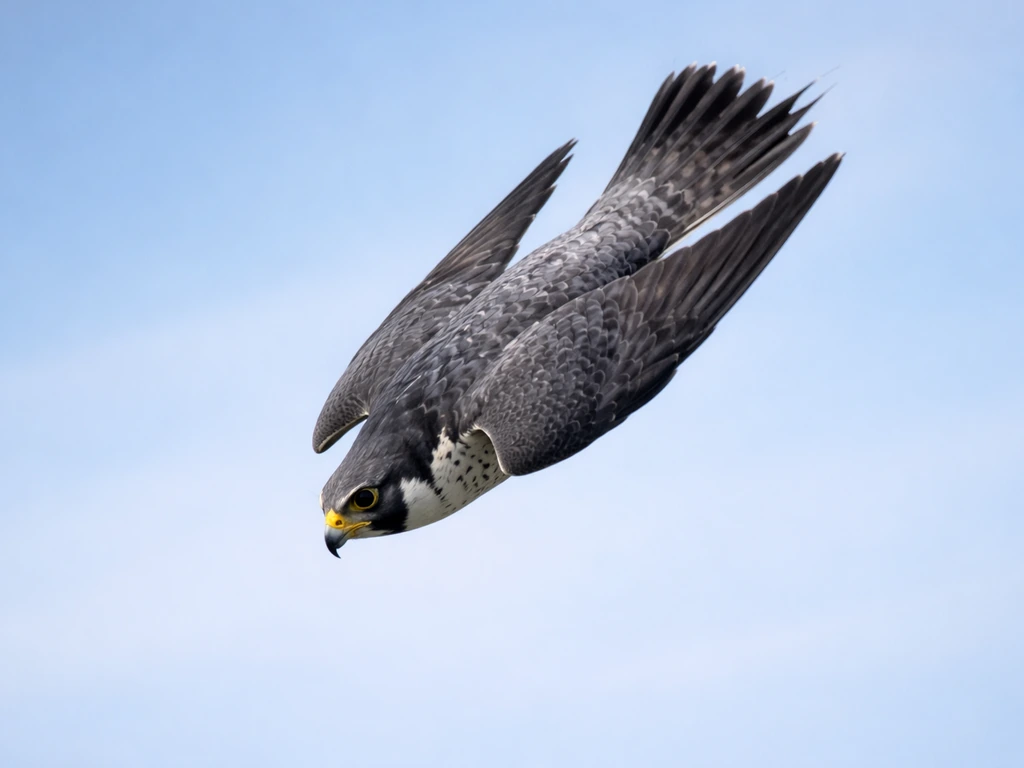
The peregrine falcon is the fastest animal on Earth in a dive, reaching over 240 miles per hour. It achieves this through a narrow, pointed wing shape that minimizes drag, an exceptionally deep keel, and pectoral muscles built for explosive speed. It's the reference point for what 'built to fly' looks like at the extreme end.
Albatross: the long-haul glider
The wandering albatross has the longest wingspan of any living bird, up to 11.5 feet. It barely flaps, using a technique called dynamic soaring to extract energy from wind gradients just above the ocean surface. It can travel thousands of miles on essentially no flapping effort. The shape of its wings, extremely long and narrow, is the anatomical signature of this flight strategy.
Ostrich: running instead of flying
The ostrich is the world's largest bird and completely flightless. It has no keel, vestigial wings that serve mainly for balance and display, and legs that evolved into powerful running tools. It evolved on the African savanna, an environment where speed on the ground was more useful than flight, and its body reflects that. Its ancestors could fly, which is confirmed by the phylogenomic research on ratite lineages.
Penguin: flippers instead of wings
Penguins are arguably the most interesting case because they're excellent flyers, just not through air. Their wing bones are rigid and fused, functioning as flippers that let them 'fly' through water with extraordinary agility. National Geographic describes this as an evolutionary progression where each improvement in diving efficiency made flying slightly less useful, until the wings were fully committed to underwater propulsion. The trade-off was total: penguins are extraordinary swimmers and completely incapable of flight.
Kiwi: the outlier
The kiwi is flightless but unusual in that it's small (about the size of a domestic chicken), nocturnal, and lives in New Zealand, where it evolved without mammalian predators. Its wings are so small they're essentially invisible under its feathers. Its nostrils are at the tip of its long beak rather than at the base, which is unique among birds. It's an example of how flightlessness doesn't always produce a large, powerful bird. Sometimes the absence of predators simply removes the need for flight entirely.
Quick troubleshooting: if you're not sure whether a bird you see can fly
Sometimes the question isn't academic. You've found a bird that doesn't seem to be flying when it should be, and you're not sure whether it's flightless by nature or injured. Here's a practical checklist for sorting that out.
- Is it a known flightless species? Ostriches, emus, penguins, cassowaries, rheas, and kiwis are never going to fly. If you're in a zoo or a zoo-adjacent habitat and the bird matches one of those, it's simply flightless.
- Is it a fledgling? Young birds learning to fly are often found on the ground looking helpless. If the bird has feathers (not bare pink skin), is hopping around, and seems alert, it's almost certainly a fledgling. Leave it alone. Its parents are almost certainly nearby.
- Is it stunned? Birds that fly into windows often sit motionless on the ground and appear dead or injured. Many recover within a few hours. Place the bird in a dark, ventilated box in a quiet space and check after a couple of hours before assuming it needs intervention.
- Is it visibly injured? A drooping or asymmetric wing, bleeding, inability to stand, or obvious predator contact (even without visible wounds) are signals to contact a licensed wildlife rehabilitator immediately rather than waiting.
- Is it behaving oddly but not injured? Some birds, like killdeer, do a convincing broken-wing display to lure predators away from a nest. A bird dragging a wing near an open field in spring may be performing, not suffering.
- Use wing shape and body shape as a sanity check: if the bird you're looking at has long, full wings proportionate to its body, it's almost certainly capable of flight when healthy. If the wings look tiny relative to the body, you may be looking at a genuinely flightless species.
If you're trying to identify the species after confirming the bird does fly, go back to the observable traits checklist above: size, wing shape, wingbeat pattern, posture, habitat, and markings. Those inputs will get you to a species name faster than any single field mark. And if you're interested in how these same identification principles apply to constructed flying things, like paper models or wing-shaped toys designed to mimic bird flight, that's a whole separate and genuinely fascinating topic where the aerodynamics of bird wings have inspired some creative engineering.
FAQ
Why can some birds “fly” but still seem unable to take off from the ground?
They may be strong gliders or launch from specific surfaces. Differences in wing loading and landing behavior matter, for example heavy species often require a run-up or height to gain enough speed for lift, so “can fly” does not always mean “can launch anywhere.”
How do I tell if a bird is flightless by nature versus just resting or hiding?
Watch for repeated, normal movement patterns. Flightless birds still move with their typical locomotion (running, hopping, swimming), while injured birds often show abnormal wing posture (drooping, uneven wingbeats) or avoid using the wing even when startled.
If I only saw one quick glimpse of a bird in the air, what details are most useful for naming it?
Wing and tail shape plus flight style usually beat color. Note whether the wings are broad versus narrow, whether the tail is forked or rounded, how often it flaps, and whether it glides or hovers, then connect those to habitat (shore, woods, open field).
Do all birds that flap hard always “fly well”?
No. Some species flap frequently because they are less aerodynamically efficient or because they are maintaining position in turbulence, while others glide longer with fewer beats. The key is to compare wingbeat rate with overall control (stable path versus bobbing) and how the bird uses wind.
What about birds that look like they are flying but are actually using water or terrain air flow?
Some birds use surfaces to gain lift, like dynamic soaring over waves, so they can travel far while flapping little. If your sighting was over the ocean or a windy coastline, prioritize wing shape and flight path over wingbeat frequency.
Can a bird be “not flying” during part of the year but still not be flightless?
Yes, temporary changes happen for reasons like molting (feather replacement), migration timing, or injury. During molt, some birds reduce flight or avoid strenuous takeoffs, so confirm whether the bird shows fresh feather growth patterns or acts sluggish only during that period.
Are there birds that only seem to fly in short bursts, like hopping up and down?
Many small birds do brief lift-offs, short flights, and quick landings because they are built for agility in cluttered habitats. Their ability to generate lift can be limited by wing loading and environment, so “short flight” can still mean powered flight, just optimized for perches and cover.
How accurate are bird ID apps if I misremember one detail like tail shape?
They can still help, but you should input confidence levels when possible. If tail shape is uncertain, focus on the silhouette, posture (upright versus horizontal), and flight pattern, then refine color only after narrowing to a small set of likely species.
What’s the easiest common mistake when trying to answer “bird can fly name”?
Assuming “most birds can fly” means any bird you see in the air is a typical flier. Confusing swimming flappers (like penguin-like motion in water) or misreading wind-driven gliding as weak flight can lead to wrong species, so separate aerial behavior from underwater movement.
If I suspect a bird is flightless, what physical cues are safest to check first?
Look for the presence or absence of a prominent keel area on the breast and the overall wing structure (vestigial, hidden, or non-functional). Also check habitat match, since flightless birds are often tied to specific environments where ground or swimming replaces airborne travel.
Next Article
Origami Bird That Can Fly Easy: Step-by-Step Guide
Make an origami bird that can fly easy with a reliable step-by-step fold, plus balance and wing tips for first launches.