
No, a bird cannot fly on the Moon. The Moon has no meaningful atmosphere, and without air there is no aerodynamic lift, no thrust from beating wings, and no oxygen to keep a bird alive for even a fraction of a second. Every mechanism that makes a bird airborne on Earth depends entirely on a dense, breathable column of gas, and the Moon simply does not have one.
Can a Bird Fly on the Moon? Physics, Limits, and Options

Marcus Chen
17 Jul 2026
Meta Description
Can a bird fly on the Moon? No, and here's the science: no air means no lift, no breathing, and no flight of any kind.
Key Facts at a Glance
- The Moon's 'atmosphere' is an exosphere of helium, neon, and argon at pressures roughly 10 to 11 orders of magnitude below Earth sea level (~10⁻¹⁰ to 10⁻¹¹ Pa vs. ~101,325 Pa on Earth).
- Aerodynamic lift scales directly with air density (L = 0.5 × ρ × V² × S × C_L). Near-zero density means near-zero lift at any wing speed a bird could physically achieve.
- Lunar surface gravity is about 1.62 m/s², roughly one-sixth of Earth's. A bird still weighs something, and with no lift possible, that weight is irrelevant to whether it can fly.
- Surface temperatures swing from +127 °C at equatorial midday to −173 °C at night; feathers cannot protect against those extremes in a vacuum.
- Unshielded birds would be exposed to galactic cosmic rays delivering ~0.3 mGy/day, approaching chronic population-level harm thresholds for small species.
- Bird embryos have been incubated in space inside pressurized incubators, but no live bird has ever survived unpressurized exposure to a vacuum environment.
- Inside a sealed, pressurized habitat with an Earth-like atmosphere, a bird could fly on the Moon. Outside one, it cannot survive, let alone fly.
The Moon's Environment: Effectively a Vacuum
When people picture the Moon from a distance, they might imagine a thin, wispy sky. There is none. NASA classifies the Moon as having an exosphere rather than an atmosphere. The Moon has essentially no collisional atmosphere; it is an exosphere composed mainly of helium, neon and argon and is effectively an airless surface where molecules travel long distances without colliding. (NASA summary; page updated Mar 5, 2026). The distinction matters enormously: in an exosphere, gas molecules are so spread out that they almost never collide with each other. They travel in long ballistic arcs across the surface without ever forming the continuous fluid medium that surrounds Earth. LADEE's Neutral Mass Spectrometer measured the dominant species near the surface (helium, neon, and argon) at number densities typically in the range of 10³ to 10⁴ atoms per cubic centimeter. Plugging those values into the ideal gas law gives a surface pressure somewhere around 10⁻¹⁰ to 10⁻¹¹ Pascals. Earth's sea-level pressure is about 101,325 Pa. That gap is not a small one; it is a difference of roughly fifteen to sixteen orders of magnitude. For all practical purposes, a bird standing on the lunar surface is standing in hard vacuum.
That vacuum brings cascading consequences beyond just the absence of air to breathe. Without an atmosphere to absorb or scatter solar radiation, there is no weather, no wind, and no convective heat exchange. The surface of the Moon at the equator bakes at around +127 °C under direct sunlight and plunges to about −173 °C during the lunar night, according to temperature data from LRO's Diviner instrument. The lunar regolith is also coated in a fine, glassy, electrostatically active dust with a small but significant fraction of particles under 3 micrometers, small enough to penetrate deep into lung tissue. And without a planetary magnetic field and atmosphere acting as a radiation shield, the surface is bombarded by galactic cosmic rays and solar energetic particles at rates that CRaTER/LRO measurements put at roughly 13 µGy per hour. All of this exists before we even get to the question of lift.
No Air, No Lift: The Physics in Plain Terms
The lift equation from classical aerodynamics is clean and unforgiving: L = 0.5 × ρ × V² × S × CL, where ρ is air density, V is airspeed, S is wing area, and CL is the lift coefficient determined by wing shape and angle of attack. Lift is directly proportional to density. If density drops to effectively zero, lift drops to effectively zero, no matter how fast the wings beat or how large they are. On Earth at sea level, air density is about 1.225 kg/m³. On the lunar surface, the exosphere's particle density translates to something astronomically smaller, many orders of magnitude below any value that could support a wing. There is no speed a pigeon's or eagle's muscles could produce that would compensate for that deficit.
To make it concrete, consider a small passerine with a body mass of about 18.6 grams, a wing area of roughly 70.78 cm² (0.00708 m²), and a typical cruise speed of around 8 m/s. On Earth, at ρ = 1.225 kg/m³ and with a reasonable C_L of about 1.0, the dynamic pressure (0.5 × 1.225 × 64) gives roughly 39 Pascals. Multiply by the wing area and you get a lift force in the ballpark of 0.28 Newtons, easily enough to support the bird's weight of about 0.18 N. Now replace ρ with the lunar exosphere value, something on the order of 10⁻¹⁷ kg/m³ derived from LADEE number densities. The lift produced is so vanishingly small it isn't worth computing to more decimal places: it is zero for every practical purpose. The bird would simply fall.
The Reynolds number (Re = ρ × V × L / μ, where L is a characteristic length and μ is dynamic viscosity) tells the same story from a different angle. Reynolds number describes the ratio of inertial to viscous forces in a fluid and determines the flow regime a wing operates in. For small birds flying in Earth's air, Re is typically in the range of 10,000 to 100,000, a regime where wings generate efficient lift with well-behaved attached flows. In the lunar exosphere, even the concept of a Reynolds number becomes physically meaningless because there is no continuous fluid. The gas molecules near the surface are in free-molecular flow, moving independently without the collective behavior that defines a fluid. No fluid, no aerodynamics, full stop.
Does Lower Gravity Help at All?
Here is where people often expect a loophole. Lunar gravity is about 1. Moon Facts, NASA reports the lunar surface gravity as approximately 1.62 m·s^-2 (~0.165 g) Moon Facts — NASA. 62 m/s², roughly one-sixth of Earth's 9.81 m/s². A pigeon that weighs 350 grams on Earth would 'weigh' the equivalent of about 57 grams on the Moon. In theory, that means its wings would need to generate much less lift to stay aloft. Wing loading (body weight divided by wing area) is a critical parameter in avian flight biomechanics, and lower effective weight does reduce the required lift. But here is the problem: even one-sixth of Earth's gravity still requires some non-zero lift, and the lunar atmosphere provides essentially none. The lift equation still depends on ρ, and ρ is still essentially zero. Reducing the required lift from, say, 3.5 Newtons to 0.6 Newtons is irrelevant when the available aerodynamic lift is 0.000000000001 Newtons. Lower gravity is a helpful factor that is completely swamped by the absence of air.
The lower gravity does have one interesting implication for theoretical maximum jump height. A bird on the Moon could leap much higher off the surface before gravity pulled it back down, since the deceleration rate is six times lower. But that is ballistic flight, not aerodynamic flight. The bird would arc up and come back down exactly as a thrown rock would. Its wings, flapping frantically in vacuum, would produce no force on any surrounding medium because there is no medium to push against. Flight, in the biological and aerodynamic sense, requires a fluid. The Moon does not provide one.
What Would Happen to a Bird's Body in Lunar Conditions
Even setting lift aside, a bird placed unprotected on the lunar surface would not survive long enough to attempt a single wingbeat. Avian lungs are among the most efficient respiratory systems in the animal kingdom: rigid, compact organs ventilated by a series of thin-walled air sacs that act as bellows, pushing air through parabronchi in a near-continuous unidirectional flow. That architecture is optimized for extracting oxygen from thin, high-altitude air during sustained powered flight. In a vacuum, the pressurized gas in the respiratory system would vent outward almost instantly, the delicate exchange surfaces would collapse and desiccate, and normal oxygen-carbon dioxide exchange would cease. The bird would lose consciousness within seconds.
Thermoregulation would fail simultaneously. On Earth, birds manage their body temperature partly through convective heat exchange with the surrounding air. Feathers trap a layer of warm air close to the skin and reduce heat loss in cold conditions. In vacuum, convection is absent and heat transfer is governed by radiation and conduction with the substrate. The lunar surface in sunlight is hot enough to cook biological tissue, and in shadow cold enough to freeze it. No arrangement of feathers can protect against that because feathers work by trapping air, and there is no air to trap. A bird would experience rapid and uncontrolled temperature change from the moment it was exposed.
The radiation environment adds a longer-term hazard. CRaTER measurements place the galactic cosmic ray absorbed dose rate near the lunar surface at approximately 13 µGy per hour, working out to roughly 0.3 mGy per day. For some small bird species, chronic population-level harm thresholds modeled in the radiation biology literature sit at several mGy per day, meaning the lunar surface GCR dose alone approaches meaningful biological concern over days to weeks, even before accounting for acute solar energetic particle events that can dramatically spike the dose rate. Acute LD50 values for some species (Japanese quail have been reported near 22.5 Gy for a 30-day endpoint) are much higher, so the immediate radiation danger is less dramatic than the atmospheric and thermal dangers, but it is a real constraint for any long-term scenario.
Bird Morphology and Muscle Power: Could Anatomy Change the Answer?
It is worth asking whether an evolutionary extreme, say, a bird with impossibly enormous wings and extraordinarily powerful muscles, could generate enough aerodynamic force from the Moon's trace exosphere to get airborne. The answer is no, and the numbers explain why. Bird flight muscle at peak burst output generates roughly 100 to 400 W per kilogram of muscle mass, with sustained flight values considerably lower. Even granting a hypothetical bird with maximally powerful muscles and wings the size of hang gliders, the lift equation still requires ρ, and ρ in the lunar exosphere is on the order of 10⁻¹⁷ kg/m³. No wing area or airspeed achievable by biological tissue can compensate for a density that is fifteen or more orders of magnitude below Earth's air. Muscle power is not the limiting factor; the medium is.
What bird morphometrics from the literature (Pennycuick's 'Modelling the Flying Bird' and related Journal of Experimental Biology studies) do show us is how sensitively flight performance depends on air density. The reason high-altitude bird flight is so metabolically costly, and why Bar-headed geese flying over the Himalayas at over 7,000 meters are physiologically remarkable, is that air density at those altitudes drops to about 0.55 kg/m³, less than half the sea-level value, and the birds have to compensate with larger stroke amplitudes, faster wingbeat frequencies, and specialized hemoglobin. The Moon's exosphere is not a thin version of that problem; it is categorically different. There is simply no gas medium to interact with.
The One Scenario Where a Bird Could Fly on the Moon
Inside a sealed, pressurized habitat filled with Earth-like air at standard density and composition, a bird could fly normally on the Moon. The lower gravity would actually make flight easier in one narrow sense: the bird's effective weight would be about one-sixth its Earth value, reducing the lift required for level flight and potentially allowing longer sustained flight at lower metabolic cost. Wing loading would drop, and the bird's muscles would have excess power capacity relative to the reduced lift demand. A pigeon that normally needs to generate around 3.4 Newtons of lift on Earth would only need to generate about 0.56 Newtons on the Moon, using the same wings and the same air. In that enclosed environment, it would fly beautifully.
Designing such a habitat is a real engineering challenge, not a thought experiment. It would require a rigid pressure vessel capable of maintaining roughly 101 kPa of atmospheric pressure, full life-support including oxygen replenishment and CO2 scrubbing, temperature control systems that compensate for the lack of convection, radiation shielding, and dust exclusion to keep the abrasive regolith particles out of the birds' respiratory systems. NASA's spaceflight history includes experiments where Japanese quail and bobwhite quail eggs were incubated in pressurized incubators aboard the Space Shuttle and Mir, demonstrating that controlled avian biology in space is technically achievable. Those embryos were inside sealed, pressurized environments with controlled temperature and gas composition. That precedent is exactly the right model for what would be needed on the Moon.
Engineered Bird-Like Flight on the Moon: Drones and Reaction Control
If the goal is flight on the lunar surface in the open environment, biology is the wrong tool. Engineered systems that mimic bird-like movement but do not rely on aerodynamic lift are the only viable option. Reaction control thrusters, cold-gas jets, and ion propulsion systems all work in vacuum because they generate thrust by expelling mass, not by pushing against a surrounding fluid. A robotic bird drone designed for lunar surface traversal would need to function more like a small spacecraft than like a bird: using onboard propellant to hop, translate, and maneuver. Several proposals for lunar hopping robots use exactly this principle. They are not birds in any biological sense, but they represent the engineering approximation of free movement across the lunar surface.
The contrast between biological and engineered flight is worth dwelling on here. Birds evolved over roughly 150 million years in an atmospheric environment where air was a universal given. Every adaptation, from the hollow-boned skeleton that reduces weight, to the asymmetrical flight feathers that generate lift and reduce induced drag, to the rigid avian lung that maximizes oxygen uptake, is a solution to a problem that assumes air is present. Remove the air and the entire system becomes irrelevant. A robotic system designed from scratch for the Moon has no such evolutionary legacy to shed. It can use reaction control, ballistic hopping with low-gravity trajectories, or electromagnetic rail-based locomotion, none of which requires a fluid medium.
| Factor | Bird on Earth | Bird on the Moon (open surface) | Bird on the Moon (pressurized habitat) |
|---|---|---|---|
| Air density (ρ) | ~1.225 kg/m³ at sea level | ~10⁻¹⁷ kg/m³ (exosphere) | ~1.225 kg/m³ (engineered) |
| Aerodynamic lift | Full lift available | Effectively zero | Full lift available |
| Effective weight | 100% of Earth weight | ~16.5% of Earth weight | ~16.5% of Earth weight |
| Breathing possible? | Yes | No — vacuum | Yes — pressurized air |
| Temperature survivable? | Yes | No — extreme swings, no convection | Yes — climate-controlled |
| Radiation risk | Negligible (shielded by atmosphere) | Significant without shielding | Depends on habitat shielding |
| Can the bird fly? | Yes | No | Yes, and more efficiently |
Ethical and Regulatory Considerations
Any genuine experiment involving live birds and reduced-gravity or space environments requires navigating a dense regulatory landscape. In the United States, animal use in spaceflight research falls under institutional animal care and use committee (IACUC) oversight, NASA's Office of the Chief Health and Medical Officer guidelines, and relevant federal animal welfare statutes. The historical quail egg experiments on Shuttle and Mir were carefully reviewed before flight. Any proposal to place live birds in a lunar habitat, even inside a pressurized enclosure, would require demonstrated life-support capability, veterinary monitoring, clearly defined welfare endpoints, and justification that the scientific or exploratory value outweighs the animal welfare risks. Given the current state of lunar surface infrastructure, none of this is imminent, but it is the right framework to think about when the question moves from thought experiment to proposal.
There are also ecological and biosecurity considerations worth naming. Any biological organism transported to the lunar surface represents a potential contamination event, both for the Moon (forward contamination) and for Earth upon return (backward contamination), per COSPAR planetary protection policy. Birds are complex, active organisms with microbiomes, feather dander, and behavioral needs that make them far more complicated biosecurity subjects than, say, a sealed bacterial culture. These are not reasons to dismiss the question, but they are reasons to take the engineering and regulatory pathway seriously if the idea ever moves toward reality.
From Birds to Humans: A Familiar Analogy
The same physics that grounds birds on the Moon grounds humans too. Questions like whether humans could ever fly like birds, whether we could achieve that kind of muscular, wing-powered flight in any environment, run into the same aerodynamic and physiological walls at different scales. See related discussion on whether humans can fly like a bird (df381e53-05fb-42e1-87f9-a8c4e18d00fa). Related question 'can we fly like a bird' examines whether humans could achieve bird-like winged flight. On Earth, the human body is too dense and too weak relative to its weight for unaided wing-powered flight. On the Moon, even the most optimistic scenario requires an enclosed pressurized environment. For related discussion about whether a man can fly in the air like a bird, see man can fly in the air like a bird. For a related discussion about human attempts to achieve bird-like, muscle-powered flight, see can man fly like a bird. The Moon is a place where the dream of free, open-air flight, biological or human, runs hard into the reality that flight is fundamentally a transaction with the air, and the Moon does not participate in that transaction.
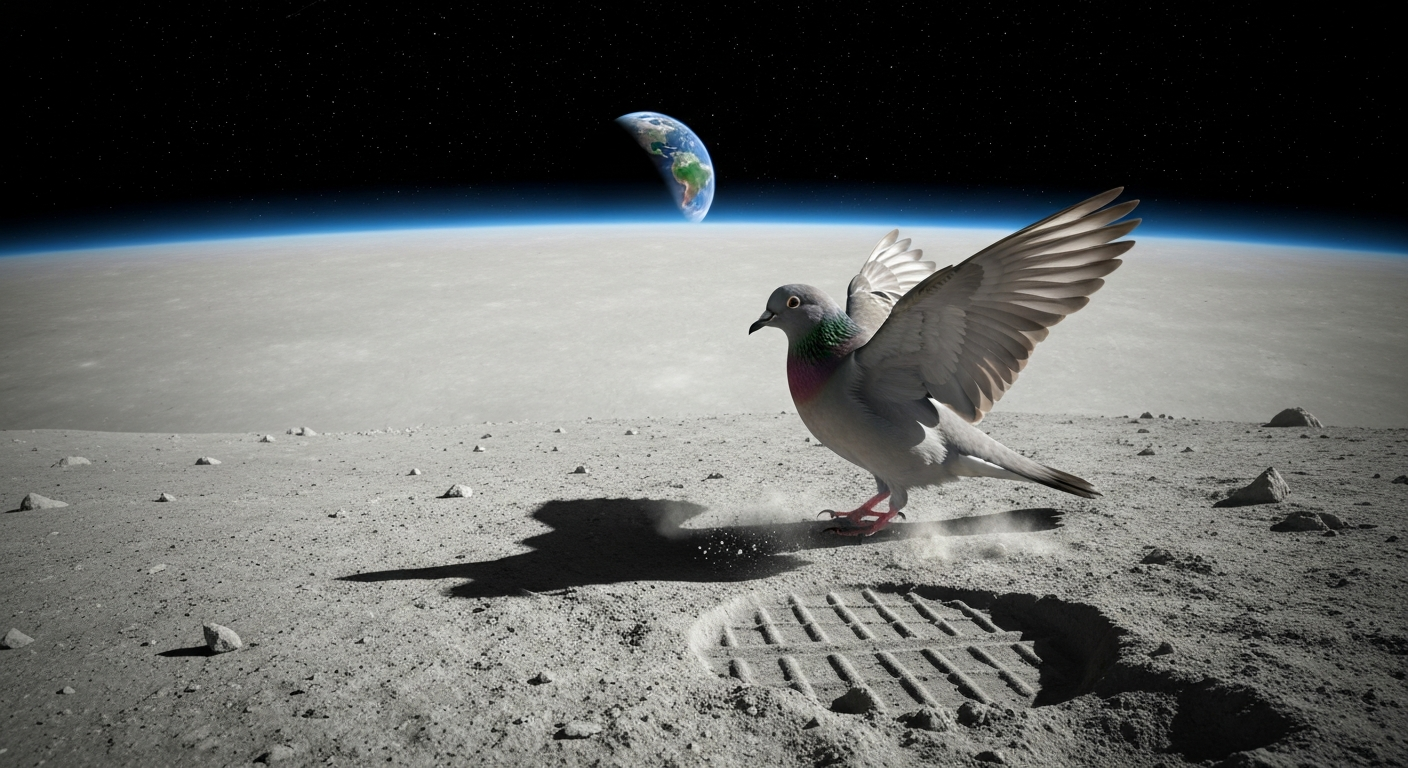
There is something worth sitting with in that image: a bird on the Moon, wings spread, in perfect form, going nowhere. It is a clean illustration of how deeply flight is tied to Earth's specific conditions. The wing shapes, the hollow bones, the elaborate feather microstructure that generates lift and reduces drag, all of it evolved here, in this air, at this density. The Moon reveals that none of it is universal. It is a very particular solution to a very particular set of atmospheric facts. That is not a limitation of birds; it is a testament to how precisely their bodies are matched to Earth.
Cultural Echo: Flight Beyond the Sky
Flight has always carried metaphorical weight that outlasts its physics. The image of a bird soaring free, unbound by earth, shows up in poetry, mythology, and popular music in ways that are not really about aerodynamics. Some contemporary songs even include lines like "i can fly like a bird not in the sky" that use flight as a metaphor for freedom. When songwriters reach for the idea of a bird flying somewhere impossible, beyond the sky, beyond gravity's reach, they are reaching for something about freedom or transcendence that does not require a Reynolds number calculation. The Temptations used bird flight that way. For a popular example, see The Temptations' song I Can Fly Like a Bird in the Sky, which uses bird-flight imagery to express freedom I Can Fly Like a Bird in the Sky (The Temptations). So did Icarus, and so do countless contemporary artists. The question 'can a bird fly on the Moon?' sits at a funny intersection of that cultural resonance and cold physics. The physics says no. The metaphor says: of course, what else would you put up there? Both answers are real, just operating in different registers.
Suggested Experimental Setup for a Pressurized Lunar Habitat Study
If a research team ever had the resources and ethical approvals to study avian flight in a lunar gravity environment inside a pressurized habitat, here is what a minimal useful experiment would look like. The habitat would need to be large enough for sustained level flight, a minimum of about 10 to 15 meters in length based on bird deceleration and turning radii from existing indoor flight studies. Atmospheric composition and pressure would be maintained at Earth sea-level equivalents. High-speed cameras and pressure sensors embedded in the floor would capture wingbeat kinematics and ground-contact forces. A centrifuge-based comparison arm, running the same birds at simulated 1g alongside the 1/6 g lunar gravity arm, would allow controlled comparison of metabolic cost, wingbeat frequency, and flight duration. The core prediction, grounded in the lift equation and bird biomechanics literature, is that birds in 1/6 g would show reduced wingbeat frequency and metabolic rate for level flight, with potentially longer glide phases and lower minimum flight speeds, given the same air density.
This kind of experiment would not just answer a question about the Moon. It would generate directly useful data about how gravity interacts with avian flight mechanics, data that is relevant to understanding how flight evolved in low-gravity or high-altitude ancestral environments and how birds might be used in future long-duration space habitats. It connects the quirky headline question, can a bird fly on the Moon, to genuinely interesting problems in comparative biomechanics and space biology.
FAQ
SEO title
Can a bird fly on the Moon? A clear, evidence-backed answer
Meta description
Short answer and explanation: Why birds cannot fly in the Moon’s near‑vacuum and what engineered workarounds would allow ‘flight’. (≤160 chars)
Can a bird fly on the Moon? (short answer)
No — a bird cannot fly on the Moon in the open lunar environment. The Moon has essentially no atmosphere, so there is no air to generate aerodynamic lift and an unpressurized bird cannot breathe or survive the vacuum, temperature swings, dust and radiation.
Why does the Moon’s lack of air prevent bird flight?
Aerodynamic lift scales with the ambient air density (ρ) via L = 0.5·ρ·V^2·S·C_L. Measurements of the lunar exosphere show number densities ≈10^3–10^4 atoms·cm⁻³ (≈1e9–1e10 m⁻³), giving mass densities on the order of 10⁻¹⁶ kg·m⁻³ — roughly 10^−16 times Earth’s sea‑level air density (~1.2 kg·m⁻³). With that near‑vacuum density, the flight speed required for a typical small bird to produce enough lift becomes physically impossible (see simple calculation below). In short: ρ is essentially zero, so lift is essentially zero.
Simple calculation showing why wingbeats can’t produce lift on the Moon
Example: a small passerine of mass 0.02 kg has lunar weight W = m·g_moon ≈0.02·1.62 = 0.0324 N. Using L = 0.5·ρ·V^2·S·C_L, take S≈0.007 m² (small bird), C_L≈1, and ρ≈1×10⁻¹⁶ kg·m⁻³ (order of lunar near‑surface gas mass density). Solving for required V: V = sqrt(2L/(ρ S C_L)) ≈ sqrt(2·0.0324/(1e-16·0.007)) ≈ 9.6×10^8 m·s⁻¹ — far above the speed of light. Even allowing order‑of‑magnitude uncertainty in ρ, S or C_L does not change the conclusion: conventional aerodynamic lift is impossible in the lunar near‑vacuum.
How do aerodynamic concepts (Reynolds number, lift coefficient) factor in?
Reynolds number Re = ρ·V·L/μ depends directly on ρ; in the Moon’s exosphere Re is essentially zero for any biologically feasible V, so classical aerodynamics (attached flows, lift-producing pressure distributions) do not apply. Lift coefficient C_L and wing geometry matter only if there is enough fluid density; when ρ→0 the aerodynamic forces vanish regardless of C_L or wing shape.
Next Article
I Can Fly Like a Bird in the Sky: Tempering Temptations
Biomechanics-backed why humans can’t fly like birds, plus safe training paths like paragliding and progressive strength