
No, humans cannot fly like a bird by flapping their arms. See the discussion titled “man can fly in the air like a bird” for a concise answer and further reading. The physics simply will not allow it: our muscles produce nowhere near enough power per kilogram of body weight, and our bones and body plan are not built for it. But that is not the end of the story. With gliders, wingsuits, ornithopters, and even human-powered aircraft, we have found ways to get remarkably close to the bird experience, and understanding exactly why unaided flapping fails makes those engineered alternatives all the more impressive. For a concise answer to the question "can man fly like a bird", see our focused guide that summarizes the biomechanics and practical alternatives.
Can We Fly Like a Bird? Why Humans Can't and How to Try

How birds actually fly: wings, feathers, muscles, and bones
A bird's ability to fly is not one trick but a whole system of specializations that evolved over roughly 150 million years. Watch a common swift at speed or a red-tailed hawk riding a thermal and you are looking at an architecture so refined it still outperforms anything engineers have built at comparable scale.
The skeleton: lightweight without being fragile
Bird bones are pneumatized, meaning many of them are hollow and connected to the respiratory system. A frigate bird with a nearly 2-meter wingspan has a skeleton that weighs less than its feathers. The fused clavicles form the furcula (wishbone), which acts as a spring storing and releasing energy during each wingbeat. The keeled sternum (breastbone) is the anchor for the pectoralis, the massive downstroke muscle that provides most of the thrust and lift in flapping flight. Contrast that with the human sternum, which is flat and has no structural keel at all.
Muscles that produce extraordinary power
The pectoralis and supracoracoideus (the upstroke muscle, cleverly routed through a pulley formed by the shoulder bones) together make up 15 to 35 percent of a flying bird's total body mass. Peer-reviewed measurements show bird flight muscle can sustain roughly 60 to 150 watts per kilogram of muscle during normal cruising, with short burst peaks in some species reaching several hundred W·kg⁻¹. Measured ascending Anna’s hummingbirds required ≈48 W·kg⁻¹ (whole‑body), which converts to ≈185 W·kg⁻¹ per unit flight‑muscle mass assuming ~26% flight‑muscle fraction, illustrating their exceptional muscle power during climbs and hovering (Ascending flight and decelerating vertical glides in Anna's hummingbirds, Journal of Experimental Biology (quantitative power estimates)) Ascending flight and decelerating vertical glides in Anna's hummingbirds — Journal of Experimental Biology (quantitative power estimates). One study on corvids recorded peak burst values approaching 471 W·kg⁻¹ of muscle mass during escape flights. For comparison, the best a trained human can sustain for an hour from the legs, measured as functional threshold power in competitive cyclists, sits around 3.5 to 5 W per kilogram of total body mass. Even accounting for the fraction of body mass that is muscle, the gap is enormous.
Feathers and wing geometry
Feathers do several jobs at once: they create a smooth, adjustable aerofoil surface, they provide insulation, and the primary flight feathers at the wingtip generate thrust during the downstroke by twisting and acting almost like individual propeller blades. Birds actively morph their wings during each stroke, spreading or folding the alula (a small thumb feather) to manage airflow at low speeds and prevent stalling. This level of continuous, real-time wing reshaping is something no rigid aircraft wing can match.
The physical principles behind flight
Lift, thrust, drag, and weight are the four forces in every flight, whether the flier is a wandering albatross or an Airbus A380. Lift is generated according to L = ½ ρ V² S CL, where ρ is air density, V is airspeed, S is wing area, and CL is the lift coefficient (a measure of how efficiently the wing shape produces lift). To support a given weight, you need either a high airspeed, a large wing area, a high C_L, or some combination of all three.
Wing loading (body weight divided by wing area, expressed in N·m⁻² or Pa) tells you how hard the wing has to work to stay airborne. blank" rel="noopener noreferrer">Pennycuick’s monograph Modelling the Flying Bird is the canonical reference for calculating wing area, wing loading, aspect ratio and aerodynamic power partitioning used in avian flight models. A low wing loading means you can fly slowly and soar easily; a high wing loading means you need speed to generate enough lift. Aspect ratio (wingspan squared divided by wing area) affects efficiency: long, narrow wings like those of an albatross are aerodynamically efficient at generating lift with minimal induced drag, which is why albatrosses can glide for hours burning almost no energy. Short, broad wings are more maneuverable but less efficient for cruising.
In flapping flight, additional mechanisms come into play. Small flapping wings generate high lift partly through unsteady aerodynamics: a leading-edge vortex (LEV) forms on the upper surface of the wing during the downstroke, and spanwise airflow stabilizes it, allowing the wing to operate at angles of attack that would cause a conventional fixed wing to stall catastrophically. This mechanism, confirmed experimentally in insect studies and extended to birds, is one reason flapping wings can produce bursts of lift far exceeding what steady-state aerodynamics would predict.
Why you can't just flap your arms and take off
The core problem is scaling. As body mass increases, the muscle power required for flapping flight does not scale the same way that available muscle power does. Scaling analyses, built on the foundational work of researchers like Pennycuick and Rayner, show that the practical upper size limit for sustained flapping flight in living birds is somewhere around 12 to 16 kilograms. Birds heavier than that, like the Kori bustard or the wandering albatross, rely heavily on soaring and gliding rather than continuous flapping, and some of the largest flying birds in history (like Argentavis) appear to have been primarily soarers.
Now put a 70-kilogram human into that equation. To support that weight at a reasonable flapping-flight airspeed using wings attached to the arms, you would need a wing area so large that the structural and muscular demands become impossible. The human pectoralis muscle makes up roughly 5 percent of body mass and is oriented for pushing and pulling the arm, not for the vertical, high-powered downstroke a bird uses. Even if you could somehow strap on wings large enough, you would need to sustain somewhere in the range of 60 to 150 W·kg⁻¹ of flight muscle output, and human arm muscles simply do not operate at that power density. The Gossamer Albatross, the human-powered aircraft that crossed the English Channel in 1979, gives a useful reference point: it had a wingspan of nearly 29 meters and weighed only about 97.5 kilograms fully loaded, and it required a trained cyclist pedaling at around 300 watts continuously just to maintain flight. Flapping those enormous wings with arms, at that sustained power level, is not a human option.
Wing loading and power-to-weight: birds, humans, and machines compared
| System | Body/Gross Mass | Wing Loading (approx.) | Aspect Ratio (approx.) | Flight Mode | Notes |
|---|---|---|---|---|---|
| Wandering albatross | 8–12 kg | ~140 N·m⁻² | ~15 | Dynamic/thermal soaring | Exceptional long-distance glider; rarely flaps in sustained flight |
| Common swift | ~40 g | ~30–40 N·m⁻² | ~10–11 | Fast flapping/gliding | Among the most aerial birds; spends months aloft |
| Anna's hummingbird | ~4–5 g | ~25–30 N·m⁻² | ~4–5 | Hovering/fast flapping | Whole-body power ~48 W·kg⁻¹ during climbing; ~185 W·kg⁻¹ per muscle mass |
| Peregrine falcon | ~0.9–1.5 kg | ~70–90 N·m⁻² | ~6–8 | Fast powered/stooping | Highest recorded bird speed in a stoop (~389 km/h) |
| Mallard duck | ~1–1.5 kg | ~100–130 N·m⁻² | ~6–7 | Fast powered flapping | High wing loading; needs running takeoff |
| Unaided human (arms as wings) | ~70 kg | >2000 N·m⁻² (estimated) | N/A | Not achievable | Muscle power density and arm area both wholly inadequate |
| Gossamer Albatross (human-powered aircraft) | ~97.5 kg gross | ~10–15 N·m⁻² | ~30+ | Slow fixed-wing powered | 29 m span; crossed English Channel 1979 on ~300 W pedal power |
| Modern hang glider | ~90–110 kg pilot+glider | ~12–18 N·m⁻² | ~8–10 | Unpowered soaring/gliding | Closest passive experience to large soaring bird |
| Powered wingsuit/jetsuit | ~80–100 kg | Variable (suit + thrust) | Low | Thrust-assisted glide | High descent rate without thrust; not true soaring |
Human alternatives that get you close to bird flight
If unaided flapping is off the table, the next question is: what actually gets a human closest to what a bird experiences? The honest answer is that different technologies capture different aspects of bird flight, and none captures all of them. Soaring in a glider is closest to what a red-tailed hawk does for hours on a summer afternoon. A wingsuit gets you the visceral sensation of high-speed low-level flight that a peregrine might feel in a stoop. An ornithopter tries to replicate the mechanics directly. Each comes with its own demands in terms of skill, equipment, cost, and risk.
Gliders and sailplanes: soaring the way raptors do
A modern sailplane is the closest human-built system to a large soaring bird. High-performance competition sailplanes have aspect ratios of 30 to 50 and glide ratios exceeding 60:1, meaning they travel 60 meters forward for every meter they descend. A wandering albatross, for comparison, achieves a glide ratio of around 20 to 25:1 using dynamic soaring over ocean waves. The albatross wins on energy harvesting in rough sea air; the sailplane wins on raw glide efficiency in calm conditions.
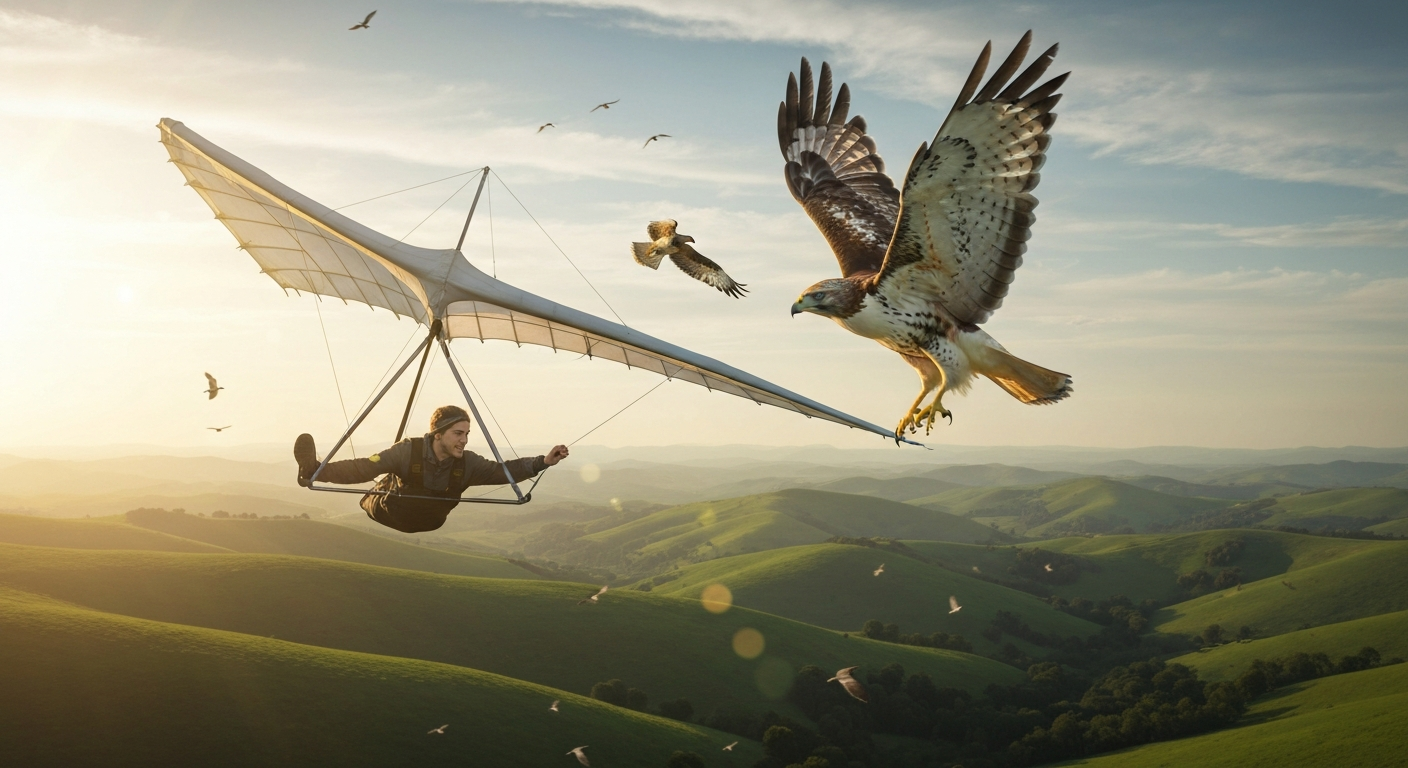
Hang gliders are a more accessible entry point. With a modest training course (typically 5 to 10 days to reach solo status at a beginner hill), a hang glider lets you feel thermals rising under the wing exactly the way a red-tailed hawk reads them: leaning into the turn, circling in rising air, choosing when to push forward and when to hold back. Wing loading on a hang glider with pilot is similar to that of many large soaring birds, which is not a coincidence since the aerodynamics are governed by the same equations.
If your goal is to understand how large soaring birds use the atmosphere, a glider or hang glider is the right tool. Training is structured, safety records are well-documented, and the experience of finding and riding a thermal is genuinely as close to raptor soaring as a human currently gets.
Wingsuits and proximity flying: fast, low, and demanding
A wingsuit converts some of a skydiver's vertical speed into horizontal speed by trapping air in fabric surfaces between the arms and body and between the legs. A skilled wingsuit flier can achieve glide ratios of around 2.5 to 3:1, a horizontal speed around 160 to 200 km/h, and a vertical descent rate of roughly 50 to 70 km/h. That is more like a stooping falcon than a soaring hawk: fast, dramatic, and not particularly efficient as gliding goes.
Proximity flying, where pilots fly wingsuits inches above ridge lines and through narrow gaps, is the most visually dramatic form of human flight and the most dangerous. The fatality rate in proximity flying is significantly higher than in conventional skydiving. Getting to the point of safe proximity flying requires typically 200 or more skydives before a first wingsuit jump, then several hundred wingsuit jumps before attempting proximity routes. This is not a casual pursuit, and it is worth being clear-eyed about that.
From a biomechanics perspective, the sensation in a wingsuit is the closest humans get to what a bird might feel at speed: the physical pressure of air against the body, directional control through slight arm and leg movements, and the feedback of the air itself as a medium. It does not replicate the upstroke-downstroke cycle, but the sensory experience of gliding at speed through a landscape is something that no other human technology quite matches.
Ornithopters and flapping machines: replicating the mechanics
An ornithopter is a machine that flies by flapping wings rather than using fixed wings or rotors. The idea is as old as Leonardo da Vinci, who sketched several designs in the late 1400s. The actual engineering turns out to be enormously difficult, precisely because bird flight relies on that combination of morphing wing geometry, unsteady aerodynamics, and very high muscle power density that is so hard to replicate mechanically.
The most significant human-powered ornithopter achievement to date is the Snowbird, built by a University of Toronto team. In 2010, it completed a certified flight covering 145 meters in 19.3 seconds, sustained under human power alone. That is an extraordinary engineering achievement, and it is also a clear illustration of the limits: 19.3 seconds, 145 meters, requiring a highly trained athlete, an ultra-lightweight structure, and conditions close to ideal. Small unmanned ornithopters have come much further, with research platforms like the Harvard RoboBee demonstrating insect-scale flapping flight, and larger drone-scale ornithopters achieving minutes of flight. But scaling up to carry a human using flapping alone remains an unsolved engineering problem.
The reason ornithopters are so hard is instructive: birds do not just flap up and down. Each wing is simultaneously generating lift and thrust through a complex three-dimensional stroke, morphing its shape throughout, and exploiting leading-edge vortices and other unsteady effects that require flexible, actively controlled surfaces. Replicating even a fraction of that aerodynamic complexity in a mechanical system is a major research challenge, and it is part of what makes bird flight so worth studying.
Jetpacks, rocket belts, and personal VTOLs: thrust instead of lift
Jetpacks and rocket belts take a fundamentally different approach: instead of generating aerodynamic lift from wings, they produce direct thrust that overcomes gravity. Early rocket belts like the Bell Rocket Belt (1961) could sustain flight for only about 20 to 30 seconds on hydrogen peroxide propellant. Modern turbine-powered jetpacks and electric multi-rotor personal VTOL craft have extended this significantly, with some commercial products claiming flight times of several minutes and speeds up to 130 km/h or more.
The bird analog here is weak in terms of mechanics: no bird flies purely by directed thrust without wing-based lift (even hummingbirds generate lift through wing aerodynamics, not jet propulsion). But the experiential sense of vertical takeoff, hovering, and maneuvering in three dimensions does capture something of what a bird like a kestrel does when it hovers over a motorway verge. The practical limitations are fuel or battery capacity, noise, mechanical complexity, and cost. Regulatory frameworks for personal VTOL flight are still developing in most countries, and piloting one requires both training and, in most jurisdictions, some form of aviation authorization.
Powered aircraft, ultralights, and light sport aircraft
For sheer practical access to bird-like flight experience, a light sport aircraft (LSA) or ultralight is hard to beat. These aircraft are regulated more lightly than full general aviation in most countries (in the US, a Sport Pilot certificate requires a minimum of 20 hours of flight training), fly at low altitudes and low speeds, and offer open-cockpit or panoramic views that bring the countryside up close in a way a commercial airliner never does. Flying a slow LSA at 100 meters above a forest, watching the landscape the way a buzzard might, is a legitimate answer to the question of how to fly like a bird.
Paramotors (powered paragliders) are arguably even closer to the bird experience for many people: a lightweight engine and propeller worn on the back, a paraglider wing overhead, and the ability to take off from almost any flat field. Flight speeds are low (35 to 60 km/h is typical), altitudes are modest, and the sensation of slow, low flight over open ground is something that recreational pilots consistently describe as uniquely birdlike. Entry costs are lower than conventional aviation, and training requirements, while real and important, are accessible.
Edge cases: flying 'not in the sky,' on the Moon, and underwater
Some of the most interesting variants of the flight question take it into unusual environments. The idea of flying 'not in the sky' appears in cultural contexts too, including the famous Temptations song that uses the image of a bird in flight as a metaphor for freedom and love rather than literal aeronautics. In a more literal sense, 'not in the sky' could describe underwater locomotion: penguins, auks, and diving ducks essentially fly through water, using the same basic wing mechanics (lift generation from an aerofoil cross-section) in a medium about 800 times denser than air. A penguin's wings are optimized for underwater thrust to the point where they can no longer fold against the body like a typical bird's wing. Humans who scuba dive and use underwater scooters, or who practice freediving with a monofin, are experiencing a functional analog of aquatic bird flight.
Flying on the Moon presents a different problem. The Moon has no atmosphere worth mentioning (surface pressure is roughly 3 × 10⁻¹⁵ atm), so aerodynamic lift from wings is essentially zero. A bird on the Moon could not fly no matter how hard it flapped. However, the Moon's surface gravity is about 1.62 m·s⁻² compared to Earth's 9.81 m·s⁻², meaning the same wing area and muscle power that barely gets you off the ground on Earth would send you to extraordinary heights in low-gravity environments that do have atmospheres, like Mars (thin but present) or the hypothetical dense atmospheres modeled for some moons. This is a genuine area of aerospace research for future planetary exploration. The question of whether a bird could fly on the Moon is definitively: no, not through aerodynamics.
Safety, training, and what it actually takes
Every form of human flight beyond a basic hang glider lesson involves real risk and real regulatory structure. Before choosing a path, it is worth matching the experience you want against the commitment required.
| Activity | Minimum Training | Approximate Entry Cost | Key Risks | Regulatory Status (US example) |
|---|---|---|---|---|
| Hang gliding (beginner) | 5–10 day course; USHPA rating | $1,500–$5,000 for gear | Turbulence, terrain, equipment failure | USHPA self-regulated; no FAA pilot certificate required at basic level |
| Paragliding | 8–12 day course; P2 rating | $3,000–$6,000 for gear | Collapses, turbulence, rotor | USPPA self-regulated; no FAA certificate required at basic level |
| Paramotor (PPG) | 10–20 hr training | $8,000–$15,000 all-in | Engine failure, propeller, low altitude | Ultralights exempt from pilot certification in US (FAR Part 103) |
| Sailplane/glider | ~30–40 hr; FAA Glider certificate | $5,000–$15,000 club/lessons | Stall/spin, off-field landings | FAA Glider Pilot Certificate required for solo |
| Light sport aircraft | ~20 hr; FAA Sport Pilot certificate | $10,000–$50,000+ | Engine failure, weather, terrain | FAA Sport Pilot Certificate required |
| Wingsuit skydiving | 200 skydives + wingsuit course | $8,000–$15,000 gear + jumps | High speed, proximity hazards, deployment | FAA USPA-governed skydiving; proximity flying unregulated separately |
| Jetpack/personal VTOL | Manufacturer training + legal review | $100,000–$450,000+ | Fuel/battery exhaustion, mechanical failure | FAA oversight varies; ultralight or experimental categories depending on design |
The consistent message across all of these is: training matters more than equipment. Every fatal accident investigation in human flight activities circles back to skills gaps, poor decision-making in marginal conditions, or attempting something before the foundational competence was there. The bird you are emulating spent millions of years of evolutionary pressure getting those skills right; we have to do it the faster, more deliberate way.
Flight as metaphor: what we mean when we say 'fly like a bird'
It would be a mistake to treat this question as purely mechanical. When the Temptations referenced flying like a bird in the sky, they were not filing a flight plan. The image of bird flight as freedom, escape, transcendence, or love appears in literature and music across centuries because it captures something real about the emotional weight of the idea. From Icarus in Greek mythology to Maya Angelou's caged bird, to every pop song that has borrowed the image, the bird in flight stands for something humans have always wanted: to leave the constraints of the ground behind.
What makes the biomechanics interesting is that the closer you study how birds actually fly, the more remarkable the real thing becomes. The leading-edge vortex, the pneumatized skeleton, the furcula acting as a spring, the primary feathers twisting to generate thrust: none of that diminishes the wonder. If anything, understanding the mechanics sharpens it. When you watch a swift banking over rooftops at dusk and you know something about wing loading and unsteady aerodynamics, the experience becomes richer, not reduced.
Where to go from here
If you want to actually fly: start with a tandem hang glider or paraglider flight with a certified instructor to get a visceral sense of unpowered soaring before committing to gear or a training program. If you want to know whether humans can fly like a bird, try a tandem hang glider or paraglider flight with a certified instructor for a visceral sense. If you want to understand the science more deeply, exploring the anatomy of bird wings in detail, the evolutionary story of how flight emerged, and what flightless birds reveal by having lost it are all fascinating threads from this same question. The mechanics of why some birds stopped flying is as illuminating as the mechanics of why others fly so extraordinarily well.
- Book a tandem hang glider or paraglider flight to experience thermal soaring firsthand before buying equipment
- Look into USHPA or USPPA certified schools in your region for structured, safety-focused beginner training
- If powered flight appeals more, a discovery flight at a local flight school is a low-cost way to try light aircraft before committing to a full Sport Pilot course
- For the science: Pennycuick's Modelling the Flying Bird is dense but remains the authoritative reference on avian flight mechanics; Tobalske's review papers in the Journal of Experimental Biology are more accessible entry points
- If you are fascinated by the edge cases, the questions of whether birds could fly on the Moon or how penguins fly underwater are worth exploring as separate threads that illuminate the same fundamental physics from a different angle
FAQ
Can humans fly like birds — in the same way (flapping our arms) — using only our muscles?
No. Evidence from biomechanics, muscle physiology and scaling shows humans cannot replicate bird flight by flapping our arms. Bird flight depends on much larger wing area relative to body mass (low wing loading), highly specialized flight muscles (pectoralis and supracoracoideus) with much higher mass‑specific power output than human skeletal muscle can sustain, and wing kinematics that exploit unsteady aerodynamics (leading‑edge vortices, clap‑and‑fling, spanwise flow). Typical bird flight‑muscle power outputs for sustained or burst flight are on the order of 60–170 W·kg⁻¹ of muscle; trained humans produce on the order of 3.5–5 W·kg⁻¹ of whole‑body sustained mechanical power (cycling FTP), far lower than required. Scaling laws (wing loading increases and mass‑specific power demands change with size) place practical continuous flapping limits for vertebrates well below adult human mass. Historical human attempts (ornithopters) have produced only short certified flights or required extraordinary structures; human‑powered fixed‑wing craft (Gossamer Albatross) succeeded because they used very large span, ultra‑light structure and pilot leg power to drive a propeller, not arm flapping.
What physical principles explain why birds fly but humans can’t by flapping arms?
Lift and thrust generation follow the lift equation L = ½ ρ V² S C_L, so supporting weight needs either large wing area S, sufficient airspeed V, or high lift coefficient C_L. Birds meet this with optimized wing area, shape (aspect ratio), and dynamic flapping to create unsteady lift. Key limiting factors for humans are wing loading (weight/wing area) and power‑to‑weight: required aerodynamic power scales with wing loading and speed, while available muscle power per unit mass does not scale favorably with body size. Unsteady aerodynamic mechanisms (leading‑edge vortices, clap‑and‑fling) are crucial for small and highly maneuverable fliers and depend on wing geometry and stroke kinematics birds possess but humans lack. These principles together show that with human mass and arm span, flapping cannot produce the sustained lift and power distribution birds achieve.
How do bird anatomy and biomechanics allow flight?
Bird adaptations for flight include: large, proportionally strong flight muscles (pectoralis and supracoracoideus) attached to a keeled sternum; wing bones and feathers that create large effective wing area and optimized aspect ratio; lightweight skeleton (pneumatized bones); high metabolic rates and aerobic capacity to fuel sustained muscle output; and kinematics that exploit unsteady aerodynamics (wing rotation, spanwise flow, LEV formation) to boost lift and maneuverability. Wing loading and aspect ratio vary by ecology—hummingbirds have low wing loading and muscles adapted for hovering; albatrosses have huge span, high aspect ratio wings for soaring. These combined traits let birds produce the required lift, thrust and control.
What are the quantitative limits (wing loading, power‑to‑weight) that matter?
Important metrics: wing loading W/S (N·m⁻²) and power‑to‑weight (W·kg⁻¹). Birds with low wing loading (large wing area for their mass) can hover or fly at low speeds; high aspect ratio reduces induced drag for soaring. Empirical work and datasets (e.g., AVONET, CRC body‑mass compilations) show birds span wide ranges: hummingbirds have low W/S and very high muscle power usage during hovering; large soaring birds have low induced‑drag designs with lower mass‑specific power requirements. Human muscular sustained mechanical power (~3.5–5 W·kg⁻¹ for trained cyclists) is orders of magnitude lower than required flight‑muscle outputs for sustained flapping in birds (tens to hundreds of W·kg⁻¹ of flight muscle). Classic scaling theory indicates continuous flapping capability typically stops being practical above ~12–16 kg body mass for vertebrate flyers, explaining why large species soar rather than continuously flap.
Could we build a human‑carried flapping machine (ornithopter) that truly flies like a bird?
Partially. Human‑powered ornithopters have been demonstrated but with severe limitations. The certified Snowbird flight (AeroVelo/UTIAS) achieved a short human‑powered ornithopter flight (≈145 m, ~19 s) using ultra‑light structure and optimized kinematics, but needed very large wings and careful pilot conditioning. Full bird‑like maneuverability, takeoff from level ground without assistance, and sustained flight comparable to birds remain impractical with human muscle alone because of power and structural demands. Engine‑assisted or electrically powered ornithopters can approach birdlike motion for research or recreation, but they use motors/batteries rather than human muscle and must tradeoff weight, endurance and complexity.
What practical human alternatives reproduce the experience of bird‑like flight?
Options that give birdlike sensations without biological flapping: - Gliders and sailplanes: long wings, low sink rate, exploit thermals and ridge lift — closest sustained silent soaring experience. - Wingsuits: allow prolonged gliding with body as wing; require jump from altitude and precise control; high skill and risk. - Hang gliders and paragliders: pilot‑controlled wings with launch from hills or tow; allow thermalling and soaring. - Human‑powered fixed‑wing aircraft (e.g., Gossamer Albatross): require large wingspan, light structure and sustained pedalling. - Ornithopters (motorized): mimic flapping motion for research/entertainment. - Jetpacks / rockets / eVTOLs: point‑and‑go powered flight but not birdlike flapping. Each option differs in required training, legal/regulatory constraints, and safety profile.