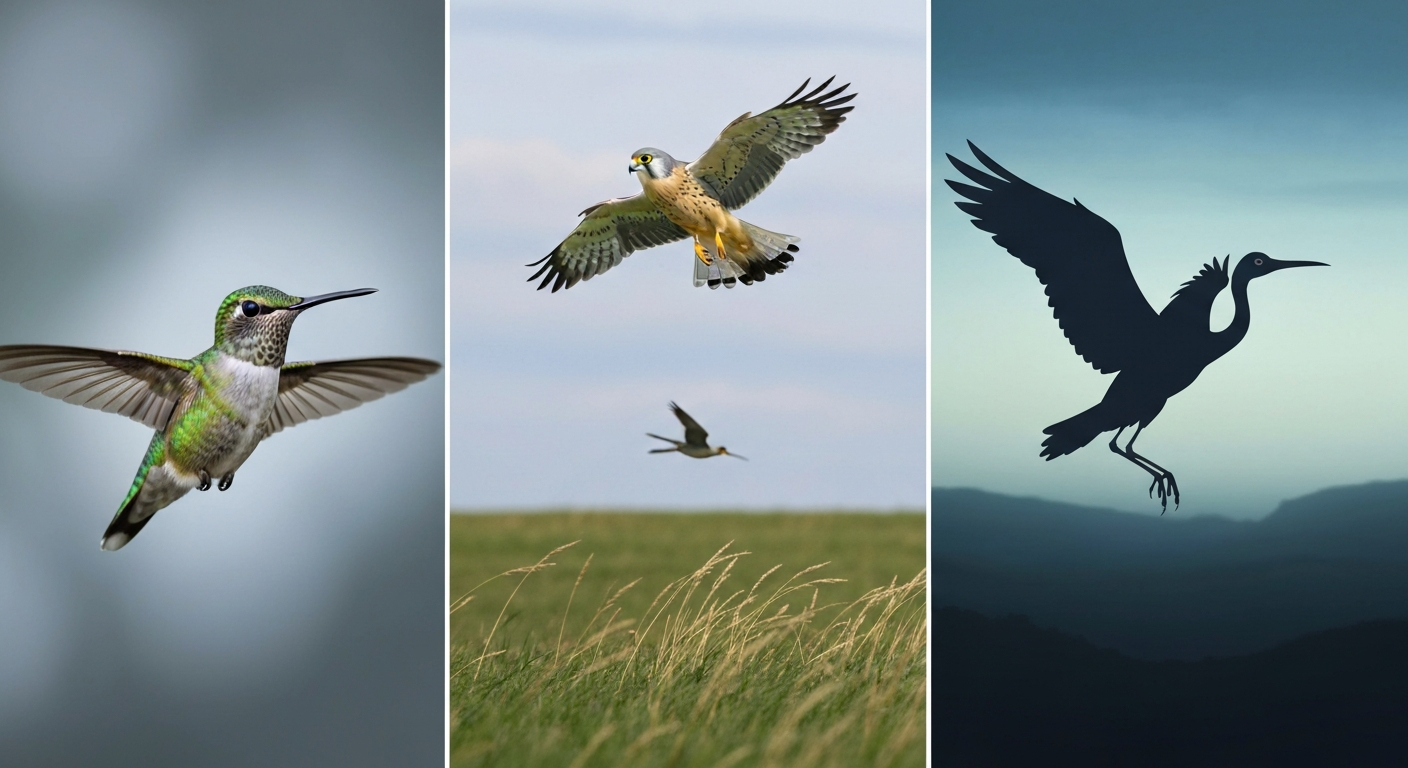
When people search 'flow explained bird,' they are usually chasing one of two things: either the invisible rivers of air that make bird flight possible, or a specific scene in a film or animation where a bird seems to float, freeze, or vanish with an eerie stillness. Both meanings are worth taking seriously. Aerodynamic flow is the physical engine behind every wing stroke a bird ever makes. Cinematic flow is how filmmakers and animators use a bird's movement, or sudden lack of it, to carry emotional weight. This article covers both, starting with the hard science and folding in the visual storytelling along the way.
Flow Explained: Bird Flight, Airflow, Film Effects and Animation
Marcus Chen
14 Jul 2026
Two readings of 'flow', and why both are worth your time
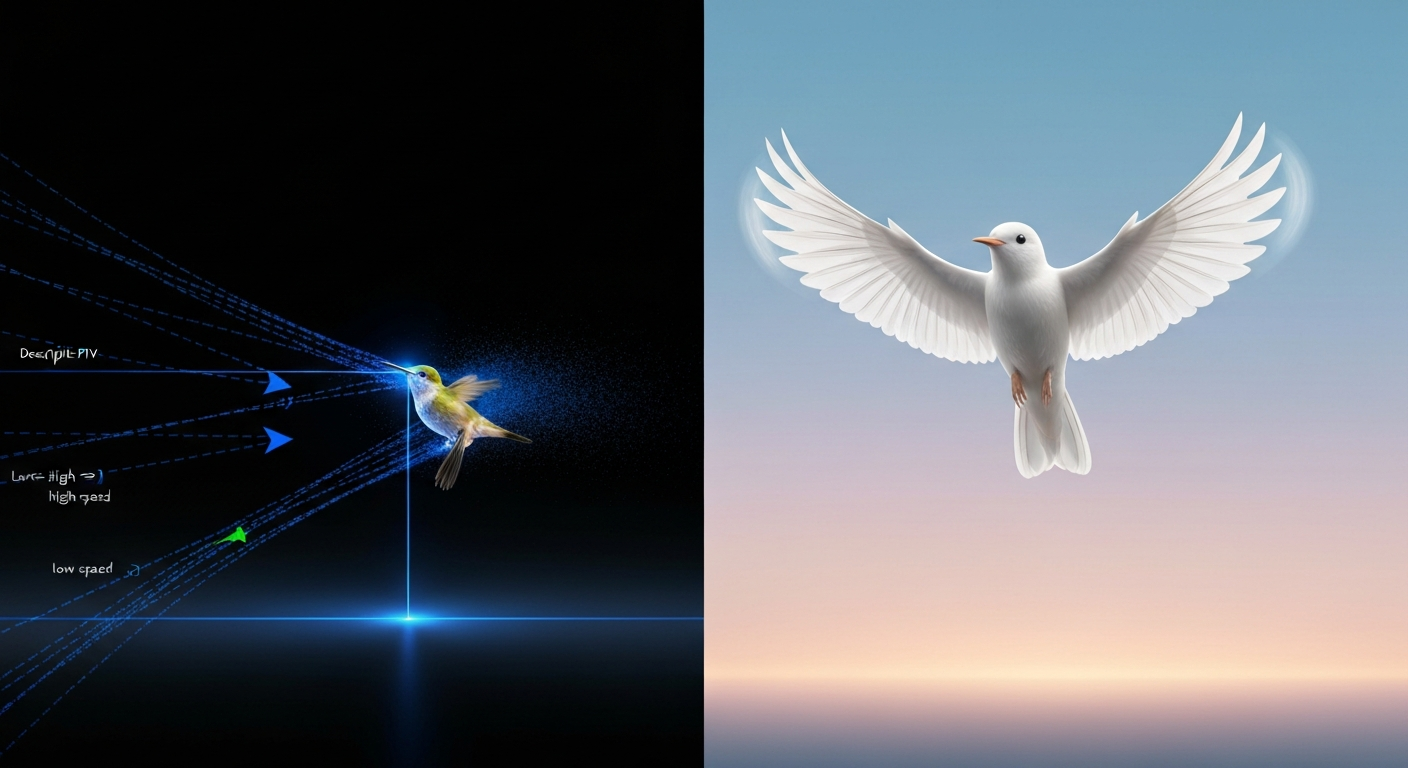
If you are a biology student or curious learner, the aerodynamics angle will give you a working mental model of how air behaves around a wing, why a hummingbird can hover while an albatross almost never flaps, and what scientists actually measure when they say a bird generates lift. If you landed here after watching a film called Flow, or after noticing a bird seemingly frozen in mid-air in an animated sequence, the cinematic angle will explain what the production team most likely did and what the bird's behavior is meant to signal. These two readings reinforce each other: understanding real airflow makes the slow-motion or frame-frozen bird in a film more awe-inspiring, not less.
Who should read this, and what you will walk away knowing
This article is written for curious learners, high school and undergraduate biology students, bird enthusiasts, and anyone who has watched a bird scene in a movie and wanted a better explanation than 'it looks cool.' By the end you will understand the four forces of flight and how air pressure differences drive them, what a leading-edge vortex is and why it matters for hovering birds, how wing shape and individual feathers are actively reshaped mid-flight, why different species use such different flight styles, and how filmmakers use frame rate, slow motion, CGI, and narrative timing to make a bird's appearance carry meaning. Where relevant, related topics on this site, including the symbolic role of birds in the animated film Flow and the real science behind a bird appearing to float or freeze in mid-air, connect naturally to what is explained here.
Part I, The physics of airflow around birds
Air is a fluid, and birds move through it the same way a fish moves through water: by pushing the medium aside and exploiting the pressure differences that result. Fluid mechanics describes this behavior through a set of principles, the most important being that air flowing faster over a surface produces lower pressure than slower-moving air beneath it, and that any object moving through a fluid disturbs the flow in ways that persist as a wake. For birds, understanding that wake is the key to understanding flight. Researchers at institutions like Lund University have built specialized low-turbulence wind tunnels precisely to observe this wake with minimal interference, placing real birds inside and using laser-based imaging techniques to map velocity fields in the air the bird leaves behind.
One concept that often surprises people is the Reynolds number. It is a dimensionless ratio comparing inertial forces to viscous (sticky) forces in a fluid, and it scales with the size and speed of the object moving through it. A large albatross cruising at 15 meters per second operates at a Reynolds number around 100,000 to 500,000. A hummingbird's wingtip, moving much faster relative to its size, operates lower, around 5,000 to 20,000. At lower Reynolds numbers, viscous effects matter more, the boundary layer (the thin layer of air clinging to the wing surface) behaves differently, and the aerodynamic tricks a bird needs to stay airborne shift accordingly. The aerodynamics textbooks written for aircraft engineers, like John D. Anderson's widely used 'Fundamentals of Aerodynamics,' provide the baseline equations, but applying them to birds requires accounting for flapping, feather compliance, and body sizes several orders of magnitude smaller than a commercial aircraft.
Forces and airflow fundamentals
Four forces govern any flying object: lift (upward), weight (downward), thrust (forward), and drag (backward). A bird manages all four simultaneously, and in flapping flight the same wing stroke often generates both lift and thrust at once. Lift arises because air moving over the curved upper surface of a wing accelerates, dropping in pressure, while slower air beneath maintains higher pressure. That pressure difference pushes the wing upward. Drag opposes forward motion and comes in two main flavors: pressure drag (from the bird's body blocking airflow) and induced drag (a byproduct of generating lift, caused by wingtip vortices bleeding energy into the wake). Thrust comes primarily from the downstroke of flapping wings, where the leading edge pushes air backward and downward.
Sighard Hoerner's engineering handbook 'Fluid-Dynamic Drag' provides empirical drag coefficients useful for estimating the aerodynamic cost of different body shapes, and researchers adapting those values to birds have found that feathers, body posture, and even the position of the legs contribute measurably to total drag. In practical wind-tunnel experiments on swallows, direct mechanical power measurements revealed that the energetic cost of flight follows a U-shaped curve: it is highest at very slow and very fast speeds, with an efficient sweet spot in the middle. That curve shapes nearly every behavioral decision a bird makes about when to flap, glide, or adjust speed.
Wing anatomy and feathers: the active architecture of flight
A bird's wing is not a fixed surface. It is a jointed limb covered in overlapping feathers of different shapes and stiffnesses, each contributing to the overall aerodynamic profile. The primary feathers at the wingtip are long, asymmetric, and individually controllable. The secondaries closer to the body create the main lifting surface. Coverts lie over the base of both and smooth the airflow. The wing can be swept back to reduce drag at high speed, spread wide for maximum lift at low speed, and twisted along its length so that the tip and root meet the airflow at different angles simultaneously.
Feather microstructure matters too. Owl primary feathers have comb-like serrations along their leading edges and a velvety surface on their upper vanes. A 2024 study published in Nature Communications showed that combining these serration geometries with cicada wing profiles measurably reduced aerodynamic noise and altered boundary-layer behavior, suggesting that the serrations help maintain smooth (laminar) flow at the low speeds owls use for silent hunting. For the bird, this is not just about stealth: a smoother boundary layer delays the flow separation that causes a wing to stall, allowing the owl to fly slower and more precisely than its prey can react to.
The alula, a small group of feathers on the bird's 'thumb,' deserves special mention. At slow flight speeds and high angles of attack, the alula lifts away from the wing surface and creates a narrow slot. This slot injects a thin jet of fast-moving air into the boundary layer on the upper wing surface, re-energizing it and delaying separation. You can often see birds extending the alula when they land: it is essentially a high-lift device equivalent to the leading-edge slats on an aircraft wing.
Mechanisms that actually generate lift: vortices, separation, and wakes
Steady-state airfoil theory, the kind taught in introductory aerodynamics, explains lift reasonably well for gliding birds at moderate speeds. But the moment a bird flaps, the situation becomes unsteady: the wing is accelerating, decelerating, rotating, and changing shape dozens of times per second. Three additional mechanisms become important at these scales and speeds.
- Leading-edge vortex (LEV): When a wing moves at a high angle of attack or rapidly accelerates, a vortex forms along the leading edge and remains attached to the upper surface rather than shedding immediately. This attached vortex creates an area of very low pressure that dramatically boosts lift. LEVs were first studied in detail in insects, but PIV measurements on hovering hummingbirds by Warrick, Tobalske, and Powers confirmed their presence in vertebrate hovering flight, providing a key explanation for how hummingbirds generate enough force on both the downstroke and the upstroke to stay aloft.
- Flow separation and stall: If a wing's angle of attack increases too far, the boundary layer separates from the upper surface, the LEV detaches, pressure recovery collapses, and lift drops sharply. This is a stall. Birds manage stall continuously during slow flight through wing morphing, alula deployment, and by keeping individual feathers in positions that minimize local separation.
- Wake dynamics and vortex rings: The air a bird leaves behind carries a record of the forces it produced. At slow speeds, each downstroke sheds a discrete vortex ring into the wake, a doughnut-shaped loop of rotating air that carries the bird's weight as momentum. At higher speeds, the upstroke also contributes and the wake transitions to a continuous pair of tip vortices trailing behind the bird like contrails. Jeremy Rayner's foundational vortex theory of animal flight formalized this connection between wingbeat kinematics and vortex ring geometry, giving researchers a tool to estimate forces from wake measurements alone.
Particle Image Velocimetry (PIV) is the tool that made all of this measurable. A PIV setup seeds the air with tiny particles, illuminates a thin plane with a pulsed laser sheet, and photographs the particles twice in rapid succession. Twenty years of particle image velocimetry, R. J. Adrian (review of PIV methods) summarizes PIV fundamentals, common error sources, and best practices for designing experiments (seeding, laser-sheet alignment, stereo PIV, and uncertainty quantification) Twenty years of particle image velocimetry — R. J. Adrian (review of PIV methods). By comparing the two images, software computes where every particle moved, yielding a full velocity field across the measurement plane. Geoffrey Spedding and Anders Hedenström's 2009 review in Experiments in Fluids is the standard methodological reference for applying PIV to flying animals. Open-source toolkits like OpenPIV have since made this approach accessible to university labs and, with smartphone cameras and low-cost laser pointers, even ambitious classroom setups. If you want to visualize airflow yourself, seeding a small wind tunnel or fan with fine mist and filming it with a high-frame-rate phone camera is a legitimate starting point.
Wing morphing and active control in flight
Birds do not fly with rigid wings. Throughout each wingbeat cycle, they continuously adjust wing area, span, camber (curvature), and twist. The kinematic dataset compiled by Tobalske and colleagues for hummingbirds in 2007 captured wing trajectories frame by frame and showed how the angle of attack changes through each stroke, peaking near mid-downstroke and reversing on the upstroke. This constant reshaping is called wing morphing, and it lets a single wing operate efficiently across a wide range of speeds and maneuvers that would require completely different fixed-wing aircraft designs to match.
The tail plays an underappreciated role. Birds spread and depress their tails during slow flight and landing to increase total lift area and generate additional drag for deceleration. During high-speed turns, the tail twists to redirect the flow and tighten the arc. The alula, mentioned in the feather section above, is the bird's most precise boundary-layer management tool. Flapping kinematics also involve a rotational component: the wing supinates (rotates along its long axis) at the end of the downstroke, which both unloads it for the upstroke and can capture energy from the wake the previous stroke left behind, a mechanism called wake capture.
Special flight modes: what each one demands aerodynamically
Different flight modes represent different solutions to the same underlying problem: staying airborne and moving efficiently while managing the four forces. The table below summarizes the key modes, the species most associated with each, and the primary aerodynamic mechanism at work.
| Flight Mode | Representative Species | Primary Aerodynamic Mechanism | Key Trade-off |
|---|---|---|---|
| Hovering | Ruby-throated hummingbird | Stable LEV on both strokes, near-symmetric figure-eight wingbeat | Extremely high metabolic cost; only feasible at small body sizes |
| Continuous flapping | Swallow, starling | Steady-to-unsteady lift from alternating downstroke/upstroke; continuous tip vortex wake at cruising speed | Sustained power demand; efficient at moderate speeds on U-shaped power curve |
| Gliding | Red-tailed hawk, stork | Steady-state airfoil lift; wing held extended; exploits thermals for altitude gain | Requires lift-generating air currents or gradual altitude loss |
| Dynamic soaring | Wandering albatross | Energy harvesting from vertical wind shear; repeated climb-into-wind / descend-downwind arcs | Requires sustained wind gradient near ocean surface; not available over flat calm water |
| Bounding flight | Woodpecker, finch | Alternates flapping bursts with wings-folded ballistic arcs | Reduces induced drag during glide phase; effective at moderate speeds for small birds |
| Burst / escape flight | Pheasant, quail | Rapid powerful downstrokes generating very high instantaneous thrust; high anaerobic muscle output | Energetically unsustainable; used for predator escape only |
| Underwater 'flight' (penguins) | Emperor penguin | Deforming hydrofoil; spanwise wing bending increases propulsive efficiency on upstroke | Wing evolved for aquatic thrust; birds are flightless in air |
Hovering: the aerodynamic extreme
Hovering is the most energetically demanding form of flight. A hummingbird must generate enough vertical force on every stroke to support its own weight, with zero contribution from forward speed. It does this by tracing a nearly horizontal figure-eight with its wings, inverting the wing on the upstroke so the leading edge faces the right direction to maintain angle of attack. PIV measurements of hovering hummingbirds found that the downstroke contributes roughly 75 percent of the vertical force and the upstroke the remaining 25 percent, with a stable leading-edge vortex augmenting lift on both. The three-dimensional kinematic data Tobalske and colleagues captured show just how precisely controlled each stroke is: the wing tip moves at up to 10 meters per second while the bird's body stays nearly stationary, a feat of neuromuscular control that remains an active research area.
Dynamic soaring: how albatrosses travel thousands of kilometers without flapping
The wandering albatross has a wingspan of up to 3.5 meters and can travel over 10,000 kilometers in a single foraging trip. It does almost none of this under muscle power. Dynamic soaring extracts energy from the vertical wind shear that exists just above the ocean surface: wind speed increases with height, and the albatross exploits this gradient by repeatedly climbing into the wind (gaining energy from the increasing headwind speed) and then wheeling downwind and descending (gaining speed from the tailwind gradient). GPS trajectory studies and optimization models show that the optimal dynamic soaring pattern consists of successive shallow arcs rather than steep climbs, keeping the bird within the shear layer for maximum energy harvest. The flight looks effortless because, mechanically, it nearly is.
Penguins: when 'flight' moves underwater
Penguins are often cited as flightless birds, but that framing misses something important: they fly through water. Water is about 800 times denser than air, which means the fluid forces on a penguin's wing during a swimming stroke are enormous compared to what the same motion would generate in air. Three-dimensional motion analyses and water-tunnel force measurements published in 2021 showed that penguin wings act as deforming hydrofoils: the wing bends along its span during the stroke, reducing the angle of attack at the tip and keeping the flow attached across more of the wing surface. The result is a higher thrust-to-drag ratio than a rigid wing would achieve. The same physics that governs a hummingbird's hovering governs a penguin's sprint through the water column. The medium changes; the fluid mechanics remain the same.
Part II, Flow in film and animation: why birds float, freeze, and leave
The 2024 Latvian animated film Flow uses a bird, specifically a white bird with an almost ethereal stillness in several scenes, as one of its central visual and symbolic anchors. Viewers who arrive here after watching that film are often asking a layered question: why does the bird move the way it does, and what is the production team communicating through that movement? For a focused explanation of how a bird can appear frozen in mid-air, see the article 'Bird frozen in air explained'. The short answers are that the film uses a combination of carefully keyframed animation, slow-motion rendering, and deliberate narrative timing to make the bird represent freedom, presence, and transition, and that the real flight behaviors depicted draw on genuine aerodynamics that the animation team studied or intuited correctly. For a focused discussion addressing 'flow animation what happened to the bird', see the film analysis section on the bird's motion and symbolism.
A bird that appears to float in mid-air, whether in real life or on screen, is almost always exploiting one of the flight modes described above: gliding in a thermal, hovering in a headwind, or riding an updraft. The apparent stillness is real aerodynamic equilibrium, lift exactly balancing weight while the bird makes continuous fine adjustments. When filmmakers want to communicate something transcendent or liminal, they often reach for this image because audiences instinctively recognize it as extraordinary. The science and the symbolism agree: a bird holding perfectly still in the air is genuinely doing something remarkable. Related discussions of what the bird specifically represents in the film Flow, and the narrative reasons why it departs when it does, go deeper into the symbolic reading of these scenes.
Cinematic techniques that shape how we perceive bird flight
High-speed cameras filming at 1,000 frames per second and played back at 24 frames per second produce slow motion that reveals wingbeat structure invisible to the naked eye. At normal speed, a hummingbird's wings beat 50 to 80 times per second, a blur. Slowed down, each stroke becomes a distinct mechanical event, the leading-edge vortex formation, the wing rotation at stroke reversal, the tail spreading as the bird decelerates. Documentary filmmakers use this technique not just for aesthetics but because it is genuinely the only way to show a human audience what is actually happening. In animation, the equivalent is reducing the number of frames per pose change for a specific character while the background continues at normal speed, creating the impression that the bird occupies a different temporal space than everything around it.
Frame-freezing, where the bird appears frozen while the world moves, is a production choice that almost always signals a narrative threshold: something is about to change, or the bird is observing rather than participating. CGI bird sequences in contemporary films use physically based rendering engines that simulate feather transparency, subsurface scattering in feather shafts, and motion blur calibrated to real wingbeat frequencies. When an animated bird looks uncanny or wrong, it is usually because the motion blur, the wing stroke arc, or the body bob during each wingbeat has been misrepresented. Real birds bob their heads and bodies to stabilize their visual field during flight, and audiences notice when that is absent even if they cannot articulate why.
Seeing flow for yourself: simple demonstrations
You do not need a wind tunnel to get an intuition for airflow around wings. Here are four approaches scaled to different levels of access.
- Paper strip demo: Hold a strip of paper just below your lower lip and blow across the top surface. The strip rises because the fast-moving air above it has lower pressure than the still air below. This is Bernoulli's principle made tactile. It is not a complete explanation of lift, but it gives you the pressure asymmetry in your hands.
- Smoke or mist visualization: Direct a hair dryer or small fan across a thin stream of incense smoke near a curved object like a spoon. You will see the smoke bend around the curve and then separate at some point downstream. Where it separates is roughly where a real wing would stall if the angle increased further.
- High-frame-rate phone video: Film a pigeon taking off at 240 frames per second (available on most modern smartphones) and play it back at normal speed. You will see the alula extending, the primary feathers separating at the wingtip, and the tail spreading on initial lift-off. This is real PIV-adjacent observation.
- OpenPIV classroom setup: For a more serious demonstration, seed the flow behind a small model wing in a fan-driven stream with a theatrical fog machine, illuminate a thin slice with a laser pointer or laser line module, film with a phone or webcam, and process the footage using the free OpenPIV software. Published studies using this approximate approach have produced velocity fields accurate enough to estimate circulation and lift coefficients.
Common misconceptions worth clearing up
- Bernoulli alone does not explain lift: The 'longer path on top' explanation taught in many schools is incomplete and sometimes wrong. Real lift involves both pressure differences and the downward momentum imparted to air. Both Newton and Bernoulli are right simultaneously.
- Flapping creates only thrust, not lift: In reality, a bird's downstroke produces both thrust and lift simultaneously. The wing moves down and forward, pushing air backward and downward, and the reaction forces drive the bird up and forward at the same time.
- Gliding birds do nothing aerodynamically: A gliding bird is constantly making small adjustments, feather angle, wing sweep, tail position, to maintain controlled descent or to exploit rising air. It is active management, not passive falling.
- Penguins cannot fly: They cannot fly in air. In water, their wing kinematics, hydrodynamic forces, and propulsive efficiency are directly analogous to aerial flight in other bird species.
- Birds in films freeze because of CGI tricks alone: Many of the most striking bird-freeze moments in nature documentaries are real behavior captured at high frame rates, not computer-generated. Birds genuinely do hover, hang in updrafts, and hold position in wind.
Where to go from here
The aerodynamics covered here connects outward in several directions. If the film Flow brought you here, the symbolic meaning of the bird's journey and the narrative reason for its departure are explored in depth in related articles on this site. If the sight of a bird hanging motionless in the sky caught your eye, detailed explanations of the biomechanics behind a bird appearing to float or freeze in mid-air go further into the real physics and the behavioral context. For a focused explanation of the biomechanics behind a bird floating in mid-air, see bird floating in mid air explained. For readers who want to go deeper into the science, the primary literature starting points are Pennycuick's wind-tunnel protocols, Warrick and Tobalske's hummingbird PIV studies, and Rayner's vortex wake theory, all of which remain foundational decades after publication. Classic PIV studies and reviews summarized two primary wake regimes, vortex‑ring and continuous‑vortex motifs, supporting how airflow produces lift across different flight gaits (see Biomechanics of bird flight (review summarizing wake regimes and PIV findings), Journal of Experimental Biology) Biomechanics of bird flight (review summarizing wake regimes and PIV findings) — Journal of Experimental Biology (review article). For anyone who simply wants to watch birds more carefully: the next time you see a gull hanging over a sea cliff, or a kestrel locked over a motorway verge, you are watching dynamic pressure management in real time. The flow is always there. Now you know what to look for.
FAQ
What does “flow” mean when explaining birds, and why are there two senses in this article?
In aerodynamics, “flow” means the motion of air (velocity, pressure, vorticity) around a bird’s body and wings that generates lift and drag. In film/animation, “flow” refers to how a bird’s motion is portrayed onscreen—appearing to float, freeze, leave a scene, or vanish—using timing, camera, editing, and visual effects. The article treats both: the physics and empirical methods that explain actual airflow, and the production/visual techniques and narrative reasons that create perceived flow in media.
Which aerodynamic mechanisms produce lift and maneuvering forces in bird flight?
Key mechanisms: steady wing‑lift from cambered aerofoil sections and wing area; unsteady mechanisms in flapping flight including the leading‑edge vortex (LEV), wake capture, added‑mass effects, and clap‑and‑fling in some taxa; tip vortices and spanwise circulation that create induced drag; flow separation and reattachment controlled by wing shape and feather compliance; and wing morphing (spanwise twisting, area change) to tune forces across a wingbeat. Vortex wakes (ring or continuous regimes) link kinematics to produced forces.
What role do feathers and wing anatomy play in airflow control?
Feathers modify boundary layers, stall behavior, and noise. Leading‑edge serrations, compliant vane overlap, and microstructure can stabilize LEVs, reduce separation, and damp noise (e.g., owls). Wing bones and musculature enable spanwise bending, sweep, and twist—changing local angle of attack and camber to shape circulation and manage lift/drag across speeds and maneuvers.
How do flight modes compare (hovering, flapping cruise, gliding, dynamic soaring, underwater “flight”)?
Short comparative summary: Hovering — high wingbeat frequency, strong unsteady lift (LEV/wake rings), high power per mass (hummingbirds). Flapping cruise — periodic wingbeats, mixed steady/unsteady lift, moderate power (swifts). Gliding/soaring — wings extended, lift primarily from steady aerofoil and shear/thermal exploitation, low power (albatross dynamic soaring uses wind shear to harvest energy). Underwater ‘flight’ (penguins) — wings act as deforming hydrofoils producing thrust; kinematics tuned to water viscosity and density. (The article contains a concise table comparing kinematics, wake motif, energetic cost, and typical species for these modes.)
What empirical methods measure flow around birds and their wakes?
Common methods: wind‑tunnel experiments with force balances and live or model wings; high‑speed videography for 3‑D kinematics; Particle Image Velocimetry (PIV) — planar and stereo — to map velocity/vorticity fields and compute circulation; flow visualization (smoke, dye in water analogs); and GPS/accelerometer telemetry for field trajectory and energy estimates. PIV plus kinematics allows wake‑based force reconstruction and per‑stroke power estimates.
Can I do simple DIY demonstrations or classroom experiments to visualize bird‑scale flow?
Yes. Low‑cost demos: smoke or fog through a model wing in a desktop wind tunnel; smartphone‑camera PIV workflows with seeding particles and a laser or LED light sheet (OpenPIV tutorials provide stepwise guidance); tufting (streamers attached to a model wing) to show flow attachment/separation; water‑tank models using dye to mimic wake rings. Careful calibration, seeding density, and safety (lasers) are required for quantitative results.
Next Article
Bird Frozen in Air Explained: Hovering, Illusions & Meaning
Why a bird can look 'frozen in air': science, film tricks, safety tips, and Flow's symbolism explained.