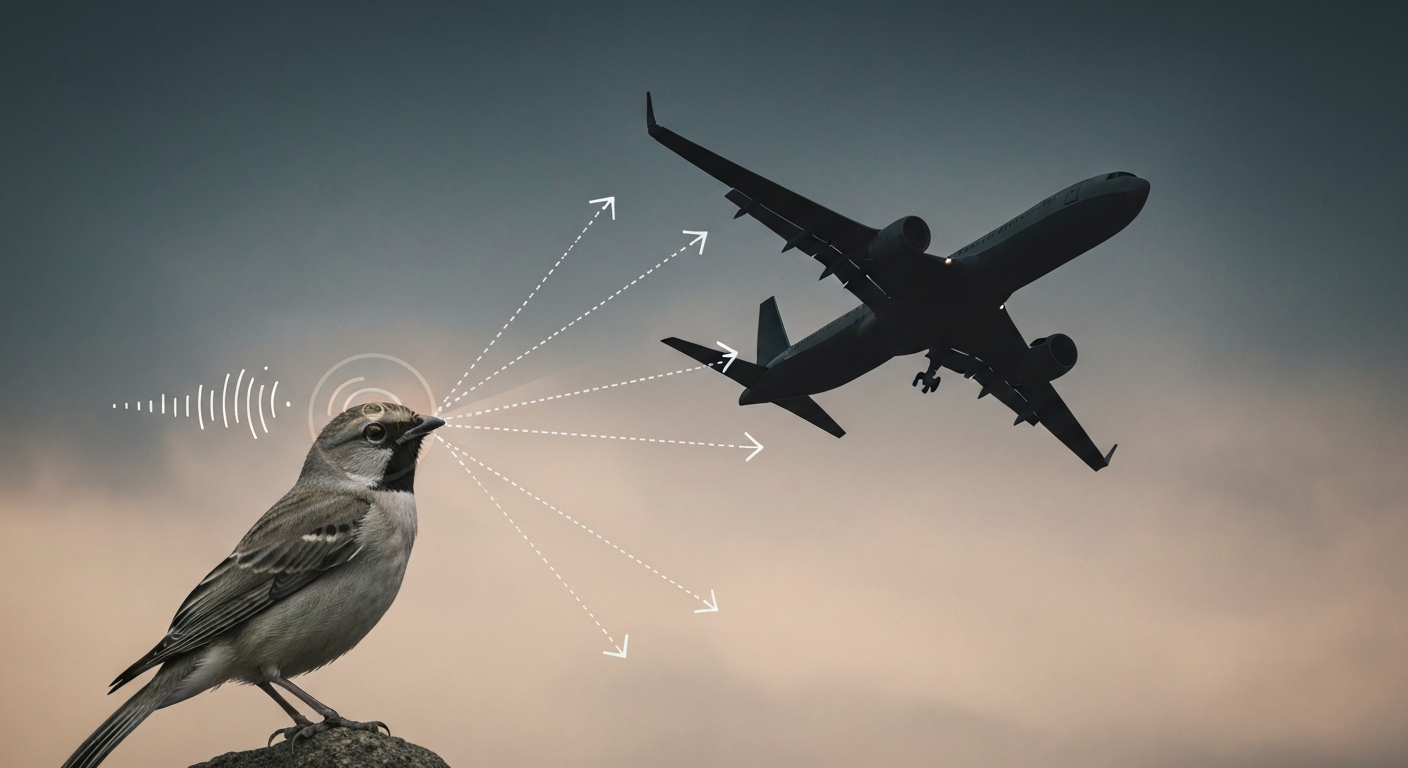
When a bird flies into an airplane's path, the result depends almost entirely on three things: how big the bird is, how fast the plane is moving, and exactly where on the aircraft the collision happens. Most birdstrikes cause little or no damage. A small sparrow hitting a fuselage at low speed leaves a smear. A Canada goose ingested into a jet engine at takeoff power is an entirely different physics problem, one that can end in an emergency landing or, in rare cases, a catastrophic loss of thrust. Understanding what actually happens, physically, operationally, and procedurally, strips away both the panic and the false reassurance that headline coverage tends to produce.
What If a Bird Comes in Front of an Airplane: Risks & Response

Marcus Chen
13 Aug 2026
What exactly is a birdstrike?
A birdstrike (also written bird strike or wildlife strike) is formally defined by ICAO and the FAA as any collision between an aircraft and a bird or other wildlife. The FAA runs the National Wildlife Strike Database (NWSD), which operators and airports can populate by submitting FAA Form 5200-7 after each incident. ICAO maintains a parallel international system called IBIS (Bird Strike Information System). These databases exist because strike reporting is voluntary in the United States for civil aviation, which means the real number of strikes is almost certainly higher than the recorded count. Feather and tissue remains can be submitted to the Smithsonian Institution's Feather Identification Laboratory for species confirmation, which feeds hazard-ranking research. When you see headlines like 'bird hit plane today,' this is the formal category that incident falls into. For more on how bird strikes can escalate to accidents, see bird hit plane crash.
Why birds end up in front of airplanes in the first place
From the bird's perspective, airports are attractive. Grass-covered runway strips are prime foraging habitat for starlings, lapwings, and small raptors. Ponds and retention basins near airports draw waterfowl. Thermal columns rising from paved surfaces can carry vultures and raptors at altitudes that overlap departure corridors. Birds are not suicidal or careless; they are doing exactly what evolution shaped them to do, and the geometry of an airport simply places them in the same airspace as aircraft.
Bird flight behavior makes certain encounters almost inevitable. Many species travel in dense flocks, especially during spring and autumn migrations, because predator confusion is a survival advantage. A flock of European starlings can contain hundreds of thousands of birds moving together in tight murmuration patterns. An airplane flying through a flock at 150 knots does not encounter one bird; it can encounter dozens in the span of a second. Migratory species also use high-altitude corridors, and while most songbird migration happens below 2,000 feet, certain species (bar-headed geese, for example) cruise at altitudes where even cruise-phase encounters are possible. The combination of flocking behavior, habitat exploitation near airports, and altitude overlap with approach and departure paths is what makes birdstrikes a persistent, unsolvable problem rather than a freak accident.
The physics of a bird hitting a plane
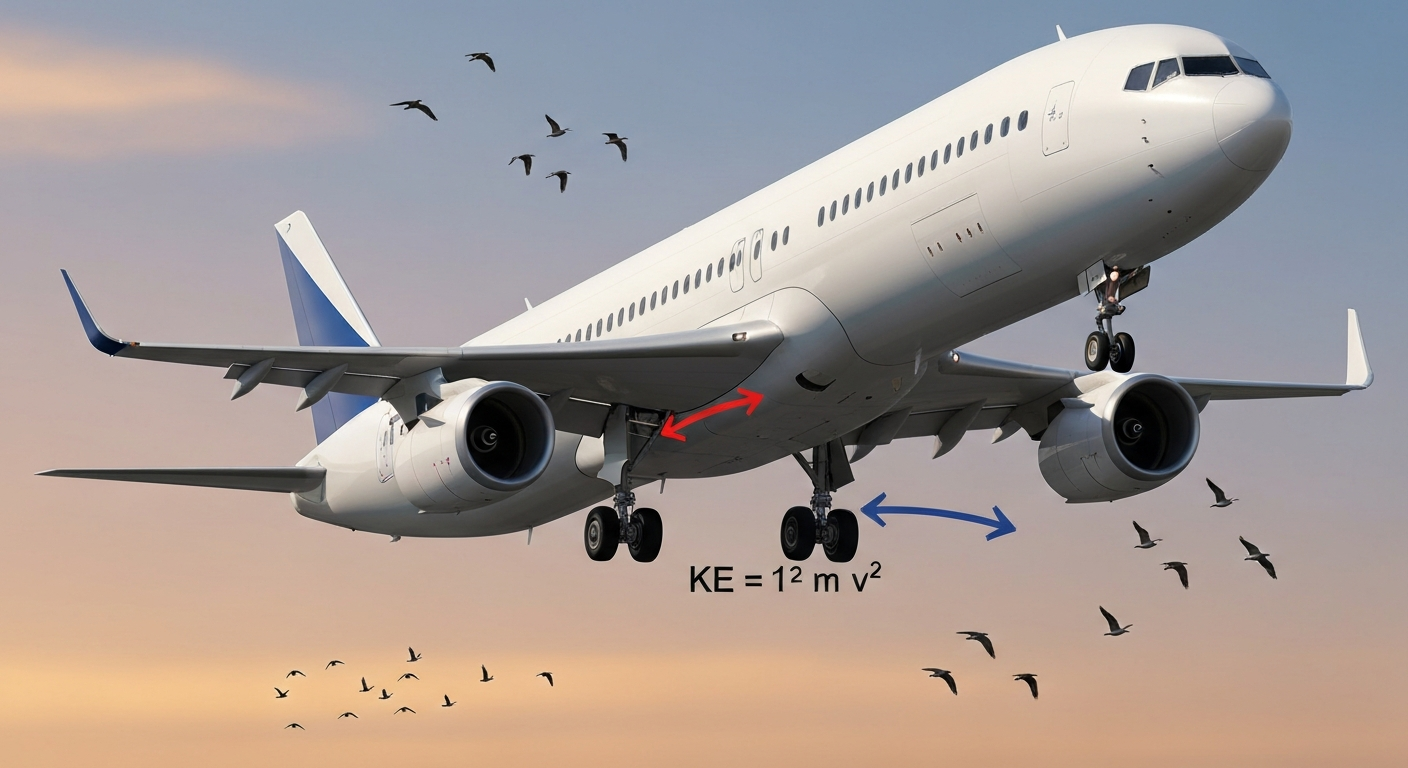
The core equation here is kinetic energy: KE = ½mv². The damage a bird causes scales with its mass but with the square of relative velocity. This means speed is the dominant variable. A 1 kg bird at 100 knots relative speed carries roughly four times the kinetic energy of the same bird at 50 knots. When you add aircraft speed to the bird's own flight speed (since the bird may be flying toward or across the aircraft's path), relative velocities during takeoff roll and initial climb can exceed 150 to 200 knots for commercial jets, and cruise-phase encounters on approach or departure can involve even higher closing speeds.
Bird tissue does not behave like a rigid projectile. Finite-element and smoothed-particle hydrodynamics (SPH) simulations of bird impacts show that at high closing velocities, soft avian tissue behaves more like a high-pressure fluid than a solid mass. The bird effectively 'splashes' across the impact surface in a fast, non-linear pressure pulse. This is why windshield certification testing uses real bird carcasses (or calibrated gelatin substitutes) rather than rigid impactors: the deformation characteristics of the projectile matter enormously to how the load is transmitted to the structure beneath. FAA certification rules (14 CFR §25.775) require that transport-category aircraft windshields resist penetration by a four-pound (approximately 1.8 kg) bird at the airplane's design cruise speed at sea level. That is not a trivial standard; it reflects the real-world mass of species like ring-billed gulls, which are among the most commonly struck birds near coastal airports.
For engines, 14 CFR §33.76 prescribes bird-ingestion certification tests scaled to engine inlet area. FAA AC 33.76‑1B, Bird Ingestion Certification Standards provides the FAA‑accepted means and test procedures applicants should use to show compliance with §33.76 (engine bird‑ingestion certification) blank" rel="noopener noreferrer">FAA AC 33.76‑1B — Bird Ingestion Certification Standards. See 14 CFR §33.76, Bird ingestion (eCFR) for the rule codifying bird‑ingestion tests scaled by inlet area that define large‑bird, medium‑bird and flocking tests and require engines not to suffer hazardous uncontained failures blank" rel="noopener noreferrer">14 CFR §33.76 — Bird ingestion (eCFR). Larger engines must demonstrate safe behavior against larger single birds and against simulated flocks of medium-sized birds simultaneously. The requirement does not demand that the engine continue operating normally; it demands that it not suffer a hazardous uncontained failure, meaning no shrapnel breaks through the engine case. Engine manufacturers including Rolls-Royce and CFM have publicly documented ingestion tests showing fan blade damage, stall, and controlled shutdown as acceptable outcomes when containment is maintained. A shutdown engine is a serious problem, but it is a survivable one in most twin-engine aircraft designs.
Which flight phases carry the most risk
The altitude profile of birdstrikes tells a clear story. Roughly 71% of reported strikes in FAA and NTSB analyses occur below 500 feet above ground level. That number points directly to the terminal environment: the runway, the immediate airspace above it, and the first few thousand feet of climb and the last few thousand feet of descent. Approximately 59 to 62 percent of strikes in multi-year NWSD summaries occur during arrival and landing phases, with the remaining 38 percent or so during takeoff and climb. Cruise-phase strikes are rare but not unheard of, particularly with large soaring birds and during nocturnal migration.
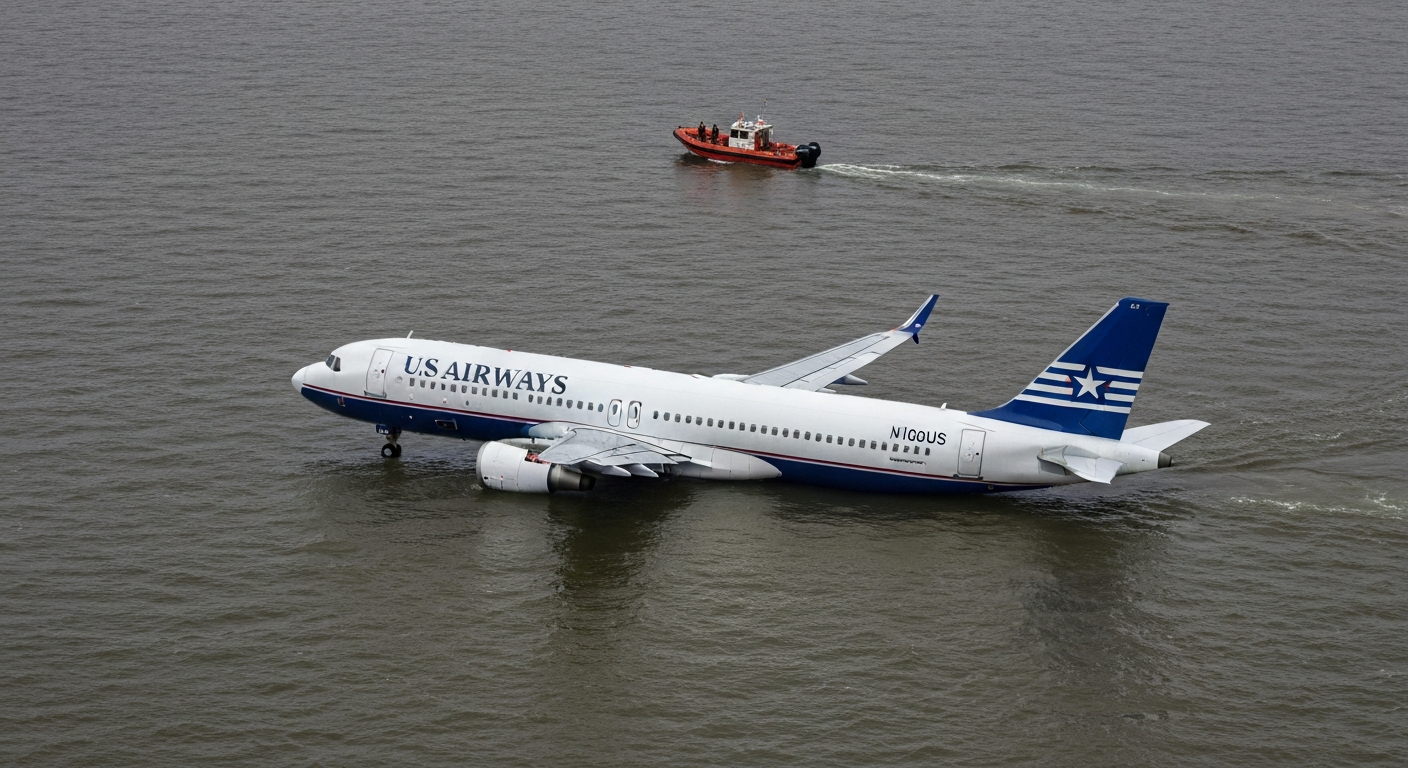
Takeoff and initial climb are the most dangerous phase combination despite accounting for fewer total strikes, because engine power is at or near maximum, speed is building rapidly, and the aircraft has no altitude margin for an emergency. A dual-engine bird ingestion during rotation, as happened to US Airways Flight 1549 on January 15, 2009, removes the standard toolbox of options almost instantly. The crew of that Airbus A320 had approximately 208 seconds from the Canada goose strike to touchdown on the Hudson River. That case, which is examined in detail in the context of the Miracle on the Hudson, demonstrated both how quickly low-altitude dual-engine loss becomes unsurvivable without immediate action, and how a well-trained crew could turn it into a survivable outcome.
| Flight Phase | Strike Frequency | Primary Risk | Speed at Strike |
|---|---|---|---|
| Taxi / Ground | Low | Propeller, nose, fuselage contact; minor structural | Under 30 knots |
| Takeoff roll | Moderate | Engine ingestion, nose/windshield impact | 30–160 knots, accelerating |
| Initial climb (below 500 ft AGL) | High | Engine ingestion, dual-engine loss risk, windshield strike | 160–250 knots |
| Climb (500–3,000 ft AGL) | Moderate | Engine ingestion, fuselage/leading edge damage | 200–280 knots |
| Cruise (above 10,000 ft) | Low | Windshield impact, fuselage denting, occasional engine ingestion | 400–500+ knots |
| Approach/descent (below 3,000 ft) | High | Engine ingestion, windshield, landing gear/flap area | 150–250 knots |
| Landing roll | Moderate | Propeller, engine ingestion, fuselage underside | Under 160 knots, decelerating |
What the damage actually looks like
Windshield and cockpit strikes
A windshield impact by a large bird at speed is one of the most visually dramatic outcomes. Modern laminated windshields on transport aircraft are engineered to the 4-pound standard mentioned above, and industry test methods specified in ASTM F330 govern how these tests are conducted. A strike that does not penetrate may still crack, craze, or delaminate the outer ply, reducing forward visibility and requiring an immediate return to land. A penetrating strike in a worst case can incapacitate the flight crew, which is why some historic fatal accidents have been associated with large-bird windshield events in smaller aircraft where certification standards were less stringent.
Engine ingestion
Engine ingestion is the scenario that gets the most attention, and for good reason. When a bird enters a turbofan engine, it first contacts the spinning fan blades. At high rotational speeds, fan blades strike the bird with extreme force. The bird tissue is fragmented and driven into the core of the engine, where it can cause compressor blade damage, disrupted airflow, stall (called a compressor surge or flameout), and in severe cases, uncontrolled vibration leading to shutdown. The certification requirement under 14 CFR §33.76 is designed to ensure that even a large-bird ingestion does not produce uncontained rotor failure, the kind that sends high-energy debris through the engine casing and into the fuselage or fuel systems. However, certification does not guarantee the engine keeps running; it guarantees it fails safely.
Airframe and structural hits
Strikes to the nose, fuselage, leading edges of wings, and horizontal stabilizer typically cause dents, punctures, or deformation of aluminum or composite skin panels. These are often discovered during post-flight walkaround inspections rather than felt during flight. A strike to the leading edge of a wing or empennage can compromise aerodynamic performance if severe enough, but in most cases the structural integrity of the underlying spar is unaffected. Landing gear bay strikes and undercarriage strikes during approach can damage hydraulic lines, sensors, or the gear mechanism itself.
Tail and empennage strikes
The tail of an aircraft (horizontal stabilizer, vertical fin, elevators, and rudder) is a control surface, not just a structural panel. A severe impact that deforms an elevator hinge or jams a control surface can have flight control implications. These are rarer outcomes but represent a category of damage where even a modest-mass bird can create a disproportionate operational consequence if the geometry is unfortunate.
Comparing outcomes by where the bird hits
| Strike Location | Typical Damage | Operational Consequence | Immediate Flight Risk |
|---|---|---|---|
| Windshield (outer ply) | Cracking, crazing, delamination | Reduced visibility, return to land required | Low to moderate |
| Windshield (penetrating) | Ply breach, possible crew injury | Loss of situational awareness, emergency declared | High |
| Engine (single, large aircraft) | Fan blade damage, possible shutdown | Single-engine operation, divert or return to land | Moderate |
| Engine (both, twin aircraft) | Dual thrust loss, possible flameout | Emergency landing / ditching | Very high |
| Nose/radome | Denting, puncture, radar damage | Possible weather radar loss, cosmetic | Low |
| Wing leading edge | Skin denting, possible spar exposure | Aerodynamic inspection required, usually minor | Low to moderate |
| Fuselage skin | Denting, paint removal, occasional puncture | Inspection required, typically cosmetic | Very low |
| Horizontal stabilizer/elevator | Surface denting, hinge area risk | Possible control restriction | Low to moderate |
| Landing gear/bay | Sensor, hydraulic, or door damage | Gear system check required, possible abnormal landing | Low to moderate |
How dangerous are birdstrikes, really?
This is where context matters most. The FAA's National Wildlife Strike Database contained over 142,000 strike records for the 1990 to 2013 period alone, and the database has grown substantially since. Against that volume of strikes, the number that resulted in aircraft accidents or fatalities is a small fraction. The vast majority of birdstrikes cause no damage at all, or minor cosmetic damage discovered after the flight. FAA analyses show that for the 33 most frequently identified species, the probability of aircraft damage increases by approximately 1.22% per additional 100 grams of mean bird body mass. That relationship explains why a European starling (roughly 85 grams) hitting a wide-body jet is rarely newsworthy, while a double-crested cormorant (roughly 1.8 to 2.5 kg) ingested into a regional jet engine produces very different outcomes.
The species-hazard picture is well-documented. USDA and FAA researchers (Dolbeer and colleagues) have ranked bird species by hazard to aviation based on mass, flocking behavior, and strike frequency. Gulls, Canada geese, white-tailed kites, and brown pelicans rank high on the damage-probability scale because of their mass. Starlings and rock doves rank high on the frequency scale because of their abundance near airports and their flocking behavior. The combination of high mass and high frequency is what produces the most dangerous situations.
When a birdstrike becomes an emergency
A birdstrike becomes an emergency when it compromises primary flight controls, causes a loss of thrust on one or both engines at a critical phase of flight, or results in crew incapacitation. The threshold for declaring an emergency is left to the pilot-in-command's judgment, but most airline standard operating procedures include specific checklists for engine failure following bird ingestion, windshield damage, and controllability anomalies. Single-engine operations following a birdstrike are handled by well-practiced procedures and modern aircraft are certificated to land safely on one engine. The genuinely dangerous scenario is dual-engine loss at low altitude, which the Miracle on the Hudson case illustrated so vividly in 2009. The Canada goose flock that disabled both CFM56 engines of the A320 is the kind of high-mass, high-flocking-density event that airport wildlife management programs exist to prevent.
What happens after a birdstrike: inspections, reporting, and maintenance
After any suspected or confirmed birdstrike, the aircraft enters a mandated inspection cycle. Maintenance crews examine engine fan blades visually and borescope the compressor stages. Leading edges, nose sections, and windshields are checked against damage-tolerance limits described in the aircraft's structural repair manual. Bird remains are collected where possible for species identification, and a strike report is submitted using FAA Form 5200-7, feeding the NWSD. Tissue samples may go to the Smithsonian Feather Identification Lab, which has an extensive reference collection for matching feather fragments and proteins to specific species. This post-strike data loop is how researchers build the hazard rankings that inform airport wildlife management programs in the first place.
How airports reduce birdstrike risk
Airport wildlife management is its own discipline, guided by FAA Advisory Circular AC 150/5200-32 and supported by wildlife biologists employed specifically for this purpose. The toolkit includes habitat modification (keeping grass short, draining standing water, removing berry-producing vegetation), active deterrence (pyrotechnics, trained falconry birds, acoustic devices, laser systems), and population management under FAA and USDA Wildlife Services coordination. Airports near migratory flyways issue NOTAMs (Notices to Air Missions) warning pilots of elevated bird activity during peak migration seasons. Radar systems designed to detect bird flocks (MERLIN Avian Radar is one commercial example) are deployed at some larger airports to provide real-time alerts to air traffic control.
- Grass management: keeping airfield grass between 7 and 14 inches tall reduces habitat attractiveness for many foraging birds while being too tall for others
- Water removal: filling or fencing retention ponds near runways reduces waterfowl congregation
- Falconry: trained raptors patrol airfield boundaries at airports including London Heathrow and several major U.S. airports
- Pyrotechnics and noise: propane cannons, distress call recordings, and handheld pyrotechnics disperse congregating flocks
- Population control: under federal depredation permits, lethal removal of problem species (particularly Canada geese and starlings) is used when non-lethal methods fail
- Reporting: every strike feeds data that improves species-specific hazard modeling and helps airports target management resources more precisely
What passengers should actually know
If you hear a thump or bang during a flight and the crew announces a possible birdstrike, the appropriate response is calm attention to crew instructions rather than panic. The overwhelming majority of such events result in an inspection on landing, not an emergency. If an engine is shut down as a precaution, the aircraft will land normally at the nearest suitable airport; twin-engine and four-engine aircraft are certificated for exactly this scenario. The flight crew will be working through established checklists. Passengers can help most simply by staying seated and keeping seatbelts fastened, as turbulence and rapid maneuvering following an event can injure unbelted passengers far more reliably than the birdstrike itself.
When you encounter a news headline about a bird hitting a plane, the story is almost always about a specific unusual event rather than a reflection of routine danger. For recent incidents, news entries titled 'bird hit plane today' summarize specific cases and show how those reports fit into the broader strike statistics. Birdstrikes happen thousands of times per year across U.S. civil aviation alone; they generate news coverage only when they involve a notable aircraft type, a delay at a busy airport, or a rare escalation to an actual emergency. The frequency itself, ironically, is a sign that the aviation safety system is working: rigorous certification standards, active wildlife management, mandatory inspection procedures, and well-practiced crew training mean that the vast majority of these high-energy collisions resolve as minor maintenance events rather than accidents. The Miracle on the Hudson remains memorable precisely because outcomes that severe are so unusual.
A brief note on 'it's a bird, it's a plane'
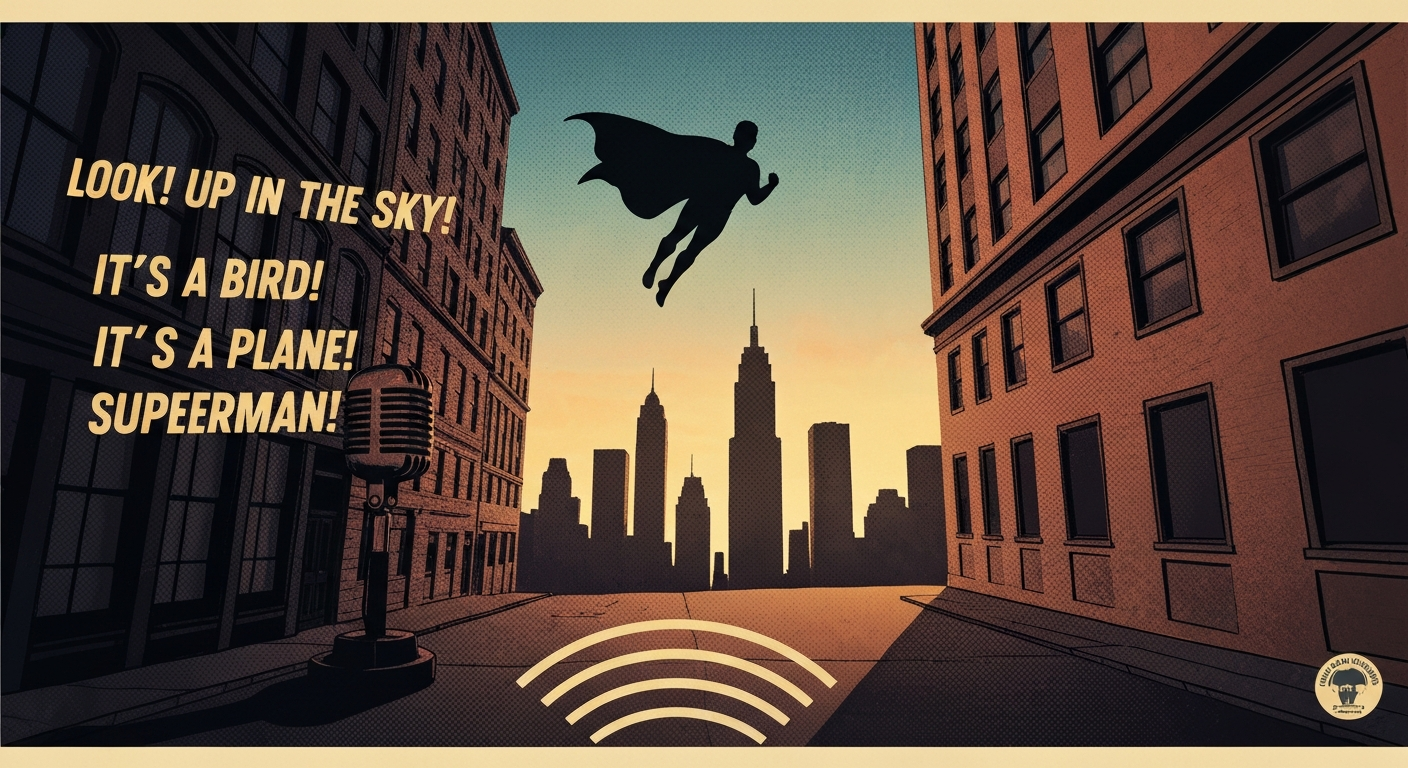
The famous phrase from Superman's introductory scenes captures something genuinely real about how humans perceive fast-moving objects in the sky: at a distance, a large bird and a low-flying aircraft can look startlingly similar in silhouette. Put another way, to a bird what's a plane can be hard to tell at distance, which is why silhouette confusion matters for detection and mitigation. For a brief explanation of the phrase's origins and meaning, see it's a bird it's a plane meaning. The confusion is not just cultural metaphor. Wildlife radar operators at airports sometimes track what appears to be a flock of birds and turns out to be a formation of light aircraft, or vice versa. The perceptual overlap between birds and planes in the sky has driven serious engineering attention, including the development of aircraft lighting patterns designed to make planes more distinct from bird silhouettes at dusk and dawn. The cultural echo of that Superman shout-out turns out to have more practical aviation relevance than the writers probably intended. For a Swahili translation of the phrase, see this is a bird not an aeroplane in swahili. For the original wording, see the classic 'is it a bird, is it a plane' quote from Superman's introductions is it a bird is it a plane quote. For a commonly shared visual riff on the line, see the 'is it a bird is it a plane' gif is it a bird is it a plane gif.
FAQ
What is a 'birdstrike' (wildlife strike)?
A birdstrike (also called a wildlife strike) is any collision between an aircraft and a bird or other wildlife. International and U.S. authorities (ICAO, FAA) treat these events as reportable safety occurrences and collect data in centralized systems (ICAO IBIS, FAA National Wildlife Strike Database). For reporting guidance see ICAO Doc 9332 and FAA Advisory Circular AC 150/5200‑32 and FAA Form 5200‑7.
How often do birdstrikes occur and when are they most likely?
Birdstrikes are relatively common near airports and low altitudes. FAA/NWSD analyses show a majority happen below 500 ft AGL and during terminal phases: takeoff/climb, approach/landing and taxi. Multi‑year NWSD summaries report roughly 59%–62% during arrival/landing and a large share also during takeoff/climb.
What determines how damaging a birdstrike is (physics and biomechanics)?
Damage is governed mainly by bird mass and relative speed: kinetic energy scales with ½·m·v², so heavier birds and higher closure speeds disproportionately increase damage risk. Impact location (windshield, nose, fuselage, control surfaces, or engine) and whether the bird is single or a flock also matter. Windshield and structure response is highly nonlinear at high strain rates; engine ingestion can cause fan damage, stall or engine shutdown depending on bird size/number and engine design.
How do impact location and bird size compare in likely outcomes?
Comparative summary (qualitative): - Windshield/cockpit: certification requires no penetration for specified large‑bird tests; cracks or delamination possible, pilot injury rare if windshield holds. See 14 CFR §25.775 and ASTM F330. - Fuselage/empennage/control surfaces: dents, punctures, or surface damage; control system compromise is uncommon but investigated. - Engines (inlet / fan): ingestion can cause blade damage, stalls, increased vibration, and possible shutdowns—engines are certified to withstand prescribed bird tests (14 CFR §33.76) but damage and loss of thrust can still occur in service. - Multiple‑engine/dual loss: statistically rare; dual engine loss from ingestion is uncommon but has occurred in exceptional events.
What are the probable operational outcomes (examples)?
Possible outcomes range from 'no damage' to partial systems impairment: shattered or cracked windshield, dented/abrased skin, pitot/static sensor damage, engine surge/stall or uncontained failure (rare). The most dramatic, though rare, outcome is dual‑engine loss at low altitude—an example is US Airways Flight 1549 (Miracle on the Hudson) where large geese disabled both engines and a successful ditching followed.
How do pilots and flight crews typically respond after a birdstrike?
Pilots follow established procedures and checklists: assess aircraft controllability, check engine instruments for vibration, EGT, N1, N2; run engine‑failure or engine‑damage checklists; declare emergency to ATC if required; perform single‑engine or engine‑out procedures, return or divert, and prepare for possible landing or precautionary/forced landing. Crews also brief cabin, prepare for evacuation if necessary, and complete required reports after landing.