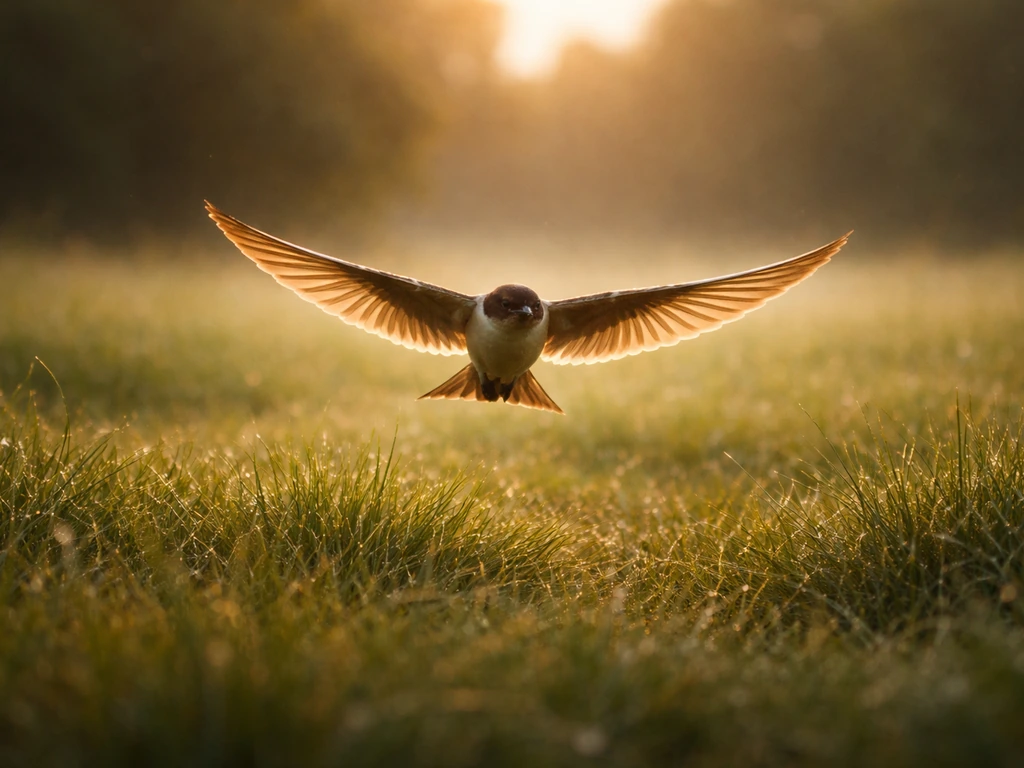
If you are searching for the best flying plane like a bird, you are probably looking for one of a few very different things: a research-grade flapping-wing drone that genuinely mimics avian biomechanics, a hobby-friendly ornithopter you can fly in a park, a classroom demonstrator that brings biology to life, or a simple paper or origami bird you can fold and launch in an afternoon. There is no single best answer, because the right bird-like aircraft depends entirely on what you want to do with it. What I can do is walk you through the real science behind how birds fly, map the main categories of bird-mimicking aircraft, and give you an honest comparison of the notable models so you can pick the one that actually fits your needs.
Best Flying Plane Like Bird: Guide to Bird-Like Aircraft

Marcus Chen
10 Aug 2026
What people actually mean by a flying plane like a bird
The phrase bundles together a surprisingly wide range of intentions. A university robotics team asking this question wants to know about micro air vehicles (MAVs) with measurable Strouhal numbers and documented PIV wake data. A hobbyist wants to know if a BionicBird RC ornithopter is worth the price. A middle-school teacher wants something safe, cheap, and repeatable for a classroom demo. And a folder of paper planes might simply want to know the best origami design that actually glides like a swallow. This article covers all of those use cases, anchored in the biomechanics of real birds, because understanding how birds actually fly is the fastest route to understanding why some engineered designs succeed and others fall flat.
How birds actually fly: the mechanics behind the magic
Bird flight is built on three interlocked systems: wing shape, feather mechanics, and muscular kinematics. The wing itself is a morphing aerofoil. Birds continuously adjust span, camber, and twist mid-stroke, which is something no fixed-wing aircraft can do passively. The primary flight feathers at the wingtip generate most of the thrust during the downstroke, while the secondary feathers closer to the body carry most of the lift. During the upstroke, many birds partially fold the wing to reduce drag, a behavior called intermittent flight.
The key measurable axes that biomechanists use to characterize a bird's flight are wingbeat frequency, stroke amplitude, stroke-plane angle, wing loading (body weight divided by wing area), and aspect ratio (wingspan squared divided by wing area). These are not just academic labels. Wing loading predicts how fast a bird must fly to stay airborne; high wing loading means fast, energy-intensive flight. Aspect ratio predicts glide efficiency; a long, narrow wing like an albatross's soars cheaply, while a short, broad wing like a sparrow's is nimble but costly. These same metrics apply directly to engineered bird-like aircraft and are the fairest way to compare designs across scales.
One of the most useful cross-species performance metrics is the Strouhal number, defined as St = f·A/U, where f is wingbeat frequency, A is the peak-to-peak amplitude of the wingtip, and U is forward speed. Research published in Nature (Taylor et al., 2003) showed that flying and swimming animals cruise in a narrow Strouhal range of roughly 0.25 to 0.35, a window tuned for high propulsive efficiency. If an engineered flapping wing operates far outside that range, it is almost certainly wasting energy. For any bird-like aircraft claiming high efficiency, Strouhal number is the first number I want to see.
Unsteady aerodynamics and why conventional aircraft theory falls short
Standard fixed-wing aerodynamics assumes steady, attached flow over the wing. Birds routinely break that assumption. At slow speeds and small scales, insects and hummingbirds generate lift through leading-edge vortices (LEVs), spiraling tubes of rotating air that form along the wing's front edge and dramatically boost lift beyond what steady-state theory predicts. PIV studies on hovering hummingbirds, published in Nature by Warrick et al. (2005) and followed up in Proceedings of the Royal Society B (2013), mapped the 3-D vortex wake in Anna's hummingbirds and confirmed that these vortex loops account quantitatively for the lift required to hover. Any small ornithopter claiming to hover like a hummingbird should be evaluated against that vortex-wake evidence, not just marketing copy.
Bird species whose flight styles directly inspire aircraft designs
Designers do not mimic birds generically. They target specific species because each represents a different engineering solution to the problem of flight. Here are the four most influential models, with the performance targets they set.
The wandering albatross: mastering dynamic soaring
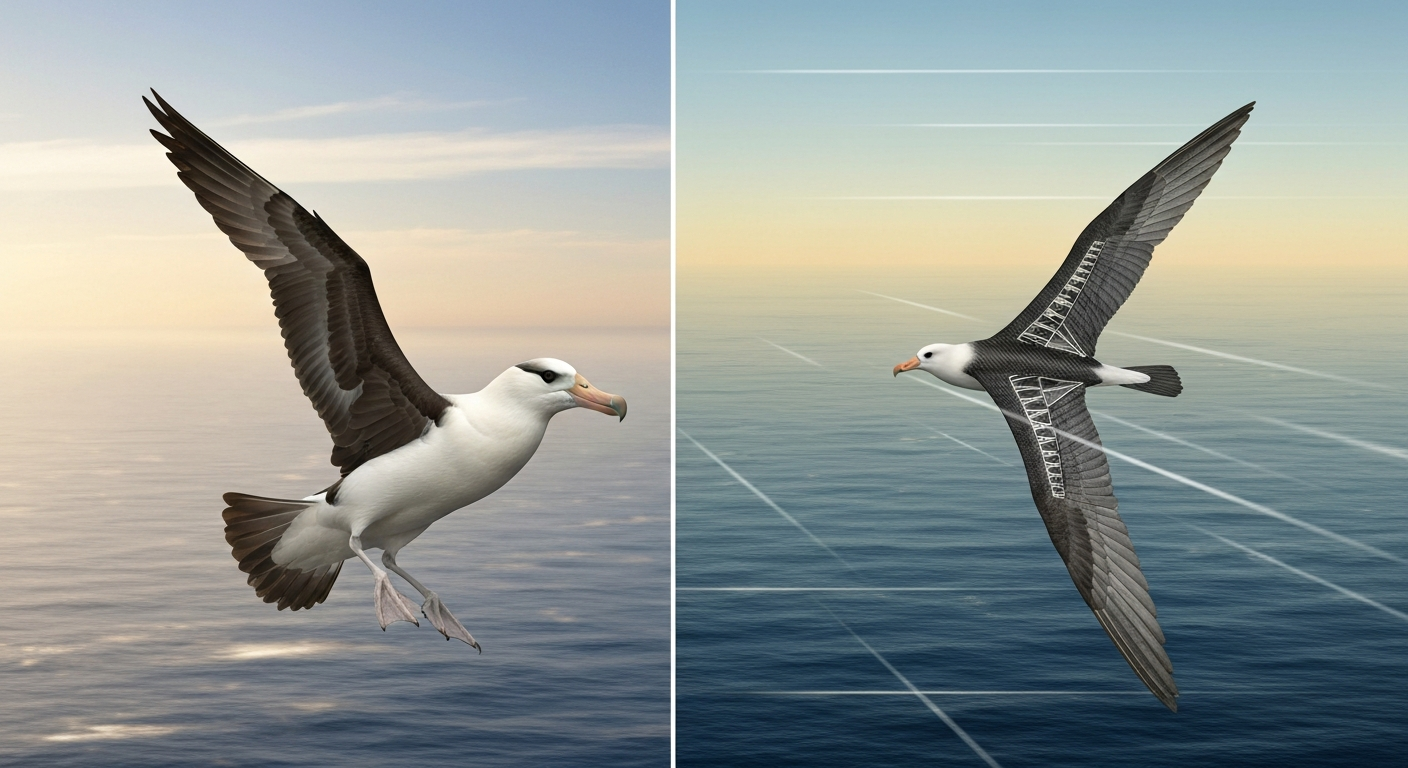
Wandering albatrosses have an aspect ratio near 15 and a wingspan up to 3.5 m, which gives them the lowest cost-of-transport of any flying bird. They do not flap much at all during long oceanic crossings. Instead they use dynamic soaring, a series of shallow arcs that extract energy from wind-speed gradients near the ocean surface. A 2024 PNAS study tracking wandering albatrosses with GPS showed they use orientation and routing strategies comparable to competitive yacht racers, optimizing heading relative to wind just as a sailor would. Albatrosses employ orientation and routing strategies similar to yacht racers, PNAS (2024). For UAV designers, the albatross sets the benchmark for range and endurance in a gliding platform: the target metrics are turn radius, wind-speed envelope, and energy extracted per cycle.
The hummingbird: hovering at the edge of insect-scale aerodynamics
Hummingbirds beat their wings at roughly 40 to 80 Hz, generating lift on both the downstroke and the upstroke, which is unusual among birds. The wing operates in the low Reynolds-number regime (Re roughly 5,000 to 15,000 at the wingtip), where unsteady effects dominate. This makes hummingbirds the biological template for hovering micro air vehicles. The engineering challenge is enormous: matching the 3-D vortex wake structure documented in PIV experiments while keeping mass below a few grams requires actuators, power sources, and structural materials that are still at the frontier of engineering.
The peregrine falcon: speed, morphing, and controlled stooping
The peregrine falcon reaches speeds exceeding 320 km/h during a hunting stoop. A 2014 PLOS ONE study using wind-tunnel flow visualization and field radar showed that the stoop relies on time-varying wing morphing, progressively tucking the wings to reduce drag while maintaining pitch control through asymmetric adjustments. The vortex-dominated flow patterns measured in that study set concrete target maneuver metrics (peak acceleration, flow-separation thresholds, turning radius at high speed) for any high-speed bird-like aircraft. For surveillance or racing ornithopters, the falcon is the benchmark species.
Swifts, swallows, and pigeons: versatile flappers for general ornithopter design
Most consumer and educational ornithopters are not built to mimic a specific species but draw loosely on the kinematics of medium-sized birds like swifts, swallows, and pigeons. These species operate at Strouhal numbers squarely in the 0.25 to 0.35 efficiency window, use intermittent flapping-and-gliding, and have moderate aspect ratios that balance maneuverability and range. They are the practical middle ground for design and are the biological inspiration behind models like the Festo SmartBird and the BionicBird family.
Categories of bird-like aircraft
Bird-mimicking aircraft fall into four broad categories. Understanding the category first saves a lot of time when comparing products.
Ornithopters
An ornithopter uses flapping wings as its primary propulsion source, just as birds do. The wings move through a cyclical stroke, generating both thrust and lift simultaneously. Ornithopters range from hand-launched rubber-band-powered toys to sophisticated RC models and large research platforms. They are the most biologically faithful category in terms of propulsion mechanism, though most commercially available ornithopters simplify the wing twist and camber changes that real birds perform continuously.
Flapping-wing micro air vehicles (MAVs)
Flapping-wing MAVs are research-grade miniature aircraft, typically with wingspans under 15 cm, designed to study control, sensing, and aerodynamics at insect or small-bird scales. They use specialized actuators such as piezoelectric elements or shape-memory alloys rather than conventional motors. Harvard's RoboBee, whose first controlled flight was published in Science in 2013, is the most cited example: it uses piezoelectric bimorph actuators and operates at insect Reynolds numbers. These platforms are not commercially available as consumer products; they are laboratory instruments.
Morphing fixed-wing aircraft
Morphing fixed-wing aircraft do not flap but change their wing geometry mid-flight, adjusting span, sweep, dihedral, or camber to optimize performance for different phases of flight. This mimics the way a peregrine tucks its wings in a stoop or an albatross adjusts its gull-angled sweep in turbulence. These aircraft are closest in form to conventional drones or gliders but are biologically inspired at the structural and control level. They tend to have better range and payload than ornithopters at comparable sizes.
Paper and origami bird toys
Paper and origami bird toys occupy a special corner of this topic. They are not powered aircraft, but a well-designed paper bird that can fly captures real aerodynamic principles: camber, dihedral stability, and aspect ratio. Classic origami flapping birds (the tsuru, for example) do not actually fly, but there are specific origami and paper-toy designs optimized for gliding, including the paper swallow and various competition glider folds. These are the most accessible entry point for students and casual learners, and the biomechanical principles behind why some folds fly and others tumble are genuinely interesting.
How to fairly evaluate a bird-like aircraft
Marketing language for ornithopters and bird-like UAVs is often loose, so it helps to know which criteria actually matter and how they are measured in credible research.
- Efficiency: best expressed as Strouhal number (St = 0.25 to 0.35 is the validated efficient range) or cost of transport (energy per unit weight per unit distance). Raw flight time figures from manufacturers need independent validation.
- Maneuverability: measured as minimum turning radius, roll rate, and pitch response at specified speeds. Falcon-scale platforms should be benchmarked against the stoop metrics from wind-tunnel studies.
- Biological fidelity: how closely the wing kinematics (stroke amplitude, twist, camber change, LEV generation) match the target species. PIV wake topology is the gold-standard measurement.
- Payload: maximum additional mass (cameras, sensors) the aircraft can carry without degrading flight. Most consumer ornithopters carry zero payload beyond their own electronics.
- Scale: wingspan and mass, which determine the Reynolds number regime and therefore which aerodynamic mechanisms dominate. Comparing a 2 m ornithopter with a 10 cm MAV on the same criteria is not meaningful.
- Cost: total cost including controller, batteries, and spare wings. Replacement parts for ornithopters are often fragile and expensive.
- Intended use: research, surveillance, art installation, hobby flying, or classroom demonstration. Each use case has different priorities that dominate the evaluation.
Notable prototypes and commercial models worth knowing
Festo SmartBird
The SmartBird, developed by German automation company Festo as an industrial demonstrator, remains the most technically sophisticated large ornithopter publicly documented. It has a 2.0 m wingspan, a mass of approximately 450 g, and uses active wing torsion, meaning the wing twist during each stroke is driven by a dedicated actuator rather than being purely passive. This active torsion is what allows it to achieve the smooth, low-drag, gull-like flight that made it famous. Festo's technical documentation describes the wing-morphing actuation in enough detail to be a genuine engineering reference. For educators and demonstrators wanting a visually stunning example of biomimetic engineering, SmartBird is the benchmark. It is not a commercial product you can buy and fly; it is a research and marketing demonstrator.
BionicBird and the X-Fly family
BionicBird is the consumer product most people encounter when searching for a flying plane like a bird. The X-Fly model (part of the Bionic Bird product family) has a wingspan of approximately 38 cm, a flying mass of roughly 12 g, and an advertised flapping frequency around 20 Hz. Manufacturer specifications list up to 12 minutes of flight time per charge, though real-world endurance depends heavily on wind conditions and piloting style. It is controlled via Bluetooth from a smartphone app. For hobbyists and classroom settings it is the most accessible powered ornithopter available as of 2026, but I would strongly recommend testing endurance and wing durability independently before committing to it for a curriculum.
Harvard RoboBee and Caltech/MIT micro air vehicles
Harvard's RoboBee achieved the first controlled flight of an insect-scale robot in 2013 (Ma et al., Science), using MEMS-fabricated piezoelectric actuators and weighing under 100 mg. It flies at insect Reynolds numbers where unsteady LEV-dominated aerodynamics dominate, making it a research instrument for studying control algorithms and power budgets at the smallest scales. MIT and Caltech groups have produced comparable MAV platforms exploring different actuation and sensing strategies. None of these are available commercially. They are mentioned here because they represent the current ceiling of what engineered flapping flight can do, and they set the goalposts for anyone designing a novel research MAV.
Snowbird: the human-powered ornithopter
The UTIAS Snowbird, developed at the University of Toronto, achieved the first certified sustained human-powered ornithopter flight in 2010: 19.3 seconds and 145 meters at an average speed of approximately 25.6 km/h, piloted by Todd Reichert. This is a landmark in large-scale ornithopter engineering and demonstrates the structural and power constraints you face when scaling flapping flight up to human-carrying dimensions. The wing loading, structural mass fraction, and pilot power output documented for Snowbird are useful reference data for anyone engineering a large ornithopter.
RC ornithopter kits and popular hobby models
Beyond BionicBird, several RC ornithopter kits are available from hobby suppliers. The Pterosaur and Eagle-style foam ornithopters sold by vendors like Banggood and HobbyKing typically have wingspans in the 60 to 100 cm range, use a single brushed or brushless motor driving a crank mechanism to flap foam or ripstop nylon wings, and cost between $30 and $120. They are more durable than the BionicBird family, carry a small camera in some configurations, and are repairable with standard hobby tools. Biological fidelity is low (no wing twist, no feather-like structures) but flight performance is reasonable for outdoor hobby use.
Passively morphing and compliant-spine ornithopters
Research by Wissa et al. (2015) demonstrated that inserting a compliant (flexible) spine element into an ornithopter wing reduces power consumption and increases lift in both wind-tunnel and free-flight tests. This is a structural approach to passive morphing: the wing deforms in a biologically plausible way without additional actuators. Several university competition ornithopters now incorporate compliant wing designs, and this approach is increasingly appearing in advanced hobby kits. If you are building your own ornithopter, a compliant leading-edge spar is one of the highest-leverage modifications you can make.
Comparison of notable bird-like aircraft models
| Model | Category | Wingspan | Mass | Biological Fidelity | Maneuverability | Payload | Cost (approx.) | Best Use Case |
|---|---|---|---|---|---|---|---|---|
| Festo SmartBird | Large ornithopter | 2.0 m | 450 g | High (active torsion, wing morphing) | Moderate | None | Not for sale | Demos, research reference |
| BionicBird X-Fly | Consumer ornithopter | 38 cm | 12 g | Moderate (no active twist) | Moderate | None | $50–$90 | Hobby, classroom demos |
| Harvard RoboBee | Flapping-wing MAV | ~3 cm | <100 mg | Very high (insect-scale LEV) | High (research-grade) | None | Not for sale | Academic research only |
| UTIAS Snowbird | Human-powered ornithopter | ~32 m | ~94 kg (with pilot) | Moderate (simplified kinematics) | Low | Pilot only | Not for sale | Engineering record/reference |
| RC Eagle/Pterosaur kits | Hobby ornithopter | 60–100 cm | 100–300 g | Low (crank mechanism, foam wings) | Moderate | Small camera possible | $30–$120 | Outdoor hobby flying |
| Compliant-spine research ornithopters | Research/competition | 40–80 cm | 150–400 g | Moderate-high (passive morphing) | Moderate-high | Small sensors | Build cost $100–$500+ | University research, competition |
| Paper/origami glider birds | Non-powered toy | 15–30 cm | 3–10 g | Low (shape only) | Low (unpowered) | None | <$1 | Classroom, casual learning |
| Morphing fixed-wing UAV | Fixed-wing with morphing | 50 cm–2 m | 200 g–2 kg | Moderate (wing-shape change only) | High | Moderate | $200–$2,000+ | Surveillance, range missions |
Picking the best option for your use case
The table above is useful for scanning, but the real decision comes down to what you are actually trying to accomplish. Here is how I would approach each common use case.
Academic and engineering research
If you need publishable data on flapping-wing aerodynamics, you need a platform you can instrument: force balances, PIV access, encoders on the wing joints, and ideally Strouhal-number characterization across flight speeds. The Harvard RoboBee family or university-built compliant-spine ornithopters are the right starting point. The SmartBird's published technical documentation is worth studying as an upper-bound reference for active-torsion actuation. Budget for high-speed cameras (at minimum 1,000 fps) and a PIV system if you want wake topology data comparable to the hummingbird studies.
Surveillance and outdoor autonomous flight
For surveillance, the case for a bird-like aircraft is practical as well as aesthetic: an ornithopter or morphing UAV can be visually confused with a real bird, reducing alarm in wildlife or human subjects. Morphing fixed-wing UAVs generally win here on range and payload. If true flapping is required, a hobby-grade RC ornithopter in the 60 to 100 cm wingspan range carrying a small camera is the most realistic current option. Biological fidelity is low, but detectability is reduced. Expect limited flight time (10 to 15 minutes) and vulnerability to wind above 15 km/h.
Art installations and public performance
The Festo SmartBird's design ethos, prioritizing beauty of motion over payload, makes it the inspirational reference for art and installation work. You cannot buy a SmartBird, but several makers and fabrication studios have built large custom ornithopters for installation use, often with 3D-printed wing skeletons and ripstop fabric skins. For indoor installations, the BionicBird's lightweight and quiet operation is practical. The visual effect of a well-tuned ornithopter is genuinely striking in a way that a quadcopter is not.
Hobby flying and outdoor recreation
For pure flying enjoyment, the RC Eagle/Pterosaur-style foam ornithopters in the $30 to $120 range offer the best durability-to-cost ratio. They are repairable, flyable in light wind, and satisfying to watch. The BionicBird is more visually convincing as a bird but more fragile and limited in endurance. I would suggest starting with a mid-range foam kit, learning the flight characteristics, and upgrading to a higher-fidelity design once you understand what you want to optimize.
Classroom demonstrations and STEM education
For classrooms, the best option is usually the one that survives the most student interactions. Paper and origami bird designs are the safest (zero crash damage risk), zero cost, and directly illustrate lift, aspect ratio, and dihedral stability. The BionicBird is the best powered option for a controlled indoor demo, but keep spare wings on hand. Combining a paper glider build with a live BionicBird flight and a discussion of Strouhal number and wing loading covers an impressive range of physics and biology in a single lesson.
DIY options: paper birds, origami gliders, and simple RC builds
Building your own bird-like flyer is one of the best ways to develop an intuitive feel for the aerodynamics involved. There are three practical levels of DIY, depending on your time, budget, and goals.
Paper and origami birds that can actually fly
Most people know the classic origami tsuru (crane), but it does not fly. If you want a paper bird that genuinely glides, look for designs optimized as gliders rather than as sculptural representations of birds. For a beginner-friendly option, try an origami bird that can fly easy as a starting fold for classrooms and casual testing. The key design principles are: a positive dihedral angle (wings angled slightly upward from center) for roll stability, a mild camber in the wing section for lift, and a center of gravity positioned about one-third of the way back from the nose. Thin paper (around 70 gsm) with a sharp leading-edge fold performs better than thick card. Paper toy designs that can fly like a bird, including the well-known paper swallow glider, use these principles and can be thrown with a smooth, level release at moderate speed. Avoid heavy throws, which pitch the nose down.
Simple foam or balsa ornithopter kits
The cheapest motorized build is a rubber-band-powered balsa ornithopter kit, available for $5 to $15 from hobby shops. These use a twisted rubber band to drive a crank that flaps two or four wings. They are fragile but highly educational: you can see the complete mechanical transmission from elastic energy storage through crank to flapping wing. For a more durable electric version, open-source designs using 3mm carbon fiber spars, ripstop nylon wing membranes, and a small coreless motor with a gear reduction are well-documented in maker communities like Hackaday and the RCGroups ornithopter forums.
Simple RC conversion tips
If you already have experience with RC aircraft, converting a basic ornithopter design to RC control is straightforward. You need a brushed DC motor driving a crank-rocker four-bar linkage to produce the flapping motion, a separate servo for tail rudder or elevator control, and a small receiver and 1S LiPo battery. Keep total mass under 100 g for indoor flight or under 200 g for outdoor performance. The most common mistake is making the wings too stiff: a small amount of passive flex in the wing membrane dramatically improves thrust, as the compliant-wing research confirms. Test your Strouhal number by measuring flapping frequency, tip amplitude, and flight speed and aiming for St between 0.25 and 0.35.
Safety, legal, and regulatory considerations
Bird-like aircraft occupy an interesting regulatory space. In most jurisdictions, the same drone and model aircraft rules apply to ornithopters as to any other UAV. In the United States, the FAA requires registration for any unmanned aircraft weighing more than 250 g (0.55 lb) flown outdoors. The BionicBird X-Fly at 12 g falls well under this threshold, but most outdoor RC ornithopters and any morphing-wing UAV carrying a camera will exceed it and require registration. In the EU, EASA rules categorize drones by mass and operational risk; most hobby ornithopters fall in the Open Category but still require registration and basic online training.
Wildlife interaction is a specific concern with bird-like aircraft. Flying an ornithopter near nesting birds, particularly raptors or endangered species, can cause behavioral disturbance comparable to a real predator or competitor. Several documented cases exist of large raptors attacking bird-like UAVs, which can damage both the aircraft and the bird. In protected areas, check local regulations before flying any UAV, bird-like or otherwise.
For classroom use, any powered aircraft indoors should be flown in a gym or large space with a safety perimeter, and students should wear eye protection during indoor RC flights. Paper and origami builds have essentially zero safety risk and are suitable for any age group. If you are using a BionicBird or similar device in a school, check whether your district's drone policy covers indoor RC aircraft, since some policies are written broadly enough to apply.
Further resources: where to go next
Research and technical reading
- Tobalske's review of bird flight biomechanics in the Journal of Experimental Biology is the best single starting point for understanding measurable flight kinematics and experimental methodology.
- Taylor, Nudds, and Thomas (2003) in Nature on Strouhal number is essential reading for anyone designing or evaluating a flapping-wing vehicle.
- Warrick et al. (2005) in Nature and the 2013 Proceedings of the Royal Society B paper on Anna's hummingbird wake structure are required reading for hovering MAV design.
- The 2025 review on flapping-wing robots in the robotics literature (IEEE/Bioinspiration & Biomimetics) provides a current survey of MAV controller and actuation approaches.
- Festo's SmartBird technical documentation, freely available on their website, is the best publicly accessible engineering case study for a large ornithopter.
Suppliers and maker communities
- RCGroups.com ornithopter subforum: the most active English-language community for RC ornithopter builders, with build logs, free plans, and component sourcing advice.
- Hackaday.io project listings: search 'ornithopter' for open-source build projects with documented design files.
- BionicBird official site for the X-Fly and accessories.
- Banggood and HobbyKing for foam RC ornithopter kits in the $30 to $120 range.
- Festo's Bionic Learning Network page for SmartBird and related projects, with free white papers.
Museums and institutions worth visiting
- Smithsonian National Air and Space Museum (Washington, D.C.): houses historical ornithopter models and extensive bird flight display materials.
- Natural History Museum (London): bird anatomy collections relevant to understanding wing morphology.
- MIT Museum (Cambridge, MA): periodically exhibits robotics and MAV research from MIT labs.
- Science Museum (London): aviation history collections with early ornithopter prototypes and documentation.
Image and figure suggestions
The following visuals would significantly strengthen this article and are recommended for publication.
- Wing kinematics diagram: a side-by-side illustration of wingbeat stroke phases (downstroke, upstroke, wing folding) for a pigeon or swift, annotated with stroke amplitude, stroke-plane angle, and wing-loading zones. Ideally derived from high-speed video frames.
- Species comparison panel: silhouette comparison of albatross, hummingbird, peregrine falcon, and swift wing shapes at scale, annotated with aspect ratio and wing loading values, illustrating the morphology-performance trade-off.
- Strouhal number explainer graphic: a simple plot of St = f·A/U with the 0.25 to 0.35 efficiency window shaded, with example species and aircraft plotted as data points.
- SmartBird in flight: Festo's own media photos of the SmartBird mid-flap showing active wing torsion visually, with caption noting the 2.0 m wingspan and 450 g mass.
- BionicBird / X-Fly product photo with annotated wingspan (38 cm) and mass (12 g) for scale reference.
- RoboBee close-up: Harvard Microrobotics Lab's published image of the RoboBee with scale bar, highlighting the MEMS wing structure.
- DIY step-by-step visual: a four-panel illustration showing the key folds for a paper swallow glider that can fly, with annotated dihedral angle and center-of-gravity position.
- Ornithopter four-bar linkage diagram: mechanical drawing of a crank-rocker mechanism converting motor rotation to wing flapping, with labeled components (crank, coupler, rocker, wing spar attachment point).
Quick summary and where to go from here
The best flying plane like a bird is the one that matches your actual goal. For researchers, that means a documented, instrumentable platform such as a university-built compliant ornithopter or a Harvard RoboBee-class MAV, evaluated against Strouhal number, PIV wake data, and species-specific kinematics benchmarks. For hobbyists, a foam RC ornithopter kit in the $30 to $120 range offers the best durability and repairability. For educators, combining a paper or origami bird build with a live BionicBird demonstration covers the biology and physics in a hands-on, low-risk format. To identify a specific species from its flight, tools that match observed traits to a bird can fly name are useful, see internal resource 8941de30-b002-4ad8-bb17-e58d28f31868. For artists and installation designers, the SmartBird remains the aesthetic and technical reference, even if you cannot buy one off the shelf.
Whatever your entry point, the science of bird flight is the foundation. Once you understand wing loading, aspect ratio, and Strouhal number, you can evaluate any bird-like aircraft claim on its merits rather than its marketing. And once you have flown even a simple paper glider folded into a swallow shape and watched it arc through still air, you will understand why engineers keep trying to build machines that fly the way birds do. It is not just an engineering challenge. It is, as anyone who has watched an albatross work a headwind knows, one of the most beautiful things in the physical world.
FAQ
What do people mean by “best flying plane like bird” in engineering and hobby contexts?
They mean aircraft whose flight mechanics, morphology or behavior mimic birds. That can range from aesthetic, toy‑level replicas to research platforms that reproduce avian wingbeat kinematics, wing morphing and wake patterns. "Best" depends on the goal: biological fidelity (how closely it matches bird biomechanics), aerodynamic efficiency, maneuverability, payload, scale, cost and intended use (research, surveillance, education, hobby). The article compares these axes with standardized metrics so readers can choose the most appropriate platform.
Which biomechanical features of avian flight should be understood and measured to evaluate bird‑like aircraft?
Key measurable axes are wingbeat frequency, stroke amplitude, stroke‑plane angle, wingbeat gait (continuous vs intermittent), wing loading, aspect ratio, and body/wing morphing. Relevant experimental methods include high‑speed 3‑D kinematics, accelerometry, force balances, pressure taps, particle‑image velocimetry (PIV) for wake structure, and GPS/motion capture for trajectories. Non‑dimensional metrics such as the Strouhal number (St = f·A/U) are essential for cross‑scale efficiency comparisons.
Which bird species and flight styles most commonly inspire designs and why?
Common inspirations: albatrosses (dynamic soaring, very high aspect ratio wings, efficient gliding), hummingbirds (high‑frequency hovering with leading‑edge vortices), falcons (high‑speed stoop and rapid wing morphing for maneuvering), swifts and swallows (agile flapping/gliding hybrids), and raptors (morphing and control for maneuverability). Each provides target performance metrics — e.g., optimal turn radii, Strouhal ranges, vortex signatures — that designers benchmark against.
What categories of bird‑like aircraft are there and how do they differ?
Categories: ornithopters (mechanical flapping wings, from micro to man‑carried), flapping‑wing MAVs (research micro/meso scale), morphing fixed‑wing (rigid lifting surfaces with active shape change), and simple paper/origami bird toys. They differ by actuation complexity, Reynolds number regime, achievable maneuvers, payload, durability and cost. Ornithopters aim for unsteady‑lift mechanisms; morphing fixed‑wings prioritize low drag cruise with some shape change; paper birds are low‑cost educational tools.
Which notable prototypes and commercial models are useful benchmarks or purchase options?
Representative platforms: Festo SmartBird (2.0 m, articulated torsion, good for demos/education), BionicBird/X‑Fly (consumer ornithopters for hobby/classroom), Harvard RoboBee and insect‑scale robots (state‑of‑the‑art research for control and MEMS actuation), MIT/Caltech micro air vehicles and various university ornithopters, UTIAS Snowbird (human‑powered ornithopter—large‑scale benchmark), and popular RC hobby kits (various sizes). Each is evaluated by efficiency, maneuverability, biological fidelity, payload, scale, cost and intended use.
What objective criteria should I use to compare bird‑like aircraft?
Use standardized, repeatable metrics: wingbeat kinematics (f, A, stroke plane), wing loading and aspect ratio, Strouhal number, power draw and energy per distance, steady and transient force measurements (lift/drag), wake topology (PIV: LEVs, vortex loops, wake type), maneuverability (turn radius, climb rate, max accelerations), payload capacity, endurance/range, scale (Reynolds number), reliability and cost. Report experimental protocols (high‑speed video, force balances, PIV, power logging) for fair comparison.
Next Article
Bird Can Fly Name: Which Birds Can Fly and Why
Learn which birds can fly and why, plus how to identify flight vs flightless species by traits and behavior.