
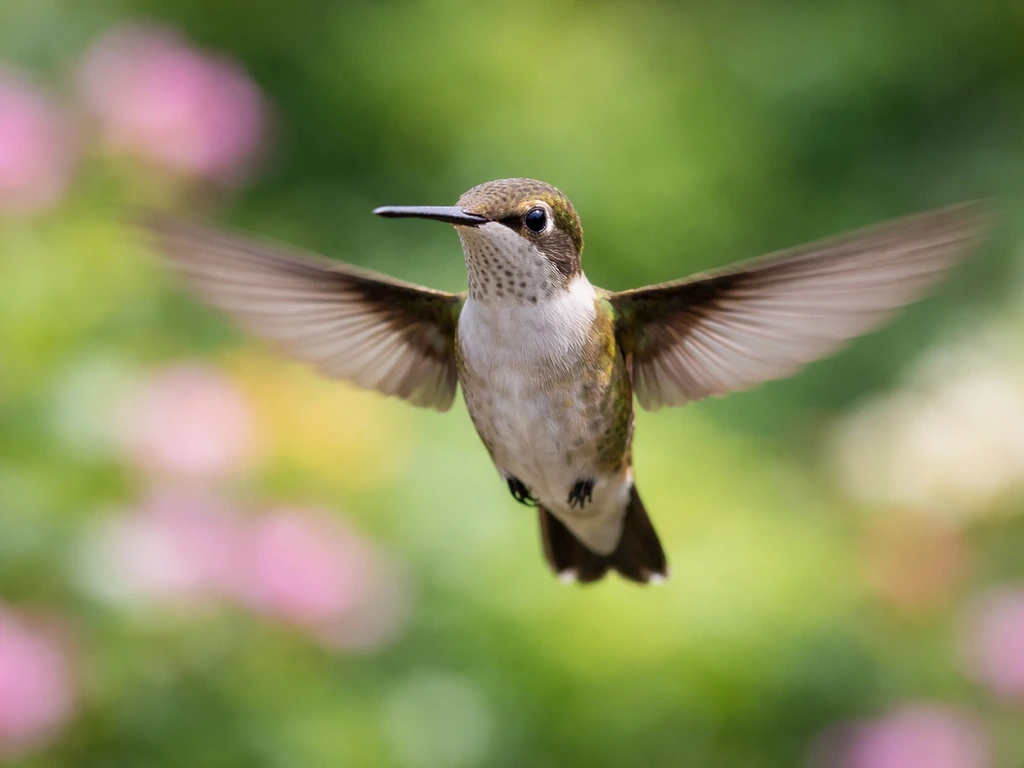
The bird that can fly backwards is the hummingbird. More specifically, every species in the family Trochilidae is capable of sustained, intentional backward flight, meaning they can translate their body in reverse through the air rather than simply hovering in place or spinning around. No other bird family has been documented doing this in peer-reviewed research. That is the short answer, and it is an unambiguous one.
What Bird Can Fly Backwards, and How It Works

Marcus Chen
2 Apr 2026
What "fly backwards" actually means (and what it doesn't)
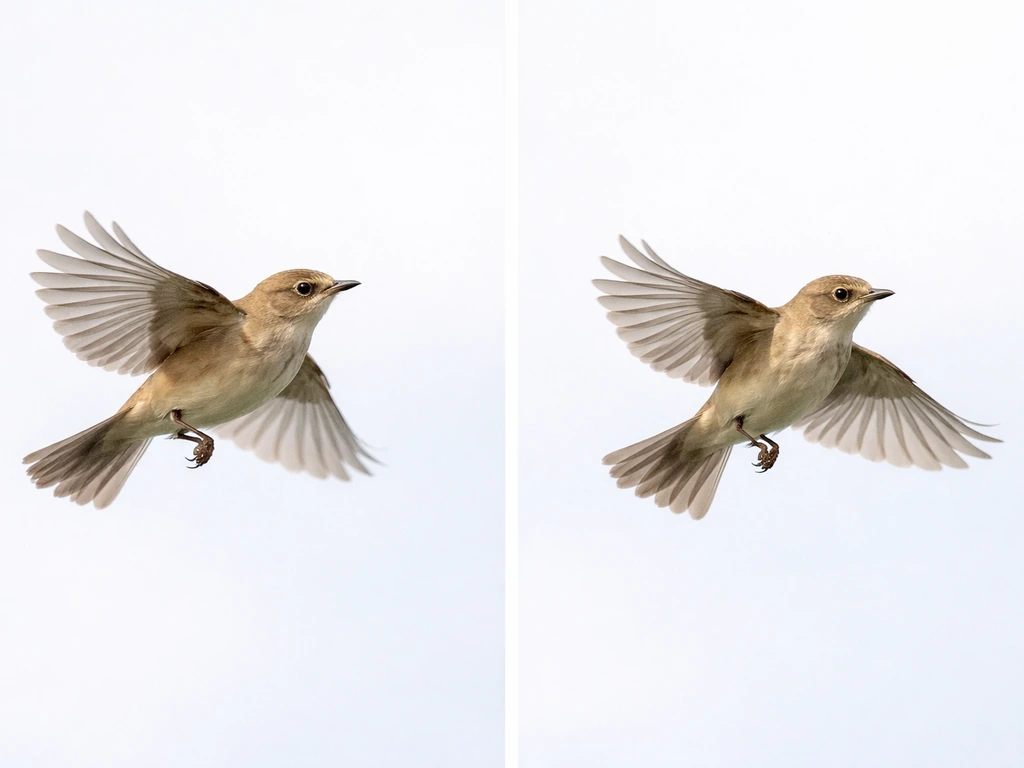
This distinction matters more than it might seem. When people ask what bird can fly backwards, they often conflate several different behaviors that look similar but are mechanically very different. True backward flight means the bird is translating in the direction opposite to the way it is facing: it moves tail-first through the air, not just drifting or yawing.
- True backward translation: The bird's body physically moves in the direction behind it, like a car reversing. This is what hummingbirds do.
- Hovering: The bird stays stationary in the air with no net movement in any direction. Many birds can do this briefly; hummingbirds can sustain it indefinitely.
- Turning or yawing: The bird pivots its body so what was "behind" is now "in front," then flies forward in that new direction. This looks like backward flight from certain angles but is not.
- Wind-assisted reverse drift: A bird facing into a very strong headwind can appear to move backward relative to the ground, but it is still flying forward relative to the air.
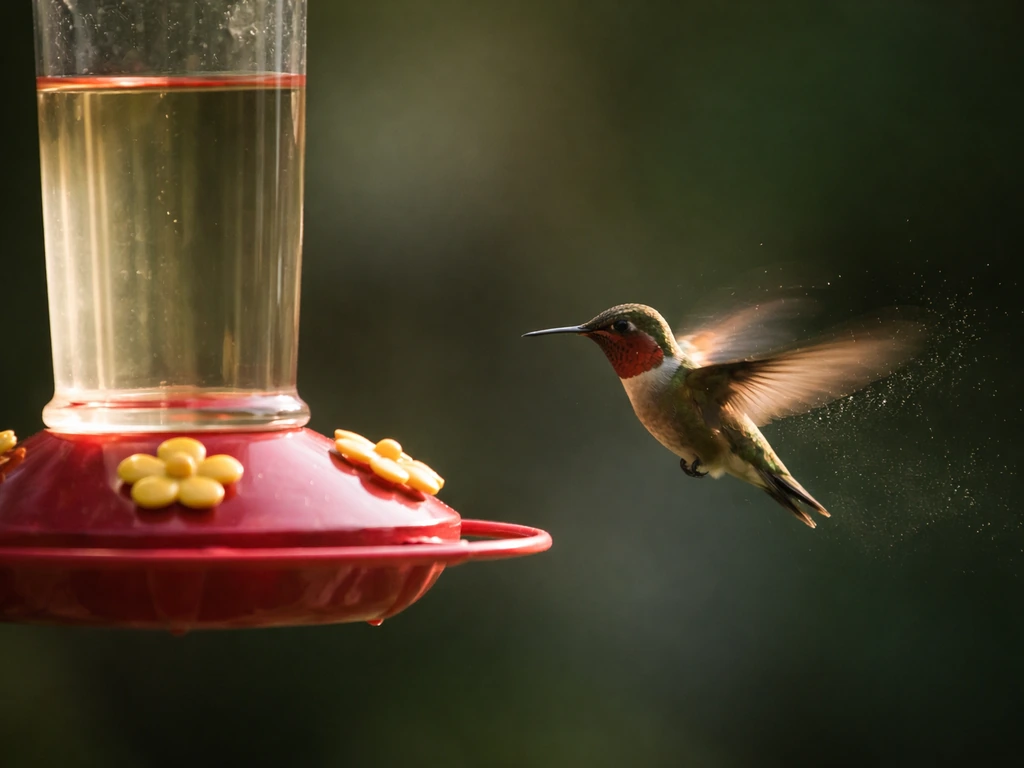
Researchers Sapir and Dudley designed an elegant experiment to eliminate any ambiguity about which category hummingbirds fall into. They set up a wind tunnel with a feeder and directed airflow so that the bird had to actively fly backward, against the wind, to remain stationary at the food source.
In the wind-tunnel setup described in the Journal of Experimental Biology feature, Sapir directed airflow at 3 m/s so the hummingbirds had to fly backward against the wind to remain stationary at the feeder or “flower. ” directed airflow so that the bird had to actively fly backward, against the wind, to remain stationary at the food source.
When the feeder and airflow arrangement was rotated 180 degrees, the same birds had to fly forward into the wind to stay put. This within-study contrast between forward and backward translation leaves no room for misinterpretation.
How hummingbirds actually pull this off
The mechanics behind hummingbird backward flight are genuinely impressive, and understanding them helps you appreciate why no other bird can do what they do. Their wing anatomy and musculature are fundamentally different from every other bird group. While most birds generate useful lift almost exclusively on the downstroke, hummingbirds generate substantial lift on both the downstroke and the upstroke, by rotating their wings nearly 180 degrees at the shoulder joint on each beat. That figure-eight stroke pattern is what makes reverse translation physically possible.
In controlled backward-flight experiments with Anna's hummingbirds (Calypte anna), researchers documented backward airspeeds of up to 4.5 meters per second, which is roughly 16 kilometers per hour. That is a meaningful velocity, not a tiny drift. To achieve it, the birds adopt a specific body configuration: a steep body angle combined with pronounced head flexion, so the head tilts forward toward the direction of travel even as the body moves tail-first. If you picture the bird's posture during this, it looks almost like someone leaning into a strong wind while walking backward.
The wingbeat kinematics change measurably during backward flight. The stroke plane becomes noticeably flatter relative to horizontal compared to forward or hovering flight. The wingbeat frequency increases, and the ratio of upstroke duration to downstroke duration shifts as well. Each of these adjustments redirects the net aerodynamic force vector so it has a backward-pointing horizontal component, providing the reverse thrust needed to actually translate the bird's body in that direction.
The energy cost (it's not as expensive as you'd think)
One of the more surprising findings from the blank" rel="noopener noreferrer">Sapir and Dudley study is how metabolically affordable backward flight is for hummingbirds. The oxygen uptake curve during backward flight closely resembled the power curve for forward flight at equivalent airspeeds. More striking, backward flight turned out to be roughly 20 percent more efficient than hovering. This makes evolutionary sense: if a hummingbird needs to retreat from a flower without turning around, it can do so without burning significantly more fuel than flying normally. Much like a bird that flies like a helicopter, the hummingbird has essentially solved the problem of multidirectional flight through structural and muscular specialization rather than brute energy expenditure.
Other birds that can move backward (sort of)
Hummingbirds are the only birds documented to perform sustained, intentional backward translation in controlled research. But a few other species can produce brief reverse motion under specific circumstances, and it is worth being precise about what those cases actually involve.
- Eagles, hawks, and other raptors can momentarily slip backward during aggressive aerial maneuvers or when braking hard into a landing, but this is inertia-driven drift, not powered reverse thrust.
- Some seabirds and shorebirds appear to move backward while hovering into a headwind, but as noted earlier, that is ground-relative drift against air-relative forward flight.
- Kingfishers and kestrels can hover with remarkable precision using rapid wingbeats and tail adjustments, but they do not translate backward in a controlled way. Even birds with unusual flight patterns like the crane, which can cover enormous distances and perform elaborate aerial courtship displays, have no documented ability to fly in reverse.
- Cuckoos are sometimes cited in popular lists of surprisingly capable fliers, but if you want to know whether a cuckoo can fly backwards, the short answer is no: they are capable long-distance migrants with perfectly competent forward flight, but backward translation is not in their repertoire.
The confusion often comes from observer-centered versus bird-centered frames of reference. When a hummingbird hovers and shifts orientation, it uses visual motion and optic-flow cues to stabilize itself. From a fixed camera angle, that can look like backward drift even when the bird is just rotating. High-speed video from a bird-centered perspective removes that ambiguity entirely, which is why the best research uses 3D reconstruction and bird-centered coordinate systems to measure wing and body motion relative to the surrounding airflow rather than relative to a fixed point in the room.
Comparing the flight capabilities: hummingbirds vs. other notable fliers
| Bird / Group | Sustained backward flight | Hovering | Forward sustained flight | Notes |
|---|---|---|---|---|
| Hummingbirds (Trochilidae) | Yes, up to 4.5 m/s documented | Yes, indefinitely | Yes | Only group with documented true backward translation |
| Kestrels / Kingfishers | No | Yes, briefly | Yes | Headwind hovering only; no reverse thrust |
| Raptors (eagles, hawks) | No (incidental drift only) | Rarely, very briefly | Yes | Backward drift is inertia during braking, not powered |
| Cranes | No | No | Yes, long-distance | Powerful fliers; no reverse capability |
| Cuckoos | No | No | Yes, migratory | Capable migrants; no backward flight |
How to verify this yourself (without a wind tunnel)
The best primary source to find is the Sapir and Dudley wind-tunnel study. Search for the exact phrase "backward flight in hummingbirds employs unique kinematic adjustments and entails low metabolic cost" to pull up the PubMed record directly. That study gives you the controlled experimental design, the 4.5 m/s backward airspeed figure, and the metabolic comparison data. A companion piece in the Journal of Experimental Biology, searchable as "hummingbirds make flying backwards look easy," walks through the same experimental setup in a more accessible format and is worth reading alongside the primary paper.
For video evidence, the key thing to look for is not just a hummingbird moving away from a flower, but footage that clearly shows the bird's body orientation remaining constant (head toward the flower, tail retreating) while the bird moves away. Slow-motion footage is essential because the wingbeat frequency is so high (around 40 to 80 beats per second depending on species) that normal-speed video blurs everything into an invisible blur. The best publicly available clips come from university research groups and are often linked from the Journal of Experimental Biology's press releases. Be skeptical of any clip where the bird turns around before moving away, because that is just forward flight in a new direction.
It is also worth knowing that the history of avian flight is full of surprising capabilities that took careful experimental design to confirm. Thinking about what was the first bird to fly and how its flight mechanics compared to modern birds puts the hummingbird's specialization in useful evolutionary context: 150 million years of iteration have produced some genuinely remarkable outliers. Experimental aircraft programs have also chased similar multidirectional agility goals for decades; the challenges engineers faced when designing vehicles like the Boeing Bird of Prey illustrate just how non-trivial it is to engineer a vehicle that can move in multiple directions with equal efficiency.
What to do right now if you want to go deeper
- Search PubMed or Google Scholar for: "Sapir Dudley backward flight hummingbird wind tunnel" to find the primary experimental study with controlled conditions.
- Search YouTube for "hummingbird backward flight slow motion" and filter for university or research lab channels rather than general wildlife channels, where the framing is more likely to be accurate.
- Look for footage or papers that specify the airspeed and body angle, not just "the bird went backward." Numbers and geometry separate real documentation from casual observation.
- If you want to understand the hovering-versus-backward distinction visually, search for "hummingbird optic flow stabilization" to see how researchers have used controlled visual environments to tease apart different flight modes.
- For the kinematics in even more detail, search for "three dimensional kinematics of hummingbird flight" to find papers that use 3D reconstruction and bird-centered coordinate systems, which give you the clearest mechanical picture of what the wings are actually doing during reverse flight.
The bottom line is straightforward: hummingbirds are the answer, the evidence is solid, and the verification path is accessible without a university library subscription. The Sapir and Dudley experimental design is clean enough that even a non-specialist can read the methods section and understand exactly why the results are reliable. That combination of a clear claim, a well-controlled study, and quantified results (4.5 m/s, 20% more efficient than hovering) is exactly what good verification looks like.
FAQ
Can any other bird fly backwards the way hummingbirds do?
Brief reverse motion has been reported in some species during particular maneuvers, but it is not the same as sustained, intentional tail-first translation with measurable backward thrust. In controlled experiments, no other bird family has shown the same consistent backward flight behavior.
How can I tell if a video shows true backward flight or just turning and drifting?
Look for body orientation staying consistent as the bird moves away, head directed toward the “target” side while the body translates tail-first. If the bird rotates to face the direction of travel at any point, it is likely forward flight in a new heading rather than backward translation.
Do hummingbirds fly backwards only while hovering at flowers or feeders?
The best evidence comes from setups where the bird must actively maintain position relative to airflow and a food source. That suggests backward flight is easiest to demonstrate when the bird is motivated to hold station against wind forces, not just during casual movement.
Is backward flight slower or faster than forward flight?
Backward airspeeds in experiments are not just tiny movements, they reach meaningful values (up to about 4.5 m/s in one documented case). The exact speed depends on species and conditions, so you should not assume backward performance is always the same as forward cruising speed.
Why does it seem like hummingbirds can do it with almost no effort, and is it actually efficient?
Experimentally, oxygen use during backward flight tracks closely with the metabolic pattern for forward flight at comparable airspeeds. The surprising finding is that backward flight can be around 20% more efficient than hovering, which helps explain why it is evolutionarily viable rather than constantly costly.
What wingbeat changes make reverse translation possible?
In backward flight, the stroke plane becomes flatter and the timing between upstroke and downstroke shifts, changing the direction of the net aerodynamic force. These kinematic adjustments create a backward-pointing horizontal component of force rather than relying on spinning or sideways drift.
Do all hummingbirds do it, or only certain species?
The research claim is that the entire hummingbird family (Trochilidae) can perform sustained, intentional backward translation. Still, individual species and experimental conditions can affect the measured airspeeds and wingbeat patterns you see in the data.
Are claims online about “backward flying birds” reliable?
Be cautious with clips that lack bird-centered perspective or slow motion. Many viral videos can be explained by orientation changes, camera-relative motion, or blurred wingbeats, so reliability improves when the bird’s posture and translation direction are clearly distinguishable.
What posture cues should I look for if I want to identify backward flight in real time?
A key cue is the combination of a steep body angle with head flexion, where the head appears to tilt forward toward the travel direction even as the bird moves tail-first. This posture is not what you typically see when a bird is simply turning to face where it is going.
How should I search if I want to verify the main study without guessing terms?
Use an exact phrase search that includes both the behavioral claim and the mechanics, like the full wording provided in the article body. If you search only “hummingbird backward flight” you may get observational anecdotes, so include terms about unique kinematic adjustments and metabolic cost to narrow to the controlled experimental work.
Next Articles
Bird Has Flown Meaning: Definition and How to Respond
Understand the bird has flown meaning, when it’s used, and how to reply with examples for real-life conversations.
Prefix Meaning Flight or Bird: Definition and Examples
Learn the flight or bird prefix meaning, origin, examples, and a checklist to decode new words and avoid look-alikes.
Flyer Meaning Bird: What It Says About Flight Ability
Clarifies flyer meaning for birds and explains which species fly well and why, plus a checklist to verify in context.