
A bird flying in the sky exhibits a combination of translational motion (the whole bird moving forward and upward through space), oscillatory motion (the periodic up-and-down wingbeat cycle that drives it), and, during turns or maneuvers, rotational motion (pitch, roll, and yaw). During steady cruise, that translational motion is uniform: average lift balances weight, average thrust balances drag, and the bird's center of mass accelerates at roughly zero. When a bird climbs, banks, or surges into a gust, the motion becomes accelerated. So the honest answer is: mostly translational, always layered with oscillatory wing mechanics, and periodically rotational.
A Bird Flying in the Sky Is Which Motion: Flight Types Explained

Marcus Chen
18 Jul 2026
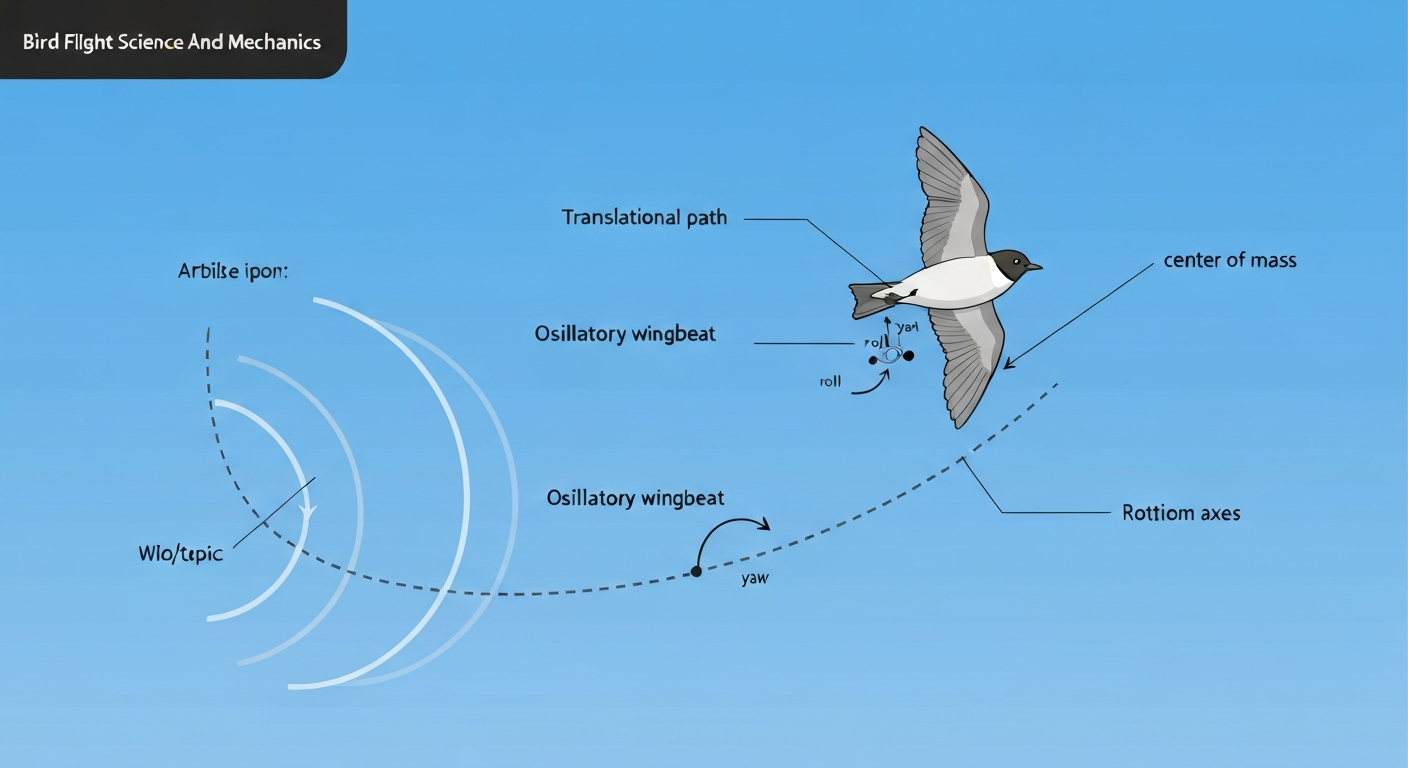
What Type of Motion Is a Bird Flying in the Sky?
Physics textbooks classify motion into a handful of clean categories, and bird flight sits at the intersection of at least three of them. Understanding which applies, and when, is the key to answering the question precisely.
- Translational motion: the bird's center of mass moves from one location to another, either in a straight line (rectilinear) or along a curved path (curvilinear). A pigeon crossing a park is a textbook example of curvilinear translation.
- Oscillatory (periodic) motion: a quantity repeats at regular intervals. Each wingbeat is a cycle: downstroke, upstroke, repeat. A cruising pigeon beats its wings roughly 6 to 9 times per second, generating an oscillating aerodynamic force on top of the net forward motion.
- Rotational motion: the bird spins around one or more axes. During a banked turn, a pigeon rolls around its long axis; during pitch-up to land, it rotates about its transverse axis. Kinematic studies of turning pigeons show that asymmetric wingbeats produce measurable aerodynamic torques that drive these rotations.
- Steady vs. accelerated: when cruise speed and altitude are constant, time-averaged acceleration of the center of mass is approximately zero — this is steady flight. Any climb, dive, speed change, or gust response makes the motion accelerated.
In everyday observation, the dominant and most visible component is translational: the bird crosses the sky. But the oscillatory wingbeat machinery is what makes that translation possible, and the rotational adjustments are what make it precise.
How We Classify Motions in Flight
It helps to nail down each category with a concrete definition before applying them to feathers and bones.
Translational motion
Translational motion means every point on the object moves the same distance in the same direction at the same time, the object does not rotate or deform as a whole. For a flying bird, we usually track the center of mass (roughly near the sternum) and treat the whole bird as a particle moving through space. That center of mass traces a path, straight, curved, climbing, descending, and that path is what most people see when they watch a bird fly.
Oscillatory motion
Oscillatory motion is periodic: something moves back and forth, or up and down, around an equilibrium position, repeating at a characteristic frequency. A wingbeat is the most obvious oscillation in bird flight. The wing sweeps down and forward on the downstroke, generating lift and thrust, then sweeps up and back on the upstroke. This cycle repeats dozens of times per second in a hummingbird, or a handful of times per second in a large eagle. The aerodynamic forces produced by that cycle are themselves oscillatory, meaning lift and drag fluctuate strongly within each beat even though their time average supports steady cruising flight.
Rotational motion
Rotational motion means the object (or part of it) turns about an axis. Birds rotate their entire body when they bank into a turn (roll), tilt the nose up or down to climb or descend (pitch), or swing the nose left or right (yaw). They also rotate individual wing segments continuously throughout each wingbeat, folding and spreading feathers to control force production. These rotations are not incidental; they are the steering system.
Forces and Kinematics Behind Bird Flight
Four forces govern every moment of a bird's flight, and their balance or imbalance determines whether the motion is steady or accelerated.
- Lift: an upward aerodynamic force generated primarily by the wings as they move through air. It acts perpendicular to the bird's velocity vector.
- Thrust: a forward force produced by the downstroke of the wings (and, in some birds, the tail). It overcomes drag and propels the bird forward.
- Drag: a rearward aerodynamic resistance force opposing motion through the air. It acts parallel and opposite to the velocity vector.
- Weight: the downward gravitational force acting through the bird's center of mass (mass × gravitational acceleration, approximately 9.81 m/s²).
In steady level flight, these forces cancel in pairs: average lift equals weight (L = W) and average thrust equals drag (T = D). The center of mass moves at constant velocity, so net acceleration is zero. When a bird climbs, lift exceeds weight momentarily; when it accelerates forward, thrust exceeds drag. The instantaneous velocity of the bird (speed and direction combined) is called its kinematic state, and changes in that state, described by acceleration vectors, tell us everything about whether the flight is steady or not.
Key Equations That Describe Bird Flight
You do not need a wind tunnel to think quantitatively about bird flight. A few standard equations capture the essentials.
Newton's second law applied to the center of mass
The foundation is F = ma (net force equals mass times acceleration). For a bird of mass m in flight, the net force in the vertical direction is (L - W) and in the horizontal direction is (T - D). When both of these equal zero, a = 0 and flight is steady. When they are nonzero, the bird accelerates in the corresponding direction. For steady cruise: L = W and T = D, so the center-of-mass acceleration ≈ 0.
The lift and drag equations
Lift and drag are computed with the same structural formula. Lift: L = ½ × ρ × CL × S × V². Drag: D = ½ × ρ × CD × S × V². Here, ρ is air density (at sea level under standard conditions, ρ ≈ 1.225 kg/m³), CL and CD are the dimensionless lift and drag coefficients that encode wing shape and angle, S is the wing planform area in square meters, and V is airspeed in meters per second. Doubling airspeed quadruples lift and drag, which explains why birds have an energetically optimal cruise speed rather than simply flying as fast as possible.
A simple force diagram for level flapping flight
Picture a bird viewed from the side. Weight (W) points straight down from the center of mass. Lift (L) points straight up, perpendicular to the flight path. Thrust (T) points forward along the flight path. Drag (D) points backward along the flight path. In steady level flight those four arrows are equal in opposite pairs and the bird neither climbs nor accelerates. Now picture the downstroke: L and T both spike upward and forward momentarily before averaging out across the full wingbeat cycle. That spike is the oscillatory component sitting on top of the translational trend.
A Taxonomy of Bird Flight Modes
Not all flying birds flap continuously, and the motion classification changes depending on which flight mode is active. Here is a practical breakdown.
Flapping flight
The most common powered flight mode: both wings beat continuously to generate lift and thrust. The motion is translational overall, with strong oscillatory force variation within each wingbeat cycle. Pigeons (Columba livia, wingbeat frequency roughly 6-9 Hz at cruise speeds of 10-18 m/s) and most songbirds are quintessential flappers.
Gliding
The bird holds its wings extended and descends gently through the air, converting potential energy (altitude) into kinetic energy and heat. No muscular power drives the wings; gravity is the engine. The motion is almost purely translational and closely approximates projectile motion when glide angles are steep. Raptors and large waterbirds glide frequently between flapping bouts.
Soaring
Soaring is gliding in rising air. Thermals (columns of warm air rising from heated ground) and orographic lift (updrafts deflected off ridges) allow birds to climb without flapping. A wandering albatross soaring over the Southern Ocean exploits wind-gradient soaring (dynamic soaring) rather than thermals, extracting energy from the vertical wind shear near the wave surface. The motion remains largely translational at the scale of the whole bird.
Hovering
In hovering, translational motion of the center of mass is near zero while the wings beat at very high frequency to support the bird's weight entirely through aerodynamic force. Hummingbirds are the specialists: Anna's hummingbird hovers at roughly 40-60 Hz, and some tiny woodstars have been recorded near 90-100 Hz in display contexts. The motion at the bird scale is nearly stationary (minimal translation) but maximally oscillatory.
Intermittent flight
Many small birds alternate brief flapping bursts with short non-flapping intervals. Two subtypes exist: flap-glide (wings spread during the pause, generating some lift, as in woodpeckers) and flap-bounding (wings folded tight against the body during the pause, so the bird follows a brief ballistic arc, as in finches and sparrows). Both patterns reduce the average cost of flight compared to continuous flapping at the same speed.
Gliding Motion Up Close: Trajectory, Glide Ratio, and Projectile Analogies
Gliding deserves its own section because it is the flight mode that most cleanly maps to physics concepts students already know. If you have watched a hawk tip its wings and slide silently across the sky without a single flap, you have seen gliding motion in its purest form.
The glide trajectory
A gliding bird descends along a straight or gently curved path at a glide angle determined by the ratio of drag to lift. Shallow glide angles (small drag relative to lift) mean the bird travels far horizontally for every meter it loses in altitude. Steep glide angles (high drag, low lift) mean it descends quickly and covers less horizontal ground, useful for a peregrine diving toward prey.
Glide ratio and the lift-to-drag ratio
The glide ratio is defined as horizontal distance traveled divided by altitude lost: glide ratio = Vhorizontal / Vsink. For steady gliding, this equals the aerodynamic lift-to-drag ratio (L/D). A bird with L/D = 10 travels 10 meters forward for every 1 meter it sinks. Published measurements reveal striking species differences: the wandering albatross (Diomedea exulans) achieves L/D values around 20, which is why it can glide thousands of kilometers over the Southern Ocean with minimal effort. Common kestrels top out near L/D ≈ 10.9 in field measurements, and the humble pigeon (Columba livia) manages only about L/D ≈ 6.
When gliding approximates projectile motion
A classic physics projectile moves under gravity alone after an initial launch, following a parabolic arc. A gliding bird is not quite a projectile because aerodynamic lift and drag act continuously alongside gravity. However, at steep glide angles or in a near-vertical dive (like a peregrine stooping), aerodynamic lift becomes small relative to weight and drag, and the trajectory increasingly resembles a ballistic arc. At shallow glide angles, the bird's path is far flatter than any purely ballistic trajectory, because lift is doing most of the work of supporting weight. The key conceptual point: gliding is accelerated translational motion (the bird is always accelerating slightly downward and forward under gravity, modified by aerodynamics), not projectile motion, though the two share structural similarities.
Energetics of gliding
Gliding costs almost no metabolic energy from the flight muscles; the bird is essentially converting gravitational potential energy into kinetic energy and heat via drag. This is why large soaring birds like vultures, eagles, and albatrosses have evolved high-aspect-ratio wings that maximize L/D: minimizing drag lets them glide farther and soar longer before needing to flap. When a bird glides across the sky without a wingbeat, it is a masterclass in energy conservation. See when the bird glides across the sky wuwa for further details on glide energetics and energy conservation. For more on this energy-saving behavior, see when the bird glides across the sky.
What to Watch For: Observational Cues and Simple Field Measurements
You do not need lab equipment to observe and roughly quantify bird flight motion. Here is what I watch for in the field, and how to translate those observations into the physics categories above.
Identifying flight mode by eye
- Wing position: fully extended and still means gliding or soaring; rapid up-down cycling means flapping; wings tucked tight against the body during a brief pause means flap-bounding.
- Body path: a smooth, gently descending straight line usually indicates gliding; a slightly undulating path with small altitude oscillations tied to wingbeat cycles indicates flapping flight; a perfectly level path at constant speed in still air indicates very efficient soaring.
- Tail use: a fanned, spread tail usually signals slow flight, maneuvering, or landing; a folded tail in fast forward flight reduces drag.
- Head stability: many birds keep their head remarkably steady in space even while the body bobs slightly with each wingbeat — this compensatory head stabilization is a beautiful example of the bird decoupling its sensory platform from its locomotor oscillations.
Timing wingbeats
With a stopwatch or phone, count the number of complete wingbeat cycles (one full down-up stroke) in 10 seconds, then divide by 10 to get wingbeat frequency in Hz. For most songbirds this will land between 10 and 25 Hz; for pigeons and doves, closer to 6-9 Hz; for large raptors and herons, 2-4 Hz. If the bird is small and fast, counting is difficult by eye, high-speed video at 100-1000 frames per second is the standard research tool for precise kinematic measurement, processed with digitizing software to extract three-dimensional wingbeat trajectories.
Estimating speed and acceleration
In the field you can estimate ground speed by timing a bird crossing a known landmark distance. If the bird takes 3 seconds to cross a 30-meter gap (say, between two trees), that is roughly 10 m/s (about 36 km/h). Acceleration is harder to observe directly, but you can detect it: a bird that visibly gains altitude without flapping is extracting energy from rising air (soaring, not accelerating under its own power). A bird that surges forward suddenly and then resumes a steady path has produced a brief accelerated phase, identifiable as a change in the spacing of wingbeat auditory cues or a visible speed increase. In biologging research, body-worn accelerometers that measure VeDBA (vectorial dynamic body acceleration) can classify flapping versus non-flapping periods automatically, with thresholds around VeDBA ≥ 0. For example, one seabird study used a VeDBA threshold (VeDBA ≥ ~0.4 g after smoothing) to classify flapping versus non‑flapping, illustrating how blank" rel="noopener noreferrer">Latitudinal gradients in air density create invisible topography at sea level, affecting animal flight costs (ScienceDirect article using VeDBA thresholding). blank" rel="noopener noreferrer">Ecological inference using data from accelerometers needs careful protocols (Methods in Ecology and Evolution) documents operational definitions where 'steady' flapping is selected as continuous flapping segments of about 2 s (≈10 wingbeat cycles for many birds), and researchers treat the mean acceleration over that window as approximately zero. 4 g used in seabird studies to distinguish the two modes.
Field-note language
When writing field notes, be specific about what you observed rather than inferring physics you did not measure. Good examples: 'Bird flew level with continuous flapping at approximately 8-10 wingbeats per second' or 'Bird glided on extended wings in a smooth descending arc for roughly 4 seconds without a wingbeat.' Avoid 'the bird soared' unless you have evidence the bird was gaining or maintaining altitude without flapping in rising air, many birders use 'soared' to mean glided, but the two are physically distinct.
Comparing Motion Types Across Flight Modes and Species
The table below summarizes how motion classification, dominant forces, representative species, and observable cues map onto the main flight modes. Use it as a quick reference for connecting what you see in the sky to the physics underneath.
| Flight Mode | Primary Motion Type | Main Forces Active | Steady or Accelerated? | Representative Species | Key Observable Cue |
|---|---|---|---|---|---|
| Continuous flapping | Translational + oscillatory | Lift, thrust, drag, weight (all four) | Steady (cruise) or accelerated (climb/surge) | Pigeon (Columba livia), common swift | Rapid, continuous wingbeat; slight body bob |
| Gliding | Translational (curvilinear descent) | Lift and weight dominant; drag decelerates | Accelerated (slow deceleration under drag) | Red-tailed hawk, pelican | Wings extended, no flapping; smooth descending path |
| Soaring (thermal/orographic) | Translational (helical climb or level cruise) | Lift > weight; drag < thrust from rising air | Near-steady (altitude maintained or gained) | Turkey vulture, golden eagle | Wide circling on spread wings; altitude gain without flapping |
| Dynamic soaring | Translational (undulating arcs) | Lift, drag; wind gradient energy extraction | Alternating accelerated phases | Wandering albatross (L/D ≈ 20) | Repeated low-altitude arcs, rarely flaps over ocean |
| Hovering | Near-zero translation + high oscillation | Lift ≈ weight; thrust ≈ drag ≈ 0 (no forward motion) | Steady (stationary) | Anna's hummingbird (~40–60 Hz) | Stationary position; audible wing hum; rapid wingbeat |
| Flap-glide (intermittent) | Translational + alternating oscillatory | Alternating: all four forces, then lift/weight/drag | Alternating steady and accelerated phases | Woodpecker, kestrel | Short flap bursts; brief wing-spread glide pauses |
| Flap-bounding (intermittent) | Translational + ballistic arc phases | Alternating: all four, then weight + drag only | Alternating steady and accelerated (ballistic arc) | Finches, sparrows | Short flap bursts; wings tucked; undulating path |
A Note on Language: Phrasing, Grammar, and Translations
The search phrase 'a bird flying in the sky is which motion' is a direct physics question, but related phrasings come up often in language-learning and educational contexts. For a straightforward phrasing, see the related entry 'a bird is flying in the sky'. The sentence 'a bird is flying in the sky' is grammatically correct English: it uses the present continuous tense (subject + is/are + verb-ing) to describe an action happening right now. It is entirely natural in conversation and writing. You might also say 'a bird flies through the sky' (simple present, describing habitual or general action) or 'a bird soars across the sky' for a more vivid alternative, depending on whether you mean a specific moment or a general statement. Search 'the bird is flying in French' for the common translation l'oiseau vole dans le ciel.
For language learners, related phrases translate as follows. In French, 'the bird is flying in the sky' becomes 'l'oiseau vole dans le ciel' (using the present tense 'vole,' since French does not have a true present continuous). In Spanish, 'that bird is learning to fly' becomes 'ese pájaro está aprendiendo a volar,' using the present progressive with 'estar' and the gerund 'aprendiendo.' These translation nuances connect directly to the sibling topics on this site, which explore how different languages express flight in progress, a reminder that the mechanics of flight and the language we use to describe it are both worth understanding precisely.
FAQ
What is the direct answer to “A bird flying in the sky is which motion?”
A bird in flight is primarily translational motion of its centre of mass (forward and/or vertical displacement) combined with superposed oscillatory motion from periodic wingbeats. It can also include rotational motions (pitch, roll, yaw) during maneuvers. In steady cruise the time‑averaged forces make the net centre‑of‑mass acceleration ≈ 0; during takeoff, landing, turns or gusts the bird shows accelerated translation and rotations.
How do biomechanics and forces produce bird flight?
Four aerodynamic/mechanical forces govern bird flight: lift (L), weight (W), thrust (T) and drag (D). Instantaneously L and T come from wing kinematics; W is gravity and D resists motion. In steady level flight the time‑averaged balance is L ≈ W and T ≈ D. The standard lift equation is L = ½ ρ CL S V² (and similarly D = ½ ρ CD S V²), where ρ is air density, CL/CD are coefficients, S is wing area and V is airspeed. Wingbeat cycles cause fast oscillations in instantaneous L, T and D, producing periodic body accelerations around the mean translation.
How do we classify bird flight motions (translational, oscillatory, rotational; steady/accelerated)?
- Translational: net movement of centre of mass (forward, climbing, descending). - Oscillatory: periodic wingbeat forcing that produces cyclic variations in aerodynamic forces and small body oscillations. - Rotational: changes in body attitude (pitch, roll, yaw) used in turning and stability control. - Steady (cruise): time‑averaged acceleration ≈ 0 over several wingbeats (L ≈ W, T ≈ D). - Accelerated: any sustained dV/dt ≠ 0 (takeoff, climb, dash, braking, gust response). A real flight typically includes combinations of these types.
What are the main flight modes and examples of species that use them?
- Flapping flight: continuous wingbeats generating lift and thrust (pigeons, swifts, many passerines). - Gliding: wings held extended, no flapping, trading altitude for forward distance (pigeons, gulls between flaps). - Soaring: using vertical/upward air currents (thermal or dynamic) to gain or maintain altitude with little flapping (vultures, albatrosses, condors). - Hovering: staying nearly stationary relative to air by rapid wingbeats (hummingbirds, some kites in windhovering). - Intermittent flight: alternating flaps and glides or bounding (woodpeckers, some small passerines, many ducks). Examples: wandering albatross — efficient dynamic soaring; kestrel — hovering/hanging; pigeon — flapping with occasional glides; hummingbird — sustained hovering.
What is special about gliding motion and when does it approximate projectile motion?
Gliding is steady flight without wingbeats where the bird descends at a sink speed while moving forward; for steady glides the glide ratio (horizontal distance / vertical drop) equals the aerodynamic L/D. Glide behavior is governed by the glide polar (sink speed vs airspeed). A glide approximates projectile motion only when aerodynamic forces become negligible relative to gravity — which is not the case for real birds. Instead, a steady glide is an aerodynamic equilibrium where lift and drag determine trajectory; only in an extreme, unrealistic limit (no lift/drag) would the COM follow a pure ballistic parabola.
What is the glide ratio (L/D) and typical values for species?
Glide ratio equals L/D (horizontal distance per unit altitude lost). Representative values: wandering albatross L/D ≈ 20 (very efficient); kestrel L/D ≈ 10–11; pigeon L/D_max ≈ 6. These values vary with wing posture, speed and wind. Higher L/D means farther horizontal travel for each meter of altitude lost.
Next Articles
A Bird Flying in the Sky: How to Read Its Flight Fast
Spot a bird flying in the sky fast with cues for flight style, lift, wind, thermals, and safe next steps.
When the Bird Glides Across the Sky Wuwa Explained
Disambiguate wuwa and explain bird gliding mechanics, why birds glide, and how to spot glides vs soar or flap.
A Bird Is Flying in the Sky: Is It Correct English?
Check if “A bird is flying in the sky” is correct and learn natural alternatives for generic vs specific birds.