When you look up and see a bird flying in the sky, you're watching one of the most finely tuned physical systems in the natural world. If you want to practice the topic in another language, you can learn how to say “the bird is flying” in French and use it in a sentence bird flight in French. Whether it's flapping steadily, circling without a wingbeat, or cutting across the horizon, every detail of that flight tells you something real: what kind of bird it probably is, what it's doing right now, and why it chose that exact patch of sky. This guide walks you through how to read what you're seeing, from the basic biomechanics to the environmental conditions shaping that bird's path today.
A Bird Flying in the Sky: How to Read Its Flight Fast

Marcus Chen
7 Jun 2026
What kind of question are you actually asking?
People search for "a bird is flying in the sky" for very different reasons. Some are trying to understand the mechanics of bird flight. Some spotted something unusual and want to identify it. Some are curious why a bird is circling overhead, or why one seems to be struggling. And occasionally, someone found a bird on the ground that can't seem to get airborne and wants to know what to do. This article covers all of those angles. If your situation is the last one (a bird that should be flying but isn't), skip ahead to the intervention section at the end.
It's also worth noting that phrases like "the bird is flying above the sky," "over the sky," or "in the sky" all describe the same scene. The preposition shifts the poetry a little but doesn't change what's happening physically. If you've come from a related question about gliding specifically, the mechanics of gliding versus powered flight are both covered below.
What's actually happening up there: flight mechanics in plain terms
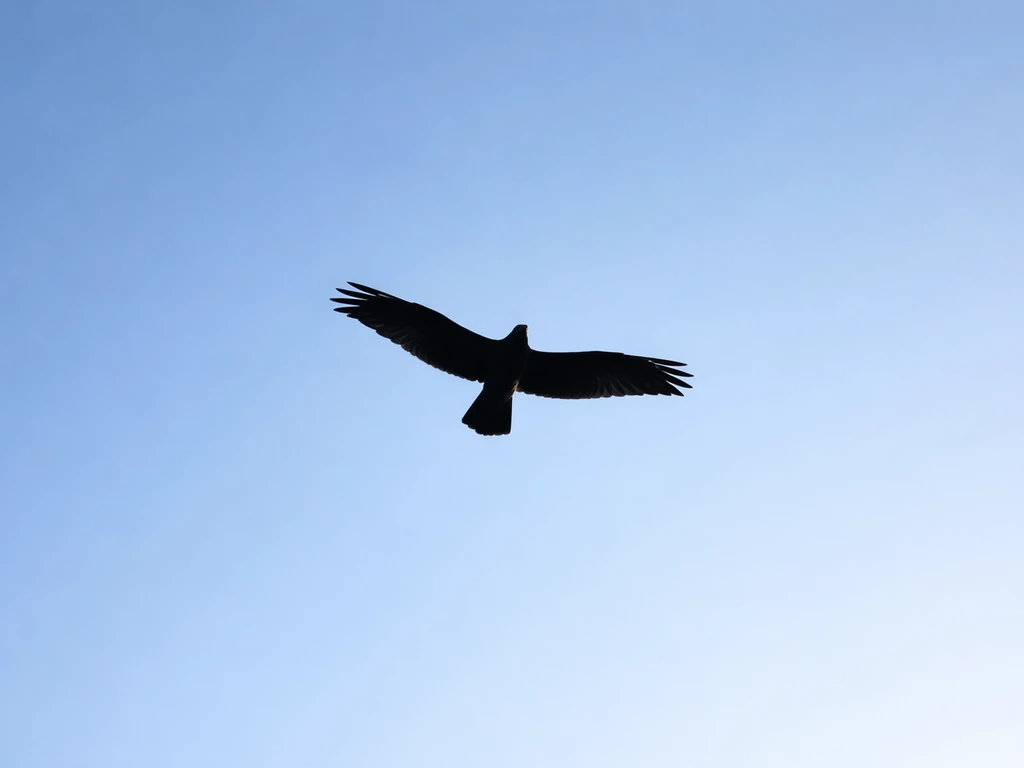
Bird flight comes down to four forces: lift, drag, thrust, and gravity. The wing generates lift by pushing air downward as it moves forward, creating lower pressure above the wing and higher pressure below. That pressure difference is what keeps a 10-pound bird off the ground. Drag is the resistance the bird fights moving through air. Thrust is what moves it forward. Gravity, of course, pulls it down.
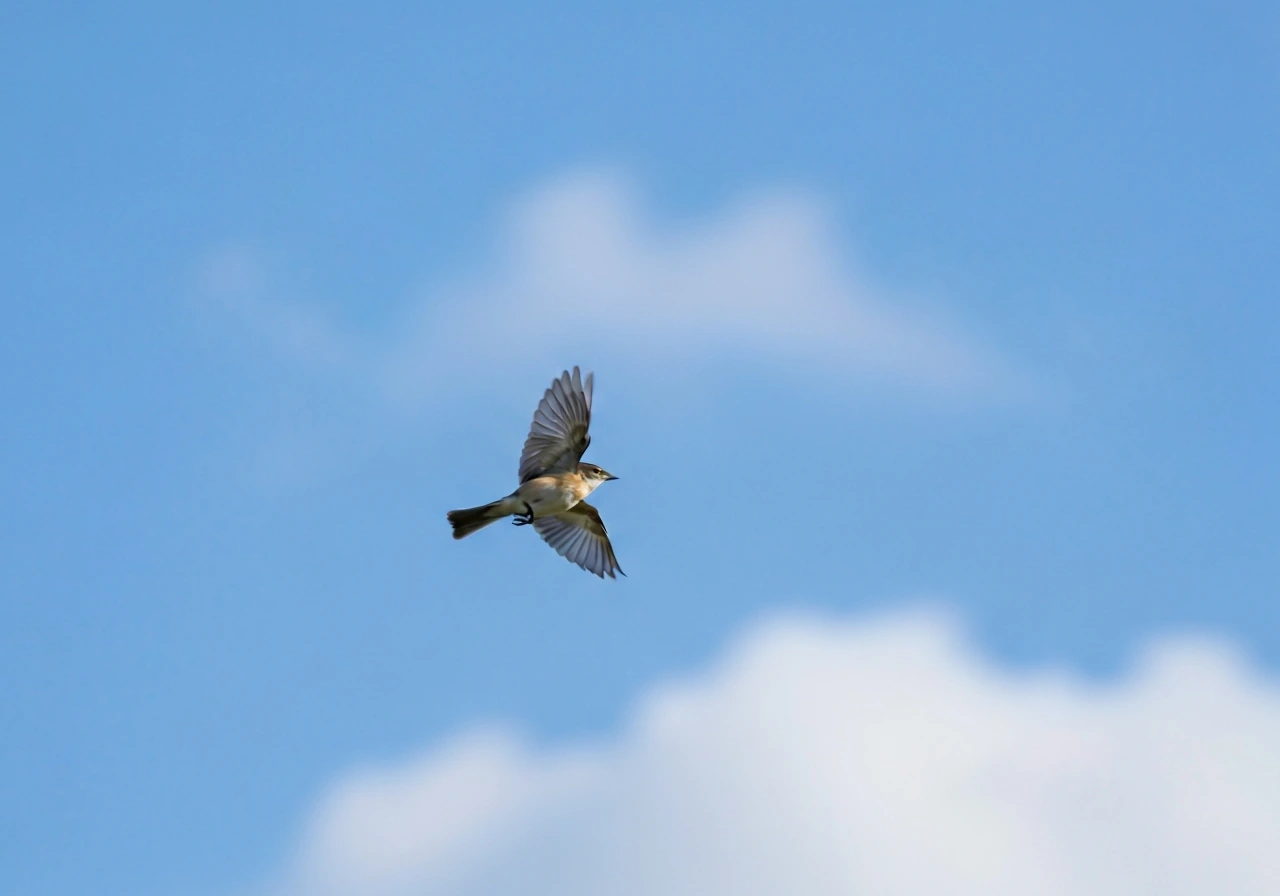
During flapping flight, the wings don't just push down. They rotate forward slightly on the downstroke, which tilts the lift force forward and transforms it into thrust. That's the clever part: the same motion that keeps the bird aloft also drives it forward. On the upstroke, the wing partially folds so it cuts through the air with less resistance. The result is a continuous, efficient cycle that you can see as a rhythmic, fluid wingbeat.
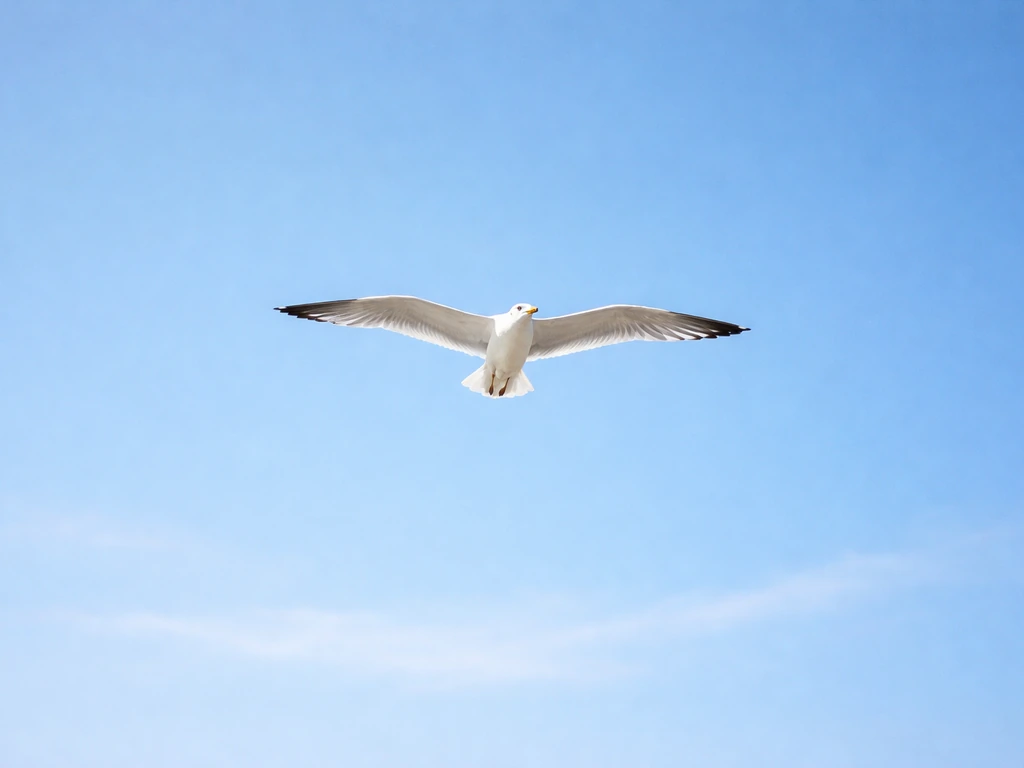
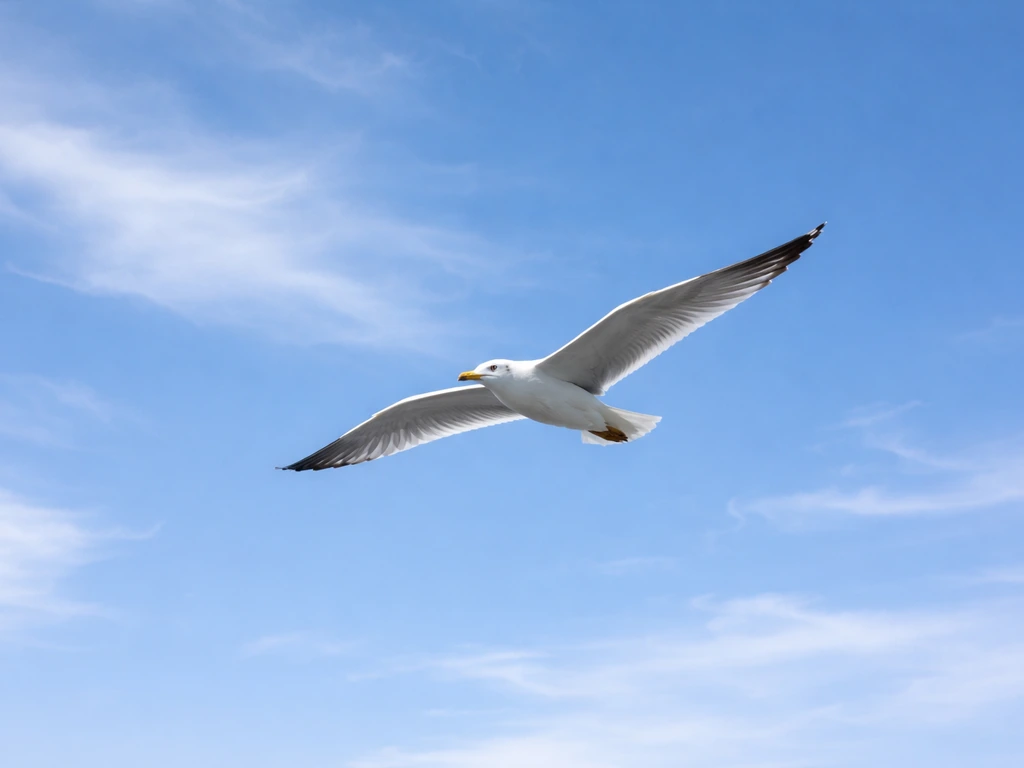
Gliding is the unpowered version. If you notice when the bird glides across the sky, it is using unpowered lift and drag to travel while slowly losing altitude gliding. The bird extends its wings and lets gravity do the work of moving it forward, accepting a gradual loss of altitude in exchange for zero energy expenditure. Soaring is gliding's clever cousin: the bird finds rising air and lets the upward current replace the altitude it would otherwise lose. No flapping required, and the bird can actually gain height. If you’re wondering about what it looks like when the bird glides across the sky, the unpowered flight section explains how gliding works and why it can cover distance. This is what hawks and vultures are doing when they circle seemingly effortlessly. The circle isn't random; it keeps the bird inside the rising column of warm air called a thermal.
Wing shape tells the story
Wing shape is one of the most important factors in how a bird flies. Two key measurements matter here: aspect ratio (the ratio of wingspan to wing width) and wing loading (the bird's weight divided by its wing area). Birds with long, narrow wings and low wing loading, like albatrosses or frigatebirds, are built for sustained soaring on rising air. Short, broad wings suit birds that need to maneuver quickly through trees. Songbirds have general-purpose wings that work well for frequent flapping and short bursts of flight, but they'd be terrible gliders. When you see a bird overhead, wing shape alone gives you a strong first guess at what it is and how it prefers to fly.
How to identify the bird from its flight
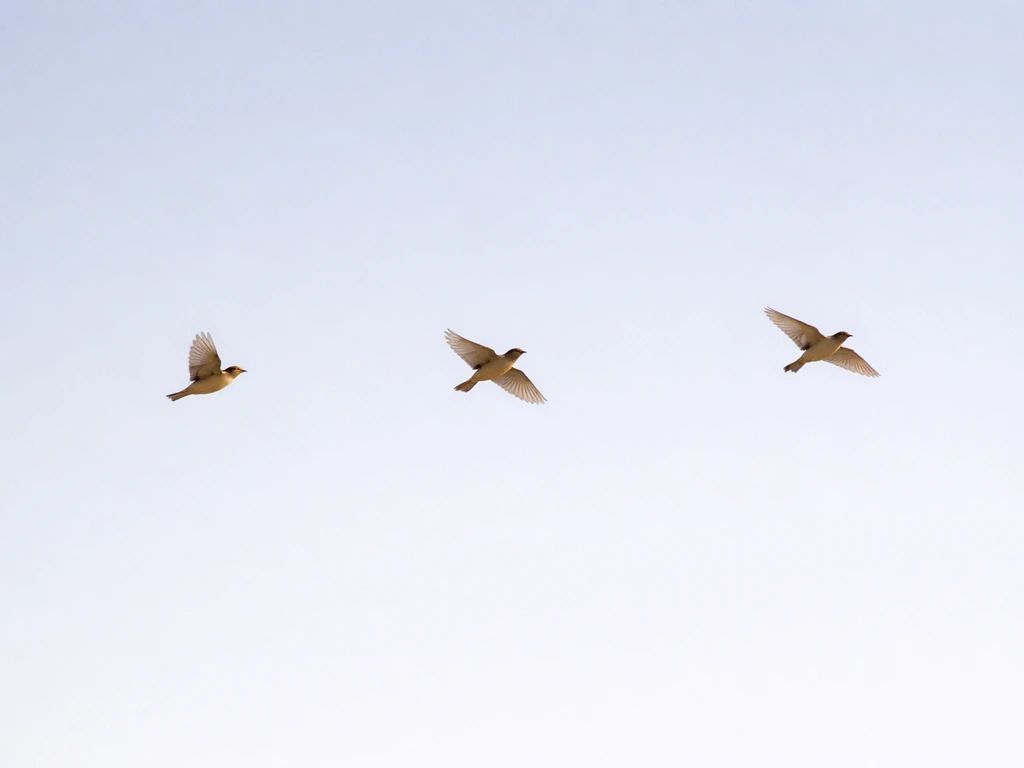
Flight pattern is one of the best identification tools available, especially when a bird is far away and field marks are hard to see. Here's what to look for:
- Wingbeat rhythm: Is it fast and buzzy, slow and deliberate, or does the bird flap in bursts and then tuck its wings into a brief glide? American Crows flap slowly and methodically. Common Ravens mix flapping with effortless gliding stretches. Woodpeckers flap-flap-flap then fold into a pronounced dip.
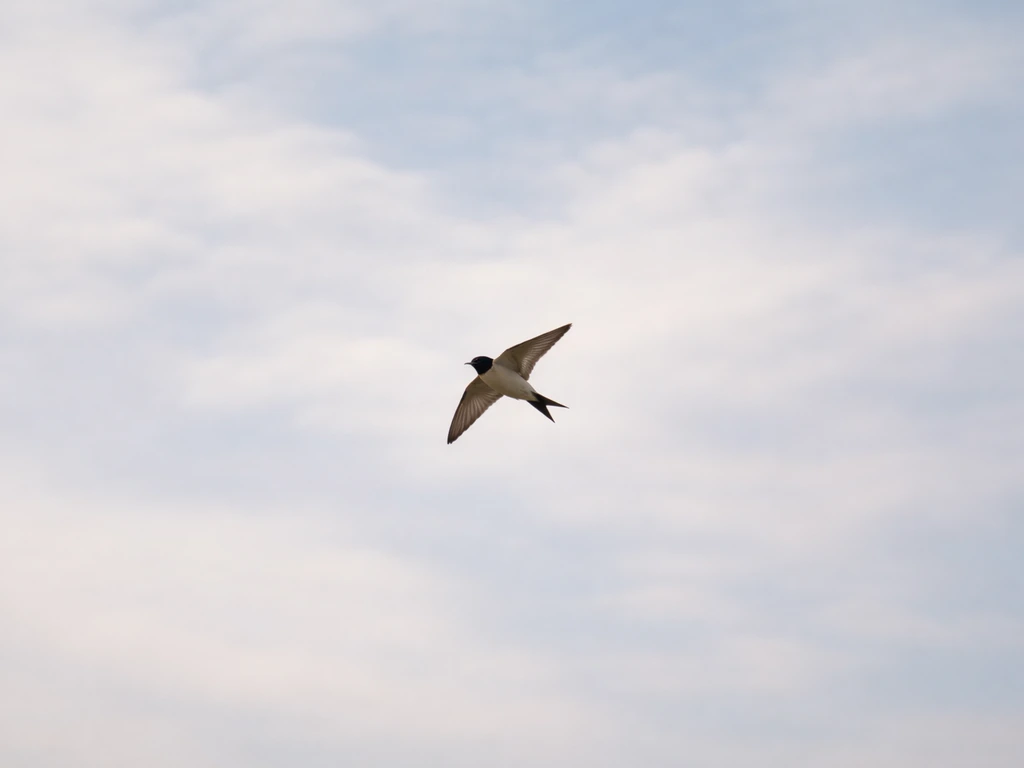
- Wing shape in the air: Long and narrow suggests a soaring or dynamic-soaring specialist. Short and rounded suggests a woodland bird built for agility. Swept back like a crescent moon suggests a swift.
- Body silhouette: Tail shape matters too. A forked tail usually means a swallow or kite. A fan-shaped tail often means a hawk. A long, square tail could be a crow or raven.
- Behavior in the sky: Is it circling tightly? Probably in a thermal. Diving and rising repeatedly? Could be a displaying raptor or a swift hunting insects. Hovering in one spot? Almost certainly a kestrel or osprey scanning for prey below.
- Color and contrast: Swifts appear dark, almost black against the sky, with longer wings and a tiny pale throat patch. Swallows and martins look similar at a glance but tend to have broader wings relative to body size and more colorful undersides.
A useful field tip from experienced birders: locate the bird with your naked eye first, then raise your binoculars to the exact spot without looking away. Scanning with binoculars across a wide sky wastes time and you'll lose the bird. Lock your eyes on it, lift the glass, and it'll be right there.
| Flight style | What you see | Likely bird types |
|---|---|---|
| Sustained soaring/circling | Wide circles, no flapping, slow altitude gain | Vultures, buteo hawks, eagles, storks |
| Dynamic soaring | Long glides, occasional dips toward the surface, minimal flapping | Albatrosses, shearwaters, large gulls |
| Flap-glide alternating | Bursts of flapping followed by wings-folded glide | Woodpeckers, finches, some sparrows |
| Continuous fast flapping | Rapid wingbeats, direct flight path, rarely glides | Ducks, geese, pigeons, doves |
| Hovering | Stationary in the air, rapid wingbeats, head locked on target | Kestrels, ospreys, kingfishers |
| Erratic, high-speed darting | Tight turns, sudden changes in direction, crescent-shaped wings | Swifts, swallows, nighthawks (insect hunting) |
Why that bird is flying where it is right now
Birds don't pick a random altitude or patch of sky. Every flight decision is shaped by physics, energy, and purpose. A raptor circling at 300 feet is almost certainly riding a thermal while scanning below for prey. A swift at 500 feet is chasing aerial insects that have been lofted there by the same warm air. A gull cruising low over a shoreline is using the consistent updraft created by wind striking a cliff or dune. Understanding these choices makes bird behavior suddenly legible.
Thermals are rising columns of warm air that form when the sun heats the ground unevenly. Darker surfaces, open fields, and parking lots heat faster and generate stronger thermals than forests or water. Birds that rely on thermal soaring, including most large hawks, eagles, and vultures, will concentrate over these heat sources and spiral upward inside the rising air. Once they've gained altitude, they glide toward the next thermal and repeat the cycle. You'll often see multiple raptors circling together (called a kettle) over a productive thermal.
Altitude also provides a strategic advantage. Higher means a wider field of view, which matters for hunting birds. It also means more potential energy: a bird at height can convert altitude into speed instantly by diving, something falcons exploit dramatically when stooping on prey.
What's shaping flight behavior today specifically
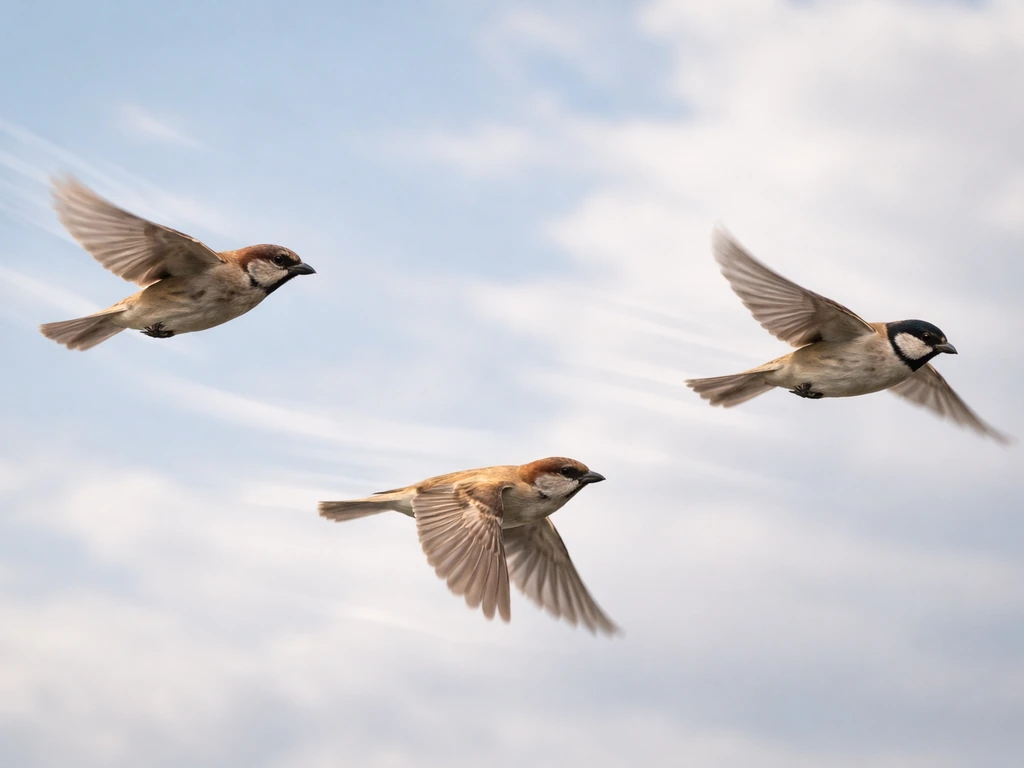
The conditions right now, on any given day, have a direct effect on how and where birds fly. Here's what to factor in when interpreting what you're seeing:
Wind
Wind changes everything. A headwind requires more energy but allows slower, more controlled flight. A tailwind lets birds cover ground cheaply and fast. Crosswinds complicate navigation. Birds like gulls can actively morph their wing shape by adjusting their elbow and wrist joints mid-flight to stabilize themselves across changing conditions, essentially fine-tuning their aerodynamics on the fly. Strong winds also create reliable updrafts along ridgelines and coastlines that soaring birds exploit without needing thermals at all.
Time of day
Thermals don't exist in the morning. The sun needs a few hours to heat the ground enough to generate meaningful updrafts, which is why you rarely see large soaring birds in early morning. By mid-morning to midday, thermals are developing. Peak soaring activity for raptors and vultures typically runs from late morning through early afternoon. Swifts and swallows start hunting insects as soon as the air warms enough to loft them, often from mid-morning through evening. At dusk, aerial insect hunters like nighthawks and nightjars take over.
Weather
Before a storm, barometric pressure drops and insects fly lower, which brings insect-hunting birds lower too. After a storm, clear skies and rapidly heating ground produce excellent thermals. Cold, overcast days suppress soaring activity significantly because thermals don't form without solar heating. On those days, you'll see far fewer large birds in the sky and more activity close to cover. Rain generally grounds most aerial activity for smaller birds, though some larger species fly through light rain without much trouble.
Season and migration
In early June, spring migration is wrapping up in the Northern Hemisphere, but many species are actively nesting and making frequent short flights for food and territory defense. You may also see fledglings taking their first uncertain flights, which can look labored or erratic. If you're watching what appears to be a young bird with a short tail and rough, unsteady flight close to vegetation, that's almost certainly a fledgling, not an injured adult.
Watching safely without disturbing the bird
Most bird flight watching doesn't require any intervention at all. The best approach is to observe from a comfortable distance using binoculars or a long camera lens rather than moving closer. Birds in flight are generally not stressed by observers who stay still and quiet, but a group of people moving toward a perched or nesting bird can absolutely disturb it. Keep your group small, move slowly and quietly, and let the bird come to you if possible.
Using a natural screen like a hedgerow, tree line, or purpose-built hide (a blind) lets you get much closer views without the bird registering your presence. This is especially worth doing near nesting sites, where repeated disturbance can cause birds to abandon eggs or chicks. Major wildlife organizations consistently advise using zoom rather than proximity, keeping observation time reasonable, and leaving before the bird shows signs of stress like alarm calling, repeated flushing, or abandoning food it was eating.
If the bird can't fly: what to do right now
Sometimes "a bird in the sky" is actually a bird that should be in the sky but isn't. If you've found a bird on the ground that appears injured, grounded, or unable to fly, here's the practical sequence to follow:
- First, assess the situation. Is it actually injured, or is it a fledgling? Fledglings have short tails, fluffy patches of down mixed with feathers, and often hop around on the ground for days while parents continue feeding them. If you see a parent nearby, leave the bird alone. It does not need your help.
- If the bird is clearly injured (bleeding, a wing hanging at a wrong angle, unable to stand), get it off the ground. The priority is containment and warmth. Place it gently into a cardboard box or shoebox lined with a cloth or paper towel. Do not use a wire cage where it can damage its wings.
- Cover the box and keep it in a warm, dark, quiet place. Darkness reduces stress significantly. Do not offer food or water, and do not attempt to treat the injury yourself.
- Contact a licensed wildlife rehabilitator as soon as possible. Your local wildlife agency, a nature center, or a web search for wildlife rehabilitators in your area will get you there. If you can't find one immediately, a local veterinarian is a reasonable fallback, though call ahead because not all clinics can isolate wild birds safely.
- Keep the bird contained and calm until you can hand it off. Minimize handling. The goal is to reduce stress and prevent further injury, not to nurse it back to health yourself.
One specific scenario worth flagging: if a bird flew into a window and is sitting stunned on the ground but appears otherwise uninjured, give it up to an hour in a quiet, safe container. Many window-strike birds recover fully and fly away on their own. If it hasn't recovered after an hour, treat it as injured and contact a rehabilitator.
What you're watching when a bird flies overhead is millions of years of evolutionary engineering expressed in a few seconds of effortless motion. The more you know about the mechanics, the more there is to see. A soaring hawk isn't just a pretty silhouette; it's a precision glider solving a thermodynamics problem in real time. Once you start reading flight the way experienced birders do, every bird in the sky tells you a story. If you want to talk about bird flight in Spanish, you can say that bird is learning to fly in Spanish.
FAQ
If I see a bird moving without flapping, how can I tell whether it’s gliding or soaring?
Not automatically. If you see a slow, steady glide with very few or no wingbeats but the bird keeps losing height, it is likely gliding. If it briefly gains height or stays level while circling, it is more likely using rising air (soaring/thermal riding).
Why does the bird keep circling, and is it always hunting?
Yes, look at direction relative to the sun and the wind. Birds often head into or across wind to make flying easier or to stay inside a moving updraft, so a pattern that seems “random” can actually be energy-smart. If you notice repeated turns toward the same area, that often points to a thermal or consistent updraft feature.
What’s the best way to track the bird when it’s moving fast across the sky?
Try a “step and stop” scan. Stay still until you can confirm the bird’s wingbeat rate, shape, and whether it’s banking. Then move minimally to keep it in view, because big, continuous motion can cause you to lose the bird and can also draw attention nearby.
When I can’t see field marks clearly, what flight features should I rely on first for identification?
Binoculars are great for flight details, but there is a limit to what you can reliably identify at distance. Wingbeat rhythm (flapping frequency), wing shape, and tail look are more useful than color when far away. For fine color or markings, you usually need a closer view or a later moment when it perches.
How can I tell the difference between a fledgling practicing and an injured bird?
It’s possible, especially with juveniles. If the bird is in a safe-looking area and repeatedly changes posture or direction but cannot sustain normal flight, it may be a fledgling practicing. If you see obvious bleeding, a wing that hangs, or repeated inability to lift off after getting a clear attempt, treat it as injured and contact a rehabilitator sooner.
What if I’m watching on a gloomy day and see fewer birds, does that mean something is wrong with them?
Yes, conditions can make “not flying” look like “something is wrong.” Cold overcast skies and heavy rain often suppress soaring and reduce aerial activity, so fewer birds in the air does not always indicate a problem for an individual bird.
My bird hit a window and looks stunned, do I wait or try to help it right away?
Window strikes are time-sensitive. Even if it seems okay, don’t release immediately into traffic or tall vegetation. Use a quiet, dim, secure container for up to an hour, and only consider release if it seems alert and can reposition and breathe normally without obvious staggering.
If thermals should be forming, why does the bird still soar near hills or the shoreline on some days?
Sometimes the bird is using updrafts from terrain and can be higher than it appears. If it’s along coastlines, ridgelines, or near buildings that channel wind, it may rely on slope and wind-driven lift rather than sun-heated thermals.
How can I tell whether the bird is actively compensating for wind versus just riding a thermal?
Yes. Some species can adjust stability with subtle wing and body changes (for example, modifying wing angle through joints) in shifting winds. If you notice quick micro-corrections while maintaining altitude or line, that often indicates aerodynamic trimming rather than random wandering.