Flying like a bird means feeling constant, subtle pressure across every feather, a low-frequency vibration through the chest as the pectoralis muscles fire on each downstroke, wide-field visual motion streaming past the eyes, and a finely tuned sense of balance adjusting to every gust in real time. There is no simple word for it because birds experience flight through at least four overlapping sensory systems at once: aerodynamic pressure on their feathers, vestibular signals from their inner ear, optic-flow information flooding their wide-angled eyes, and proprioceptive feedback from the muscles and joints driving each wingbeat. Humans reach for metaphors of freedom and weightlessness because we only ever feel the outside of flight; birds feel it from the inside.
How Does It Feel to Fly Like a Bird? A Practical Guide

What the phrase actually means: literal vs. metaphorical
The phrase "fly like a bird" carries two very different meanings depending on context, and the difference matters if you want a real answer. In everyday English it is a well-established idiom. Dictionaries list "as free as a bird" as a fixed expression meaning simply "very free," and the idea of bird-flight as a symbol of liberation, escape, or elation runs through poetry, song lyrics, and film from ancient mythology to modern pop. That metaphorical use is culturally rich and worth exploring on its own terms. Songs lean into the lyric image, dance routines translate the idea into choreography, and the phrase turns up in everything from spiritual hymns to hip-hop. But underneath the metaphor is a literal, measurable, physiological reality: a bird in flight is a small body managing four aerodynamic forces, firing major muscle groups at astonishing rates, and processing a flood of sensory information to stay airborne. Both meanings are real; this article works through both, starting with the biomechanics and building toward what it genuinely feels like to be the animal doing it.
How birds fly: a quick overview
Every flying bird manages the same four forces: lift (upward), weight (downward), thrust (forward), and drag (backward). The wings generate both lift and thrust simultaneously through a cambered aerofoil shape and the angular stroke of each wingbeat. What makes avian flight extraordinary compared with a fixed-wing aircraft is that the wings are simultaneously the engine, the propeller, and the control surfaces. The pectoralis muscle, the largest muscle in most birds and often 15 to 25 percent of total body mass, drives the power stroke downward. The supracoracoideus muscle, running through a pulley-like arrangement over the shoulder, pulls the wing back up for recovery. Tail feathers act as a variable flap, adjusting pitch and yaw. Across roughly 10,000 living bird species, the same core system has been tuned by evolution into radically different configurations: hummingbirds hover on wings beating up to 50 to 80 times per second; albatrosses glide thousands of kilometers with barely a wingbeat. Wing aspect ratio (wingspan squared divided by wing area) and wing loading (body weight divided by wing area) are the two key numbers that predict which strategy a species uses.
Takeoff: the first push into the air
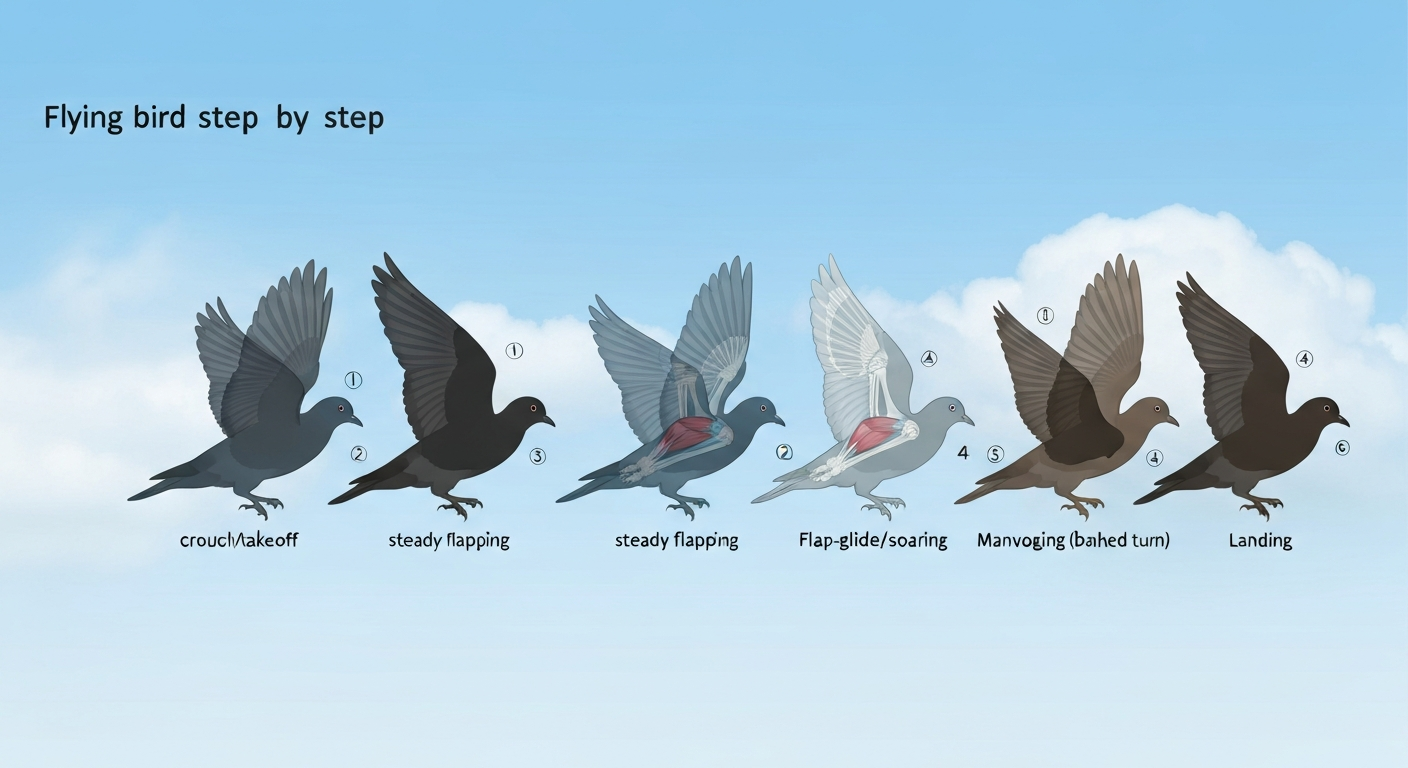
For most birds, takeoff is the most energetically expensive moment of any flight. The bird cannot yet rely on forward speed to generate aerodynamic lift, so it has to generate both thrust and enough lift to overcome gravity almost instantaneously. The sequence is well-documented: the bird crouches, then delivers a powerful leg push that launches the body upward and forward, and this is immediately followed by a large downstroke from the pectoralis. In many species the hindlimbs provide a substantial fraction of the initial kinetic energy, which reduces the aerodynamic power demand on the wings in that first critical beat. Hummingbirds are an interesting exception: their legs are short and weak, so nearly all takeoff energy comes from the wings alone. The sensory experience at this moment would be a sudden surge of whole-body acceleration, a spike in pressure across the wing feathers as they bite into still air, and a rapid shift in the visual field as the ground drops away. From a physiological standpoint, the bird's vestibular system (the biological equivalent of an aircraft's inertial platform) is registering that surge in all three axes simultaneously.
Flapping flight: thrust, lift, and the rhythm of the wingbeat
Once airborne, most birds enter powered flapping flight. The wingbeat cycle has two phases: a downstroke that generates most of the lift and thrust, and an upstroke that is either a passive recovery or, in faster birds, an active secondary stroke. Wingbeat frequency scales strongly with body size. Small hummingbirds beat their wings at 50 to 80 Hz during hovering; typical passerines (sparrows, starlings) cruise at roughly 8 to 20 wingbeats per second; large birds like herons and swans flap more slowly, sometimes under 3 Hz. Mass-specific mechanical power during extreme performance in hummingbirds has been measured at approximately 22 to 38 W per kilogram of body mass in load-lifting and hypoxic-condition experiments, which is a remarkably high power output for any animal. The felt experience of flapping flight is dominated by that cyclic rhythm: a steady pulse of force through the chest and shoulder on each downstroke, the constant pressure differential across the wing surfaces, and a slight lateral rocking as each side alternates. Birds also use intermittent flapping strategies, alternating bursts of flapping with brief glides or body-folded bounds, which reduces the average power cost significantly during cruising.
Gliding and soaring: how birds fly for free
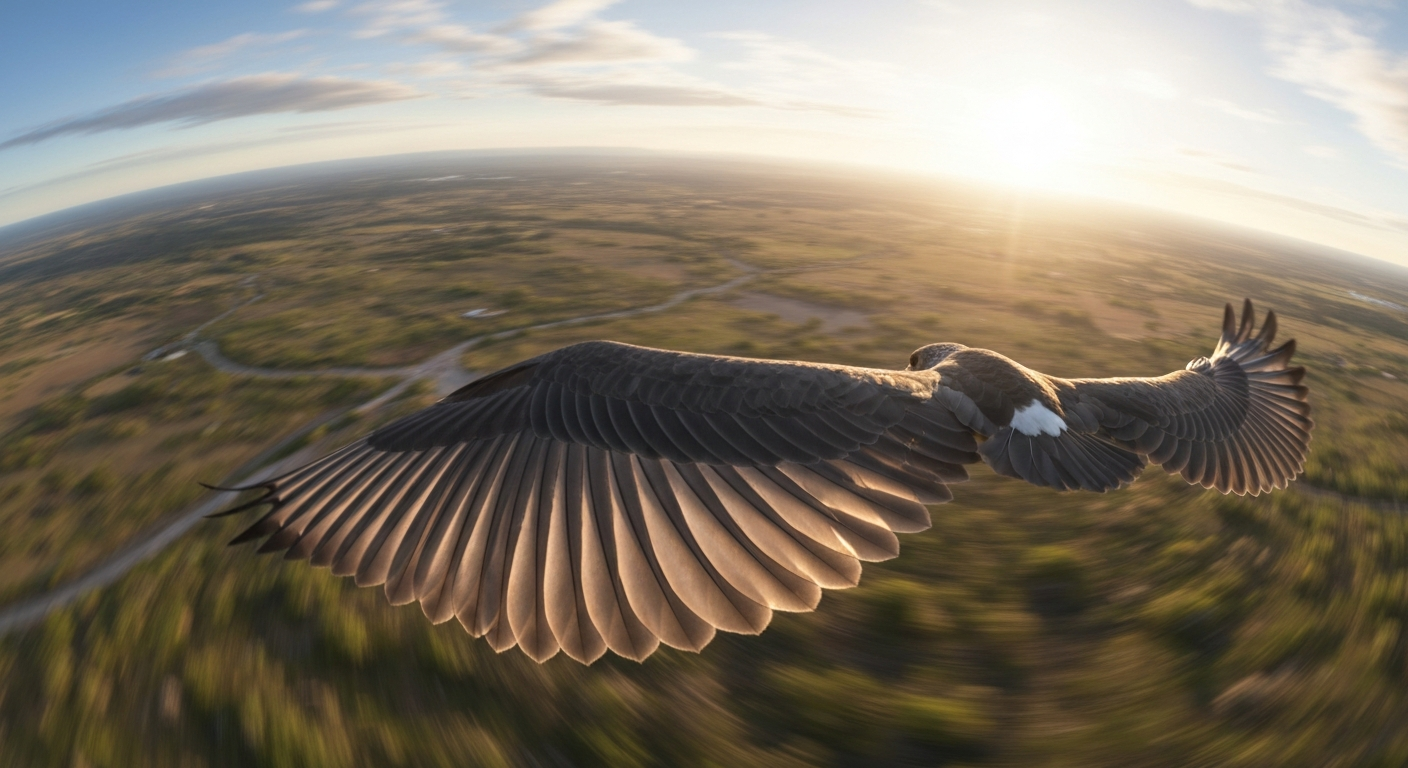
Gliding and soaring are where bird flight starts to look genuinely magical from a human perspective. In a pure glide, the wings are held extended and the bird trades altitude for forward speed, losing height at a rate determined by its glide ratio. A well-designed glider like an albatross can achieve glide ratios above 20:1, meaning it travels more than 20 meters forward for every meter it descends. Soaring goes further still: it uses atmospheric energy to maintain or even gain altitude without flapping. Thermal soaring, used by vultures, eagles, and many raptors, exploits rising columns of warm air (thermals). The bird circles within the thermal, rising with it, then glides out toward the next one. Dynamic soaring, the technique of albatrosses over open ocean, is more complex: the bird alternates between a low-altitude downwind run in faster air and a climbing turn into slower air near the surface, extracting energy from the wind-speed gradient (wind shear) in a cyclic maneuver. In both cases, the pectoralis muscles are largely quiet. The sensory experience shifts dramatically: instead of rhythmic muscle effort, there is a continuous gentle pressure across the extended wing surface, subtle adjustments at the wingtips and tail to stay centered in rising air, and a slow, wide-arcing view of the landscape below. Studies confirm that birds continuously adjust wing and tail geometry in response to turbulence, so even soaring is never entirely passive.
| Flight mode | Key species examples | Wingbeat frequency | Primary energy source | Main adaptation |
|---|---|---|---|---|
| Hovering | Hummingbirds | 50–80 Hz | Muscle power (both strokes active) | Symmetrical figure-8 stroke, high-frequency muscle fibers |
| Flapping cruise | Pigeons, starlings, passerines | 8–20 Hz | Muscle power (downstroke dominant) | Large pectoralis, cambered wing |
| Intermittent flapping | Woodpeckers, finches | Variable, with pauses | Muscle power + body inertia | Bounding/undulating flight path |
| Thermal soaring | Vultures, eagles, storks | Near 0 Hz (circling) | Rising warm-air columns | Broad wings, high lift coefficient, slotted primaries |
| Dynamic soaring | Albatrosses, petrels | Near 0 Hz (cyclic dives) | Wind-shear gradient | Very high aspect-ratio wings, low drag |
Maneuvering and landing: slowing down without crashing
Maneuvering in flight requires precise control of the wing shape, the angle of attack, and the tail. Birds adjust individual primary feathers, spread or close the alula (a small group of feathers on the leading edge of the wing, roughly equivalent to a leading-edge slat on an aircraft), and fan or fold the tail to control pitch, roll, and yaw. During high-speed maneuvers, the load factors on the bird's body are substantial. Modeling of peregrine falcon dives, for example, estimates pull-out load factors of around 3 g in observed maneuvers, with theoretical extreme values reaching up to 10 g. Radar observations of peregrine stoops record sustained 10-second average speeds of roughly 31 to 39 m/s (about 112 to 140 km/h), which gives a sense of the kinetic energy involved. Landing is effectively a controlled stall. The bird pitches its body upright, spreads and fans the tail, and spreads the wings to maximize drag and reduce lift, bleeding off speed just before touchdown. Studies of lovebirds and pigeons show that gaze stabilization through rapid head saccades plays a critical role during this final approach: birds must accurately judge distance and closing speed using visual information rather than instruments. Any miscalculation is immediately felt as a hard landing, so the visual-vestibular integration during the last few meters of approach is extremely precise.
What a bird actually feels in the air
This is the question at the center of everything, and the honest answer is that we can describe it with considerable scientific confidence even though we cannot directly experience it. A bird in flight is processing sensory information from at least four distinct systems simultaneously, and each one contributes to what we might loosely call the felt experience of flight.
Aerodynamic pressure through the feathers
Feather follicles contain mechanoreceptors, sensory cells that detect pressure, vibration, and airflow direction. Experiments have confirmed that these receptors feed real-time airflow information back into the bird's flight-control system. Optic‑flow stabilizes flight in ruby‑throated hummingbirds, Journal of Experimental Biology (2016) shows that visual optic-flow cues help stabilize flight, complementing mechanosensory feather feedback Optic‑flow stabilizes flight in ruby‑throated hummingbirds — Journal of Experimental Biology (2016). A sudden gust hitting the leading edge of the wing, a stall developing at the wingtip, or a shift in the pressure gradient across the primary feathers all generate signals that the bird processes and acts on within milliseconds. Think of it as a distributed pressure suit that covers the entire wing surface and communicates directly with the motor system. The bird does not consciously think about adjusting feather angle any more than you consciously think about balancing while walking, but the information is there and it is continuous.
Vestibular and proprioceptive balance
The vestibular system in birds, as in all vertebrates, sits in the inner ear and detects linear acceleration and rotational motion. During takeoff, level cruise, banking turns, and landing, the vestibular system is continuously updating the brain about the bird's orientation and trajectory. What makes avian vestibular processing remarkable is its integration with muscle proprioception: sensors in the wing joints and pectoralis tendons report the angle and tension of every stroke. Combined, these give the bird a continuous, embodied sense of where its body is in three-dimensional space. During a banked turn, for example, the bird feels the increased g-load on the body, senses the asymmetry between the two wings, and adjusts the stroke depth on each side to maintain the desired arc.
Vision and optic flow
Bird eyes are positioned to give a very wide field of view, often close to 340 degrees in some species, and the visual system is specialized for detecting motion. During flight, the entire visual field fills with optic flow: the streaming motion of the ground, trees, and obstacles as they pass by. Experimental work with hummingbirds in visual-arena tunnels has shown that optic flow is a primary cue for flight-speed regulation and gaze stabilization. When the visual pattern is manipulated experimentally, hummingbirds adjust their flight speed to maintain a consistent rate of optic flow, essentially using the visual world as a velocity sensor. Studies of lovebirds during obstacle negotiation show super-fast head saccades that stabilize the retinal image during rapid maneuvers, allowing the bird to get crisp visual information between movements rather than during them. How Lovebirds Maneuver Rapidly Using Super‑Fast Head Saccades, PLOS ONE (2015) documented super‑fast head saccades that stabilize gaze during rapid maneuvers and linked saccade timing to wingbeat phases and landing accuracy How Lovebirds Maneuver Rapidly Using Super‑Fast Head Saccades — PLOS ONE (2015). The overall visual experience of fast flight would be an extraordinary wide-screen streaming panorama with brief stabilized snapshots taken at key moments.
Temperature, wind, and the feeling of open air
There are aspects of bird flight that are harder to instrument but real nonetheless. At altitude, temperatures drop and wind speed typically increases. Birds flying at 1,000 meters above ground are in a meaningfully different thermal environment than at the surface. During high-speed flight the convective cooling across the face and bill is substantial. During thermal soaring in strong sunshine, the bird inside a thermal column experiences warm rising air against the underside of the wings and body. None of this is speculative: bird thermoregulation during flight is an active research area, and the energetic trade-offs between heat loss during high-speed flight and heat gain during soaring are documented. The bird feels all of it, even if it processes that information differently from the way a human would.
How flight style differs across species
The sensory and physical experience of flight varies enormously across species because wing morphology determines what kind of flight is even possible. Wing aspect ratio and wing loading are the two key predictors. A high aspect-ratio wing (long and narrow, like an albatross) is efficient for sustained fast gliding but terrible for tight maneuvering. A low aspect-ratio, broad wing (like a vulture or a buteonine hawk) generates high lift at low speeds and works beautifully for circling in thermals. A very short, rounded wing (like a quail or woodcock) allows explosive take-offs from ground cover but is energetically expensive to sustain. These are not just engineering trade-offs: they represent millions of years of selection pressure from specific ecological niches. An albatross flying over open ocean and a hummingbird hovering at a flower are both birds, but the felt experience of their respective flights would be about as different as riding a long-distance sailboat versus sprinting on a track.
| Species | Wing loading | Aspect ratio | Dominant flight mode | Felt experience emphasis |
|---|---|---|---|---|
| Hummingbird | Very low | Low–moderate | Hovering, short bursts | High-frequency vibration, intense muscle work, precise visual flow |
| Peregrine falcon | Moderate–high | Moderate | Fast flapping, steep dives | Speed, high g-loads during pull-out, precise visual targeting |
| Wandering albatross | High | Very high (~18–19) | Dynamic soaring, long glides | Minimal muscle effort, continuous pressure across wing, wind-shear exploitation |
| Andean condor / vulture | High | High (broad) | Thermal soaring, wide circles | Slow, wide arcs, gentle sustained lift, minimal flapping |
| Common swift | Moderate | High | Fast continuous flapping and gliding | Sustained speed, long aerial hours, efficient cruising |
Humans trying to fly like birds: what is actually possible
The desire to fly like a bird is ancient and understandable, and while literal shapeshifting into a bird is not possible (and worth saying plainly: no amount of technique, meditation, or ritual produces that outcome), there are real and accessible ways to experience flight modes that closely parallel specific avian strategies. The closeness of the parallel depends on what kind of bird flight you want to approximate.
Gliding and soaring: the most bird-like options for humans
Paragliding and hang gliding come closest to the soaring experience of a large bird of prey or vulture. Both use thermals and ridge lift in exactly the same way a raptor does, and skilled pilots develop a tactile and visual sense for finding and staying in rising air that genuinely parallels the bird experience. The glide ratios of modern paragliders (around 10:1 to 12:1 for recreational wings) are somewhat below those of top-performing birds but in the same order of magnitude. Sailplaning (motorless gliders) extends the glide ratio to 40:1 or above in high-performance aircraft, exceeding most birds. All of these activities require formal training, equipment certification, and site-specific knowledge. They are genuinely accessible, widely practiced, and physically rewarding.
High-speed and maneuvering options
Wingsuit BASE jumping and wingsuit skydiving approximate the feel of a high-speed raptor dive more than any other human activity. The full-body pressure from airflow, the sensitivity to body angle and limb position, and the optic-flow experience during a low wingsuit flight over terrain are genuinely close to what research suggests a diving peregrine or swift experiences. The risks are substantial and the training requirements extensive: wingsuit flight typically requires 200 or more skydives before a first wingsuit jump, and BASE applications add considerably more hazard. These are not casual pursuits. For a more accessible high-speed experience, aerobatic aircraft or even a light aircraft can approximate the vestibular and g-loading cues of fast avian flight, though without the full-body airflow sensation.
Human-powered flight: the closest thing to flapping
Human-powered aircraft have been built and successfully flown, most famously the Gossamer Albatross, which crossed the English Channel in 1979 under pedal power. These aircraft require exceptional fitness and engineering precision: human power output is roughly 400 to 500 watts sustained for a fit athlete, which is adequate for flight only in a very lightweight, high-efficiency airframe. The metabolic demand is real and the experience is demanding, but it exists. Ornithopters, aircraft with flapping wings, have also been built and flown, though human-powered ornithopters capable of sustained flight are extremely rare and technically very challenging. For most people interested in experiencing something like the physical effort of bird flight, these remain interesting engineering milestones rather than accessible activities.
Safety and training: what to know before you start
- Paragliding and hang gliding require certified instruction from a nationally recognized school; expect a minimum of several days of ground training before any unsupervised flight.
- Skydiving requires completing an Accelerated Freefall (AFF) course (typically 7 to 8 jumps with instructors) before solo jumps; wingsuit flight adds a further 200-jump requirement.
- Sailplane (glider) pilot licensing follows standard aviation regulatory paths in most countries and requires both ground school and dual instruction hours.
- All aerial activities are weather-dependent: thermal soaring in particular requires understanding local weather patterns, site-specific hazards, and air-traffic rules.
- Human-powered aircraft projects are engineering endeavors, not recreational products; they require aeronautical engineering support, not just athleticism.
The cultural side: songs, dances, and the metaphor in action
It is worth acknowledging the other reasons people search for "fly like a bird," because the metaphor has generated its own rich traditions. For recent updates on the phrase's cultural usage, see what happened to fly like a bird. For a specific example in contemporary lyrics, see the phrase "fly like a bird uh huh what you heard". A famous lyrical example is the song "Birds flying high, you know how I feel" (see entry e292a671-682d-457b-a616-e5d7ecdd3c63). The phrase appears in gospel and soul music as an image of spiritual transcendence and release. It has been used in contemporary pop and hip-hop lyrics to signal freedom from constraint or the pursuit of ambition. Line dances with "fly like a bird" in the title translate the image into choreography, using arm and body movements to mime the soaring sensation. Viral dance trends have periodically used bird-flight imagery in social media contexts. None of this is scientifically inaccurate or even in conflict with the biomechanical story: the reason bird-flight metaphors persist in human culture is precisely because birds do something that looks and, apparently, feels like pure freedom. The science just tells you what that freedom actually consists of, underneath the feathers.
Where to go deeper on this site
If this article has made you curious about the underlying mechanics, there is much more to explore here. The anatomy of bird wings, including how primary and secondary feathers are structured and how the alula functions as a stall-prevention device, is a natural next step. The biomechanics of specific flight styles, including how hummingbirds achieve hovering and how albatrosses extract energy from ocean wind gradients, are covered in dedicated sections. Flightless birds offer a compelling contrast: understanding why penguins, ostriches, and cassowaries lost powered flight, and what evolutionary trade-offs that involved, sharpens the understanding of what flight requires. If you are interested in learning to fly in the more literal human sense, there is also guidance on the practical pathways, from paragliding to human-powered aircraft, and what each one actually demands in training and equipment. For practical training and step-by-step courses on human flight methods, see our guide to learn to fly like a bird. See our practical flying bird step by step guide for a clear, actionable path from basic training to advanced techniques. The question of how it feels to fly like a bird turns out to open onto almost every area of avian biology, which is part of what makes it such a good place to start. For a speculative, cultural-and-mythical perspective, see the related piece on how to shapeshift into a bird.
FAQ
What does “how does it feel to fly like a bird” mean — literal versus metaphorical?
Literally it asks what sensory, motor and physiological experience a bird has while flying (lift, acceleration, airflow on feathers, visual flow, vestibular sensations, muscle effort). Metaphorically it’s an idiom for freedom, elation, escape or lightness (e.g., “as free as a bird”). Good explanations separate the two: describe actual avian sensations and biomechanics, then show how humans use the phrase in culture and art.
Step‑by‑step: how do birds achieve and control flight (takeoff, flapping, gliding/soaring, landing)?
Takeoff: legs provide an initial push; wings deliver a powerful downstroke (pectoralis) and an upstroke recovery (supracoracoideus); wingbeat amplitude and angle create lift and thrust. Flapping flight: coordinated wingbeats produce time‑averaged lift and thrust; kinematics (freq., stroke plane) depend on size and style. Gliding: wings are held extended to convert altitude into forward motion with little flapping. Soaring: birds exploit atmospheric energy—thermals (rising warm air) or dynamic soaring (wind shear over oceans)—to gain or maintain altitude with minimal muscle power. Landing: birds reduce speed via wing and tail shape changes, flap intermittently or use airbraking, then extend legs for touchdown. Throughout, wing morphing, tail spread and body posture modulate forces and stability.
What physiological and sensory cues does a bird experience in flight?
Aerodynamic forces: lift, drag and transient g‑loads during turns and pull‑outs. Muscle feedback: from pectoralis and other flight muscles indicating power output and fatigue. Proprioception: joint and tendon signals about wing position. Mechanosensation: feather follicle receptors and cutaneous sensors detect airflow and pressure. Vision: wide‑field optic flow stabilizes speed and distance judgments; rapid head saccades stabilize gaze. Vestibular system: inner‑ear sensing of angular and linear accelerations for balance and orientation. Combined, these cues let birds steer, land, and react to turbulence.
How do flight styles differ across species, and why did they evolve?
Flight styles scale with morphology and ecology. Low wing loading and high wingbeat frequency (hummingbirds) enable hovering and agile feeding; high aspect‑ratio wings (albatrosses) enable efficient dynamic soaring and long-range travel; broad, slotted wings (vultures) favour thermal soaring and slow flight. Swifts/swallows have swept narrow wings for fast, continuous aerial foraging. These traits evolved to match energy budgets, foraging needs, habitat structure and migration demands: aspect ratio and wing loading predict efficiency, maneuverability and required takeoff power.
What are realistic human options to “fly like a bird” and their limits?
Safe, realistic pathways: gliders, hang gliding and paragliding (pilot suspended under wing; rely on lift and pilot control), sailplanes (engine‑less gliders towed aloft then soar), wingsuits (high‑speed gliding after a jump—requires skydiving), powered ultralights and small aircraft, and experimental human‑powered aircraft (very limited performance, require teams and tethers). Limits: humans lack flapping wings, appropriate muscle‑to‑weight ratios and feathered control surfaces; these methods mimic aspects of bird flight (gliding, soaring, freefall‑glide) but cannot reproduce hovering or flapping flight of birds. Legal/regulatory, weather and training constraints also apply.
What training and safety considerations should a person know before attempting human flight activities?
Get formal instruction from certified schools (hang‑gliding, paragliding, glider, FAA‑certified pilot training for aircraft). Progress through supervised solo milestones, practice emergency procedures (stall recovery, reserve parachute deployment), learn meteorology and airspace rules, use appropriate certified equipment (helmets, harnesses, radios), and build experience gradually. For wingsuits and skydiving, complete many jumps and supervised wingsuit transition training; wingsuiting is high‑risk. Follow local regulations and maintain physical fitness and situational awareness.
Flying Bird Step by Step: How Birds Fly and How Humans Can
Explore step-by-step bird flight: mechanics, wing anatomy, species modes, and safe human flight alternatives with images