
Birds don't learn to fly the way a human learns to ride a bike, with a patient instructor and a deliberate series of lessons. What actually happens is closer to a combination of physical maturation, instinctive practice, and environmental calibration. A young bird's body develops the strength and coordination to produce lift, and then it practices, crashes, adjusts, and gradually gets better. The "learning" is real, but it's mostly a process of neuromuscular refinement rather than conscious instruction.
How Does a Bird Learn to Fly From Nest to First Flight

Marcus Chen
6 Apr 2026
What "learning to fly" actually means
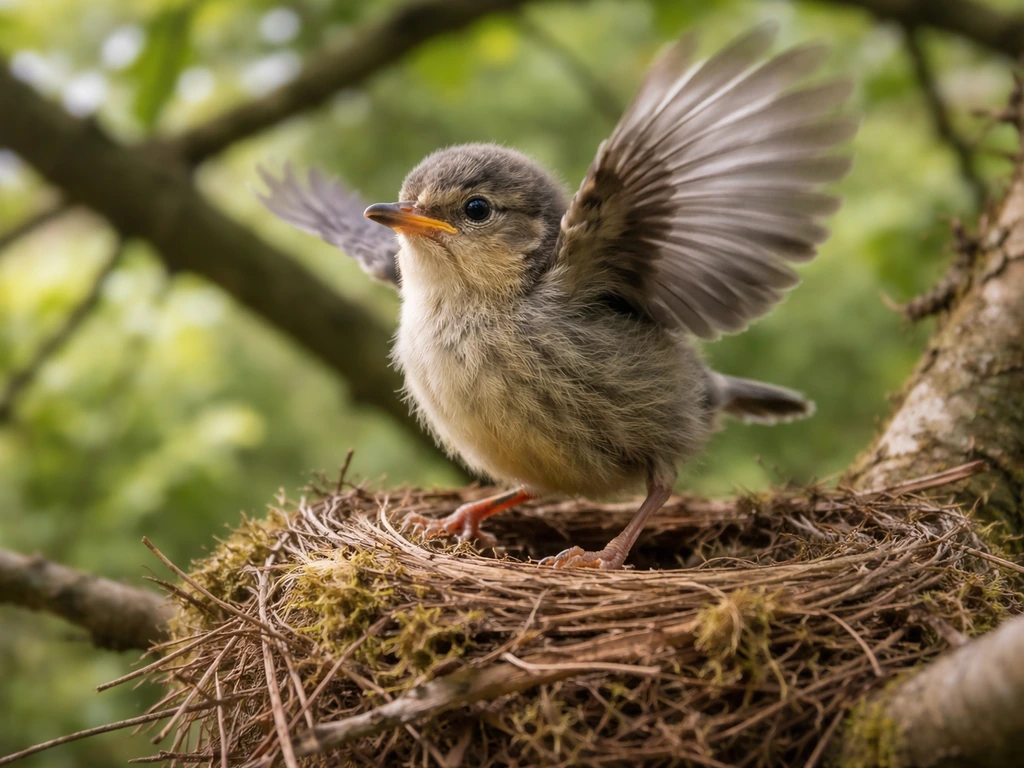
When researchers talk about flight ontogeny (the development of flight from birth to adulthood), they draw an important distinction between maturation and learning. Wing-assisted incline running is widely studied in chukar chicks and other birds, where it is generally described as a behavior for running up steep inclines using wing flapping. Maturation is what happens automatically as bones ossify, feathers grow in, and muscles strengthen. Learning is what happens on top of that, when a bird refines timing, gauges distance, adjusts wing angles, and figures out how to deal with wind. For basic flapping flight, maturation does most of the heavy lifting. For more complex modes like soaring, gliding, and thermal riding, learning plays a much bigger role.
This is worth knowing because it reframes the whole picture. You're not watching a bird "figure out" flight from scratch. You're watching a body gradually come online, with the brain calibrating motor patterns along the way. Think of it less like learning a language and more like learning to walk, your nervous system and muscles have to grow into the task before practice can even begin to help.
Early development in the nest
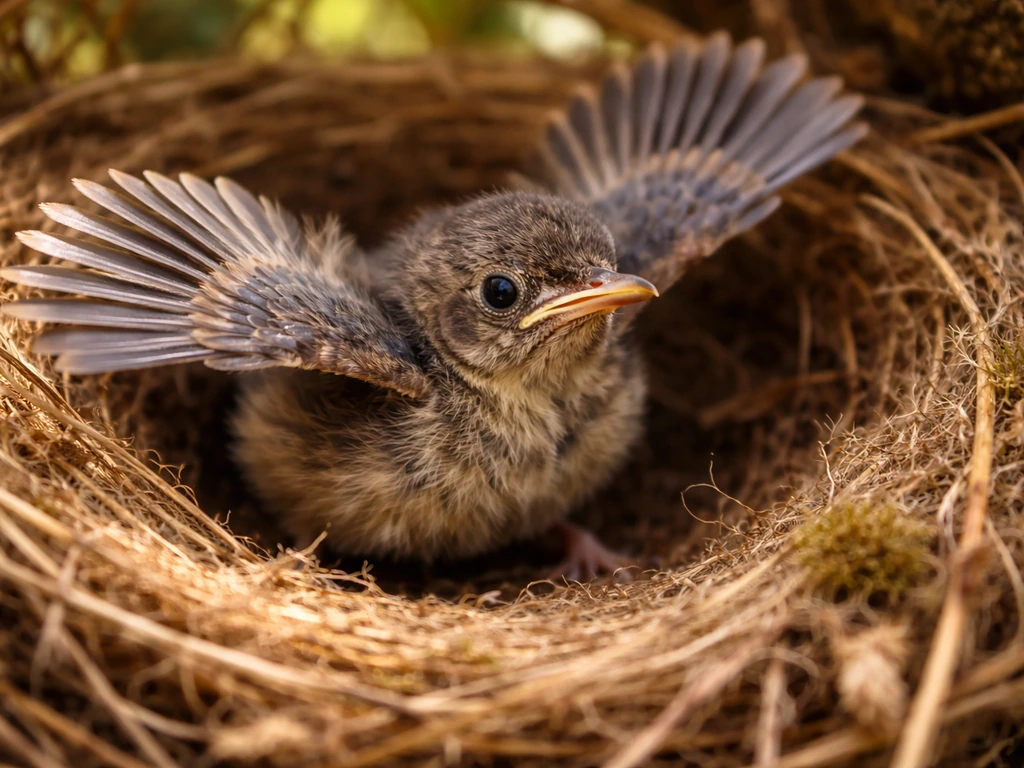
Long before a nestling ever leaves the nest, it's already doing flight preparation. Wing flapping in the nest, what researchers call "pre-flight flapping" or "wing exercising," has been observed across a huge range of bird species. The bird grips the nest with its feet and beats its wings against air, building the pectoral muscle mass that flight demands. This isn't random fidgeting. It's a consistent behavioral pattern that shows up reliably in the days before fledging.
At the same time, feather development is racing to keep up. The primary feathers (the long outer wing feathers responsible for generating thrust and lift) grow in a specific sequence and need to reach a functional length before the wing can produce usable aerodynamic force. A nestling with half-grown primaries simply cannot fly, no matter how hard it flaps. The body has to be ready before practice does much good.
Balance and proprioception (the sense of where your body is in space) are also developing during this period. Nestlings start shifting weight, gripping perches, and orienting their bodies in response to gravity. These might seem like minor details, but they're foundational. What enables a bird to fly isn't just wing size or feather quality, it's the whole integrated system: skeleton, muscle, feather, and neural control working together.
The staged journey after leaving the nest
Fledging is not a single event. For common swifts, fledging reflects a switch from a mostly sedentary nestling life to continuous flight with no post-fledging care, which helps explain why pre-fledging body and flight-related changes matter fledging reflects a switch from nestling life to continuous flight with no post-fledging care. It's a process that unfolds over days or even weeks, depending on the species. Here's how that progression generally looks:
- Wing-assisted movement on the ground or on inclines: Before a fledgling can get airborne, it often uses its wings to help with running and climbing. This behavior, called wing-assisted incline running (WAIR), has been studied in detail in chukars (Alectoris chukar) and gives young birds early experience with wing loading and aerodynamic feedback without the stakes of actual flight.
- Aerial righting: If a young bird falls or is dropped, it tries to orient itself right-side-up in the air. In chukar chicks, this ability improves from about 50% success at 4 days post-hatching to 100% success by 9 days post-hatching. That's a measurable jump in aerial coordination in under a week.
- Short hops and glides: The first airborne movements are usually short, low, and chaotic. The fledgling launches from a branch or ledge, beats its wings, and makes a rough landing (or crash-lands) nearby. Each attempt provides feedback: how much force to generate, how to angle the wings for descent, how to flare for landing.
- Controlled flapping flight: Over days of practice, the fledgling develops more consistent takeoffs, better altitude maintenance, and improved directional control. This is still rough by adult standards, but it's recognizable as flight.
- Landing refinement: Landing is actually harder than taking off. Slowing down enough to land without injury requires precise wing-spreading, tail use, and leg positioning. Fledglings often overshoot, undershoot, or tumble on landing well into their first weeks of flight.
How anatomy and biomechanics drive the whole process
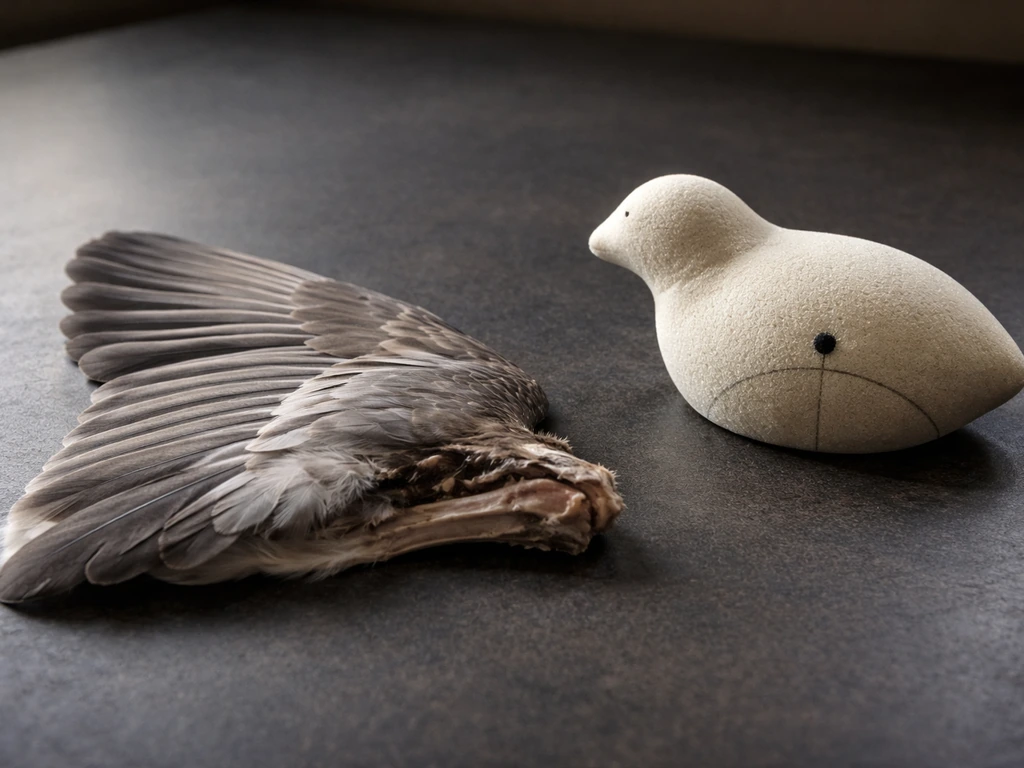
Flight is fundamentally a physics problem, and the bird's body is the solution. The wing is an airfoil: cambered (curved) on top and flatter underneath, which creates a pressure differential that generates lift as air flows over it. But that only works if the wing is the right shape, stiffened by the right feathers, and moved at the right speed and angle. The feathers that help a bird fly do a lot of the structural work here, with the primaries generating thrust and the secondaries (inner wing feathers) contributing to lift and shape.
Body mass distribution matters enormously. A bird's center of gravity is positioned close to its wings, which keeps it stable in the air. The keel, a bony ridge on the sternum, anchors the pectoralis muscles that power the downstroke and the supracoracoideus muscles that pull the wing back up. These muscles make up a huge proportion of a bird's total body weight (sometimes 25-35% in strong fliers), and building that muscle mass takes time in a growing fledgling.
Muscle control and neural timing are equally critical. The downstroke and upstroke of the wing are not symmetrical in force or angle: the wing partially folds on the upstroke to reduce drag. Getting that timing right requires practice. This is where the "learning" component really earns its name, the nervous system is calibrating motor sequences through repetition, the same way a human pianist's fingers gradually stop thinking about each note individually.
If you want a deeper look at the anatomical side of this, the features that help a bird fly go well beyond wings alone, covering hollow bones, air sac systems, and cardiovascular adaptations that the average person wouldn't immediately think of.
Learning from the environment: wind, perches, and terrain
Environment isn't just backdrop. It's an active teacher. A fledgling practicing in a scrubby hedgerow is getting very different feedback than one fledging from a cliff edge. Wind in particular is both a challenge and a tool. Early fliers often struggle with crosswinds and gusts, which can flip them or push them off course. But wind also provides lift, and birds that grow up in breezy environments get more opportunities to feel what passive uplift feels like before they have to generate all their own.
Perches play a structural role too. Having a reliable launching point at height gives a fledgling the distance it needs to transition from a fall into gliding flight. This is one reason many songbird species fledge into shrubby or forested environments rather than open ground: there are perches everywhere, which makes short practice flights easier and safer. The fledgling can launch, travel five feet, land on another branch, rest, and go again.
Obstacle navigation also develops through experience. Young birds frequently misjudge distances and collide with branches, windows, or fences. Each near-miss provides spatial calibration data. Over time, they develop what you might call a safety margin intuition, an automatic sense of whether a gap is passable at current speed and wing angle. Adults navigate complex environments with startling precision; fledglings earn that precision through a lot of awkward practice.
How species differences change everything
There is no single universal fledgling experience. A barn swallow, a golden eagle, and an ostrich represent three completely different relationships with flight, and their developmental paths look nothing alike.
Soaring birds vs. flapping birds
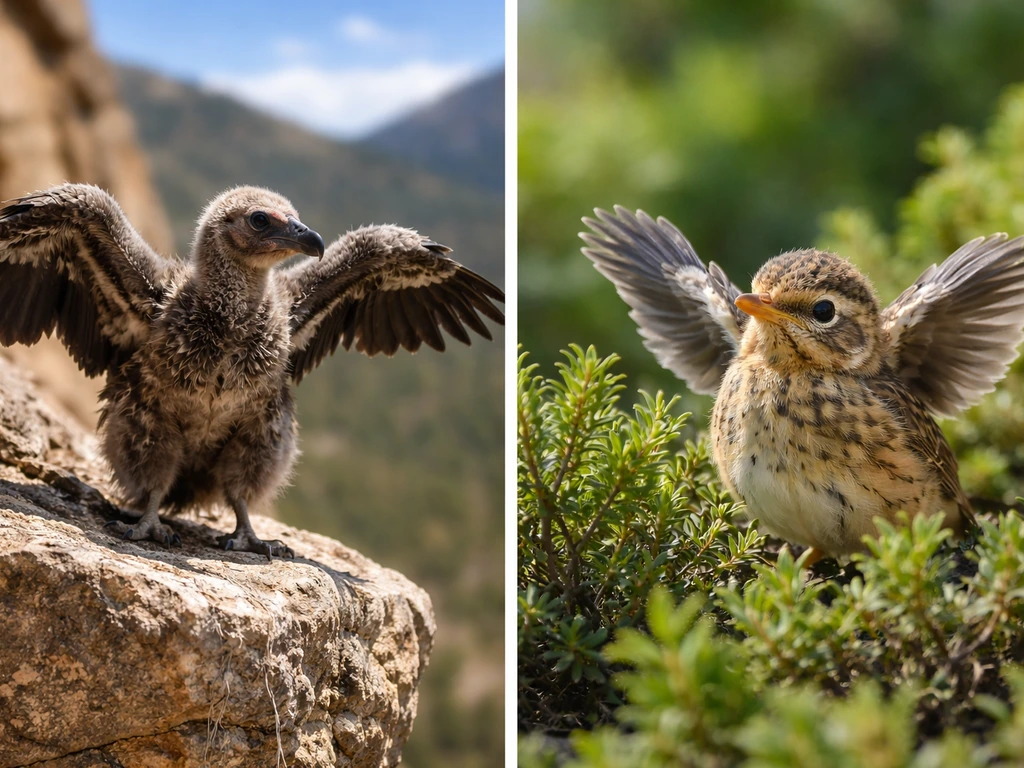
Birds that rely heavily on thermals and dynamic soaring (raptors, vultures, albatrosses) have longer fledging periods and a steeper learning curve. These species often spend weeks or months in the nest, and even after fledging, juveniles may struggle with soaring techniques for months. That's because using thermals efficiently requires reading subtle atmospheric cues and making constant micro-adjustments. It genuinely demands experience in a way that basic flapping does not. Why birds can fly at all is partly a story of evolutionary specialization, and soaring species represent one extreme of that spectrum.
Flapping-flight specialists like starlings, sparrows, and most passerines (perching birds) tend to have shorter fledging periods. Their flight style is more muscularly driven and less dependent on environmental reading. They still need practice, but the feedback loop is tighter and the useful skills are more quickly acquired. Many small songbirds go from first flight to competent forager in a matter of weeks.
Precocial vs. altricial species
Precocial birds (ducks, shorebirds, ground-nesting species) hatch relatively developed, with open eyes and the ability to move. They may be hopping around within hours of hatching. Altricial birds (most songbirds, raptors) hatch helpless and naked, requiring weeks of parental care before they're physically capable of leaving the nest. This is why you're far more likely to find a helpless baby robin than a helpless baby duckling on the ground. The developmental timelines are fundamentally different.
Flightless birds and what they tell us
Penguins, ostriches, emus, and kiwis don't fly at all, but they're still birds, and their developmental biology still shares deep roots with flying species. Young ostriches, for example, do use wing movements in social displays and balance behaviors even though those wings will never produce lift. How birds are adapted to fly is a story of divergence from a common ancestor, and flightless species illustrate what happens when natural selection deprioritizes aerodynamic function over millions of generations. Their "flight" muscles have reduced dramatically, their bones are denser, and their feather structure doesn't produce an airfoil. They're not birds that forgot how to fly. They're birds that evolved along a different path entirely.
Soaring vs. flapping: a quick comparison
| Feature | Soaring/Gliding Birds (e.g., eagles, vultures) | Flapping Birds (e.g., sparrows, starlings) |
|---|---|---|
| Nest period length | Long (weeks to months) | Shorter (days to a few weeks) |
| Primary flight mechanism | Thermal/dynamic lift | Muscular flapping |
| Role of learning | Very high (reading thermals, wind) | Moderate (timing, coordination) |
| Wing shape | Broad, long, slotted tips | Shorter, pointed or rounded |
| Time to flight competency | Months post-fledging | Weeks post-fledging |
| Environmental dependence | High (needs thermals, ridges) | Lower (can fly in most conditions) |
Found a fledgling? Here's what to actually do
This is the section a lot of people are really looking for. You're outside, you see a young bird on the ground that can't seem to fly, and you want to know if it's in trouble. The honest answer: probably not, but context matters a lot.
First, figure out whether you're looking at a nestling or a fledgling. A nestling has little or no feathers, closed or barely open eyes, and clearly cannot support its own weight. A fledgling has most of its feathers (even if they look a little ragged), can perch and hop, and has open eyes. These two situations call for completely different responses.
If it's a nestling
A nestling on the ground is genuinely in trouble. If you can find the nest and safely reach it, place the bird back in. The myth that parent birds will reject a chick that's been touched by humans is just that, a myth. Birds have a limited sense of smell and will not abandon their young because a human handled them. If the nest is inaccessible or destroyed, contact a licensed wildlife rehabilitator immediately. Do not attempt to raise a nestling yourself.
If it's a fledgling
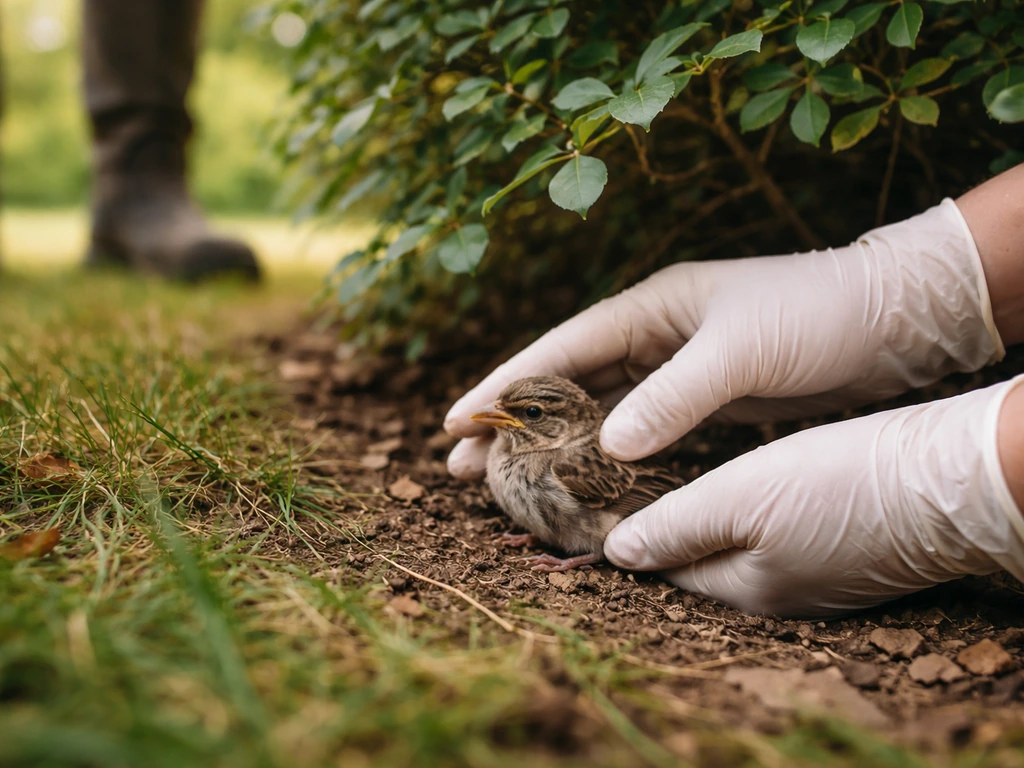
A fledgling on the ground is often doing exactly what it's supposed to do. Fledglings spend a normal portion of their development on or near the ground, where parent birds continue to feed and watch over them. The best thing you can do in most cases is leave it alone and keep pets and children away from the area. Watch from a distance (at least 30 feet) for 1-2 hours. If parent birds are coming and going, the bird is fine.
If the bird is in immediate danger (a cat is nearby, it's in the middle of a road), you can gently move it to a nearby shrub or low branch within the same general area. Do not relocate it far from where you found it, as the parents are looking for it in that location.
Call a wildlife rehabilitator if the bird is injured (bleeding, holding a wing at an odd angle, unable to stand), if you can confirm that a parent has not returned in several hours, or if the bird appears lethargic or unresponsive. Do not give it water or food unless a rehabilitator specifically instructs you to. Well-intentioned feeding is one of the most common ways people accidentally harm young birds.
The bigger picture: flight as a process, not a moment
There's something worth sitting with here. A fledgling doesn't learn to fly in an afternoon. It learns over a span of weeks, through a combination of physical readiness, instinctive behavior, environmental feedback, and incremental practice. The first flight isn't a triumph. It's usually a controlled fall that goes better than expected. The triumph comes later, quietly, when the bird suddenly navigates a dense thicket at speed or catches a thermal and spirals upward without thinking about it.
Understanding what makes a bird fly at a mechanical level deepens the appreciation for what fledglings are doing out there in your backyard. They're not failing. They're calibrating. And if you've ever wondered why birds fly in the first place (beyond the obvious), the answer connects to millions of years of evolutionary pressure that made flight the most powerful survival tool in the avian toolkit. Learning to use that tool takes time, and watching a fledgling go through that process is one of the more honest windows into how biology actually works.
For anyone curious about the finer mechanical details, how a bird is able to fly comes down to a remarkably elegant set of anatomical and aerodynamic solutions that have been refined over roughly 150 million years. The fledgling hopping around your garden is running that ancient program for the very first time.
FAQ
How can I tell if the bird on the ground is a nestling or a fledgling? (I’m not sure which one it is.)
Look for one key sign: a true fledgling can perch or hop with coordinated posture, it has open eyes, and its wing feathers are mostly present even if uneven. Nestlings usually have minimal feathering, may look lumpy or “naked,” and cannot support their body weight well. If you are unsure, treat it conservatively and keep distance until a wildlife rehabilitator can confirm.
If it seems like the parents aren’t around, should I relocate a fledgling?
Avoid moving a fledgling back into a nest or “up high” yourself. If the bird is already on the ground in its normal fledging area, parents are often nearby feeding. Relocating it far away can cause the parents to stop visiting, and it also removes the launching and perching spot the bird is using to practice.
What should I do if I don’t see the parents feeding a fledgling? How long should I wait?
If the bird is uninjured but you keep seeing it on the ground, use a short observation window. Watch from a distance (about 30 feet) for 1 to 2 hours. Parents commonly return with feeding bursts that are easy to miss. If there are no parent visits within that window, or the bird looks weak, call a wildlife rehabilitator.
Can I give water or food to a baby bird I found?
Do not try to feed it. Many common foods (including water) can cause aspiration or digestive issues, and forced feeding can worsen injuries. If you suspect injury or abandonment, the safest next step is to contact a licensed wildlife rehabilitator and keep the bird calm, warm, and contained only as directed by them.
What signs mean a young bird is actually injured, not just learning to fly?
A basic “injury checklist” helps you decide quickly: bleeding, a wing held at an odd angle, dragging a leg, inability to stand, rapid panting, or unusual lethargy are all red flags. If you notice any of these, treat it as potentially injured and contact a rehabilitator rather than assuming it is just learning.
What if the bird is in danger from a cat or dog? Should I intervene?
If a cat, dog, or other predator is involved, time matters. Keep people and pets away immediately and move the bird only a short distance to the nearest nearby shrub or low branch in the same area if it is safe to do so. Then contact a rehabilitator, especially if the bird shows any injury or shock.
Why does a fledgling seem to fall a lot in windy weather? Does that mean something is wrong?
Yes, wind and open lawns change what “normal” looks like. Some fledglings struggle more in gusty conditions and may spend extra time hopping, landing early, or choosing sheltered spots near perches. In calm moments, you may see brief glides or short flights that indicate normal practice rather than immediate failure.
Why does the first flight look more like falling than flying?
First flights can be clumsy and often involve a drop that becomes a glide, not a perfect takeoff and sustained flight. “Doing worse” over multiple attempts is normal early on, because the nervous system is recalibrating timing and wing angle each try. Repeated success usually shows up as longer, more controlled transitions between nearby branches.
Are some species expected to fledge more slowly or struggle longer than others?
For soaring specialists, you may see longer periods of partial flight, extended perching, or repeated short launches that build toward controlled gliding. The bird might seem “behind” compared with species that rely more on flapping power, because thermal and cue reading are later-learned skills.
If I need to contact a rehabber, how should I safely prepare to transport or contain the bird?
Rehab advice is species- and injury-specific, but a practical rule is to limit handling. Use a box or carrier with ventilation if you must contain the bird, keep it dark and quiet, and do not try to stretch wings or clean feathers aggressively. Contact the rehabilitator as soon as possible, especially if it is injured or lethargic.
Next Articles
Why Do Birds Fly? How Flight Works and Why It Evolved
How bird flight works and why it evolved, plus which birds can’t fly and why they still survive.

Bird Has Flown Meaning: Definition and How to Respond
Understand the bird has flown meaning, when it’s used, and how to reply with examples for real-life conversations.
Prefix Meaning Flight or Bird: Definition and Examples
Learn the flight or bird prefix meaning, origin, examples, and a checklist to decode new words and avoid look-alikes.