
A bird flies because four physical forces reach a precise balance, and because its entire body, from hollow bones to air sacs deep in its chest, has been shaped by evolution to hit that balance millions of times per day. The short answer: wings generate lift to defeat gravity, muscles generate thrust to defeat drag, and a suite of biological adaptations (feathers, fused bones, enormous flight muscles, a turbo-charged respiratory system) make sure enough power is available to keep those forces in check. Everything else, the gliding albatross, the hovering hummingbird, the ostrich that never leaves the ground, is a variation on that theme.
What Makes a Bird Fly: Forces, Body, and Flight Control

Marcus Chen
13 Apr 2026
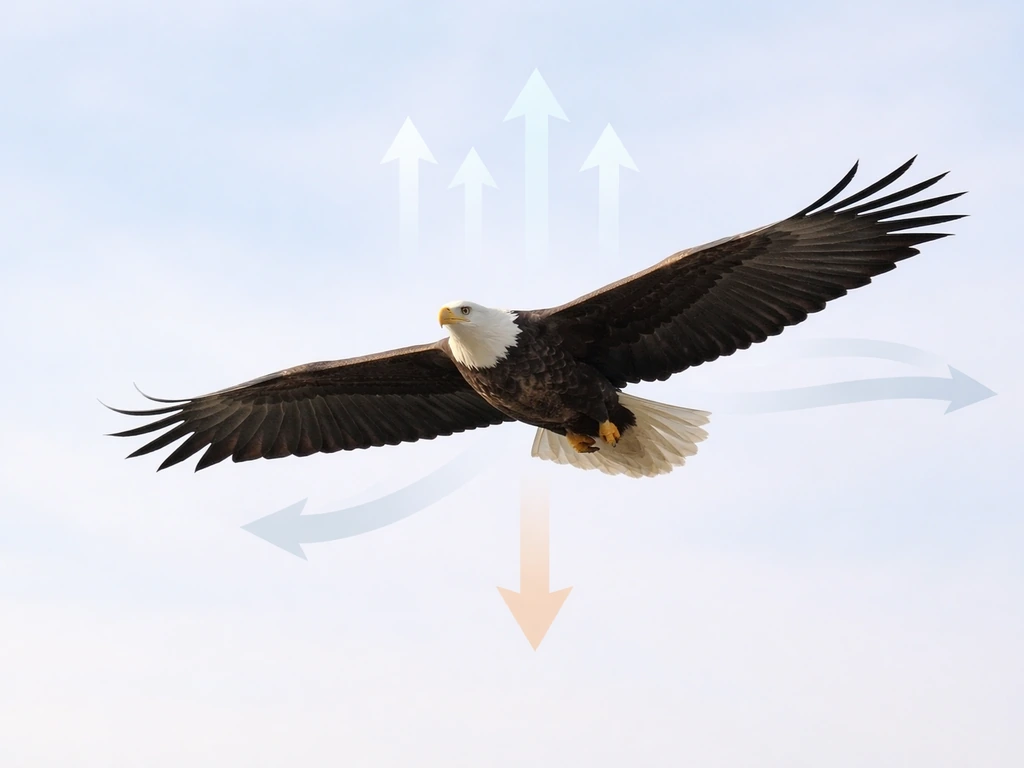
The four forces a bird has to satisfy
Any flying object, whether it is a Boeing 737 or a house sparrow, has to satisfy the same condition for steady, level flight: lift must equal weight, and thrust must equal drag. Miss either condition and the bird either sinks or slows to a stall. These are not suggestions; they are the arithmetic of staying airborne.
- Lift: the upward aerodynamic force produced by the wings, acting against gravity (weight).
- Weight: the downward pull of gravity on the bird's mass, which is why low body weight is a non-negotiable evolutionary pressure.
- Thrust: the forward force produced by flapping (or, in gliding, by trading altitude for speed), acting against drag.
- Drag: the aerodynamic resistance the bird's body and wings create as they move through air.
There is a subtlety worth knowing: flying slowly is actually harder than flying at moderate speed. Aerodynamicists call it the "back of the power curve." As a bird slows down, it has to tilt its wings to a steeper angle to generate enough lift, but that steeper angle creates more drag, which demands more thrust, which demands more muscular effort. Push the angle too far and the smooth airflow over the wing breaks down entirely, a condition called a stall, and lift collapses. NASA Glenn notes that changes in angle of attack can strongly affect drag, and that boundary-layer separation can alter the effective shape and behavior that leads into stall angle of attack can strongly affect drag and boundary-layer separation can lead into stall. This is why pigeons flare their wings and pump hard just before landing, and why very small birds have to flap almost continuously rather than coast.
Understanding why birds fly in the first place, whether for foraging, migration, or escape from predators, helps explain why natural selection kept refining these four-force solutions across 150 million years of avian evolution.
How wings actually generate lift
Wing shape: the airfoil
A bird's wing is an airfoil: curved on top, flatter underneath. Air moving over the curved upper surface has to travel farther and faster than air moving under the flatter lower surface. The faster-moving air on top creates a region of lower pressure, and the higher pressure below "pushes" the wing upward. That pressure difference is lift. The exact camber (curvature) and aspect ratio (length vs. width) of the wing determine how efficiently it generates lift relative to the drag it creates. A long, narrow wing like a frigatebird's produces a very high lift-to-drag ratio and a shallow glide slope. A short, broad wing like a pheasant's produces a lot of lift quickly but burns through energy fast. In unpowered gliding, the glide ratio equals the lift-to-drag ratio numerically, so a frigatebird with an L/D of around 15:1 descends only one meter for every fifteen meters of forward travel.
Feathers and the fine-tuning of airflow
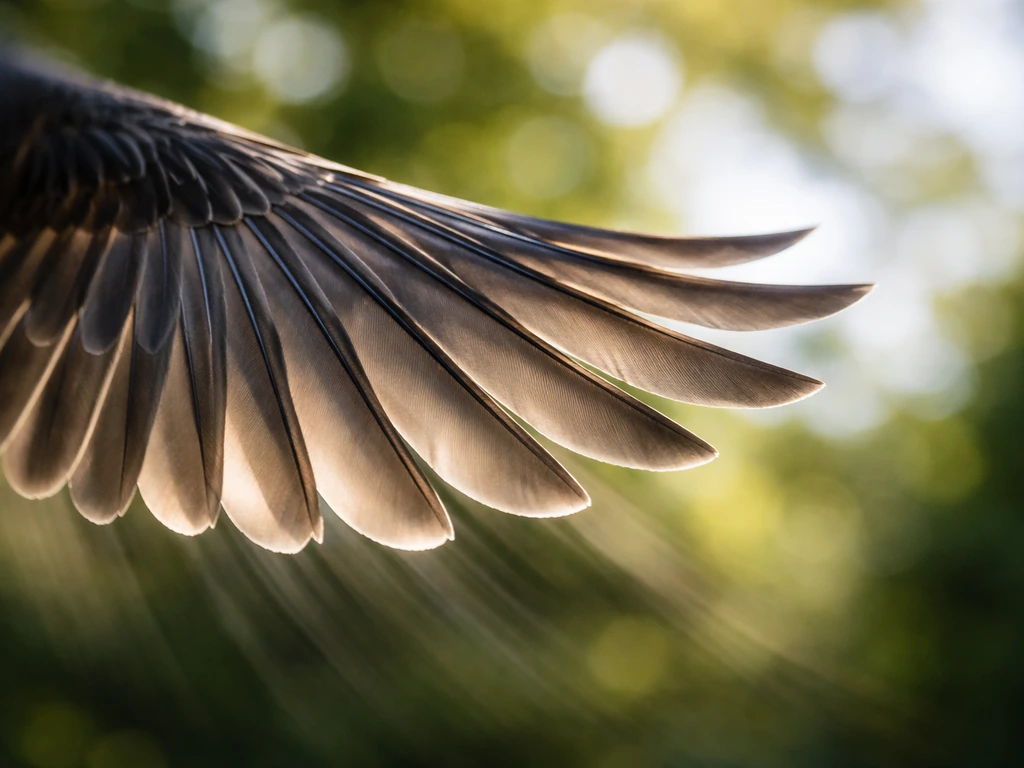
Feathers are not just insulation; they are precision aerodynamic structures. The primary feathers at the wingtip generate most of the thrust during a downstroke. The secondary feathers closer to the body maintain the curved airfoil shape that produces lift throughout the stroke. Contour feathers smooth the wing's surface so airflow stays attached rather than turbulent. Some species even have specialized slot feathers at the wingtip that act like the winglets on a commercial jet, reducing the drag-inducing vortices that spiral off the tip. If you want to go deep on which specific feathers do which job, the role of feathers in bird flight covers that in detail.
The wingbeat cycle
Each wingbeat has two phases. The downstroke is the power phase: the wing sweeps down and forward, the primary feathers twist to push backward against the air, and both lift and thrust are produced simultaneously. The upstroke is the recovery phase: the wing folds slightly, the primaries separate and let air slip through, reducing drag so the muscles are not fighting their own work. In fast-flying birds like swifts, the upstroke also generates a small amount of thrust. Hummingbirds take this further, generating lift on both the downstroke and the upstroke by rotating the wing nearly 180 degrees, which is how they hover.
Creating thrust and controlling speed
Thrust in birds comes almost entirely from the primary feathers acting like variable-pitch propeller blades during the downstroke. The faster the wingbeat and the more forcefully the pectoralis muscle drives it, the more thrust is produced. Birds modulate speed by adjusting wingbeat frequency, stroke amplitude, and the angle at which the whole wing meets the oncoming air (the angle of attack). For an airfoil, increasing angle of attack raises blank" rel="noopener noreferrer">lift) up to a critical angle, and pushing past that angle causes flow separation that decreases lift. To speed up, a bird lowers its body angle, increases stroke rate, and lets gravity assist forward acceleration. To slow down, it raises its body, spreads its tail (which acts as a brake and elevator), and sometimes spreads its feet to increase drag before landing.
Gliding birds like eagles handle the thrust equation differently: they trade altitude for forward speed, letting gravity supply the "thrust" component, and they can stay aloft almost indefinitely in rising air without a single wingbeat. The condition is still thrust = drag, but the "thrust" is now the horizontal component of gravitational force along the glide path rather than muscular flapping.
The biological machinery that powers it all
Muscles and skeleton
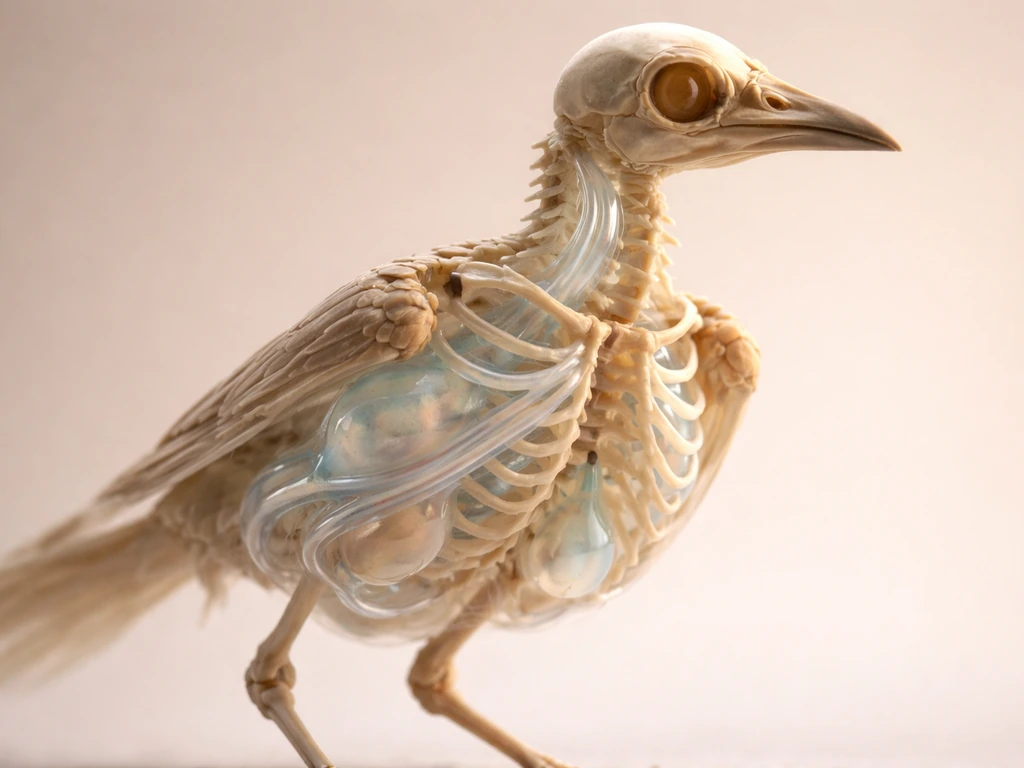
The pectoralis muscle, the massive breast muscle you notice when you eat a chicken, makes up roughly 15 to 25 percent of a flying bird's total body mass. It drives the downstroke. The supracoracoideus muscle, which lies beneath the pectoralis and runs through a pulley-like foramen in the shoulder, pulls the wing back up for the recovery stroke. These two muscles work in opposition like a two-stroke engine. The skeleton supports them with a keeled sternum, a deep breastbone ridge that gives both muscles a large attachment surface. Flightless birds have either a flat or greatly reduced keel, and that single anatomical fact tells you most of what you need to know about why they cannot fly.
The rest of the skeleton is engineered for minimal weight: many bones are hollow (pneumatized), fused where rigidity matters (the furcula, or wishbone, acts as a spring storing and releasing energy with each wingbeat), and reduced or absent where they are not needed. A pigeon's skeleton weighs less than its feathers.
Respiration and energy delivery
Flight is metabolically expensive. A bird in powered flight can burn 10 to 15 times its resting metabolic rate. To supply that much oxygen, birds evolved a one-way airflow respiratory system using a series of air sacs that flush stale air out during both inhalation and exhalation. Unlike mammal lungs, which are tidal (air goes in and comes back out the same way), bird lungs extract oxygen on every phase of the breathing cycle. This doubles effective oxygen extraction efficiency and allows sustained high-intensity flapping that would leave a mammal of similar size gasping in seconds. Migratory birds compound this by storing fat at rates that would be pathological in humans, then metabolizing it mid-flight with remarkable efficiency.
Not all birds fly the same way
Wing shape, body mass, and muscle proportion vary enormously across species, and each combination produces a distinct flight style. Knowing the style tells you what forces the bird is prioritizing at any given moment.
| Flight style | Example birds | Wing shape | Primary mechanism | Energetic cost |
|---|---|---|---|---|
| Continuous flapping | Starling, pigeon, duck | Medium aspect ratio, pointed | Muscular thrust on every stroke | High |
| Thermal soaring | Vulture, stork, eagle | Broad, slotted wingtips | Passive lift from rising air columns | Very low |
| Dynamic soaring | Albatross, petrel | Very long, narrow (high aspect) | Exploits wind gradient over ocean | Very low |
| Bounding/undulating | Woodpecker, finch | Short, rounded | Alternates flapping bursts with folded glides | Moderate |
| Hovering | Hummingbird, kestrel | Short, highly mobile shoulder | Symmetric up/downstroke or headwind hovering | Extremely high |
The albatross is worth singling out. Dynamic soaring lets it cross entire ocean basins burning almost no muscular energy at all, by repeatedly climbing into faster wind aloft, turning, descending into slower wind near the surface, and repeating the cycle to extract speed from the wind gradient. It is one of the most elegant energy-harvesting tricks in the animal kingdom.
If you are curious about how birds are able to achieve flight across such a diversity of body plans and environments, the underlying answer is always the same four-force equation being solved in different ways.
What stops flight: the case of flightless birds
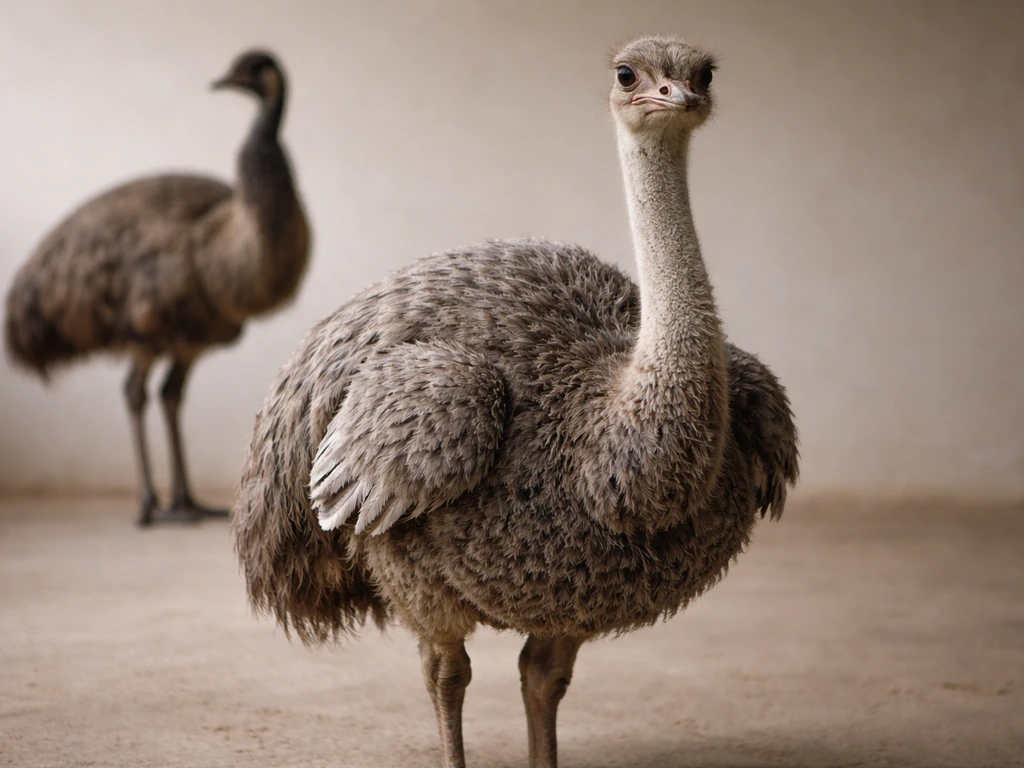
Ostriches, emus, penguins, kiwis, and cassowaries are all birds, all descended from flying ancestors, and none of them can fly. That is not a failure of evolution; it is a deliberate trade. When the energetic cost of maintaining flight muscles and lightweight bones outweighs the survival benefit, selection pressure shifts toward size, speed on the ground, or aquatic propulsion.
The anatomical signature of flightlessness is consistent: reduced or absent keel on the sternum (so flight muscles have nowhere to anchor at scale), reduced wing bones that can no longer generate meaningful lift, and in many cases dramatically increased body mass, which pushes the weight far beyond what wings could lift anyway. An ostrich can weigh 150 kilograms. Even if you gave it flight-ready wings proportional to a hawk's, the power requirement to become airborne would be physically impossible for any known muscle fiber type.
Penguins traded air flight for underwater propulsion: their "wings" are stiff, dense flippers that generate thrust in water with the same basic motion a flying bird uses in air. The physics is nearly identical, just in a much denser medium. Islands with no predators historically drove many bird lineages toward flightlessness (the dodo being the most famous example) because flight is costly and unnecessary when nothing is trying to eat you.
The structural and evolutionary differences between flying and flightless species are essentially a master class in how birds are adapted to fly, because flightless birds show you exactly which adaptations were removed, and why.
Putting it all together: the system view
It helps to think of bird flight as a system rather than a single trick. The wing shape and feathers solve the aerodynamics problem. The hollow skeleton and fused bones solve the weight and rigidity problem. The pectoralis and supracoracoideus solve the power problem. The air-sac respiratory system solves the oxygen delivery problem. Fat reserves and efficient metabolism solve the fuel problem. And the nervous system, through constant micro-adjustments of wing camber, tail angle, and stroke timing, solves the stability and control problem in real time. Remove any one component and flight degrades or fails. That interconnected dependency is exactly what enables a bird to fly while similarly sized mammals cannot.
Many of these features are not unique adaptations but rather refinements of structures that already existed. The wishbone, for example, is a fused clavicle found in theropod dinosaurs millions of years before birds appeared. Understanding these evolutionary layers enriches the picture considerably, and the full set of features that help birds fly spans skeletal, muscular, feather-based, and physiological traits that evolved in overlapping stages.
How to watch bird flight and actually see the mechanics
The best way to cement this conceptual model is to go outside and test it against real birds. You do not need binoculars or a field guide, just a park, a shoreline, or a backyard feeder.
- Watch a pigeon take off from flat ground. Notice the explosive first wingbeats: it is working hardest when speed is lowest, fighting the back of the power curve. The wingbeat rate drops and the strokes become shallower once it reaches cruising speed.
- Find a thermal soaring bird, a hawk, vulture, or large gull on a warm afternoon. Watch it circle without a single wingbeat. It is riding a column of rising warm air, spending essentially zero muscular energy. Tip its glide angle tells you its L/D ratio: a very flat, lazy circle means high L/D.
- Watch a hummingbird at a feeder. The wing blur you see is 50 to 80 beats per second, and the bird is generating lift on both the downstroke and upstroke. Notice how it pitches its body nearly vertical to brake before hovering, then tilts forward to accelerate away.
- Find a woodpecker in flight between trees. It flaps several times, then folds its wings briefly and coasts in a characteristic undulating arc. That is bounding flight: the flap phase generates surplus lift, the fold phase lets the bird coast slightly downward and recover energy in the muscles.
- Watch any bird land. It spreads its tail, drops its feet, and flares its wings to high angle of attack just before touchdown, deliberately inducing a near-stall to bleed off speed right at the moment it needs to stop moving forward.
Each behavior maps directly onto the physics. Once you have seen a hawk thermaling, you have watched the lift = weight condition being satisfied by rising air rather than muscular work. Once you have watched a pigeon pump hard off a ledge, you have watched the thrust = drag condition being negotiated in real time.
Common misconceptions worth clearing up
The most persistent myth is that Bernoulli's principle alone explains lift, as if the air on top of the wing "has" to speed up because it needs to meet the air on the bottom at the trailing edge at the same time (it doesn't, and it won't). Lift is more accurately explained as a consequence of the wing deflecting air downward: by Newton's third law, the air pushes the wing up. Bernoulli describes the pressure difference, but the deflection model is more complete and avoids the "equal transit time" fallacy that appears in many textbooks.
Another common error is assuming bigger wings always mean better flight. A larger wing generates more lift but also more drag, and it requires more muscle mass to flap, which adds weight, which requires more lift, and so on. Every species has converged on a wing size that balances those competing pressures for its specific niche, body mass, and flight style. There is no universally optimal wing.
Learning to fly: how young birds figure it out
There is one more dimension worth noting: flight is not purely innate. Young birds have the hardware, but they have to learn to use it. Fledglings are notoriously clumsy, misjudging distances, overshooting landings, and crashing into things with impressive regularity. They are learning the real-time control problem that their nervous systems have to solve: how to adjust angle of attack, wingbeat amplitude, and tail position fast enough to stay stable in variable air. For a deeper look at that developmental process, the article on how a bird learns to fly covers the fledgling-to-flight transition in detail.
The reason young birds can pull this off at all, despite zero prior flight experience, is that the basic neural circuitry for wing coordination is largely pre-wired. Practice refines it; instinct scaffolds it. That combination of innate hardware and learned fine-tuning is, in a way, a microcosm of the whole bird flight story: evolution builds the system, and behavior exploits it.
Why this question keeps pulling people in
Bird flight sits at the intersection of physics, biology, and something that feels close to wonder. The forces are the same ones that govern an airliner at 35,000 feet, but they are being solved by a 20-gram animal using feathers grown from skin and muscles powered by seeds. When you understand the full chain, from the pressure differential over a curved feather to the one-way airflow through a lung that never empties, the whole thing becomes more impressive, not less. And that is probably why birds can fly remains one of those questions people keep asking even after they know the answer.
FAQ
Is a bird’s lift the only thing that matters, or does thrust matter too?
Not exactly. Birds can maintain flight only when lift matches weight and thrust matches drag at the same moment. If lift is too low they sink, if thrust is too low they slow toward a stall, so the “engine setting” is always tied to both conditions, not just one.
If wings already generate lift, why do birds still have to flap all the time?
Because lift depends on wing angle and airflow, flapping can help even when a bird is already moving. In low-speed conditions, a bird increases angle of attack and flaps more to prevent stall, while in high-speed conditions it may flap less and rely more on aerodynamic forces and control adjustments.
What does a stall look like for a bird, and what causes it?
A stall is not just “falling.” As angle of attack increases beyond what the wing can keep attached-flow, the airflow separates and lift drops abruptly, which is why very small birds often stay active and why landing maneuvers include deliberate wing flaring and braking.
Does Bernoulli’s principle alone explain bird lift?
No. Bernoulli can describe pressure differences, but the key practical mechanism is that the wing turns air downward, and that deflected airflow pushes the wing up through action and reaction. Birds are easier to analyze with the “air deflection” viewpoint because it connects directly to changing angles of attack.
How do birds decide whether to use flapping thrust or glide in rising or falling air?
Sometimes birds trade speed for altitude and sometimes the reverse, depending on their goal and air currents. In powered flight, they modulate wingbeat frequency and angle of attack. In gliding, they reduce or stop flapping and let the horizontal component of gravity along the glide path provide the needed thrust component.
Why don’t all birds with larger wings fly better?
Bigger wings are not automatically better because lift and drag both scale with wing size and speed. Larger wings can require more structural support and more muscle effort to move, adding weight, so each species lands on a niche-specific balance rather than a universal best wing size.
If two birds have the same wing area, will they have the same flight performance?
Wing shape matters, but so does how a bird flies. Two birds can have different wing shapes and still succeed because they adjust aspect ratio, camber, and control surfaces (tail and wingtip behavior) to manage lift-to-drag and stability, often changing strategy between cruising, thermaling, and maneuvering.
Do young birds know how to fly right away, or is flight learned?
Yes, and it is a major part of control. Fledglings must learn to coordinate wingbeat timing, body angle, and tail position to keep the airflow attached and to maintain stability as conditions change, which is why misjudged landings and collisions are common early on.
Why can fledglings fly even with little experience?
Generally, flight-ready hardware is inherited but the precise control is refined through practice. Early flapping and gliding provide feedback to tune how aggressively they change angle of attack and how they time wingbeat amplitude, so “instinct” and “learning” work together.
How do birds keep their flight stable while the forces are changing every wingbeat?
Birds do not just generate lift and thrust, they also continuously prevent unwanted rotation and side slip. In real time they adjust camber, tail angle, and differential wing motions so the forces not only add up, but also align with the direction they want to move.
What makes long-distance bird flight possible, fuel-wise and oxygen-wise?
Yes. Fat stores help migratory birds sustain energy-intensive flapping, and the one-way air-sac respiratory system supports high oxygen extraction. The key is that oxygen supply and fuel use are integrated, so they can keep performance high for long durations rather than only for short bursts.
When do birds switch from powered flight to using wind or rising air instead?
Not always. Birds can choose to stop flapping if the environment provides the needed lift and thrust relationship, such as thermals for gaining altitude or wind gradients for dynamic soaring. The decision depends on whether the air can supply the energy instead of the muscles.
Do all birds produce thrust only on the downstroke?
It varies by species and situation. Some birds like swifts generate meaningful thrust on the upstroke, while others rely mostly on the downstroke for power. Hovering hummingbirds go further by producing lift during both phases via near-180-degree wing rotation.