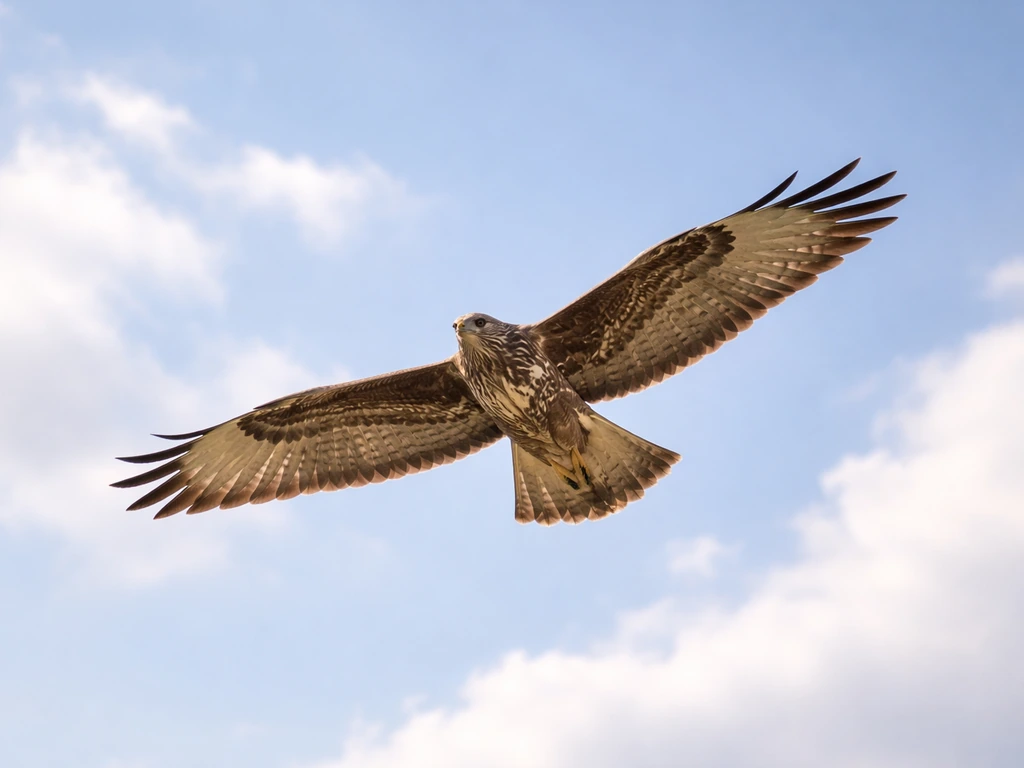
Birds are adapted to fly through a tightly integrated set of anatomical and biomechanical features: asymmetric, interlocking flight feathers that generate lift and control airflow; hollow, fused bones that cut weight without sacrificing strength; a massive keeled sternum that anchors flight muscles making up roughly a fifth of a bird's body mass; and a one-way respiratory system that delivers oxygen far more efficiently than mammalian lungs. Every one of these adaptations is essential, and they all work together in real time to keep a bird airborne, steered, and responsive. Birds fly because their anatomy and physiology work together to generate lift, thrust, and precise control why do bird fly.
How Is a Bird Adapted to Fly? Key Anatomy and Mechanics

Marcus Chen
16 May 2026
Core adaptations that make flight possible
Think of bird flight as an engineering problem that evolution solved over roughly 150 million years. The solution involved changes to nearly every major body system, not just the wings. The core adaptations break down into four categories: structural (skeleton and muscles), aerodynamic (feathers and wing shape), energetic (respiration and metabolism), and neurological (real-time control). Remove any one of them and flight either becomes impossible or severely compromised, which is exactly what you see in flightless species.
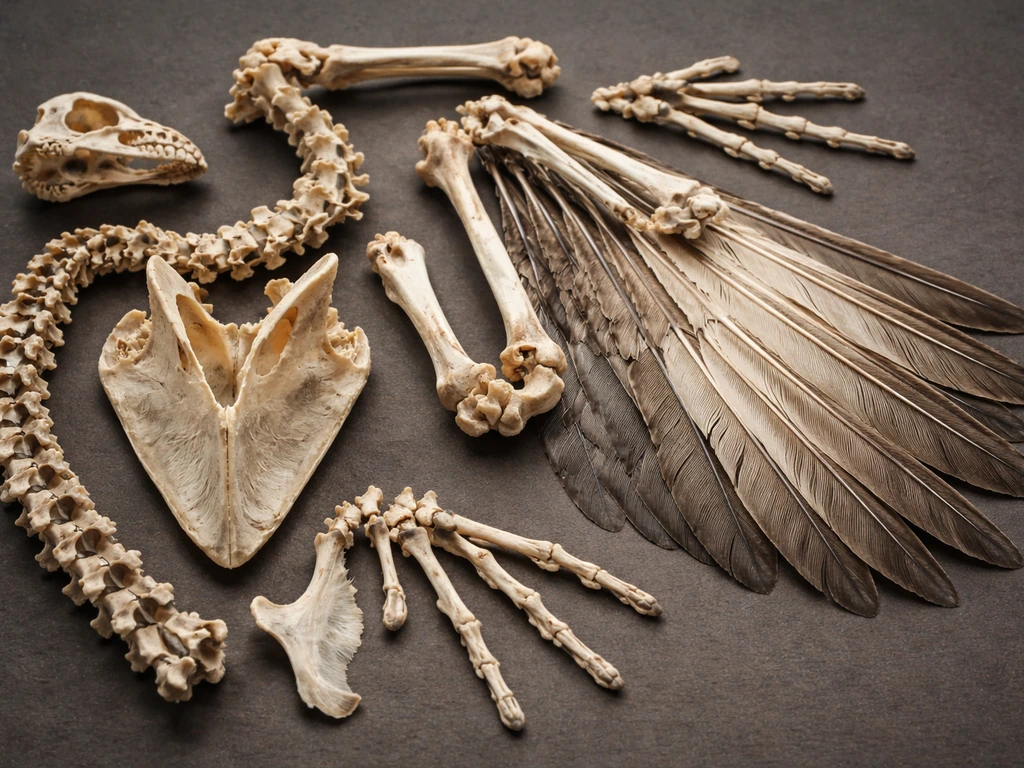
The skeletal system is the foundation. Bird bones are pneumatized, meaning many of them are hollow and connected to the respiratory air-sac system, drastically reducing dead weight. Key bones in the torso are fused into rigid structures, such as the synsacrum (fused lumbar and sacral vertebrae) and the pygostyle (fused tail vertebrae), which give the body a stable platform for powerful wing strokes. The wishbone, or furcula, acts like a spring, storing and releasing elastic energy with each wingbeat cycle.
The respiratory system deserves special attention because it is genuinely unlike anything in mammals. Birds have a network of air sacs that create unidirectional, one-way airflow through the lungs. Air moves continuously through the parabronchi (tiny tubes in the avian lung) during both inhalation and exhalation, using a bellows-like sequence. The result is that fresh, oxygen-rich air is always moving across the gas-exchange surface, not the tidal back-and-forth flow that mammalian lungs use. At altitude and under the metabolic demands of sustained flapping, this matters enormously.
Wings and feathers: lift, control, and efficiency
A bird's wing is a cambered airfoil, meaning it has a curved cross-section that forces air moving over the top to travel faster than air below, creating lower pressure above the wing and generating lift. But what makes avian wings uniquely capable is the feather system layered on top of that basic aerodynamic shape.
Primary flight feathers, the long outer feathers attached to the 'hand' bones, are asymmetric: the leading vane (closer to the front of the wing) is narrower and stiffer than the trailing vane. This asymmetry is not accidental. Wind-tunnel and morphological studies confirm it has a direct aerodynamic function, helping feathers resist twisting and maintain their shape under load. Interestingly, fossil feathers from Archaeopteryx show the same asymmetric pattern, suggesting this adaptation goes back to the earliest evolution of powered flight. The barbs and barbules of flight feathers interlock through tiny microhooks, functioning like a microscopic Velcro system that keeps the vane surface unified and airtight even under aerodynamic stress.
One small but critical feature is the alula, sometimes called the 'thumb feather.' It sits at the leading edge of the wing and functions like a leading-edge slat on an aircraft wing. Wind-tunnel experiments with and without the alula show that it delays aerodynamic stall at low speeds and high angles of attack, which is precisely when a bird needs the most control, during landing or slow maneuvering. Watch any large bird come in to land and you will often see the alula lift away from the wing surface as the bird slows down.
Wing shape itself is a major variable. The key metrics are aspect ratio (wingspan squared divided by wing area, essentially how long and narrow the wing is) and wing loading (body mass divided by wing area). High aspect ratio wings, like those of an albatross, reduce induced drag and are ideal for sustained, efficient gliding. Low wing loading means a larger wing relative to body mass, allowing a bird to fly slowly and maneuver in tight spaces. These two metrics predict a lot about how a species lives and hunts.
Lightweight skeleton and powered muscle system
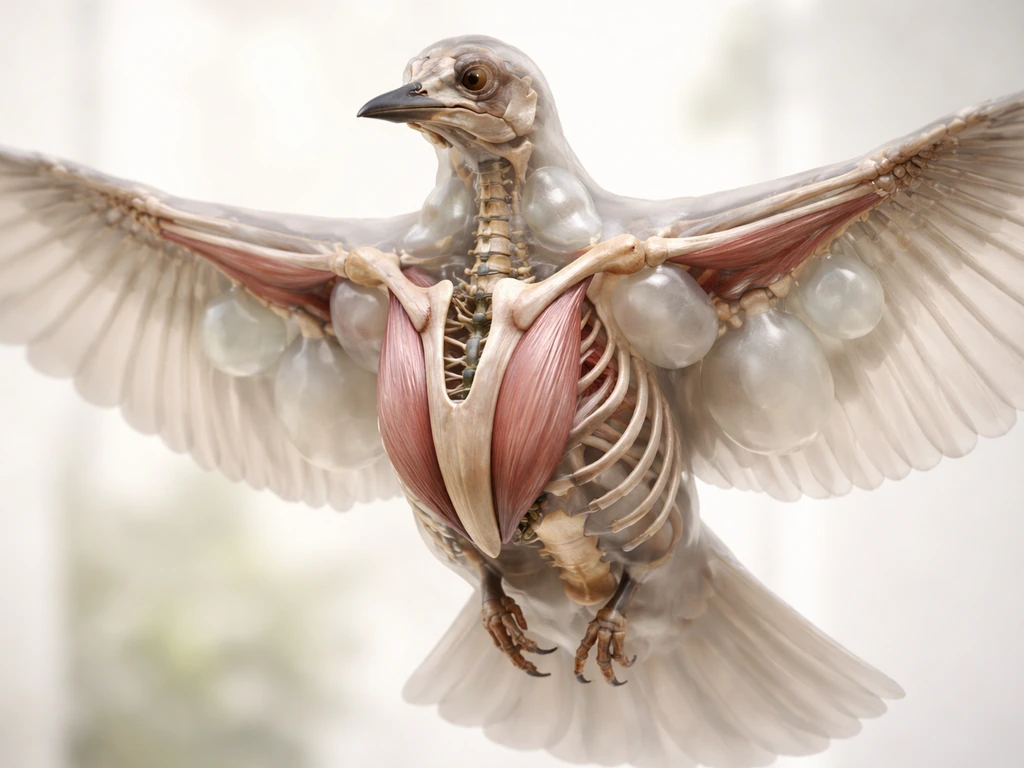
The flight muscles are where the actual power comes from, and their attachment architecture is one of the most elegant solutions in vertebrate anatomy. The sternum of a flying bird has a prominent ventral projection called the carina, or keel. This keel massively increases the surface area available for muscle attachment, allowing much larger muscles than a flat sternum could ever anchor. The two key muscles are the pectoralis major, which powers the downstroke, and the supracoracoideus, which runs underneath the pectoralis and powers the upstroke through a rope-and-pulley arrangement over the shoulder joint. Together, these muscles can account for roughly 20 percent of a bird's total body mass.
High-speed electromyography (EMG) studies of pigeon flight reveal just how precisely timed this muscle system is. The pectoralis begins activating late in the upstroke, before the downstroke even starts, pre-loading like a spring. The supracoracoideus is co-activated roughly half the time during normal flight, fine-tuning the transition between strokes rather than simply pulling the wing up. This is not a simple alternating on-off system; it is a finely tuned antagonist pair working in millisecond coordination.
The rest of the skeleton supports this power system by being as light as possible. Hollow bones with internal struts (trabeculae) provide structural integrity at minimal weight. Fused bones in the pectoral girdle create a rigid anchor for the flight muscles. Even the skull is thin-walled and toothless in modern birds, trading the weight of teeth and heavy jaw muscles for a lightweight beak. All of these reductions accumulate into a body plan that can be lifted and sustained by muscles that, while massive relative to body size, still have to overcome gravity many thousands of times per day.
How birds generate thrust and maneuver in real time
Lift keeps a bird up; thrust moves it forward; and control keeps it pointed in the right direction. During the downstroke, the primary feathers twist and splay apart, acting almost like individual propeller blades that push air backward and downward, generating both lift and forward thrust simultaneously. The upstroke is more nuanced. In species like cockatiels at slow speeds (1 to 3 meters per second), studies using 3D kinematics and accelerometers show the upstroke contributes only about 14 percent as much lift as the downstroke. At higher speeds and in species with different wing shapes, that proportion shifts.
Maneuvering in the air involves the whole body, not just the wings. High-speed 3D video tracking of cockatoos making banked turns shows average turn radii of about 0.92 meters, with heading changes linked to roll angle through the wingbeat cycle. Birds steer by asymmetrically adjusting wing shape, span, and angle between the two sides, banking the body into turns the way a cyclist leans into a curve. The tail plays a role here too: in hovering hummingbirds, vortical wake structures from both wings and the tail interact in ways that help control the angle of attack and maintain stability during stationary flight, which is extraordinarily energetically costly but made possible by hummingbirds' uniquely high wingbeat frequencies and the aerodynamic geometry of their short, high-aspect-ratio wings.
This real-time coordination happens through a combination of sensory feedback from feather follicles, vestibular input, and vision, all processed fast enough to adjust muscle activation within a single wingbeat. It is the biological equivalent of fly-by-wire avionics, running continuously and mostly below conscious control.
Species differences: how adaptations match flight style and habitat
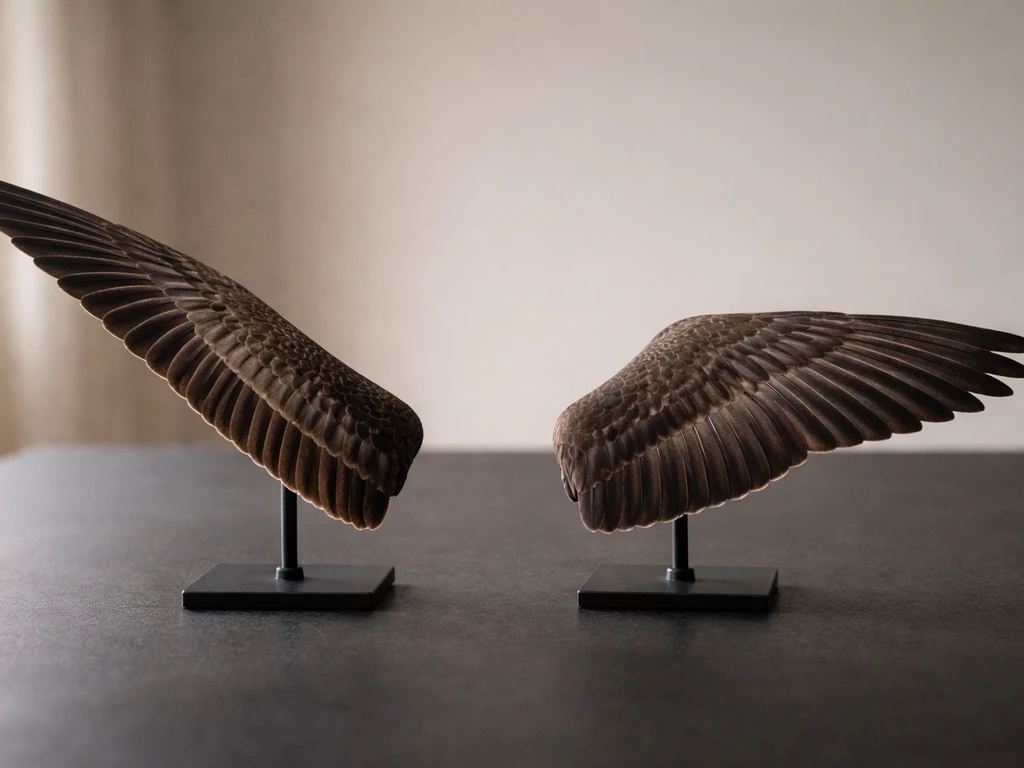
There is no single 'bird flight' template. Evolution has tuned each species' anatomy to match its ecological niche, and the result is a remarkable range of flight styles tied to measurable differences in wing shape, muscle proportion, and feather structure.
| Bird type | Wing shape | Aspect ratio | Wing loading | Flight style | Example |
|---|---|---|---|---|---|
| Ocean glider | Long, narrow | Very high | High | Dynamic soaring, minimal flapping | Albatross |
| Thermal soarer | Broad, slotted primaries | Moderate | Low to moderate | Static soaring on thermals | Turkey vulture, eagle |
| Fast pursuit flyer | Pointed, swept | High | High | High-speed chase | Peregrine falcon, swift |
| Hoverer | Short, elliptical | Moderate-high | Very low | Sustained hovering | Hummingbird |
| Woodland maneuverer | Short, rounded | Low | Low | Agile turns in tight spaces | Sparrowhawk, woodcock |
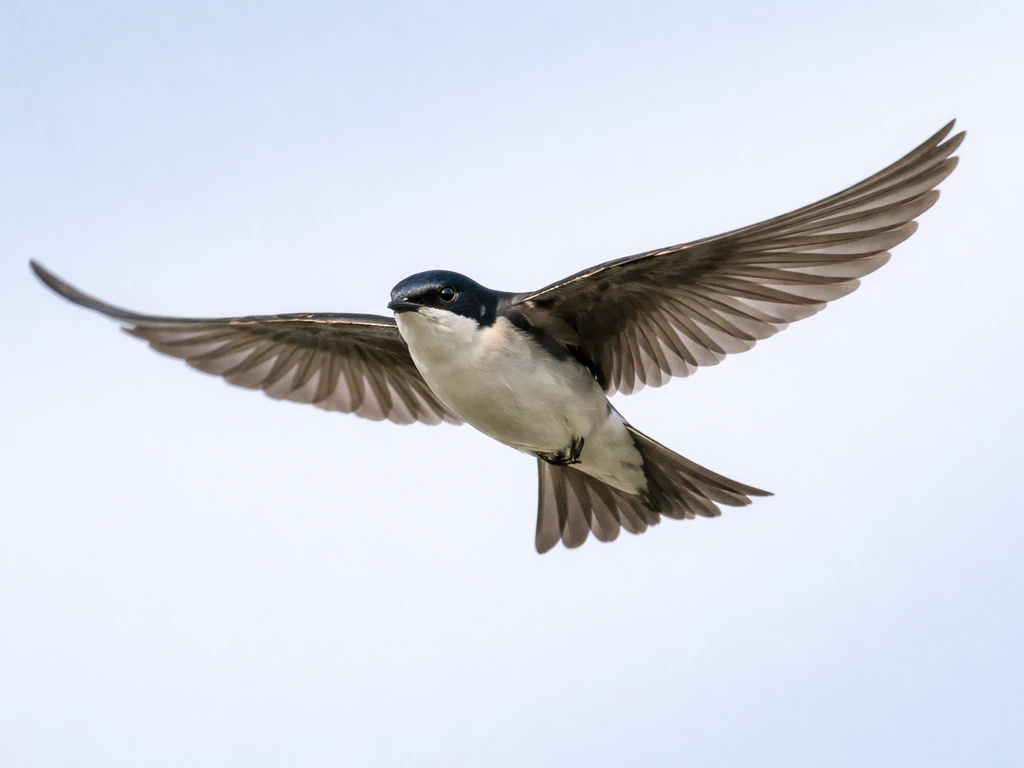
Albatrosses use a technique called dynamic soaring, extracting energy from wind gradients above the ocean surface, rarely needing to flap at all over multi-day journeys. Their extremely long, narrow wings are optimized purely for gliding efficiency. At the opposite end, hummingbirds beat their wings 40 to 80 times per second and can hover indefinitely, but at enormous metabolic cost. Their aspect ratio and the particular geometry of their wing stroke, which produces lift on both the downstroke and a partial upstroke, make hovering aerodynamically feasible in a way it simply is not for most other birds. Peregrine falcons, by contrast, sacrifice hovering ability entirely for raw speed, achieving stoops over 320 km/h with swept, pointed wings that minimize drag.
If you want to observe these differences yourself, find a coastal cliff or lake where you can watch gulls and compare them to swallows. Notice how the gull holds its wings outstretched and barely moves them, while the swallow flicks and banks constantly. Then look at the wing shapes: the gull's are long and tapered, the swallow's are swept and pointed at the tips but with a different planform. You are seeing aspect ratio and wing loading in action.
What flightless birds reveal about what's missing
Flightless birds are, in a way, the clearest evidence for how each adaptation matters. Strip away the adaptations and you lose flight, which is exactly what happened in ostriches, emus, rheas, cassowaries, and kiwis (the ratite lineages) over millions of years of evolution in environments where flight was no longer the best survival strategy.
The most visible anatomical difference is the sternum. Ratites have a flat breastbone with no keel, or a dramatically reduced one. Without that keel, there is no anchor for large flight muscles. The pectoralis and supracoracoideus are reduced to small, weak muscles relative to body size, incapable of generating the power needed to get a large body airborne. The wings themselves become vestigial, reduced in length and often with simplified feather structure. Bone pneumatization, the hollow, air-sac-connected quality of flying birds' skeletons, is also reduced or absent in many flightless lineages, suggesting that even the respiratory adaptations tied to the air-sac system are scaled back when they are no longer needed for aerial life.
Penguins are a fascinating special case. They did not simply lose flight; they redirected the same ancestral skeletal system toward underwater propulsion. Their forelimbs use the same bones as a flying bird's wing, but those bones are shortened and flattened into a rigid, paddle-like flipper. The feathers are extremely short and dense, more like scales in function, reducing drag in water rather than generating lift in air. Penguins are essentially flying underwater, using a stroke biomechanically similar to the wing stroke of aerial birds but optimized for a medium 800 times denser than air.
Looking at flightless birds also makes it easier to appreciate why the full package of adaptations in flying birds is so interconnected. It is not enough to have feathers, or just a keel, or just hollow bones. You need all of it working together, which is part of why flight evolved relatively rarely in vertebrates and why, once a lineage loses it, the path back is essentially closed.
How to actually see these adaptations in the field
The best way to make this concrete is to go look at birds, ideally with a few things in mind. Here are practical observations that map directly onto the biology covered above. Next, check the key features that help a bird to fly, then compare them with what you can observe in the field.
- Watch a large bird land slowly: look for the alula lifting away from the leading edge of the wing as the bird slows. This is easiest to spot on pigeons, crows, or large gulls at close range.
- Compare wing shapes between species in the same area. Swallows and house sparrows both weigh roughly the same, but their wing shapes are strikingly different. The swallow's swept, pointed wings reflect high-speed, aerial-insect hunting; the sparrow's short, rounded wings reflect woodland maneuvering at low speed.
- Find a feather (any large flight feather from a goose or turkey works well) and hold it up. Notice the narrower leading edge vane versus the broader trailing vane. Run your fingers against the barb direction to separate them, then stroke them back together to feel the microhook system re-zip the vane.
- If you have access to a chicken or turkey at a butcher, ask to examine the breastbone. The keel is a dramatic, blade-like projection. Compare photos of an ostrich sternum online (flat, keel-less) and the difference is immediately obvious.
- Watch soaring birds in thermals and count how rarely they flap. Then watch a hummingbird at a feeder and count wingbeats per second if you can. You are watching two completely different solutions to the same problem of staying airborne.
Understanding how birds are adapted to fly is really about seeing the whole system, not just any single feature. To understand how a bird learns to fly, it helps to connect these adaptations to the development and practice that shape flight control from hatchling to fledgling how does a bird learn to fly. The feathers handle aerodynamics, the skeleton handles weight and muscle anchoring, the respiratory system handles energy supply, and the nervous system handles real-time control. Those interacting systems together answer what enables a bird to fly. Watch birds long enough with these systems in mind and what once looked like effortless grace starts to look like what it actually is: millions of years of extraordinarily precise engineering, running at 40 wingbeats per second. This is how is a bird able to fly: the coordinated “flight package” converts muscle power into lift, thrust, and fast control.
FAQ
Is there one main adaptation that explains how is a bird adapted to fly?
A bird needs a combination, not a single “magic” trait. In practice, flight fails if the aerodynamic surface (feathers and wing shape), the power system (keel and flight muscles), or the energy supply (air-sack breathing and metabolism) is missing or severely reduced. That is why the article describes structural, aerodynamic, energetic, and neurological adaptations as a linked set.
Do all birds have to flap constantly to fly?
Not exactly. Many birds can glide briefly, but even gliding depends on generating lift with wing shape and feathers, plus active control to maintain an appropriate angle of attack. If you compare gliders to flappers, gliders rely more on high aspect ratio wings and less on muscle power per second, but control is still continuous.
How do birds fly safely at slow speeds near landing?
Yes, because wing lift depends on airspeed and angle of attack. The article’s discussion of the alula highlights how birds delay stall at low speeds, which is crucial for landing and tight maneuvers. Without that kind of stall control, a bird would struggle to slow down safely even if it has strong muscles.
How does a bird’s breathing help during sustained flight?
Birds do not breathe like mammals. During normal flight breathing, air moves through the lungs in a mostly one-way pattern driven by air sacs, which keeps oxygen-rich air flowing across the gas-exchange surfaces both during inhalation and exhalation. That steady oxygen delivery helps support sustained flapping.
Are bird bones actually hollow, and does that make them weaker?
Their hollow bones reduce weight, but they also stay strong because of internal support structures (trabeculae) and fused regions that stiffen the body. So “lightweight” does not mean “fragile,” the skeleton is engineered to transmit loads from wingbeats into a rigid torso platform.
What role do feather microstructures play in flight performance?
Feathers behave like engineered surfaces with micro-structure. Interlocking barbules keep the leading and trailing parts of a feather aligned under stress, maintaining an airtight, coherent surface that is important for lift and control during twisting and splaying.
How do bird flight muscles coordinate during the upstroke and downstroke?
Flight muscle activation is timed to the wingbeat cycle, not simply alternated muscle on/off. The pectoralis and supracoracoideus are coordinated, with pre-loading and overlapping activation that fine-tunes the transition between strokes, improving efficiency and control.
How do birds control direction during a turn, and what do the wings vs tail do?
Birds actively steer using asymmetries. They adjust wing angles, span, and the left-right differences in motion, then bank the body to turn. The tail can also contribute stability and control, especially in birds that hover or perform fine-angle adjustments.
Does the way birds fly change a lot with altitude or oxygen availability?
Altitude changes matter less than heat, wind, and the bird’s own wing loading, but oxygen demand still increases with exertion. Birds’ one-way respiratory system supports higher sustained metabolic needs, which becomes especially important during high-effort flight like takeoff, steep climbs, or long flapping bouts.
Why can’t flightless birds easily “regain” flight if they have wings?
There is an evolutionary tradeoff. Flightless lineages lose or reduce key structures like the keel and the large flight-muscle anchor, and they often show reduced or modified pneumatization. That same body plan does not readily “recreate flight” because the whole package has to be rebuilt together.
How are penguins adapted for swimming if their ancestors could fly?
Penguins are a good example of redirection rather than simple loss. Their forelimb bones become rigid, paddle-like flippers, and their feathers are short and dense to reduce water drag. Their “wing stroke” becomes underwater propulsion, which works in a fluid that is much denser than air.
What should I look for when observing birds to understand how wing shape affects flight?
Taller or more aerodynamic species can be hard to interpret from one moment of observation. A useful check is to compare how wings change with speed, for instance whether the wings are held rigid for gliding (often long and narrow wings) versus actively maneuvered with frequent banking (often different planform and wingbeat patterns).
Next Article
How Is a Bird Able to Fly? Mechanics, Biology, and Flight Styles
Learn how birds generate lift, thrust, and control in flight, plus soaring vs hovering and why some can’t fly.